
7-Wood vs 4-Hybrid: Why the Same 21° Loft Produces Completely Different Shots
A 21° 7-wood and a 21° 4-hybrid share the same loft on paper, but produce completely different ball flights. Here is how shaft length, head design, and sole shape change launch, landing, and turf interaction.
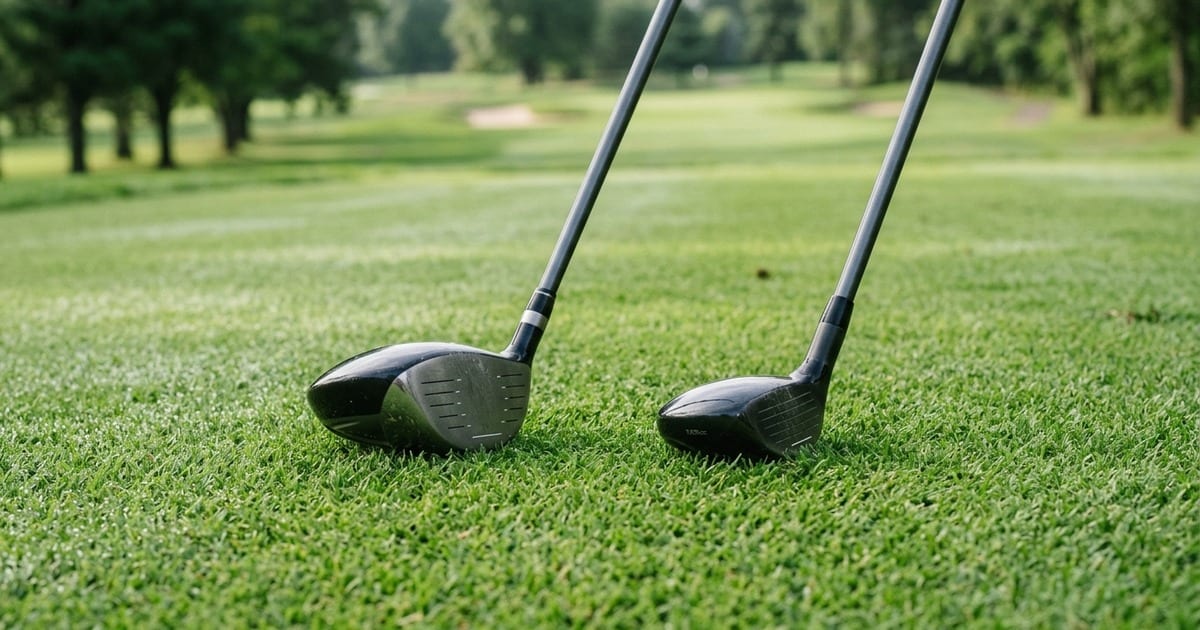
A 7-wood is a high-lofted fairway wood built with a broad sole and deep center of gravity to launch the ball high with maximum stopping power, while a 4-hybrid is a compact utility club engineered with a shorter shaft and flatter sole to slice through difficult lies with iron-like control.
Browse the equipment discussion boards or walk the driving range on any Saturday morning, and you will see golfers debating the exact same dilemma: “My 4-iron is gone. I need a 200-yard club that lands softly on par-5s and par-3s. Should I buy a 21-degree 7-wood or a 21-degree 4-hybrid?”
On paper, the specifications look nearly identical. Both clubs are stamped between 20° and 22° of loft. Both are marketed as easy-to-hit alternatives to traditional long irons. Many golfers assume that choosing between them is purely a matter of cosmetic preference: whether you like looking down at a miniature wood head or a beefy iron head.
The two clubs don’t fly the same way. The 7-wood launches higher and comes down more steeply, which helps it hold firm greens. The 4-hybrid flies on a lower, more piercing trajectory, cuts through heavy rough more easily, and tends to run out farther after touching down.
They share the same stamped loft, but they are built on completely different physical geometries. Understanding how shaft length, head volume, and center-of-gravity (CG) depth alter the launch conditions is the key to choosing the right club for your bag.
The short answer
- Shaft length: A standard 7-wood shaft is 41.50” to 42.00” long, whereas a standard 4-hybrid shaft is 39.75” to 40.25” long. A longer shaft widens the swing arc, which generally adds clubhead speed for the 7-wood.
- Peak height: The 7-wood’s larger head and deeper CG are built to launch the ball higher than a 4-hybrid of the same loft.
- Landing angle: A higher flight comes down more steeply, so a 7-wood tends to stop faster on firm greens. A 4-hybrid lands at a shallower angle and tends to roll out more.
- Turf interaction: The 7-wood’s broad sole glides across fairways and fairway bunkers; the 4-hybrid’s compact, narrow sole cuts through thick rough and divots.
1. Shaft Length: Why the 7-Wood Flies Farther
When comparing two clubs with identical 21° lofts, the most influential factor dictating distance is shaft length.
Consider the official catalog specifications from major equipment manufacturers:
- Ping G430 Max: The 7-wood measures 42.00 inches, while the 4-hybrid measures 39.75 inches, a difference of 2.25 inches (5.7 cm).
- TaylorMade Qi10: The 7-wood measures 41.75 inches, while the 4-Rescue measures 40.25 inches, a difference of 1.50 inches (3.8 cm).
- Titleist TSR2: The 7-wood measures 41.50 inches, while the 4-hybrid measures 40.00 inches, a difference of 1.50 inches (3.8 cm).
Specifications from Ping G430 Max Fairway, Ping G430 Hybrid, TaylorMade, and Titleist.
A longer shaft widens the swing arc. So a 7-wood that is 1.5 to 2.25 inches longer than the 4-hybrid generally produces more clubhead speed for the same swing effort, and more speed means more carry.
If you put a 21° 7-wood and a 21° 4-hybrid in the same bag, they are unlikely to travel the same distance. The 7-wood can end up overlapping with your 3-hybrid or 5-wood, leaving a gap right where your 4-iron used to be.
2. Head Volume and CG Depth: Why the 7-Wood Flies Higher
The second dramatic divergence is in trajectory height.
A standard 7-wood head has a volume of approximately 165 to 175 cc. A 4-hybrid head ranges between 120 and 127 cc.
Because a fairway wood has a much larger footprint extending backward from the face, club designers can place internal weighting significantly farther away from the clubface. This creates a center of gravity (CG) that is both substantially lower and deeper than in a hybrid.
A deep CG produces two distinct aerodynamic effects:
- Dynamic Loft Multiplication: During the downswing, the CG sitting well behind the shaft axis causes the shaft to deflect forward (droop and lead), increasing the dynamic loft at the moment of impact. Even though both clubs have a 21° static loft, the 7-wood tends to present more dynamic loft to the ball.
- Backspin Preservation: The lower CG increases gear-effect launch and helps maintain backspin, preventing the ball from knuckling or falling prematurely out of the sky.
That extra height changes how the ball handles trees, elevated greens, and forced carries.
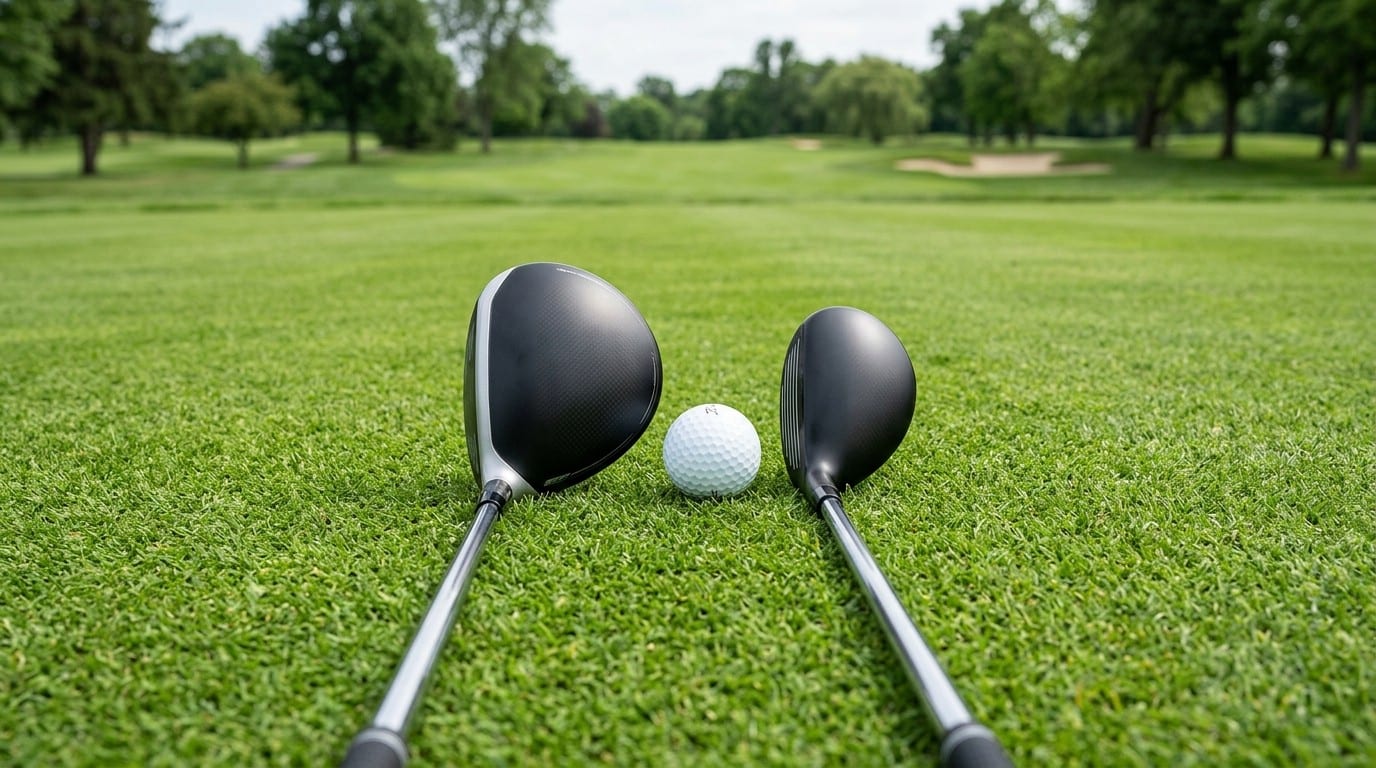 Figure 1: An illustration of the two heads at address. The 7-wood (left) has a larger head with weight spread toward the back for a deep CG, while the 4-hybrid (right) has a compact profile designed for turf penetration.
3. Descent Angle: How to Hold Firm Greens on Long Approaches
For competitive players and mid-handicappers alike, the primary challenge with long approach shots is not merely reaching the green; it is staying on the green.
Green-stopping power is governed by two factors: spin rate and descent angle (landing angle).
- 4-Hybrid: Lands at a shallower angle. The ball tends to skip forward on landing and roll out, and on hard summer greens a 4-hybrid approach can roll off the back edge.
- 7-Wood: Lands more steeply. Combined with its backspin, the ball tends to stop closer to its pitch mark.
This steeper landing is why many golfers, tour professionals included, carry high-lofted fairway woods. When facing a long second shot into a tucked par-5 pin guarded by water, a 7-wood delivers green-holding capability that a utility iron or low-launching hybrid struggles to match.
4. Turf Interaction: Fairway Glide vs. Rough Extraction
While the 7-wood holds a decisive advantage in launch height and landing angle, the 4-hybrid dominates in versatility and adverse lies.
The physical design of each club dictates how it moves through turf:
- 7-Wood (Broad, Curved Sole): Fairway woods are built with wide, rounded soles designed to glide across closely mown fairway grass and skim across the sand in fairway bunkers without digging. However, when the ball sits down in wet, lush, or knotted rough, that wide sole catches the tall grass, twisting the clubface and reducing clubhead speed through impact.
- 4-Hybrid (Compact, Narrow Sole): Hybrids feature a much smaller footprint, a flatter face profile, and a blunt leading edge modeled after an iron. In heavy rough, the compact head offers far less surface area to snag grass blades, allowing the club to power through the roots and pop the ball cleanly back into play.
Furthermore, on tight, bare lies or into stiff headwinds, the hybrid’s shorter shaft (40.0”) provides superior strike repeatability and a piercing trajectory that does not balloon into the wind.
5. The Decision Matrix: Which Club Belongs in Your Bag?
Choosing between a 7-wood and a 4-hybrid comes down to identifying the specific weakness in your long game.
Choose the 7-Wood If:
- You struggle with trajectory height: If your long shots fly low and you cannot stop the ball on the green from long range.
- You have a moderate-to-slow swing speed: Golfers with slower driver swing speeds benefit from the 7-wood’s longer shaft and high-launch geometry.
- Your home course features firm, fast greens or elevated approaches: Where a steep, vertical drop is mandatory to avoid running off the back.
- You want a confidence-inspiring head: The larger 165 cc profile looks friendlier at address than a compact hybrid.
Choose the 4-Hybrid If:
- You play in windy conditions: The hybrid’s lower, penetrating ball flight resists ballooning and provides tighter dispersion in gusty crosswinds.
- You frequently face thick rough: If your home course features penal rough where a broad wood head gets tangled.
- You prefer an iron-like visual setup: Players who compress the ball with a downward, iron-style strike often struggle to sweep fairway woods.
- You want to fill the gap between your 5-iron and your 5-wood: A 4-hybrid can slot into that gap without overlapping your 5-wood.
Can You Carry Both?
Yes. Carrying both a 7-wood and a hybrid is an increasingly popular setup. However, they should not share the same loft:
- Fairway Wood: 21° 7-Wood (the high-launch club)
- Hybrid: 24° to 26° 5-Hybrid (Replaces the 4-iron or 5-iron, with rough-cutting versatility)
This combination eliminates distance overlap while providing the high-stopping power of a wood and the rescue capability of a hybrid.
Frequently Asked Questions
Can I carry both a 7-wood and a 4-hybrid?
Yes, but do not buy them in the same loft. A 21° 7-wood usually flies farther than a 21° 4-hybrid because of its longer shaft. To carry both without duplicating distances, pair a 21° 7-wood with a 24°-26° 5-hybrid.
Why do tour pros use 7-woods instead of hybrids?
Tour players use 7-woods primarily for green-stopping power on long par-5s and long par-3s. The 7-wood produces a steeper descent angle and higher apex than a hybrid, allowing the ball to stop quickly on firm, lightning-fast championship greens.
Is a 7-wood easier to hit than a 4-hybrid?
Off a clean fairway or a tee peg, many mid- and high-handicappers find the 7-wood easier to hit because its larger sole prevents digging and its deep CG easily gets the ball airborne. However, from heavy or deep rough, the compact 4-hybrid is easier to control because it encounters less turf resistance.
How much farther does a 7-wood go compared to a 4-hybrid?
There is no single number. The gap depends on the two models and on your swing. Across the Ping, TaylorMade and Titleist models above, the 7-wood shaft is 1.5 to 2.25 inches longer than the 4-hybrid, and that longer shaft plus higher launch generally makes the 7-wood carry farther. Hitting both clubs on a launch monitor is the way to find your own gap.