
Iron offset explained: why game-improvement clubs curve behind the hosel
Why beginner irons feature a noticeable gooseneck bend while tour irons sit straight. How offset delays impact and stops the amateur slice.
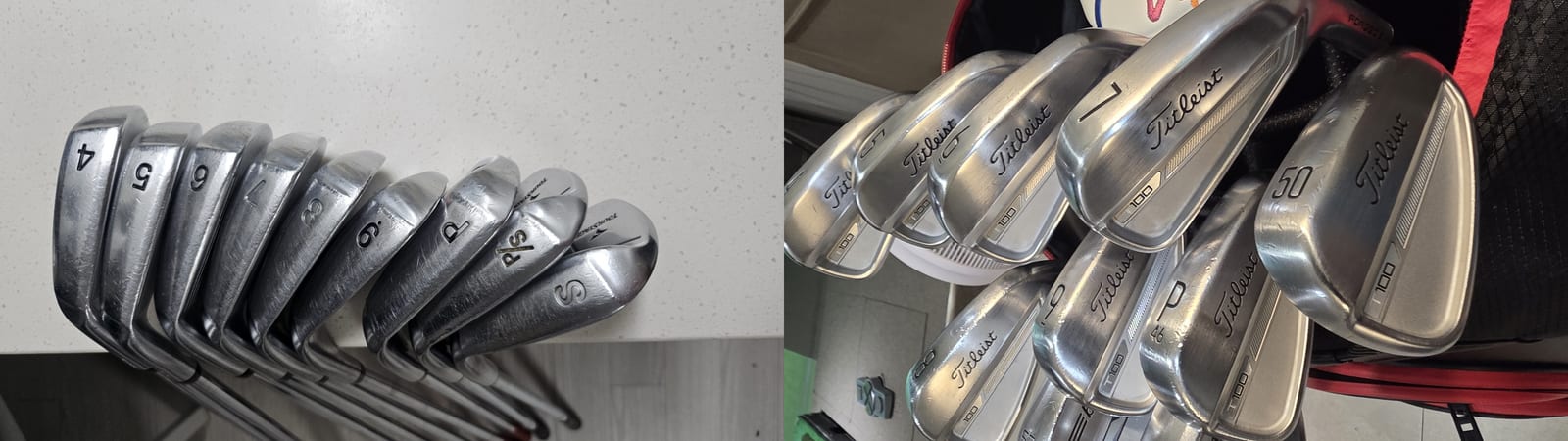
When I set my Titleist T100 next to the used Tourstage V300 III irons I played before it, the difference was easy to see. The T100 had a straight, flush line where the shaft entered the clubhead. The Tourstage had a pronounced forward bend, making the face look like it was tucked away behind the hosel.
Clubmakers call that bend offset. Golfers informally call it a gooseneck.
Most golfers assume offset is merely a visual alignment aid designed to make the club look friendly at address. In reality, offset is one of the most effective mechanical anti-slice interventions in clubhead design.
Here is the physics behind iron offset, why beginners need it, and why better ball-strikers eventually migrate away from it.
Key Takeaways
- Game-improvement 7-irons typically carry 4.5 to 6.0 mm of offset, while tour player irons sit between 1.5 and 2.5 mm.
- Offset also shifts the clubhead’s center of gravity farther behind the shaft line, producing dynamic shaft deflection that launches the ball higher.
- Golfers who already draw the ball or release the club aggressively can over-rotate an offset iron, turning straight shots into violent pull-hooks.
In this article:
- What offset actually measures
- How offset delays impact to square the face
- The center-of-gravity launch boost
- Game-improvement vs player irons: the measurement gap
- When offset becomes a liability
- Who should play offset irons
- Frequently Asked Questions
- What I’d tell someone shopping for irons
- Terms in this article
What offset actually measures
Hold any iron upright and look straight down the shaft from the grip toward the ground.
On a club with zero offset, the leading edge of the face aligns flush with the front edge of the hosel. On an offset club, the leading edge is set back, creating a visible shelf between the hosel and the scoring lines.
Manufacturers measure offset either in millimeters or decimal fractions of an inch. A typical progression through a set looks like this:
| Club number | Game-improvement iron offset (mm) | Player tour iron offset (mm) | Practical difference |
|---|---|---|---|
| 4-Iron | 6.0 - 7.0 mm | 3.0 - 3.5 mm | Massive visual gooseneck on GI |
| 5-Iron | 5.0 - 6.0 mm | 2.5 - 3.0 mm | Promotes higher long-iron launch |
| 7-Iron | 4.0 - 5.0 mm | 2.0 - 2.5 mm | Noticeable face setback |
| 9-Iron | 2.5 - 3.5 mm | 1.5 - 1.8 mm | Moderate setback |
| Pitching Wedge | 1.5 - 2.5 mm | 1.0 - 1.2 mm | Almost straight across both categories |
Data compiled from manufacturer spec sheets for mainstream game-improvement sets compared to tour player categories.
Notice that offset naturally decreases as clubs get shorter. Long irons are hardest to square and launch, so engineers pack maximum offset into the 4 and 5-irons. Wedges rarely need anti-slice help, so their offset shrinks toward zero.
How offset delays impact to square the face
Here is the mechanical core that most golf marketing skips: offset alters time, not just geometry.
When you swing down, your hands lead the clubhead into the hitting zone. In an amateur slice swing, the golfer’s hands arrive on time, but the clubface lags behind, open to the target line.
Because an offset clubface is physically set back behind the hosel, the shaft reaches the golf ball first. The clubface arrives a fraction of a moment later, which gives the golfer’s rotating wrists a little more time to complete their release.
The center-of-gravity launch boost
Offset performs a second, equally important task: it helps amateur golfers get the ball airborne.
Every clubhead has a center of gravity (CG). On an offset iron, because the entire face and body of the club sit back from the shaft, the CG is located farther behind the centerline of the shaft.
During the downswing, the downward force of your hands against the resistant mass of the clubhead causes the shaft to flex forward toward the target. Club designers call this lead deflection.
When the CG sits far behind the shaft axis, this forward bending increases right before impact. The head tilts slightly backward, adding dynamic loft at the moment of contact.
This explains why super-strong game-improvement irons (like a 28-degree 7-iron) can still fly with decent height. The wide sole and heavy offset artificially force dynamic loft back into the ball.
Game-improvement vs player irons: the measurement gap
If offset makes golf easier, why doesn’t every tour pro play massive offset?
Consider two examples:
The Tourstage V300 (or modern Ping G430) features deep offset and a wide sole. At address, you see a thick topline and an obvious gooseneck curve. You cannot lose the ball right unless you make an extraordinary effort.
The Titleist T100 features compact blade styling and minimal progressive offset. The leading edge sits nearly flush with the hosel.
| Feature | High offset iron (Game-improvement) | Minimal offset iron (Player category) |
|---|---|---|
| Primary design goal | Maximum slice reduction and high launch | Precision distance control and shot shaping |
| Address visual | Gooseneck curve with face tucked back | Clean, straight line from hosel to edge |
| Turf interaction | Wide sole skips over heavy turf | Sharp leading edge cuts cleanly through grass |
| Ball flight tendency | High draw bias | Flat, workable, neutral trajectory |
Better players shape the ball both directions. A high-offset iron constantly fights a controlled fade because the head is built to turn over. Tour pros reject heavy offset because it robs them of directional control.
When offset becomes a liability
Offset is medicine for a slice. But if you do not have that disease, taking the medicine causes side effects.
When a golfer develops an inside-out swing path and learns to release the clubface naturally, offset becomes dangerous.
The delayed impact that saved their slice now causes the face to over-rotate. The ball starts left and hooks sharply into the left rough (a classic pull-hook).
Furthermore, high-offset irons can look disorienting to players who like to aim with the leading edge. If the face sits 5 millimeters back, aiming the face accurately requires looking past the hosel rather than down a straight line.
Who should play offset irons
Use this checklist to choose the right category:
You need generous offset if:
- Your standard iron miss is a push, fade, or slice to the right.
- You struggle to get mid and long irons (5, 6, 7-iron) up into a high, soft-landing trajectory.
- You have a handicap above 15 and prioritize easy distance and straight flights over workability.
- You play infrequently and need a club that covers up late wrist release.
You should choose minimal offset if:
- Your common miss is a hook or pull to the left.
- You like to hit low knock-downs, controlled fades, and trajectory-managed shots into the wind.
- You want a clean, straight topline that frames the ball without visual distraction.
Frequently Asked Questions
Does offset change the club’s static loft? No. A 30-degree iron with 5 mm of offset has the same static loft as a 30-degree iron with zero offset. What changes is dynamic loft at impact due to the center of gravity position and shaft deflection.
Can a clubmaker bend or remove offset from my irons? Only very slightly. Bending an iron stronger (reducing loft) slightly increases offset, while bending an iron weaker (adding loft) slightly reduces offset. However, the basic hosel shape is cast or forged into the head and cannot be eliminated.
Why do wedges have almost no offset? Wedges are short clubs swung on steep angles where golfers rarely struggle to square the face. Minimal offset on wedges allows clean turf contact on delicate chips and prevents short approach shots from hooking left of the pin.
What I’d tell someone shopping for irons
Do not let vanity pick your iron specs.
Many golfers buy low-offset player irons because they look sleek in the bag and look clean in magazine photos. Then they spend their weekends missing greens 15 yards to the right because their hands cannot rotate a blade face square in time.
If you shoot in the 90s, offset is your best friend on the golf course. It forgives late hands, launches your long irons into orbit, and turns what would have been a pushed greenside bunker shot into a putt for par.
Save the straight-hosel blades for the day your problem becomes hooking the ball too far left. Until that day comes, let the gooseneck do its job.
Terms in this article
- Offset: The distance the leading edge of a clubface is set back behind the front edge of the hosel.
- Gooseneck: Informal golf slang describing an iron with a pronounced curved hosel and heavy offset.
- Leading edge: The bottom front edge of the clubface where the face meets the sole.
- Lead deflection: The forward bowing of a golf shaft immediately prior to ball impact caused by swing acceleration against head mass.
- Dynamic loft: The actual loft angle delivered to the ball at the exact moment of impact.
- Pull-hook: A golf shot that starts to the left of the target line and curves even farther left (for a right-handed golfer).