
Regular vs stiff shaft: how much stiffer S actually is
Nippon publishes 103.0 g for R and 106.5 g for S in one iron shaft, a 3.5 g step with 0.2 degrees less twist. Fitters put a flex step near 12 CPM.
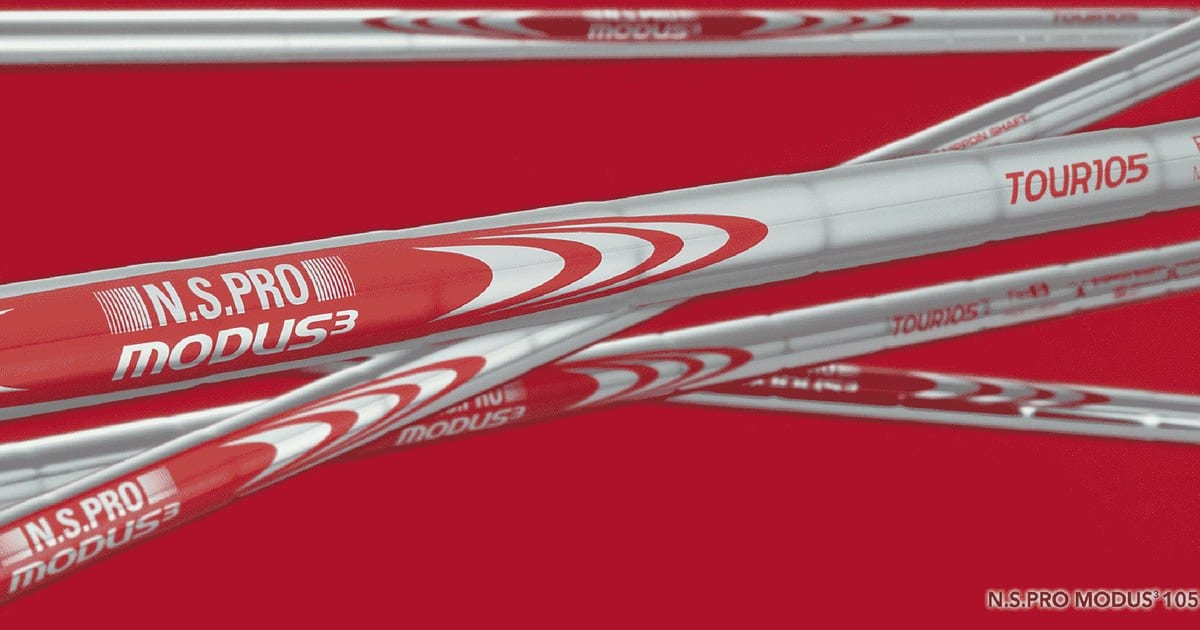
Every shaft in the rack has a letter on it. R, S, sometimes SR or X. What none of them tell you is how big the step between two letters actually is.
So I went looking for a number instead of an adjective. Three came back. The first two measure different properties, so they sit side by side, but the last two flatly disagree. I’ll give you all three and say which one I carry around in my head.
Then we’ll look at what happened when six golfers hit all three flexes on a launch monitor. That’s a machine that measures what the club and ball actually do at impact. Trackman is one brand of it.
The short answer
- In one steel iron shaft model, Nippon publishes 103.0 g for R and 106.5 g for S. That’s a 3.5-gram step, plus 0.2 degrees less twist.
- Club fitters usually put one flex step near 12 CPM, a stiffness measurement explained below. On a shaft reading 250 CPM, that’s a shade under a 5 percent change.
- When six golfers hit regular, stiff and x-stiff versions of one 6-iron on Trackman, the group averaged about 5 yards longer with regular.
- Individual players moved 7.5 to 16 yards in the other direction. The average gap is small. Yours might not be.
What the letter is actually marking
Flex is how much the shaft bends while you swing it. Softer flex bends more, stiffer flex bends less. The ladder runs L (ladies), A (senior), R (regular), SR (stiff regular), S (stiff) and X (extra stiff), softest to stiffest.
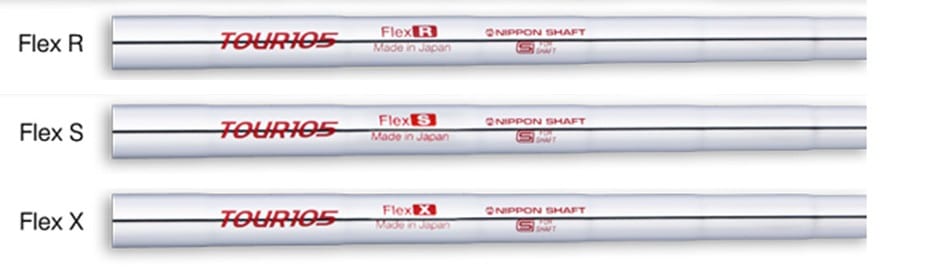 Image: Nippon Shaft official product page, cropped to the label band of each flex.
Those three bands carry the same shaft name and the same weight class. Weight class is the gram number printed next to the letter, and all three read TOUR105. The only thing that changed is one character.
That’s the useful way to read a flex letter. It sorts one model into steps. It isn’t a measurement you can carry to another brand’s rack. That’s a separate problem, and I worked through it in how the same letter changes meaning between brands.
The maker’s own numbers: 3.5 grams and 0.2 degrees
The cleanest answer comes from a spec sheet, because the maker is comparing a shaft to itself. Nippon publishes this for the N.S. Pro Modus3 Tour 105, an iron shaft you’ll see in a lot of fitted sets.
| Flex | Weight | Torque |
|---|---|---|
| R | 103.0 g | 1.9 degrees |
| S | 106.5 g | 1.7 degrees |
| X | 112.0 g | 1.6 degrees |
Torque is how far the shaft twists around its own length during the swing, measured in degrees. A lower number twists less.
Those are the published figures for the model (Nippon Shaft, retrieved 2026-08-31). So inside this one model, stepping from R to S costs you 3.5 grams and takes away 0.2 degrees of twist.
One caveat before you carry those numbers around. Nippon doesn’t publish a stiffness figure for each flex, so weight and torque are the closest published stand-ins. The CPM section below is the one that measures stiffness directly.
The steps aren’t even. R to S is 3.5 grams. S to X is 5.5 grams. The ladder gets further apart as you climb it.
The frequency answer: about 12 CPM per step
Fitters don’t argue about letters. They measure the shaft and get a number called CPM.
CPM stands for cycles per minute, and it counts how fast a shaft vibrates when you flick it. A fitter clamps the grip end, pulls the tip down, lets go, and counts the oscillation. Higher CPM means stiffer, and most shafts read somewhere between 200 and 300-plus (Golf.com, June 2020, retrieved 2026-08-31).
The working rule among fitters is that one flex step is about 12 CPM. A shaft reading 300 is one full flex softer than a shaft reading 312 (KZG, retrieved 2026-08-31). A second explainer gives the same 12 and adds a worked example. If a stiff shaft measures 250, the regular version of that shaft from that brand should land near 238 (Golfible, June 2023, retrieved 2026-08-31).
Twelve out of 250 is a shade under 5 percent. That’s the size of the step you’re choosing between.
Where the sources disagree
Not everyone lands on 12. One shaft-fitting explainer says steel iron shafts run from roughly 270 CPM at A-flex to roughly 340 at X-flex, measured on a 5-iron (1 Iron Golf, retrieved 2026-08-31). Counting A to R to S to X gives 70 CPM across three steps, closer to 23 CPM each.
SR sits between R and S on that ladder. Most brands don’t publish it in steel irons, so I left it out of the count. If you slot SR back in, it becomes four steps of about 17.5 CPM instead of three of 23.
Both can be true, and I think they are describing different things. The 12-CPM rule describes neighboring flexes inside one model. The 70-CPM spread is the whole market, where one brand’s soft R and another brand’s firm X sit at the two ends.
If I had to carry one number, I’d carry 12. It’s the one that matches the question you’re actually asking in a shop, which is almost always about two shafts from the same rack.
One caveat sits under all of these figures: no manufacturer publishes a CPM step per flex. Every number in this section comes from a fitting-industry explainer rather than from published measurement. They’re working rules of thumb, not settled specifications.
Where weight and flex come apart
The Nippon table makes stiffer look reliably heavier. Pull a second maker’s sheet and that tidiness falls apart.
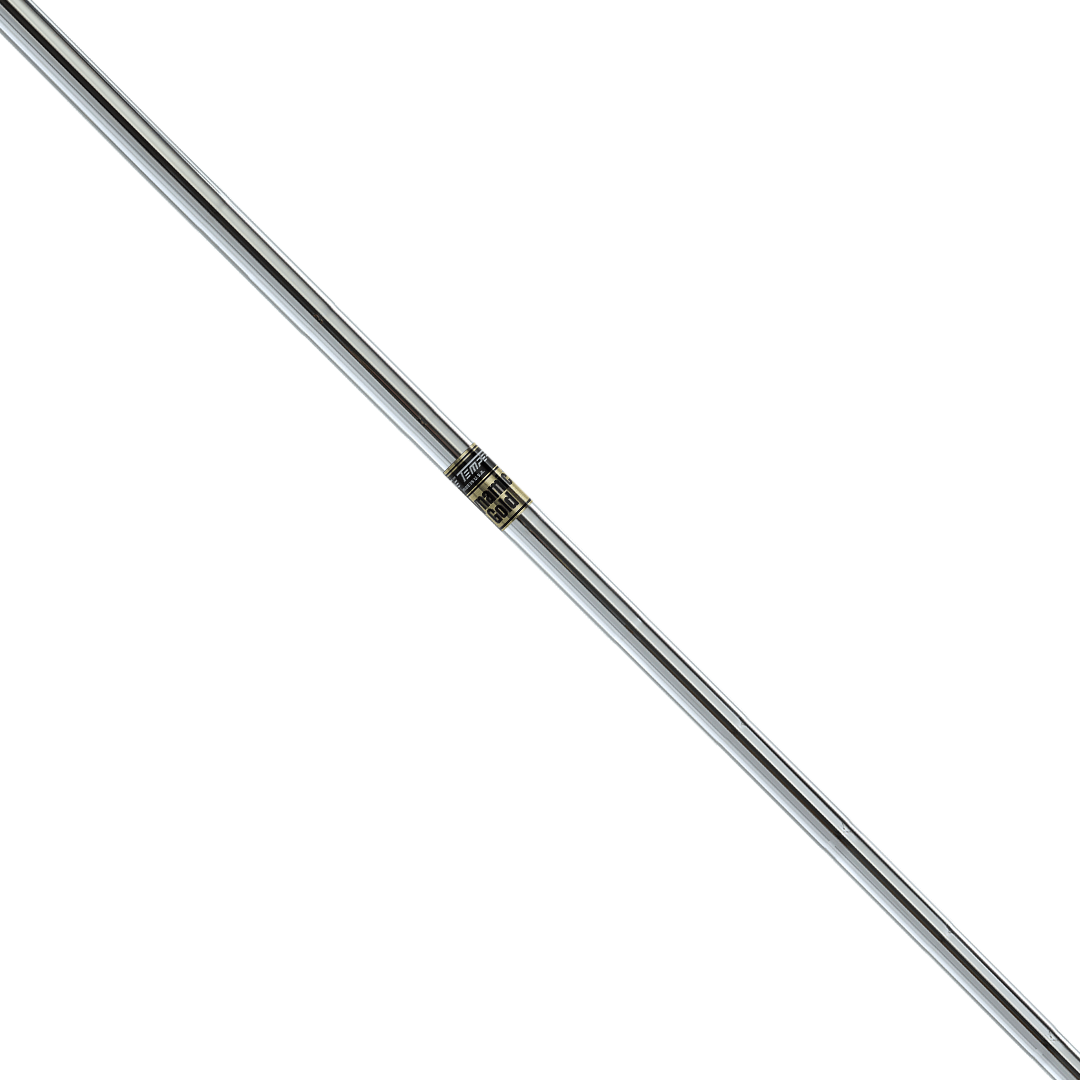 Image: True Temper official product page.
True Temper publishes these weights for Dynamic Gold, which the company bills as the most played iron shaft on tour (True Temper, retrieved 2026-08-31).
| Flex | Weight |
|---|---|
| R300 | 127 g |
| S200 | 127 g |
| S300 | 130 g |
| S400 | 132 g |
| X100 | 130 g |
That one is worth a second look. R300 and S200 weigh exactly the same, and one is a full flex stiffer than the other. Then X100, the stiffest of the five, comes in 2 grams lighter than S400.
So “stiffer means heavier” is a tendency, not a rule. Weight and flex are two separate dials, and a maker can move one without moving the other.
This matters when you’re standing over a used club. The gram number on the band is a measurement anyone can compare. The letter next to it isn’t. Printed specs drift between model years as well, which is what I found tracing Titleist T100 lofts across generations.
One letter has to cover the whole shaft
Here’s the part that made the 12-CPM figure click for me. A shaft isn’t equally stiff along its length, but it only gets one letter.
 Image: Fujikura official product page. The band on this one reads 8-S.
Fujikura labels three separate zones on the same shaft. The handle is stiff, the middle is stiff, the tip is ultra-stiff. All of that gets summarized as the S in the 8-S printed on the band.
Two shafts can share a letter and still bend in different places. That’s why a fitter watches your ball flight instead of trusting the label. It’s also why “same flex, different feel” is a real thing, not something in your head.
What happened when six golfers hit all three
Numbers on a page are one thing. In 2016, Plugged In Golf put the question on a launch monitor.
Six golfers, handicaps from 10 to scratch, hit a single 6-iron head fitted with regular, stiff and x-stiff versions of the same shaft model. Scratch means a handicap of zero, so that group ran from solid club golfer to the top of the amateur range. Seven shots each, on Trackman, at Club Champion, a club-fitting chain. No shots were deleted from the results (Plugged In Golf, October 2016, updated January 2020, retrieved 2026-08-31).
The group averages ran opposite to the folk wisdom. Regular produced a little more club head speed, a little more ball speed and a slightly higher smash factor. Smash factor is ball speed divided by club head speed, so a higher number means a more efficient strike.
Regular came out about 5 yards longer than stiff and about 2 yards longer than x-stiff. Four of the six testers hit their longest shots with regular. Regular also produced fewer mishits.
The picture changes inside the group. One player picked up over 7.5 yards of total distance moving from regular to stiff, and finished 6 yards closer to the target. Another gained 16 yards going from stiff to x-stiff.
That split is the real finding. Averaged across a group, flex barely moves distance. For one individual it can move a lot, and the direction isn’t predictable from the letter.
So which one do you play?
Speed is the starting point, not the answer. If you’ve never had your swing measured, golf shops often put you on a launch monitor for free. The full letter-by-speed chart sits in my walkthrough of flex by swing speed.
After that, three things are worth holding onto.
- Hit regular and stiff back to back. The Trackman test is the argument for it. Four of six were longest with the softer shaft, and no chart would have predicted that.
- Read grams before letters when two brands are on the table. The flex chart piece linked above works through why.
- There’s no reason to buy stiff because it sounds better. Nothing in the group averages rewards playing above your speed, though two of the six testers did measure better with the stiffer shafts. Which group you’re in is a question for a launch monitor, not for pride.
Graphite driver shafts tangle weight classes and flex together in a way steel doesn’t. I pulled apart one manufacturer’s lineup in my Ventus TR comparison.
Frequently asked questions
How much stiffer is stiff than regular?
Fitters work to about 12 CPM for two neighboring flexes in the same model (KZG, retrieved 2026-08-31). Against a 250-CPM shaft, that’s a shade under 5 percent. In Nippon’s Modus3 Tour 105, the same step adds 3.5 grams and removes 0.2 degrees of torque.
Will a stiff shaft make me hit it further?
The measured evidence says not by itself. In the Plugged In Golf test, the group averaged about 5 yards longer with regular, and four of six testers were longest with it. Individual players did gain from stiffer shafts, but which way it goes has to be measured.
Is a stiffer shaft always heavier?
No. True Temper lists R300 and S200 at the same 127 grams, and lists X100 lighter than S400 (True Temper, retrieved 2026-08-31). Weight and flex are set separately.
Is the R-to-S step the same size in every shaft model?
No. Inside a single model, fitters work to about 12 CPM between neighboring flexes (KZG, retrieved 2026-08-31). Across steel-iron models as a group, one explainer puts A-flex near 270 CPM and X-flex near 340 (1 Iron Golf, retrieved 2026-08-31). That spread works out to roughly 23 CPM per step, close to double the within-model figure. Neither number is a published manufacturer spec. Both come from fitting-industry explainers.
Terms in this article
- Flex: how much the shaft bends during your swing. Marked L (ladies), A (senior), R (regular), SR (stiff regular), S (stiff) or X (extra stiff), softest to stiffest.
- CPM: cycles per minute. How fast the shaft vibrates when a fitter clamps the grip, pulls the tip and releases it. Higher means stiffer.
- Torque: how far the shaft twists around its own length during the swing, in degrees. Lower twists less.
- Smash factor: ball speed divided by club head speed. Higher means a more efficient strike.
- Weight class: the number printed next to the flex letter. On steel iron shafts it is the actual gram figure, and unlike the letter it compares across brands. Graphite driver shafts use it as a rounded class instead, not a weight.
- Launch monitor: a machine that measures what the club and ball actually do at impact. Trackman is one brand of it.
- Handicap / scratch: a handicap is a number describing how far above par you usually play. Scratch means a handicap of zero.