
Tourstage V300 III iron lofts by club, and what my used set cost
Tourstage V300 III lofts and lies by club, 23 degrees at the 4-iron to 45 at the PW, plus what ten months on a used set actually cost me.
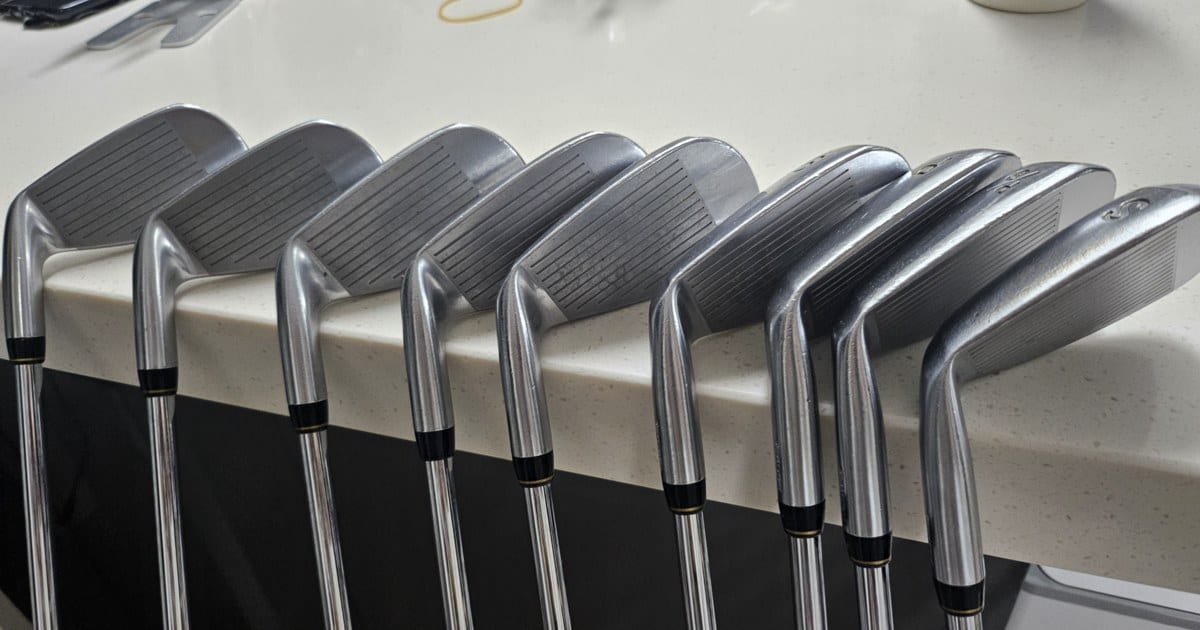
My first set of irons was a used Tourstage V300 III. Someone told me it holds its value well, and that part was true: ten months of use cost me 20,000 won. Here are the lofts by club, and why 20,000 won was the whole bill.
The short answer
- V300 III lofts run 23 degrees at the 4-iron to 45 at the pitching wedge, with the 7-iron at 32.
- It’s a forged cavity back, meaning a head pressed from solid metal with the weight moved out to the edges. Korea listed it from February 2011 as a nine-club set: 4 through PW, plus PS (pitching sand) and SW (sand wedge).
- My set came with N.S.PRO 950GH in R flex, the middle stiffness, which Nippon Shaft publishes at 94.5 g.
- Resale held up. Ten months of use cost me 20,000 won on a set I bought in the 300,000s, and that really was the whole bill. The set came already regripped and I sold face to face, so none of the usual three extras appeared.
- What the strong resale bought me was the right to be wrong about my first set. To me that was worth more than a low price.
Why I bought a set I had never hit
I didn’t test this set before buying it. A friend had one, the name kept surfacing, and someone said it holds its value. Only the last one was a claim I could check, and the second one explains it.
The “everyone knows it” part has a real number behind it. The retailer Golfzon Market pulled point-of-sale data from its 24 stores for 2013. The V300 III topped that chain’s iron set sales at 22.1 percent, with second place at 9.3 percent (Edaily, February 2014).
That’s my best explanation for the resale holding up. Received wisdom is that a set that sold in numbers has buyers waiting later, and I didn’t know that.
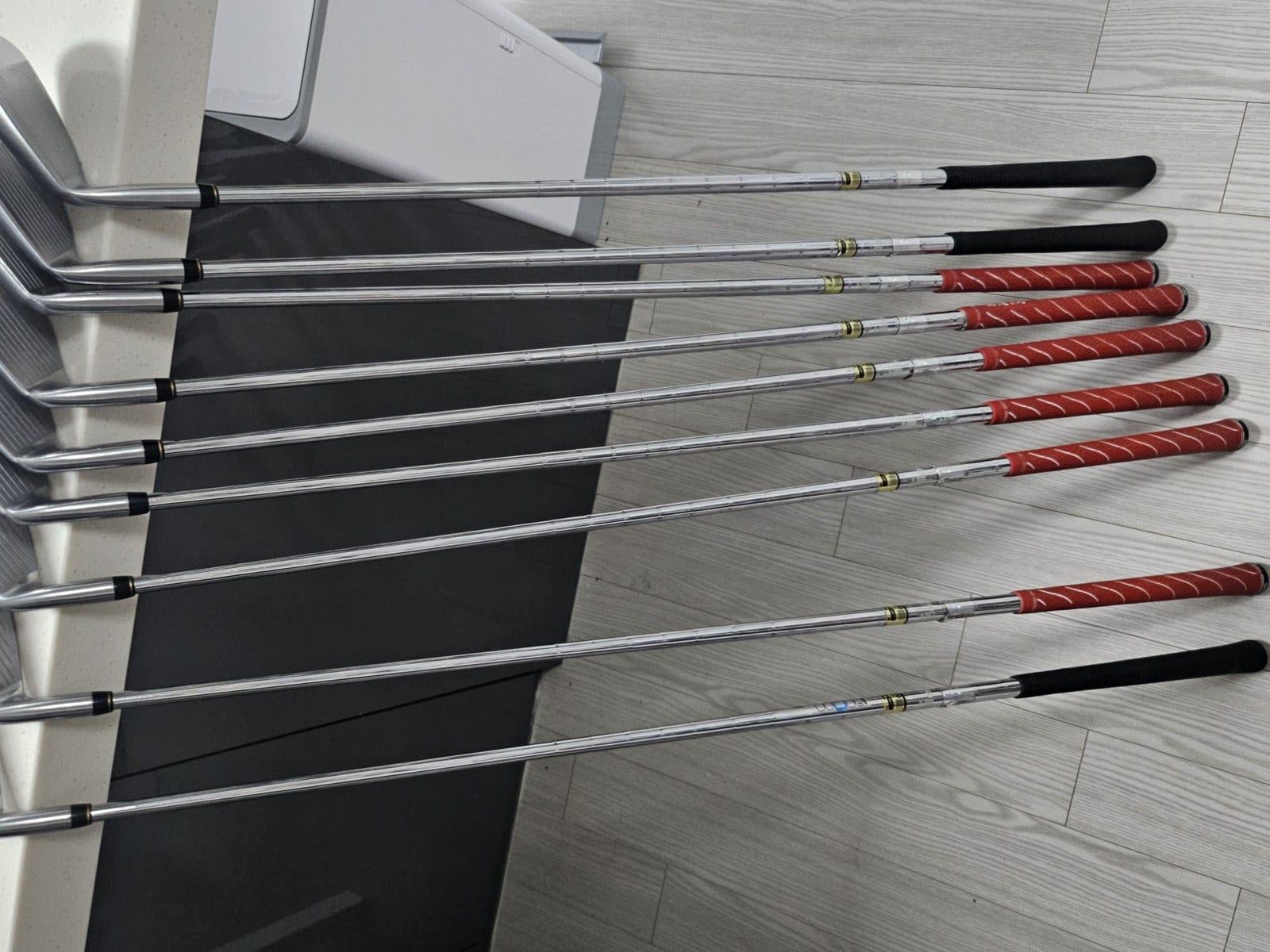
Photo: my old set, before I sold it. The grips are mixed red and black because a previous owner regripped them, not me.
Tourstage V300 III specs and iron lofts by club
Tourstage was Bridgestone’s Asia-market brand until a 2014 merger into one global Bridgestone Golf brand (Car Watch). My set predates that, so the sole still says Tourstage.
Forged means the head was pressed from solid metal rather than poured into a mold. Cavity back means weight sits at the edges of the back, so off-center hits behave better.
Loft is the angle of the clubface. All else equal, lower loft sends the ball lower and farther. Lie is the angle between the shaft and the ground when the sole sits flat.
Here’s what’s published.
| Spec | Value |
|---|---|
| Model | Tourstage V300 III (third generation) |
| Listed in Korea | February 2011 |
| Construction | Forged, cavity back |
| Set makeup | 4, 5, 6, 7, 8, 9, PW, PS, SW (nine clubs) |
| Shaft | N.S.PRO 950GH, R flex |
| Shaft weight and torque | 94.5 g, 2.0 degrees |
Specs from the Danawa product listing and, for the shaft, Nippon Shaft’s official 950GH page.
PS stands for pitching sand, the Japanese and Korean label for the wedge between pitching wedge and sand wedge. A US set calls it a gap wedge. Torque is how far a shaft twists under load, and lower numbers twist less. R flex means regular, the middle stiffness in the letter scale printed on shafts. For what the R to S step actually measures, the makers publish their own numbers.
Tourstage V300 III lofts and lies, club by club
| Club | Loft | Lie |
|---|---|---|
| 4 | 23 | 61.0 |
| 5 | 26 | 61.5 |
| 6 | 29 | 61.5 |
| 7 | 32 | 61.5 |
| 8 | 36 | 62.0 |
| 9 | 40 | 62.0 |
| PW | 45 | 62.0 |
All values in degrees. The table covers the 4-iron through the pitching wedge, not the PS or SW.
A 32-degree 7-iron reads weak against a 2026 set. It isn’t old-fashioned so much as differently numbered, and the same number now covers 26.5 to 35 degrees depending on the model.
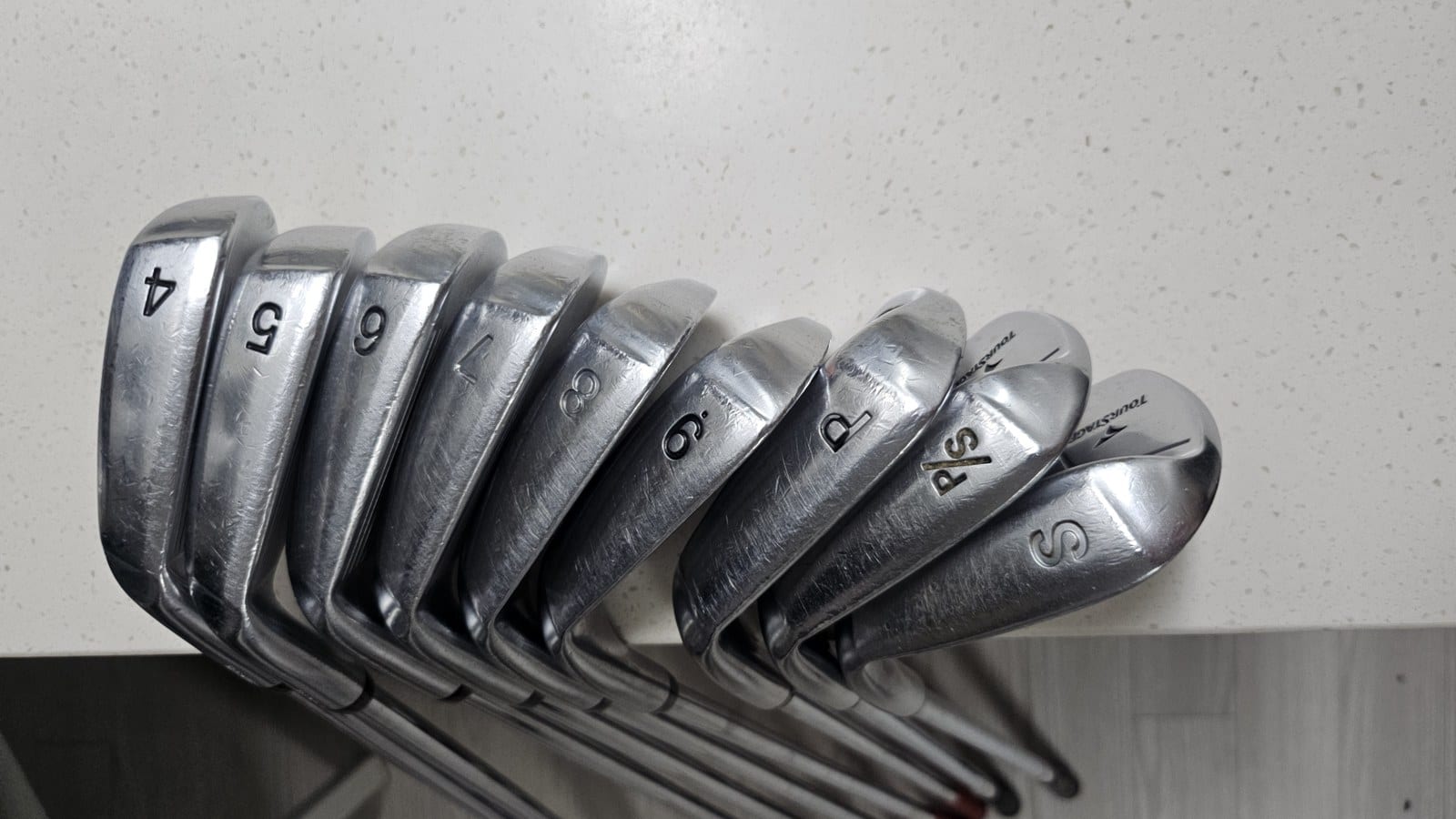
Photo: my own set. The numbers run 4 through 9, then P, PS, S, so both wedges came in the box.
That mattered more than I realized at the time. As a beginner I never had to figure out which wedges to buy.
Ten months of easy golf, and why I switched anyway
The set felt easy. Standing over the ball felt settled, and I hit it without thinking. I’d been playing less than a year with nothing to compare it against. I can’t tell you my read was accurate, only that it was mine.
At around ten months I replaced the whole set rather than the shafts, moving to a set of Titleist T100s. Three things pushed me there, and I still can’t rank them.
The clubs had started to feel light in my hands. I’d also heard somewhere that these were beginner clubs, though I never learned who decides that. And I’d started to feel like I could play a bit, so a step up seemed reasonable.
Two of those deserve a caveat. No published standard sorts irons into beginner and intermediate, and the same set gets called both depending on who’s talking. That label is received wisdom, not a spec. My own sense that I’d improved wasn’t measured either.
The shaft band complicates the first reason. My set had N.S.PRO 950GH in R flex, a lightweight steel shaft, meaning steel built lighter than the traditional kind. Nippon Shaft publishes it at 94.5 g, not a featherweight.
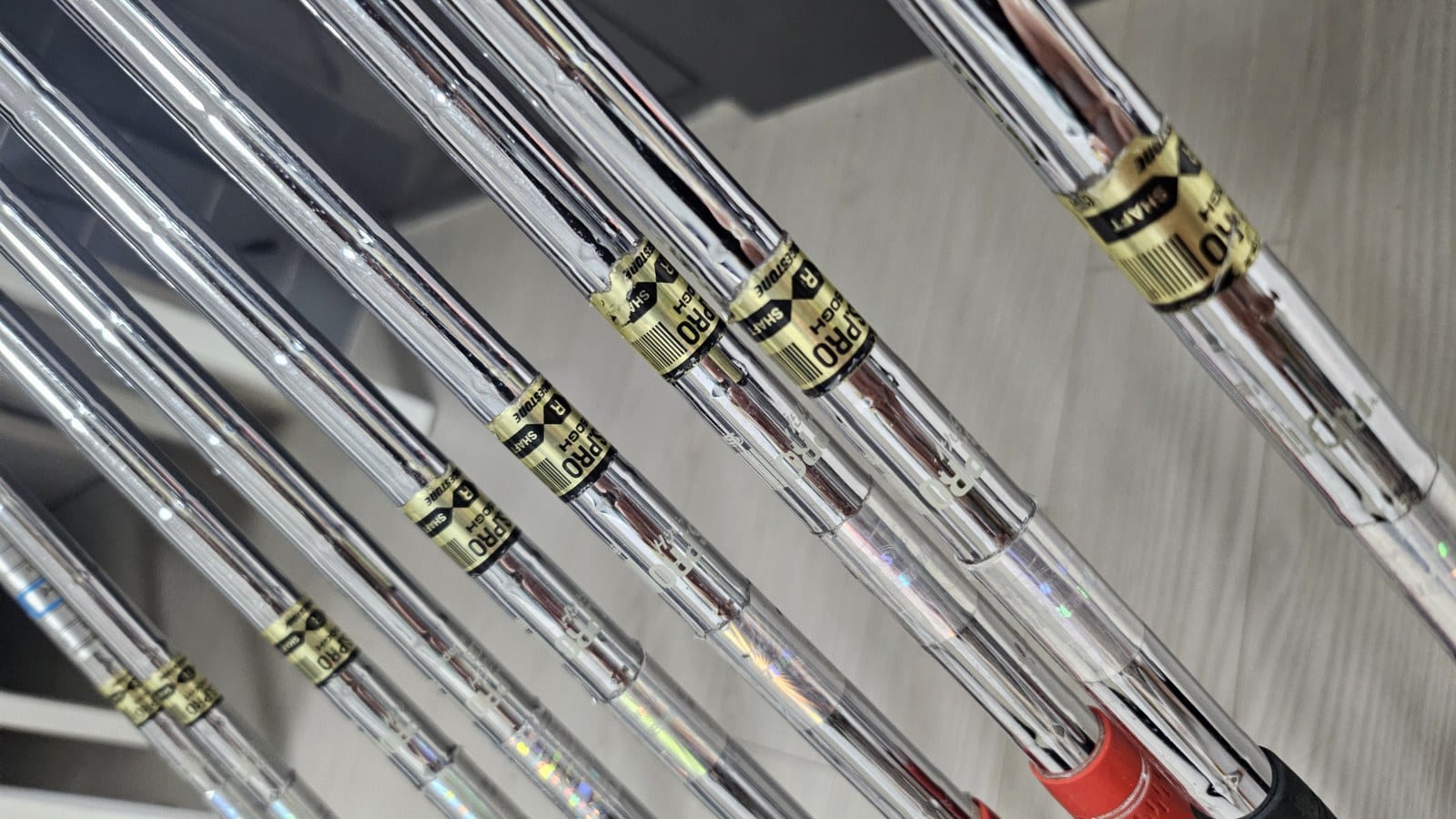
Photo: a close-up of the shaft band. The band reads N.S.PRO, the weight code, and R, with Bridgestone wrapping around the far side.
So “light” didn’t mean the set was unusually light for its class. It meant I’d outgrown a standard weight. I never tested a heavier shaft in this head, so I can’t say a reshaft would have solved it. For what the letters on a shaft band mean, see my shaft flex chart guide, where the letters turn out not to be standardized between brands.
Why 20,000 won really was the whole bill
I bought the set in the 300,000s, and the 20,000 won I lost on resale was the whole bill. Three costs never appeared. Face to face removed the fees and the shipping. Luck removed the grip cost.
- Grips. A previous owner had already regripped the set, so I never paid for grips. Regripping is priced per club, so a nine-club set pays for it nine times.
- Fees. I bought and sold face to face on Danggeun, Korea’s local secondhand marketplace. A face-to-face sale there carries no fee, while platforms that hold the money until delivery charge the seller. Rates move, so check before you list.
- Shipping. Face to face also meant no box, twice, on a set that’s heavy and bulky.
None of these scale with the price of the club. A regrip costs the same on a cheap set as on an expensive one. So on cheaper clubs, those fixed costs eat a bigger share of the price.
Would I buy a used first set again?
Yes, for a reason I couldn’t have named then.
A beginner buying a first set is guessing, and only playing settles the guess. Strong resale doesn’t make the guess cheaper. It makes it reversible, and that’s what “it holds its value” bought me.
Irons are where this works best, which is received wisdom rather than a measurement. The Korean shorthand is to buy the driver new and the irons used.
Only one of the two things that kept my bill down was a decision. Look for a set that’s already regripped, and sell face to face.
One thing I still can’t explain. After I switched, my scores looked better on the old set than the new one. My guess is that a club I didn’t have to think about let me play without thinking. But I never measured anything, and a beginner’s scores move for many reasons, so I’m not calling that a finding.
Terms in this article
- Loft: the angle of the clubface. All else equal, lower goes lower and farther.
- Lie: the angle between the shaft and the ground when the sole sits flat.
- Cavity back: weight moved to the edges of the back, so off-center hits behave better.
- Forged: a head pressed from solid metal rather than poured into a mold.
- Torque: how far a shaft twists along its length under load.
- PS: pitching sand, the wedge between pitching wedge and sand wedge.
- Lightweight steel: steel iron shafts built lighter than traditional steel.
- R flex: regular stiffness, the middle of the letter scale on shafts.