
Titleist T200 vs T100: same length, same lie. Loft is what actually changes.
The 2021 Titleist T200 and T100 share one lie table and one length table. Loft is the only geometry that changes, and the weight difference sits in the stock shaft, not the head.
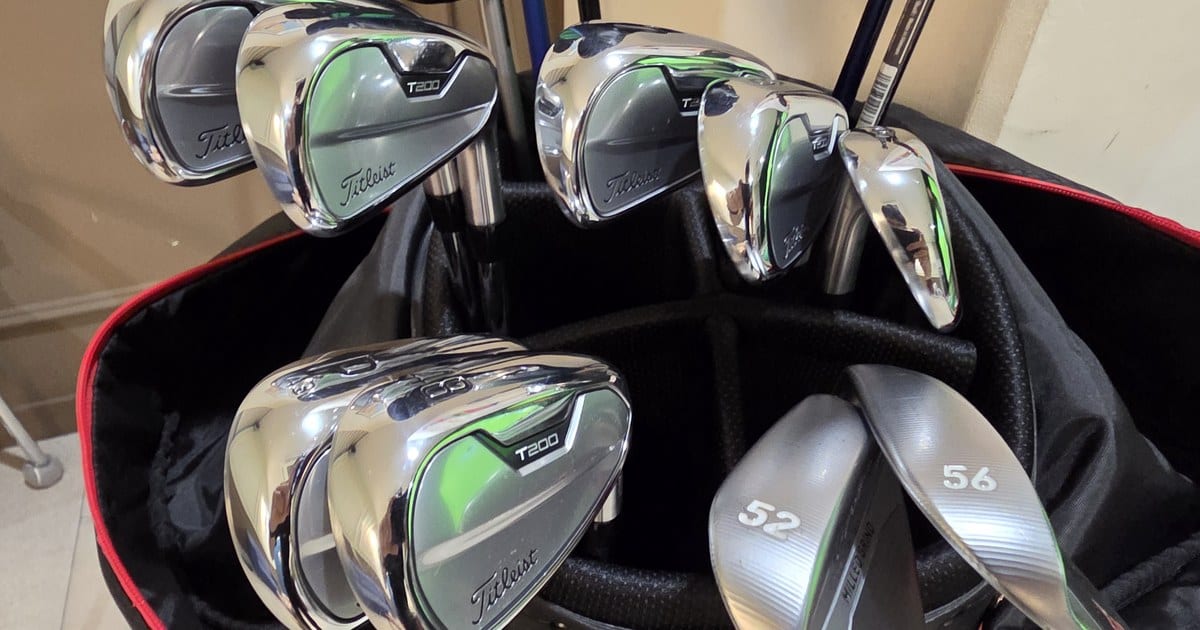
A friend bought the 2021 T200 because the T100 looked like too much iron for him. He still says he wishes he had bought the T100 anyway.
He describes the set four ways. It’s easy to hit, it’s light, and the feel is flat compared to a forged blade. And it sets up long and upright, so he stands taller over the ball than he expects to.
I play the T100, so I hit his 7-iron next to mine one evening in August, then went home and opened both spec tables. The flat feel is the only one of the four I could test for myself. That’s the one I went to the bay looking for and didn’t get. Two more are in the tables below, and the first one, easy to hit, is where this ends up.
The short answer
- Titleist publishes one lie row and one length row for the entire 2021 T-Series. A T200 7-iron and a T100 7-iron are both 37.00 inches with a 63° lie (Titleist Japan, retrieved 2026-09-06).
- Loft is the only geometry that changes. The 2021 T200 is 3° stronger than the T100 in the 7 through the P, and 2° stronger in the 5, 6 and W.
- Compared by loft rather than by number, the picture flips. The T200 7-iron is half an inch shorter and half a degree more upright than the T100 6-iron it replaces.
- The lighter feel is the shaft, not the head. With the same shaft in both, Titleist publishes the same total weight and the same head-heaviness.
- How much distance you gain is the least settled number here. One tester measured 6 yards. Another measured 1.5 to 2 clubs, where a club is the distance gap between two adjacent irons.
Loft is the angle of the club face, in degrees. Lie is the angle the shaft sits at when you set the club on the ground. A higher number is more upright, and it stands you closer to the ball.
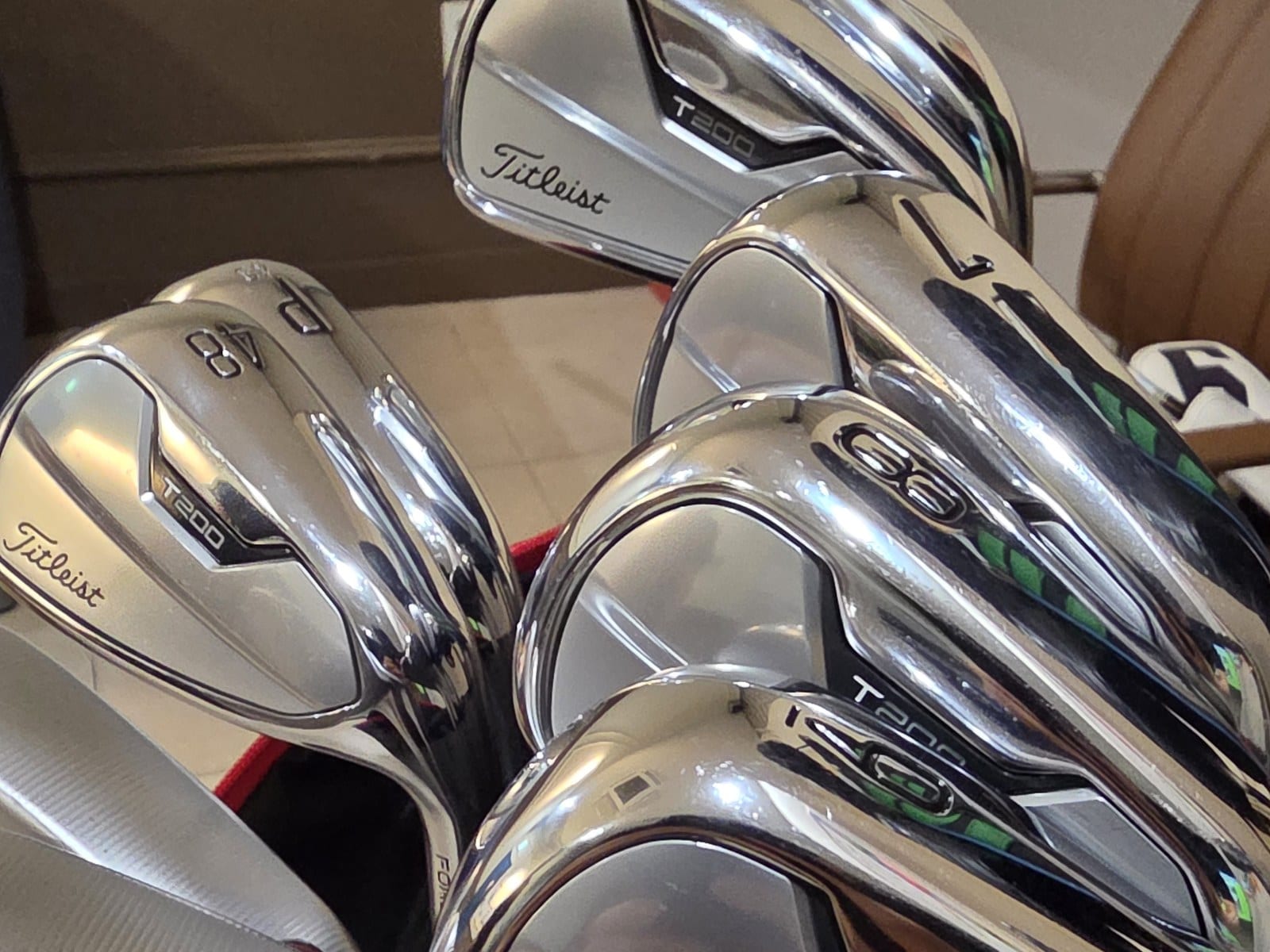
His T200s. The P and the 48 you can read here are two different clubs, not one club stamped twice. That 48 is the W in the table below, usually sold separately rather than in the set.
The “T100 is too much iron, get the T200” ladder is real
If you ask in a Korean golf forum whether a beginner can handle a T100, the answers arrive in a fixed order. T100 is too much. Take the T200. If that’s still too much, take the T300.
That ladder is shop and forum habit, not a Titleist recommendation, and it sorts the range by one axis: how much the club forgives you. My friend bought off it. So the question isn’t whether the ladder exists. It’s what you actually change when you step down a rung.
English-language forums don’t use the range this way, and the T200 comes up there mostly as the long-iron half of a combo set.
I’ve written up how T100 lofts moved across generations separately, since that one confuses people on its own.
Same number, same length, same lie
Here is the part that surprised me. Titleist Japan’s 2021 spec page carries one lie row and one length row, and every model in the range shares them. T100, T100·S, T200, T300 and T400 all sit on the same two lines. The T100 numbers below match the US spec page I quoted in the lofts piece, so this isn’t a Japan-only table.
| Club | T100 loft | T200 loft | Lie, both | Length, both |
|---|---|---|---|---|
| 5 | 27° | 25° | 62.0° | 38.00” |
| 6 | 30° | 28° | 62.5° | 37.50” |
| 7 | 34° | 31° | 63.0° | 37.00” |
| 8 | 38° | 35° | 63.5° | 36.50” |
| 9 | 42° | 39° | 64.0° | 36.00” |
| P | 46° | 43° | 64.0° | 35.75” |
| W | 50° | 48° | 64.0° | 35.50” |
Source: Titleist Japan spec tables for T100 and T200, both retrieved 2026-09-06. I link Japan because both pages print one lineup-wide table, which is why you get a single lie column and a single length column. My own T100 is the 2023 set. Titleist didn’t change T100 loft, lie or length between 2021 and 2023, so this column is my clubs too.
So a T200 7-iron is not a longer club than a T100 7-iron. It’s the same length and the same lie angle, to the decimal. Whatever my friend feels at address, the number stamped on the sole isn’t where it comes from.
That number isn’t a unit either. Two current PING irons publish six different 7-iron lofts across 8.5 degrees, all at the same 37 inches.
Offset is how far the face sits behind the hosel, the socket that holds the shaft, and it used to separate these two. Testing the 2019 set, Plugged In Golf called offset the biggest difference between the two models (Plugged In Golf, January 26, 2020). In 2021 that stopped, and Titleist’s launch material describes the new T200 as having “less offset (same as T100)” (Titleist Newsroom, July 29, 2021). That older advice still circulates.
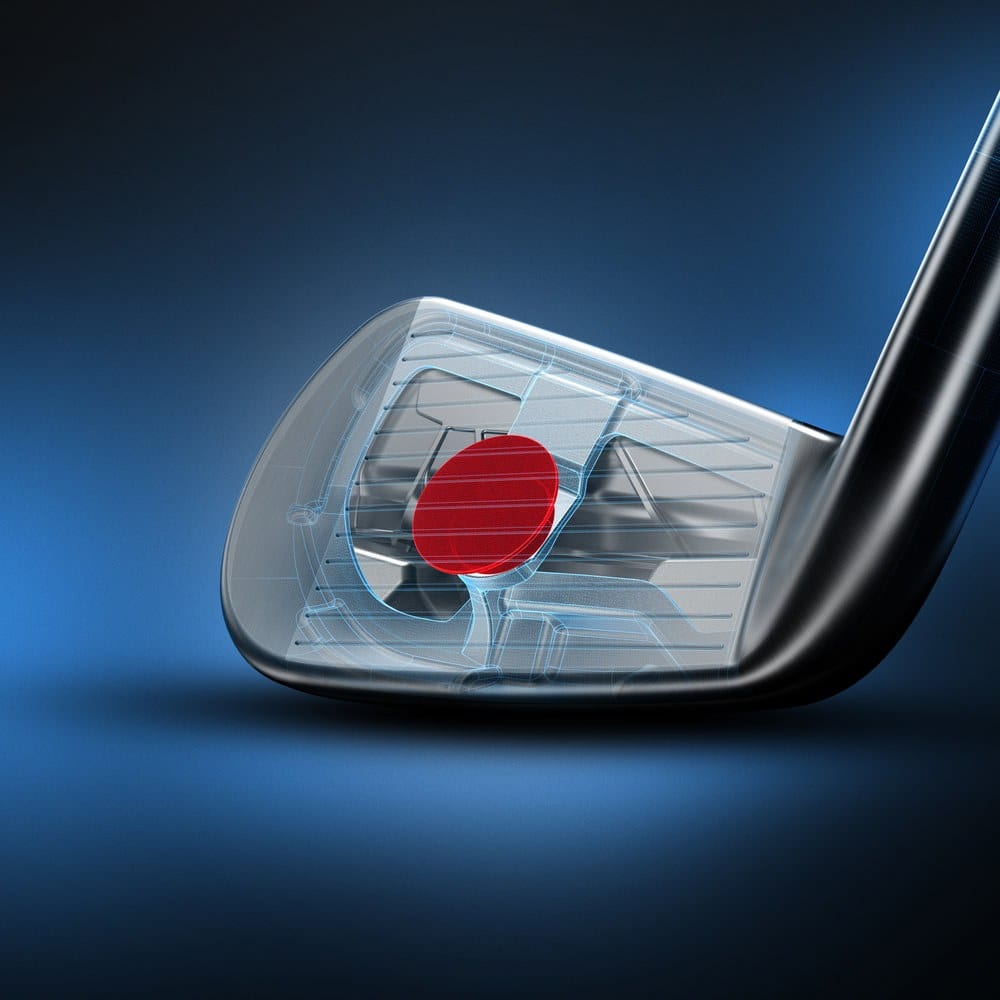
The 2021 T200 with the body made transparent. The red disc is the polymer core. Image from the Titleist media center.
What happens when you match the lofts
Nobody plays a 7-iron because it says 7. You play it because it goes a certain distance. So if you line the two sets up by loft instead, the picture changes.
| Closest loft, different number | Loft | Length | Lie |
|---|---|---|---|
| T100 6-iron | 30° | 37.50” | 62.5° |
| T200 7-iron | 31° | 37.00” | 63.0° |
| T100 8-iron | 38° | 36.50” | 63.5° |
| T200 9-iron | 39° | 36.00” | 64.0° |
Same source as above. The two lofts in each pair are within a degree of each other. The pattern holds down the set, because the loft shift moves every club one slot.
Read that way, half of what my friend feels is in the table. Whatever distance he now covers with the T200 7-iron, the T100 club that used to cover it was half a degree flatter. A more upright lie does stand you closer and taller.
The other half goes the wrong way. That club is also half an inch shorter, which should have him bending a little more, not less. I’d trust the lie half and put the rest down to a new set feeling like a new set.
The lighter feel is the shaft, not the head
This one is cleanest, because Titleist publishes the answer directly. Both 2021 pages list total club weight by shaft, and both offer the same steel shaft.
| Model | Shaft | Shaft weight | 7-iron total | Swingweight |
|---|---|---|---|---|
| T100 | N.S. PRO 105T | 111.3 g | about 426 g | D1 |
| T200 | N.S. PRO 105T | 111.3 g | about 426 g | D1 |
| T100 | N.S. MODUS3 TOUR 115 | 118.5 g | about 432 g | D3 |
| T200 | N.S. PRO 880 AMC, S | 94.5-106.5 g | about 419 g | D2 |
| T200 | 3D055 graphite | 57-65 g | about 380 g | D1 |
Source: Titleist Japan T100 and T200 shaft tables, retrieved 2026-09-06. The 880 AMC row says S because that’s the only flex on the page for it.
Swingweight is how head-heavy a club feels while you swing it. D1 is a position on that scale, not a weight in grams. Flex is how much the shaft bends under your swing, and R and S are two of the labels for it.
With the same shaft in both, they weigh the same and swing the same, D1 against D1. When the shaft changes, both numbers move. The MODUS3 build is 6 grams heavier and two swingweight points up. The graphite build is 46 grams lighter than the 105T at the same D1.
His set is none of those. His T200 came with the N.S. PRO 880 AMC, a steel shaft you can get on the T200 and not on the T100. In the S flex that build is about 419 g at D2, seven grams under the 105T build on the same page.
His is the R, a flex you won’t find on that page, so I can’t put a published total weight on his exact set. What I can say is where the weight he feels comes from. The same-shaft row above already told you the two heads weigh the same. It came with the shaft, not with the head he chose.
My own 2023 set isn’t on that table either. It came with a MODUS3 TOUR 105, so neither of us is playing a row you can look up here.
The US builds say the same thing. Titleist’s stock steel is AMT Tour White at 106-130 g in the T100 and AMT Black at 95-116 g in the T200. In graphite it’s Tensei White AM2 at 94-108 g against Tensei Blue AM2 at 74-88 g (Titleist Newsroom, July 29, 2021). That’s 11 to 20 grams, all of it in what the two models ship with, and a fitter can change it on either one.
So if weight is your problem, that’s a shaft conversation. Mine starts with what the letters and the gram numbers on a shaft mean, and carries on into the difference between regular and stiff.
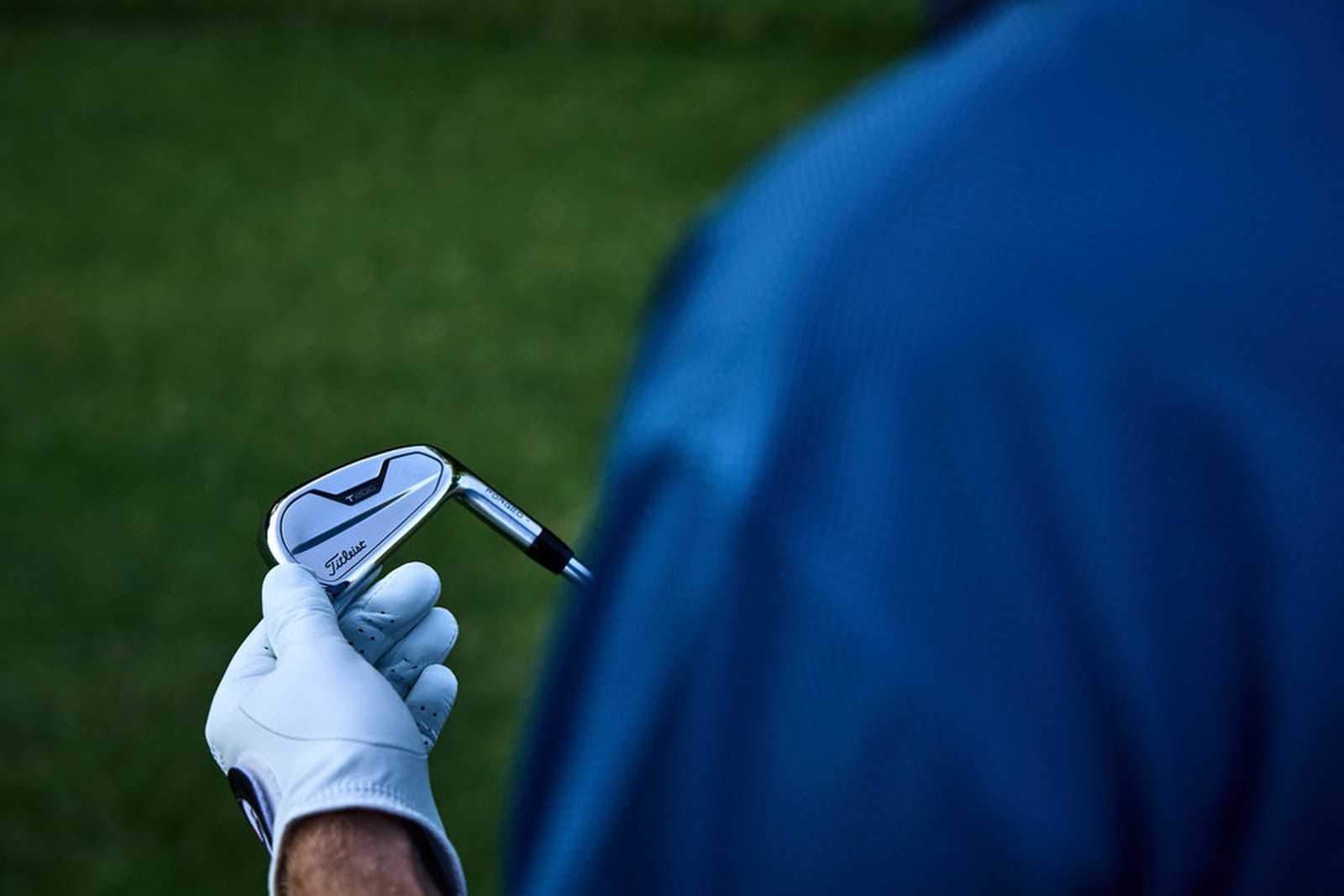
The muscle plate across the back. Titleist’s own description of it is about sound, not speed. Image from the Titleist media center.
What the hollow body trades away
My friend calls the feel flat next to a forged blade, and he’s describing something Titleist built on purpose. The T200 is a hollow head with a forged face and a polymer core behind it. The plate across the back is there, in Titleist’s words, for “precision sound tuning” (Titleist Newsroom, July 29, 2021). The Japanese page is blunter: the plate’s structure and wall thickness control vibration and resonance (Titleist Japan, retrieved 2026-09-06).
Damping is the design brief. And damping doesn’t only remove the buzz you don’t want. It removes signal along with it.
Plugged In Golf’s tester put the cost precisely, testing the previous generation. Feedback through the hands was good, and he could feel where the ball met the face. But “audio feedback is less clear: pure strikes and mishits sound quite similar” (Plugged In Golf, January 26, 2020).
That was the 2019 head, and sound tuning is what Titleist says it changed for 2021. So the quote tells you what a damped hollow head costs you, not how much the new plate moved it.
That’s what people mean by feel more often than they mean softness. Not how nice a good one is. How different a good one is from a bad one. A solid forged head has nothing in it to absorb that difference, which is the same reason it stings when you catch one thin.
Here’s the part I have to be honest about: I didn’t feel the flatness. For one session at that bay, his 7-iron came off easier and livelier than his complaint and that audio quote had prepared me for. It also wasn’t a clean comparison, for three reasons.
We’re both on steel, and not the same steel. His is the 880 AMC in R, the build I said I can’t put a weight on. Mine is a MODUS3 TOUR 105.
His 7-iron is 3° stronger than mine, which is the whole loft gap in this article. And the audio finding above came from the 2019 head, not the 2021 one he plays. I was never comparing heads alone.
One session with someone else’s club doesn’t overturn anything. But it does suggest that a flat feel is a comparison rather than a property. And my friend is comparing against a set he hits every week.
What I’d tell someone standing where he was
The place to start is the number nobody agrees on. Golfalot measured the 2021 T200 at 4 mph more ball speed and 6 yards more carry than the T100, with launch and landing angle unchanged (Golfalot, July 29, 2021). Plugged In Golf, on the 2019 set, found it 1.5 to 2 clubs longer (Plugged In Golf, January 26, 2020).
Carry is how far the ball flies before it lands, not counting roll. Launch angle is how steeply the ball leaves the face, and landing angle is how steeply it comes back down.
Different generations, one tester each. I wouldn’t average them, and I’d take the disagreement as the finding. Nobody can tell you in advance what this set adds.
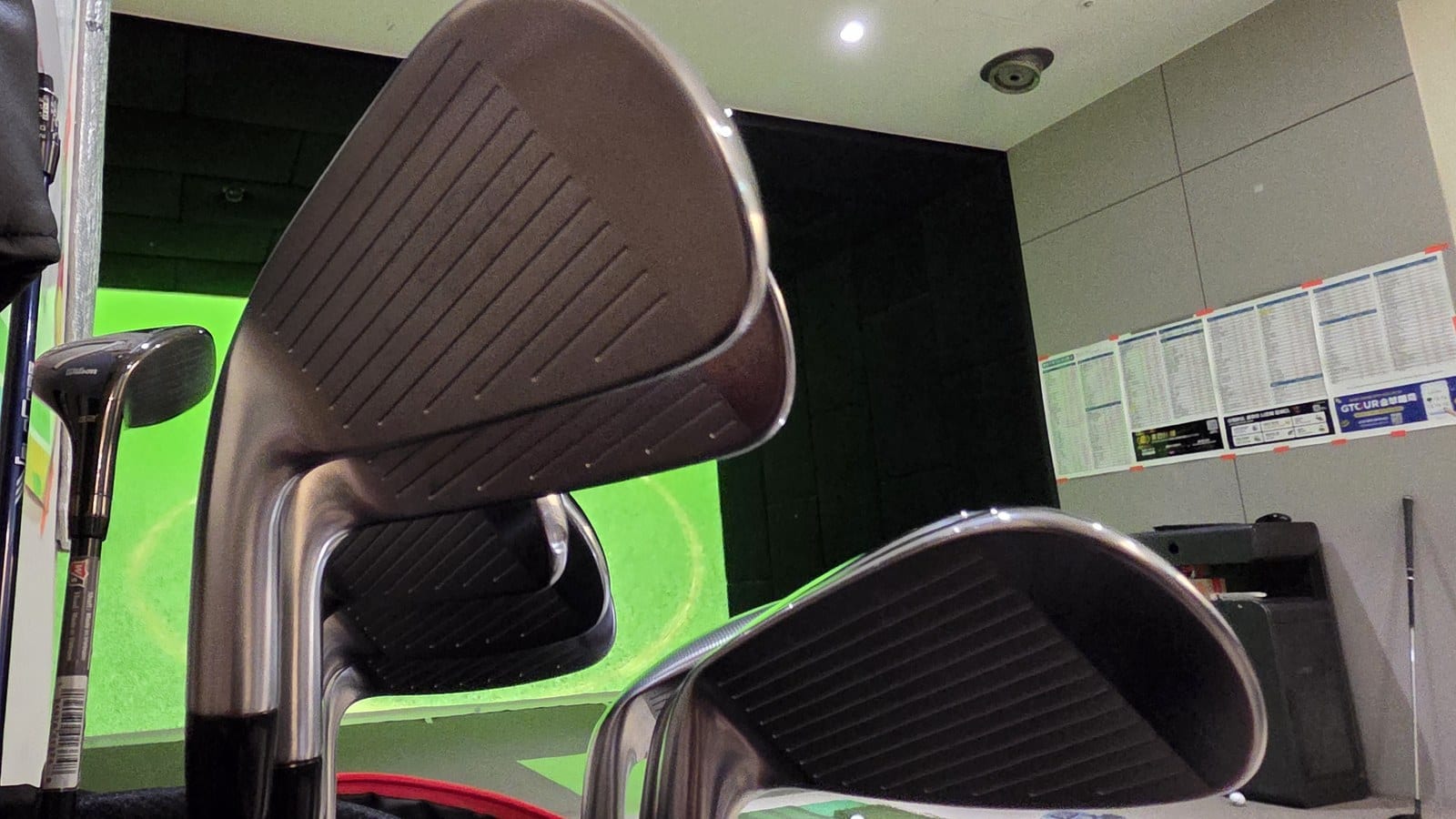
Irons on the mat at an indoor bay, which is where this comparison started.
Which leaves the actual choice, and it isn’t difficulty. Easy to hit was the first thing my friend said, and it’s the one reason nothing in these tables supports. Lie and length don’t move, weight is a shaft you can specify, and distance is unsettled.
What separates these two is how much the club tells you about the strike you just made. The only test of that I could find was run on the older head.
If being told is what makes practice work for you, that’s an argument for the solid head, whatever the ladder says. If you’d rather not be told, the T200 is doing what it was built to do. My friend didn’t buy the wrong iron. He bought it for the wrong reason, and the ladder handed him that reason.
Terms in this article
- Loft. The angle of the face, in degrees. Less loft, lower flight, more distance.
- Lie angle. How the shaft sits when the club is grounded. A higher number is more upright, which stands you closer to the ball.
- Hollow body. A head built as a shell with a thin forged face and space behind it, rather than solid metal.
- Swingweight. How head-heavy a club feels as you swing it. D1 is a scale position, not a weight in grams.
- Flex. How much the shaft bends under your swing. R and S are two of the labels for it.
- Offset. How far the face sits behind the hosel, the socket that holds the shaft. More offset buys you a fraction longer to square the face.
- Carry. How far the ball flies before it lands, not counting roll.
- Club, as a distance unit. The distance gap between two adjacent irons. “Two clubs longer” means two of those gaps.
- Launch angle. How steeply the ball leaves the face.
- Landing angle. How steeply it comes back down.