
7-iron loft isn't one number. Two PING irons span 8.5 degrees.
Two current PING irons publish six 7-iron lofts, 26.5 to 35 degrees, all at 37 inches. Why the number on the sole isn't a unit, and how to find yours.
If you came here to find out how many degrees a 7-iron is, I have to tell you up front that there isn’t a number.
I went looking for it myself and stopped when I found this. Two irons from one maker, sold in the same year, carry six different 7-iron lofts between them. Every one of those clubs is 37 inches long.
So this is about why the number stamped on the sole stopped being a unit, and what to carry around instead. The last part is the useful part: finding the loft of your own 7-iron takes about two minutes.
The short answer
- Two current PING irons publish six 7-iron lofts between them. The G740 comes at 26.5°, 28.0° or 30.0° (PING G740), and the Blueprint S at 31.5°, 33.0° or 35.0° (PING Blueprint S), both retrieved 2026-09-07.
- All six are 37 inches long. Length is not what separates them.
- Three of those six sit on one model. You choose the loft when you order the club, without changing models.
- The sole of an iron doesn’t carry its loft. It carries the number. To get the loft you need the model name and the maker’s spec page.
- No official line separates a “strong” loft from a normal one. Korean golf media puts it at 31° or less on the 7-iron, and calls 34° or more classic (Golf Digest Korea, May 12, 2022).
Loft is the angle of the club face, in degrees. Less loft sends the ball lower and, all else equal, further. A strong loft means a smaller number than whatever it’s being compared with, and nothing more precise than that.
Two irons from one maker, six 7-iron lofts
The number on an iron isn’t a unit of anything. It’s a position in a set, and the maker decides which angle sits at that position.
Here are two of PING’s current irons. One is built for forgiveness, the other for control.
| PING 7-iron, 2026 | Power Spec | Standard | Retro Spec | Length |
|---|---|---|---|---|
| G740 | 26.5° | 28.0° | 30.0° | 37” |
| Blueprint S | 31.5° | 33.0° | 35.0° | 37” |
Source: PING US spec tables for the G740 and the Blueprint S, both retrieved 2026-09-07.
That’s 8.5 degrees from one end to the other. A step from one iron to the next in these sets is 3.5 to 4 degrees. So the spread is a little over two clubs’ worth of loft, inside one brand.
The length column is the part I’d point at. It doesn’t move. You can’t explain any of that spread by saying one club is longer, because they’re all 37 inches.
Lie angle is the angle the shaft sits at when you ground the club. The two models differ by a degree at the 7-iron. That stands you a fraction closer to the ball, or further from it, and that’s it.
Power Spec and Retro Spec are order options, not models
Those six numbers are two clubs. PING sells both of these irons in three loft configurations, and you pick one at fitting. That’s the session where a shop measures you and specifies the club before it’s built.
PING describes Power Spec as “a fitting option for players looking to boost their iron distance or decrease spin to hit a desired trajectory window.” Retro Spec is “a fitting option if you’re less concerned with overall distance and more with precision and a higher trajectory.” PING adds that it “yields functional distance gaps for utilizing a 3-wedge setup or a more classic loft spec” (PING, retrieved 2026-09-07).
I’m quoting rather than paraphrasing, because I don’t know why the range is built this way. What the option list proves is narrower and enough: the maker treats the link between the number and the angle as something the buyer sets.
From the 5-iron to the pitching wedge the gap is 5 degrees at every club. That is worth more than the 7-iron number on its own.
Both sets step through the bag at the same pace. The whole Blueprint S set just sits one slot back. A G740 8-iron at 32.0° and a Blueprint S 7-iron at 33.0° are almost the same club, with different numbers on them.
Where the word “strong” comes in
Golf Digest Korea says plainly that no clear standard exists for a strong loft, then gives the working line the Korean market uses. A 7-iron at 31° or less is treated as strong lofted. At 34° or more it’s called a classic loft, and sorted into the players’ iron category. About 32° sits between the two (Golf Digest Korea, May 12, 2022).
That’s a Korean media convention, not a rule anyone enforces. It’s still useful, because it shows how far PING’s own range reaches.
The G740 lands in the strong band and the Blueprint S standard in the middle one. In Retro Spec the Blueprint S comes out at the classic end. These two models cover all three.
Titleist does a smaller version of this. Its 2021 T200 and T100 differ by 3 degrees at the 7-iron, while sharing one length table and one lie table.
One caution on all of the above. Lineups age, and this one turned over recently, so the older G730 numbers still surface in search as if they were current. I read both spec pages on 2026-09-07. Open them again if you’re reading this much later.
How to find out what your own 7-iron is
Turn your 7-iron over and the loft won’t be there. Irons get stamped with the number and that’s usually all, so you have to look the club up.
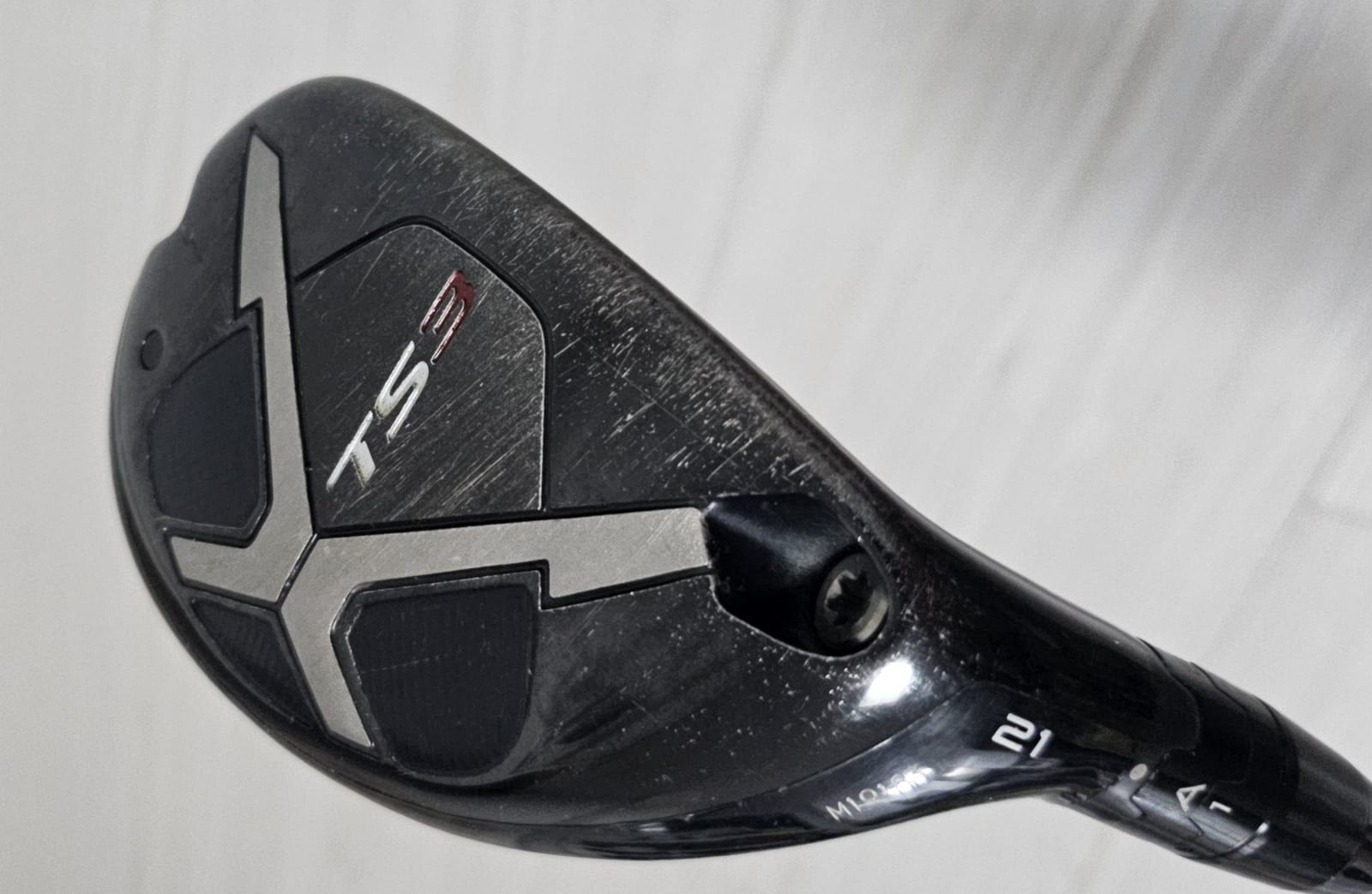
Photo: my own bag. This one is a hybrid, not an iron, and it prints its loft: the 21 next to the hosel, the socket that holds the shaft. The model name sits on the sole too, which is what you actually need, because my irons print the number and nothing else.
Three steps, in order.
- Read the model name off the head. It’s stamped on the back cavity, the sole, or the hosel. That plus the maker is what you search with, not the club number.
- Open the maker’s spec page and find the row for your club. Every maker publishes lofts, lies and lengths for current models.
- If the model is discontinued or Asia-market, the maker’s page is often gone. Danawa, a Korean retail site, carries the full spec table for sets sold in Korea, which is where the 2011 numbers further down came from. It’s Korean-language, so you’ll be reading it through a translator. For PING’s G irons, I’ve put every generation from the G400 on in one loft chart.
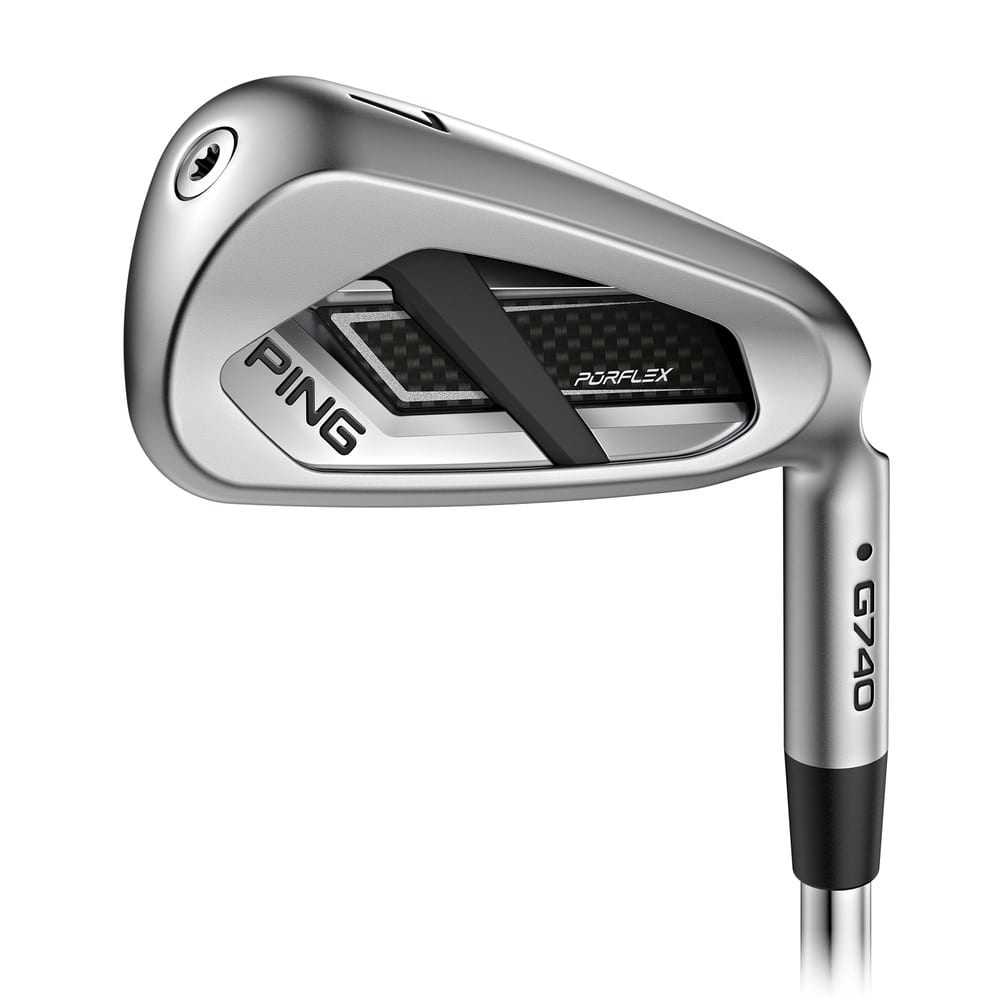
Photo: PING’s own product page for the G740, retrieved 2026-09-07. This is what step 1 is looking for. PING sits on the badge and G740 on the hosel, and neither of them is a loft.
One thing that page won’t tell you. If you bought your set used, the loft in your hands may not be the loft on that page. Anyone can have a club bent. I’m not putting a figure on how far they move, because I haven’t got a source for that.
My own two sets went the other way
Everybody knows modern irons are lofted stronger than old ones. That’s the convention, and both of my sets broke it.
My first set was a used Tourstage V300 III, listed in Korea in 2011. It’s a cavity back, which means the weight sits around the rim of the head instead of behind the face. Its 7-iron is 32 degrees.
I’ve played a 2023 Titleist T100 since, and its 7-iron is 34 degrees. I went 12 years newer and 2 degrees weaker.
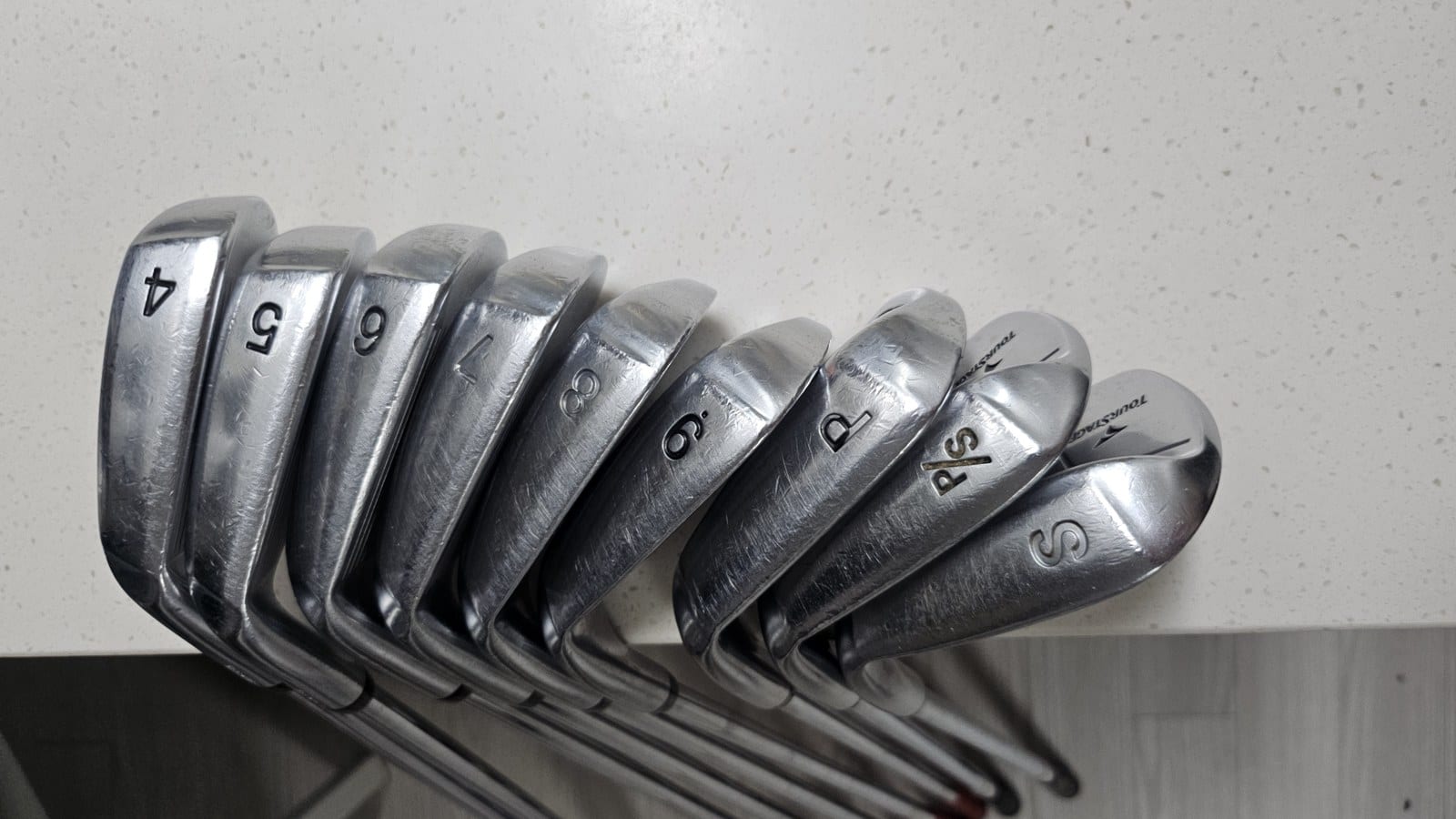
Photo: my first set. The soles read 4 through S and nothing on them is a loft, which is the whole problem this article started with. The 7 in that row is the 32-degree club.
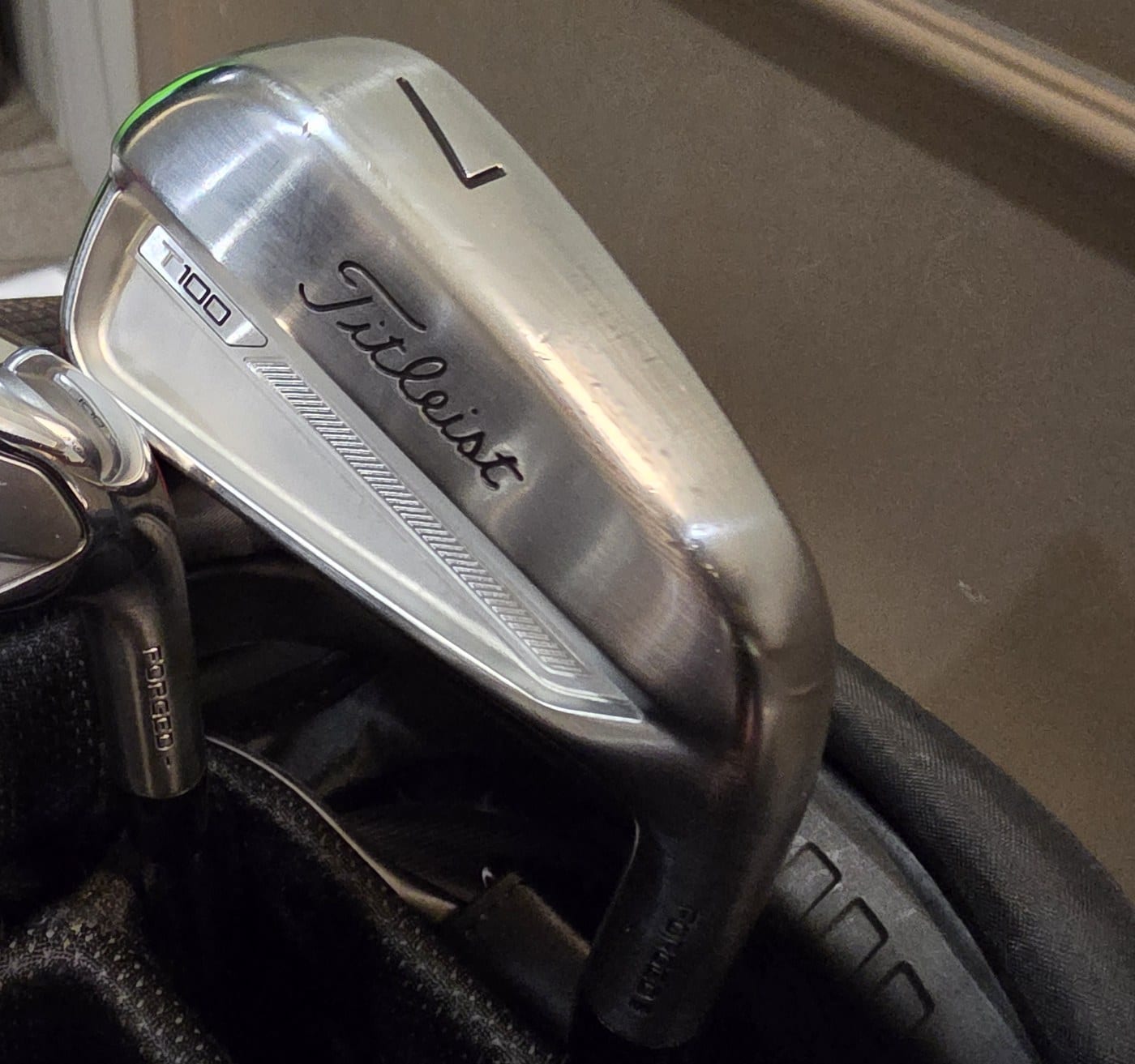
Photo: the 7-iron I play now. The same number, this time on the toe, and 2 degrees weaker than the Tourstage 7 above it.
The 12 years did none of that. The T100 is a players’ iron, a smaller and thinner head built for control rather than forgiveness. Forgiveness is how much of your distance a club keeps when you miss the middle of the face.
That category runs weaker lofts, which is what the chart above shows inside PING’s own range. Changing category moved my 7-iron further than the calendar did.
Line that 2011 set up against the G740, PING’s game-improvement iron, the larger and more forgiving category the Blueprint S sits opposite. The UW in that last row is the utility wedge, the club after the pitching wedge.
| Tourstage V300 III (2011) | Loft | PING G740 (2026) | Loft |
|---|---|---|---|
| 6-iron | 29° | 7-iron | 28.0° |
| 7-iron | 32° | 8-iron | 32.0° |
| 8-iron | 36° | 9-iron | 36.0° |
| PW | 45° | UW | 45.0° |
V300 III specs from the Danawa listing, quoted in my write-up of that set. PING specs as above. Three of the four pairs match to the decimal.
A 15-year-old set lines up club for club with a current one, one number down. The old 7-iron is the new 8-iron.
I’d stop short of a rule there. My two sets aren’t a trend, and one of them is a model most people have never held. What they do show is that the number on the sole gives you no protection. Keep the number, change the set, and the loft moves in whichever direction the new set goes.
So what do you actually do with the number
When you compare distance with someone, drop the club number out of the sentence and put the loft in.
“How far do you hit your 7-iron?” is a question with a hidden variable in it. If their 7-iron is 26.5° and yours is 35°, you’re comparing two clubs that aren’t close to each other. The answer tells you nothing about either of you.
This is also why published tables of average 7-iron distance don’t settle anything. They average clubs that no longer share a spec. Strike quality moves the result too, which I’ve written about when a good ball speed still comes with a short drive.
The second use is inside your own bag. The steps between one club and the next are called gapping, and uneven loft steps show up as uneven distance steps. That makes the whole column worth reading, not one row.
The G740 steps by 3.5 degrees at the top of the set and 4 through the middle. Then it jumps 5 degrees from the pitching wedge to the utility wedge. That last step is the widest in the set.
It also sits where the set usually stops and your own wedges start, since the UW tends to get bought on its own. That part is shop habit rather than a spec, and it’s why the widest step is the one people notice least.
You can’t see any of that by reading the numbers on the soles. They come 1 apart all the way down, which is the problem.
What to take away
Comparing by number works fine in one place: within a single model, where the maker built the steps deliberately. Across two models it stops working, and the gap can reach two clubs’ worth of loft without either club being unusual.
The line between a strong loft and a classic one is a market convention, not a standard. It’s worth knowing the phrase without leaning on it.
The one thing to do now takes two minutes. Find the model name on the back of your 7-iron, search it with the maker, and write the loft down somewhere. That number is the one that compares.
Terms in this article
- Loft. The angle of the club face, in degrees. Less loft flies lower and, all else equal, further.
- Strong loft. A smaller loft number than whatever it’s being compared with. There is no official threshold.
- Lie angle. The angle the shaft sits at when you ground the club. A higher number is more upright and stands you closer to the ball.
- Power Spec and Retro Spec. PING’s alternative loft configurations for the same iron, chosen at fitting. Power Spec is stronger, Retro Spec weaker.
- Gapping. The loft steps between one club and the next through a set. Uneven loft steps show up as uneven distance gaps.
- Club, as a distance unit. The distance between two adjacent irons. “Two clubs’ worth” means two of those steps.
- Cavity back. An iron with weight moved to the perimeter of the head, leaving a hollow behind the face.
- Players’ iron. A smaller, thinner iron built for control over forgiveness, usually with weaker lofts.
- Forgiveness. How much of your distance a club keeps when you miss the middle of the face.
- Game-improvement iron. The opposite category. A larger, more forgiving head, usually with stronger lofts.
- Fitting. The session where a shop measures you and specifies the club before it’s built.
- Utility wedge (UW). The club after the pitching wedge in a maker’s own set, sold separately more often than not.
- Hosel. The socket on the head that the shaft goes into.