
PING Iron Loft Chart: G410, G425 Same; G430, G440 Stronger
PING G400, G410 and G425 irons share one loft chart (PW 44.5°). The G430 cut the PW to 41° in 2023; the G440 set it at 42°. G7xx included.
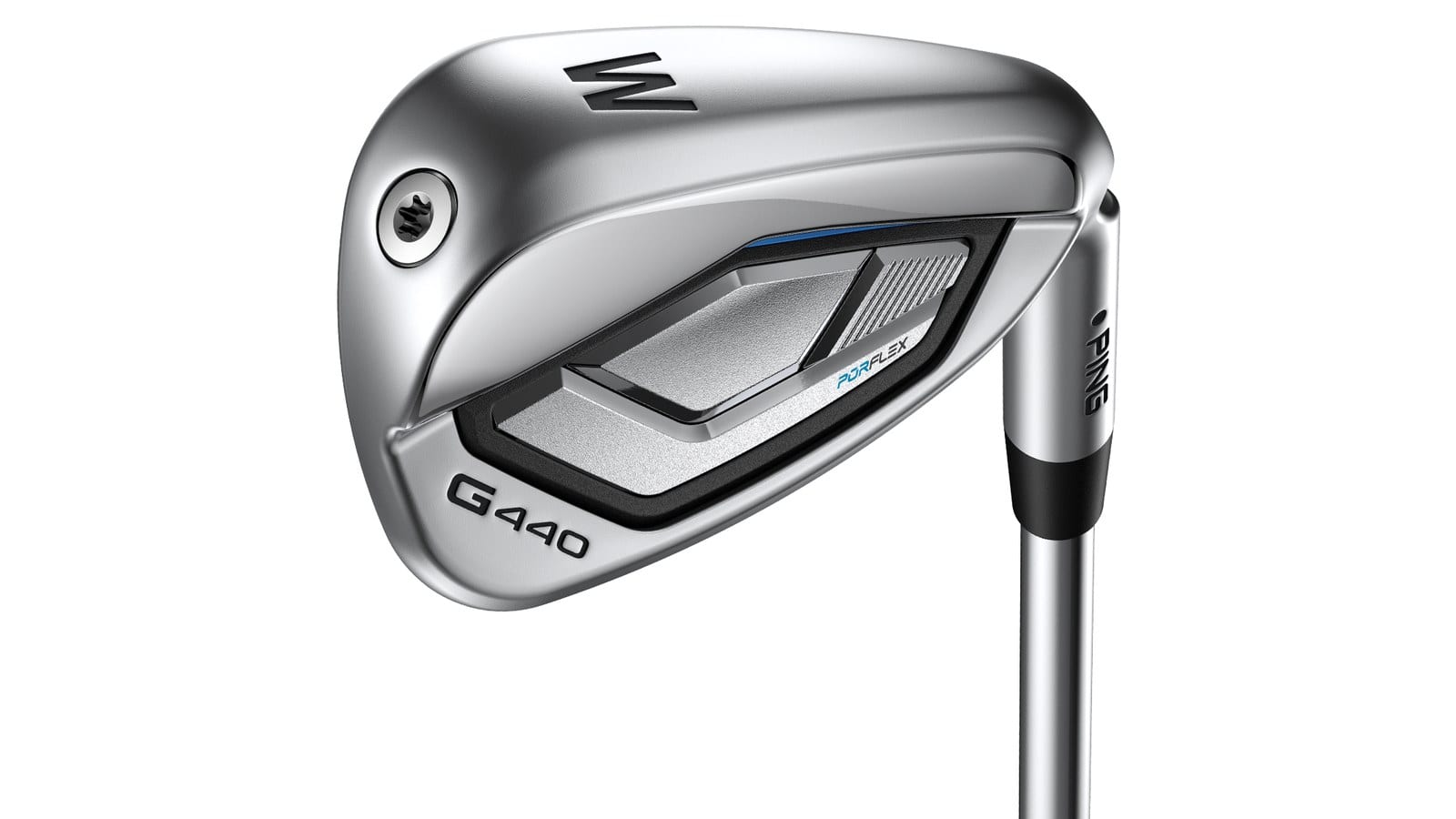
44.5 degrees became 41. That’s the PING G pitching wedge before and after January 10, 2023, when the G430 replaced the G425 (PING G425 specs, archived; PING G430 specs; PING G430 release).
No club from the 4-iron to the PW moved that far in any other release of the G line. Three generations before it, the G400, G410 and G425, share a single loft table. The G440 that followed in 2025 kept the G430’s 4-iron to 9-iron lofts and put the PW back up one degree.
So if you’re looking at a used PING set, or adding a new wedge to an old one, the model name decides your lofts. In PING’s own images of these heads, no loft number shows. Here are all of them in one place.
In brief
- The G400 (2017), G410 (2019) and G425 (2021) use identical standard lofts: 20.5° in the 4-iron, 30° in the 7-iron and 44.5° in the PW.
- The G430 (2023) is 1 to 3.5 degrees stronger in every iron: 29° in the 7-iron and 41° in the PW. PING added 45.5° and 50° wedges below it.
- The G440 (2025) keeps the G430’s 4-iron to 9-iron lofts. Its PW is 42°, then a 47° UW and 52° and 56° wedges.
- No loft shows on the back of the G410, G425, G430 or G440 heads in PING’s product images, and the color dot is lie angle. You find your loft by finding your model name.
- The G700, G710, G730 and G740 are a separate line with their own, stronger lofts. A G730 7-iron is 28°.
- I found no yards-per-degree figure from PING. Its “7 to 10 yards” for the G430 is PING’s own launch claim, not a measurement.
- Values from PING’s spec pages, live and archived, read 2026-10-05.
PING G410, G425, G430 and G440 iron lofts in one table
These are PING’s standard lofts, club by club. The G400, G410 and G425 share one column because their tables are identical, digit for digit. Bold marks a loft that’s new in that generation’s set.
| Club | G400, G410, G425 | G430 | G440 |
|---|---|---|---|
| 4 | 20.5° | 19° | 19° |
| 5 | 23.5° | 22° | 22° |
| 6 | 26.5° | 25.5° | 25.5° |
| 7 | 30° | 29° | 29° |
| 8 | 34.5° | 33° | 33° |
| 9 | 39.5° | 37° | 37° |
| PW | 44.5° | 41° | 42° |
| 1st wedge | UW 49.5° | 45.5° | UW 47° |
| 2nd wedge | SW 54° | 50° | 52° |
| 3rd wedge | LW 58° | 54° | 56° |
| 4th wedge | none | 58° | none |
Sources: PING’s spec pages for the G400, G410 and G425 as archived by the Wayback Machine, and the current G430 and G440 pages. All read 2026-10-05. PING’s G430 table heads one column “45°,” but its loft row gives that wedge as 45.5°.
The PW is the pitching wedge, the strongest wedge in an iron set and the club after the 9-iron. UW is PING’s label for the next wedge down in the G400 to G425 sets and again in the G440.
These are standard lofts only. PING also built these sets in Power Spec and Retro Spec, which change the numbers. The Power Spec and Retro Spec section below covers them, because a used set may not be standard.
You can check every loft, lie and length here against PING yourself. Each one comes from PING’s live spec pages or its old pages saved by the Wayback Machine, an archive that keeps copies of web pages.
Two things you’ll have to work out without this table. One is how many yards a degree is worth for you: I found no yards-per-degree figure from PING or from a test I could open. The other is where a G400 prints its model name, because I haven’t held these heads and couldn’t confirm it. I’ve also left out serial-number dating, since I found no source for it I could verify.
Lie and length hardly move
Lie angle is the tilt of the shaft when the sole sits flat on the ground. From the G410 on, every generation in the table shares the same lies: 60.5° in the 4-iron, 62° in the 7-iron and 64.1° in the PW. The G400 is flatter in three long irons, at 59.2°, 60.1° and 61.1° in the 4, 5 and 6.
Lengths are identical from the G400 through the G430: 38 7/8” in the 4-iron, 37” in the 7-iron and 35 1/2” in the PW. The G440 adds length in the 4, 5 and 6 only, to 39 1/4”, 38 1/2” and 37 3/4”. Same spec pages as above.
Reading the model name off the head
Before the loft table helps, you need two facts: which line your irons belong to, and which year. PING has run two game-improvement lines side by side. A game-improvement iron is built to be forgiving on off-center hits, usually with a larger head and a cavity back.
| Model | Line | Announced | Source |
|---|---|---|---|
| G400 | G | July 10, 2017 | Plugged In Golf |
| G700 | G7xx | January 15, 2018 | Golf.com |
| G410 | G | January 23, 2019 | GolfWRX |
| G710 | G7xx | January 20, 2020 | Golf Digest |
| G425 | G | January 11, 2021 | PING release |
| G430 | G | January 10, 2023 | PING release |
| G730 | G7xx | March 7, 2024 | PING release |
| G440 | G | January 2025 | PING news |
| G740 | G7xx | March 10, 2026 | PING release |
The pairs that sat on the shelf together were G400 with G700, G410 with G710, G430 with G730, and G440 with G740.
The model name is printed on the head, but not in the same place each generation.
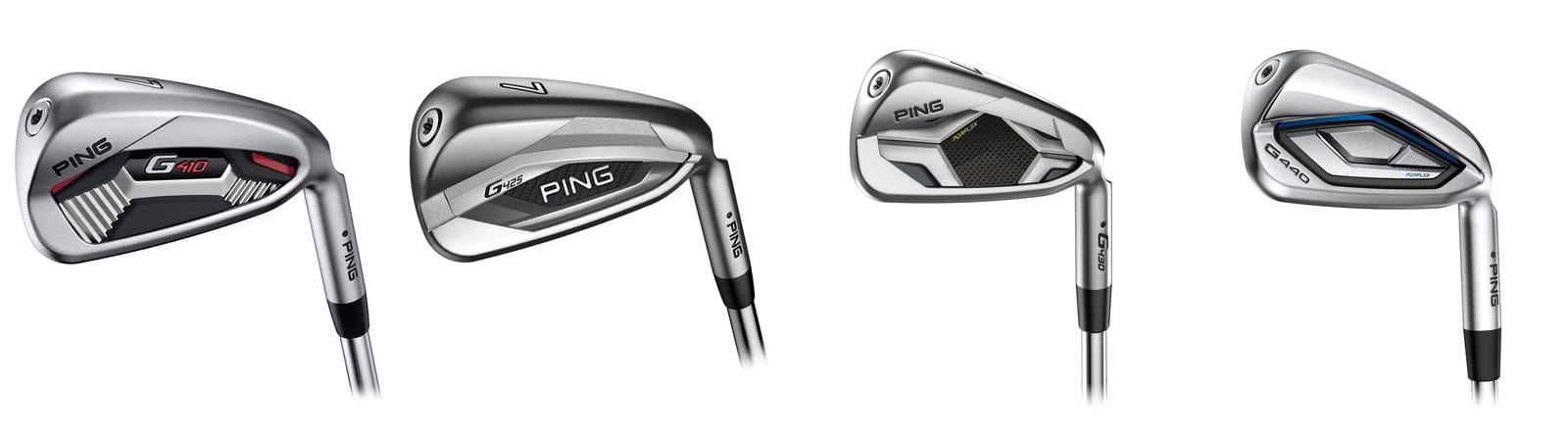
In these PING images, the G410 carries its name on a red badge in the middle of the cavity. The G425 has a small “G425” on the toe side of the cavity, next to a large PING logo. The G430 moves the name to the hosel, the neck where the shaft joins the head. The G440 puts it back on the cavity, toward the toe.
The G410 and G425 heads show a 7 on the toe. None of the four shows a loft. The pitching wedge at the top of this page is PING’s own image of the G440 PW: the toe reads W, the cavity reads G440, and nothing on the back gives a loft. Since the G410 and G425 tables are identical, mixing those two up costs you nothing on loft.
The colored dot on a PING club isn’t a loft code either. It’s PING’s Color Code for lie angle, which runs from 5° upright to 4° flat (PING Color Code chart). PING’s current spec pages list lies for the black dot at standard length.
The G700 to G740 irons are a different chart
The G7xx irons are the distance-first line. PING introduced the G730 as “the longest and most forgiving iron in our current lineup” (PING release). Their lofts are stronger than the G set of the same era.
| Club | G700, G710 | G730 | G740 |
|---|---|---|---|
| 4 | 20° | none | none |
| 5 | 23° | 21.5° | 21° |
| 6 | 26° | 24.5° | 24.5° |
| 7 | 29.5° | 28° | 28° |
| 8 | 34° | 32° | 32° |
| 9 | 39° | 36° | 36° |
| PW | 44° | 40° | 40° |
| UW | 49° | 45° | 45° |
| Next wedge | SW 54° | 50° | 50° |
| Last wedge | none | 56° | 56° |
Sources: PING’s G700 and G710 pages as archived, the G730 page on PING’s EU site, and the current G740 page, read 2026-10-05. The G730 labels its PW “W.”
If your 7-iron says G730, the G chart above is the wrong one. A G730 7-iron is 28°, a degree stronger than the G430 sold beside it. The G740 also stands about a degree more upright than the G730, 63° against 62° at the 7-iron. For how far 7-iron lofts spread across PING’s whole range, see why 7-iron loft isn’t one number.
The 2023 cut, club by club
Subtract the G430 column from the G425 column. The 6-iron and 7-iron lost one degree each, and the 4, 5 and 8 lost 1.5. The 9-iron lost 2.5 and the PW lost 3.5, so the biggest cuts sit at the short end.
That shape matters more than any single number. The steps between clubs changed, not just the clubs themselves. The G425 goes from 7-iron to PW in steps of 4.5, 5 and 5 degrees. The G430 makes the same trip in three even steps of 4. The G440 goes 4, 4, then 5 into its PW.
Below the PW, the G430 and G440 trade differently. Count three wedges past the PW: a G430 set reaches 54° (45.5, 50, 54), and a G440 set reaches 56° (47, 52, 56). The G440 widens its first two wedge steps to 5 degrees (42, 47, 52), then closes with 4.
What does a degree or two mean in yards for you? Nobody has published a number I could check. PING’s G430 release claims “distance gains of approximately 7 to 10 yards” and “up to 2 more mph of ball speed” (PING release). That’s PING’s own claim for its new iron, not a test of yours.
Power Spec and Retro Spec: why a G440 PW can read 41°
PING sold most of these sets in more than one loft. Power Spec is PING’s stronger-loft option. Retro Spec is the weaker-loft option. A used set can be either, and PING’s images of these heads show no loft to tell you which.
| Model | Standard 7 / PW | Power Spec 7 / PW | Retro Spec 7 / PW |
|---|---|---|---|
| G400, G410 | 30° / 44.5° | 28.5° / 42.5° | n/a |
| G425 | 30° / 44.5° | 28.5° / 42.5° | 32.3° / 47° |
| G430 | 29° / 41° | 27.5° / 41° | 31° / 41.5° |
| G440 | 29° / 42° | 27.5° / 41° | 31° / 42.5° |
| G730, G740 | 28° / 40° | 26.5° / 40° | 30° / 40.5° |
Sources: the same PING spec pages linked above. On the archived G400 and G410 pages, PING prints “n/a” for Retro Spec. It first appears in the G425 and G710 tables.
Look at the PW column on the G430 and G440. The 7-iron swings 3.5 degrees from Power to Retro, but the PW moves 1.5 at most. On these two sets, the spec you got changes your middle irons far more than your PW.
This is where loft quotes get crossed. If you see a G440 set listed with a 41° PW, that’s PING’s Power Spec figure, not the standard 42°. Mistakes run the other way too. On a Golf Monthly forum thread, posters took the standard G430 setup of a 41° PW, 45.5° and 50° for Power Spec (Golf Monthly forum, November 2023).
If a seller’s lofts match none of PING’s specs for that model in the table above, I’d ask for a loft check at a fitter before paying.
Buying used or adding one wedge: where the gaps open up
Your irons are the easy part. The 2023 change shows up at the bottom of the bag, between the 9-iron and the wedges.
Choosing among a used G400, G410 or G425. Lofts are identical, so condition and price decide, not loft. One reviewer calls the G410 and G425 “virtually identical” (golfergeeks), and a used G410 gets pitched as the value pick (Next Round Golf). Those are opinions, not tests. The one test I found says the same. Plugged In Golf hit both 7-irons and found them similar, with the G425 launching slightly higher and spinning a bit more (Plugged In Golf). The one catch is a G400 4, 5 or 6-iron, which sits flatter than the same club from later sets. If you’re mixing those in, lie angle is worth a check.
Moving up from a G425 to a G430 or G440. Each iron gets 1 to 3.5 degrees stronger. One review site calls the G430 about half a club longer (golfergeeks), which is a rough impression rather than a measurement. The bigger change is under the PW. If you carry the G425’s 54° and 58° wedges over, your new 41° PW sits 13 degrees above the 54°. That’s a club-sized hole.
Replacing a single club across the 2023 line. A G430 PW at 41° put into a G425 set lands only 1.5 degrees from the 39.5° 9-iron. A G425 PW at 44.5° put into a G430 set leaves 7.5 degrees after the 37° 9-iron. Same club in the bag, very different gaps.
Mixing G430 and G440. The 4-iron to 9-iron lofts match, though the G440’s 4, 5 and 6 are a little longer. The PW and every wedge under it differ. A G440 UW at 47° under a G430 PW at 41° leaves a 6-degree step, wider than anything in either set.
Adding a store-bought wedge. The common 52° and 56° pair is spaced, by rule of thumb, for a weaker PW than any of these (52 and 56 wedges, and the PW they assume). Below a G430 PW at 41°, a 52° leaves 11 degrees. Below a G425 PW at 44.5°, it leaves 7.5. In both cases I’d buy the wedge by the gap it fills, not by the number people usually carry.
Coming from another brand. Club numbers don’t travel. My own 4-iron is a 24° Titleist T100 (T100 lofts by generation). A G430 or G440 4-iron is 19°, five degrees stronger with the same number on the toe. You’re safer comparing by degrees, the way a loft chart by club lays them out.
If you’re buying used and can only check two things, I’d check the model name and the PW loft. The name tells you which column above is yours, and the PW tells you whether your wedges still fit under it.
Terms in this article
- Loft: the angle of the clubface back from vertical. Less loft (“stronger”) usually means a lower, longer shot.
- Stronger, weaker: a stronger loft is a smaller number. A weaker loft is a larger one.
- Lie angle: the tilt of the shaft when the sole sits flat on the ground. Upright stands the shaft up more; flat lays it down.
- PW: pitching wedge, the strongest wedge in an iron set, after the 9-iron.
- UW: PING’s label for the wedge after the PW in the G400 to G425, G440 and G7xx sets.
- Standard spec: the loft PING lists first for each club. The tables in this article use it unless they say otherwise.
- Power Spec: PING’s stronger-loft option for a set.
- Retro Spec: PING’s weaker-loft option for a set.
- Color Code: PING’s colored dot system for lie angle, from 5° upright to 4° flat. It says nothing about loft.
- Gap: the difference in loft between two clubs next to each other in the bag.
- Game-improvement iron: an iron built to be forgiving on off-center hits, usually with a larger head and a cavity back.
- Cavity back: a head with a recess in the back instead of a solid slab of metal.
- Hosel: the neck where the shaft joins the clubhead.
- Wayback Machine: the Internet Archive’s record of old web pages. It holds PING’s spec pages for discontinued models.