
Iron lie angle: height alone doesn't pick your number
PING's chart needs two measurements, not one, and brand standards differ. My own 7-iron got 1.5 degrees more upright the day I changed sets.
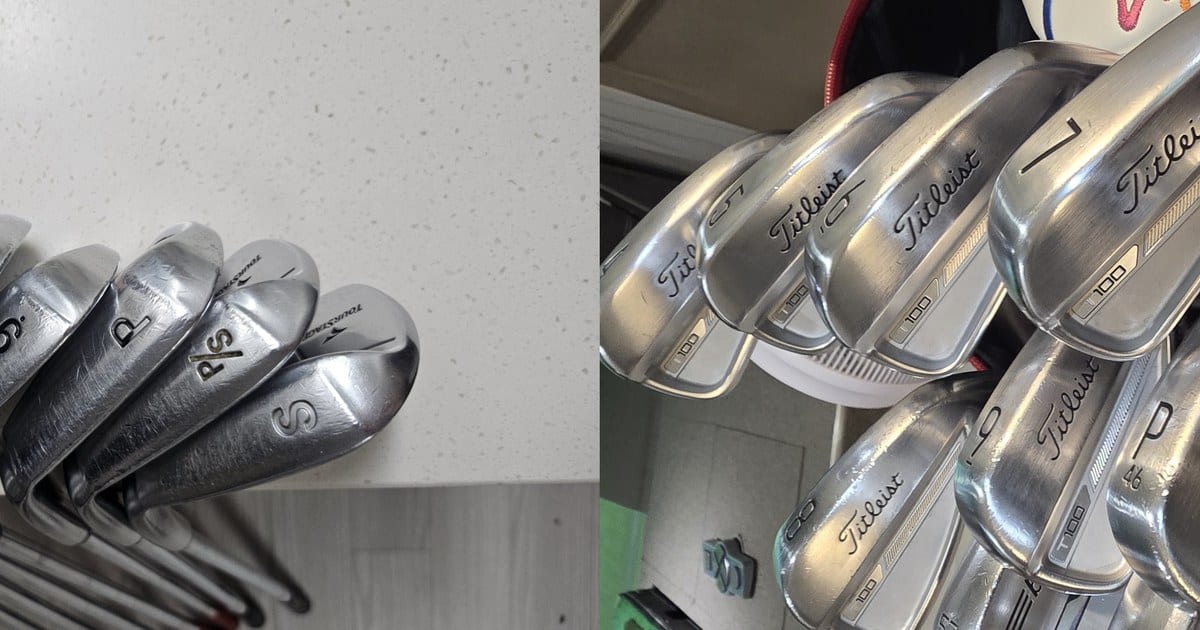
I’ve owned two iron sets: a used Tourstage V300 III from 2011, then a 2023 Titleist T100. Both times I read the loft table before buying, and both times I skipped the column next to it.
So I looked it up while writing this. The V300 III 7-iron sits at 61.5 degrees and the T100 7-iron at 63.0. My 7-iron got a degree and a half more upright the day I switched.
Those two figures aren’t the same kind of source. The T100 number is Titleist’s own spec table. The V300 III number is a Korean retail listing, because the 2011 Tourstage line is long gone from the maker’s site.
I never had either set bent. That’s the fitter’s word for clamping a head and levering the hosel, the socket the shaft sits in, to change its lie. But the V300 came to me used, so there I’m trusting a spec sheet.
That’s the part most lie angle articles bury. Your lie angle changes when your clubs change, not when your body does. The number you end up with was picked by whoever designed the set.
The short answer
- Lie angle is the angle between the shaft and the ground when the sole sits flat. Too upright and a right-hander starts the ball left. Too flat and it starts right (Golf Monthly, retrieved 2026-09-20).
- The number the industry repeats is about 4 yards offline per degree of error (Practical-Golf, TGW, updated 2026-02-26, both retrieved 2026-09-20). It’s a rule of thumb, not a published study.
- Height alone doesn’t pick it. PING’s chart asks for height and wrist-to-floor (PING, retrieved 2026-09-20), and long arms can cancel tall height out.
- “Standard” isn’t one number. Titleist’s T-Series 7-iron is 63.0 degrees and Mizuno’s JPX925 Hot Metal 7-iron is 62.0 (Titleist, retrieved 2026-08-29; Mizuno, retrieved 2026-09-20).
- There’s no agreed method for measuring it, so two shops can measure you two ways (Golf Monthly). The free check costs one marker pen: draw a line on the ball, hit it, and read the mark it leaves on the face.
Lie angle is the angle your sole makes with the ground
Ground your 7-iron the way you would at address. The shaft leaves the head at an angle, and the sole, the flat underside of the head, rests on the grass. That angle between the two is the lie angle, and makers publish it next to loft in the same spec table.
Loft is the angle of the face itself, and it sits one column over. Loft is where the face points. Lie is how the club sits on the ground.
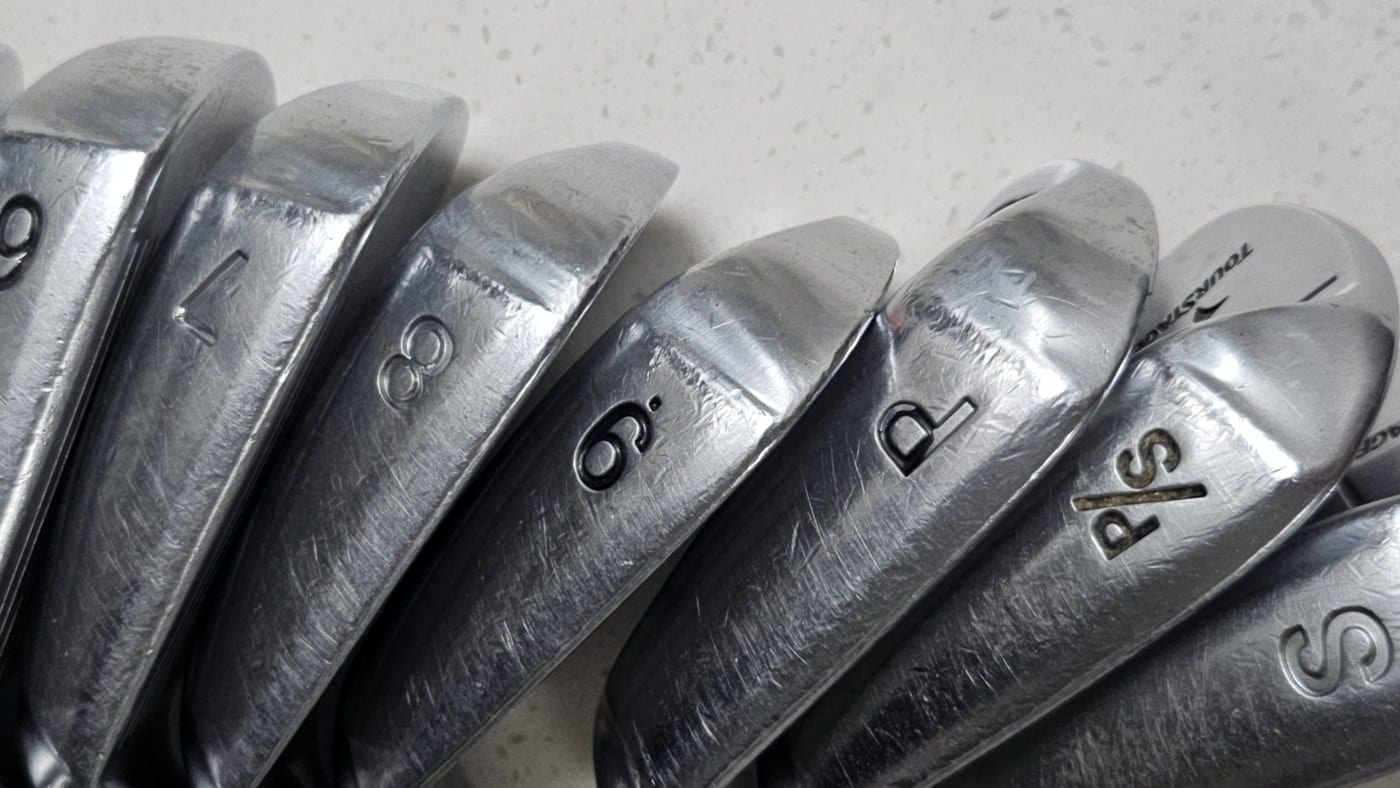
Photo: my first set. That flat sole is the surface the number is measured from. Lie angle is read with those soles resting on the ground, which is why it changes meaning the moment the sole isn’t flat at impact.
What matters is not how the club sits at address. It’s how it sits at the bottom of your swing, with the shaft bending and your hands wherever they end up. Two things go wrong from there.
- Too upright for you. The toe, the far end of the head, lifts off the ground at impact. A right-hander starts the ball left.
- Too flat for you. The heel, the end nearest the shaft, lifts instead. A right-hander starts the ball right.
The reason is face plane tilt, the direction the loft points once you tip the handle up or down. The leading edge is the front bottom line of the face. It can still look square to the target while the loft points somewhere else, and the ball follows the loft. Face plane tilt grows as loft goes up, which is why wedges are where it bites hardest (Golf Monthly, retrieved 2026-09-20).
How much does it cost? The figure repeated across the industry is four yards offline per degree.
Take that number for what it is. You won’t find a test behind it, because nobody has published one. It’s still worth carrying. A two-degree error comes out at eight yards, the difference between the middle of a green and the fringe.
Practical-Golf (as above) says some players are out by as much as 2-3 degrees, which reaches the longest bar on the chart.
Your height alone doesn’t pick it
Ask around and you’ll hear that tall golfers need upright clubs. That’s the convention, and it isn’t wrong so much as incomplete.
PING’s color code chart is the reference most shops still reach for, and it asks for two variables, not one. You need your height and your wrist-to-floor measurement, taken standing relaxed with your arms down (PING, retrieved 2026-09-20). You find your height across the top, your wrist-to-floor down the side, and read the color where they cross.
PING presents the chart as an interactive tool rather than a printed grid, so the worked rows below come from TGW’s guide to it. They show what each height and wrist-to-floor pair produces.
| Height | Wrist-to-floor | Dot | What it means |
|---|---|---|---|
| 5’10” | 34” | Black | Standard lie, standard length |
| 5’6” | 32” | Red | 1 degree flat, half an inch shorter |
| 6’2” | 36.5” | Green | 2 degrees upright, half an inch longer |
The dot is literal: PING marks the code as a colored dot on the club.
Source: TGW’s guide to the PING color code chart, updated 2026-02-26, retrieved 2026-09-20; TGW also reports PING’s own numbers.
PING replaced the older chart in 2018 and bends its irons as far as 5 degrees upright or 4 degrees flat, in 1-degree steps. You won’t be quoted anything near that. A degree either side of standard is the ordinary answer, and the last section before “Terms in this article” is about who should go looking.
Now keep your height fixed and move only the second column. A tall golfer with long arms has a large wrist-to-floor number, and the two pull against each other on the chart. Height and arm length “might effectively cancel each other out meaning standard length and lie could be the best option” (Golf Monthly, retrieved 2026-09-20).
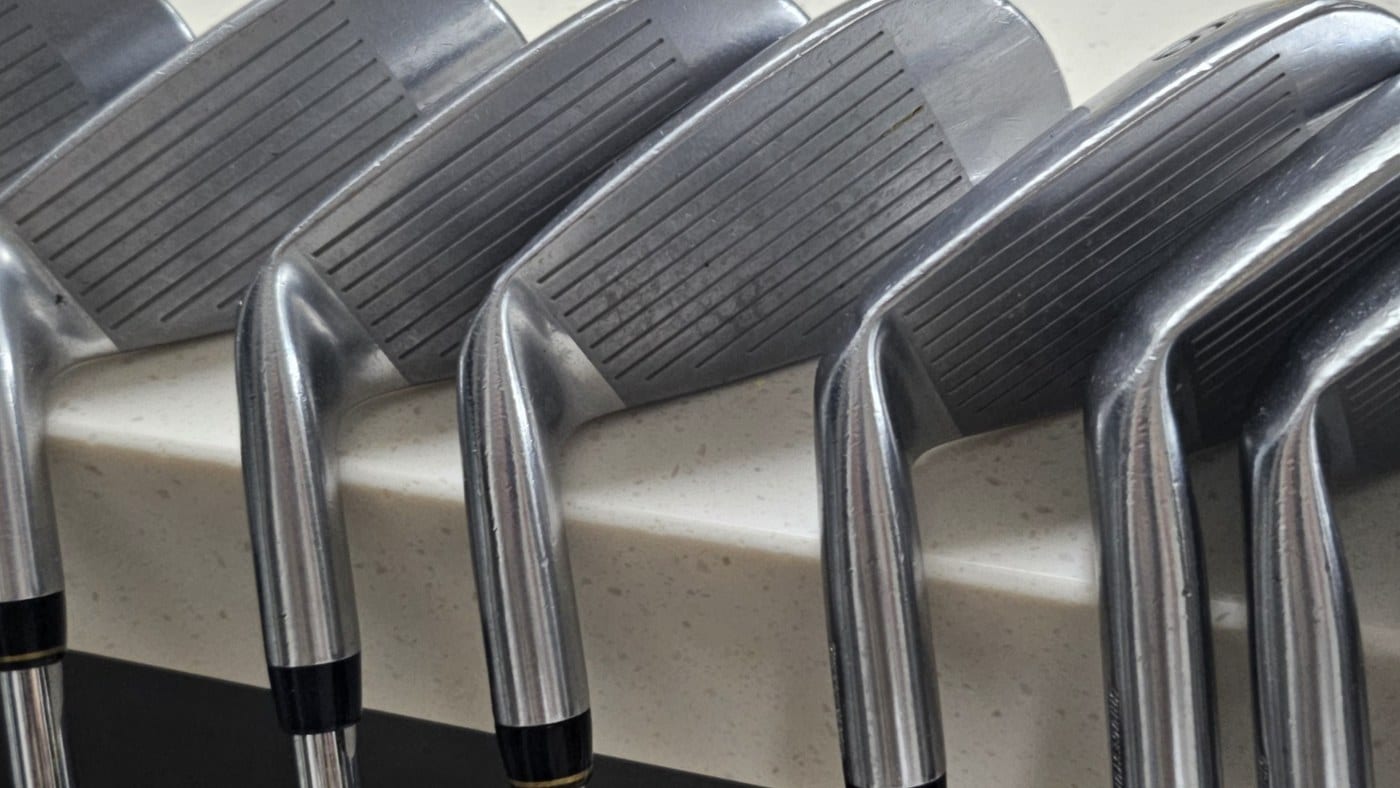
Photo: my own clubs. The angle this article is about lives right here, where the hosel leaves the head. None of mine has its lie angle stamped on it anywhere, which is why you have to look the model up.
The two columns are linked one more way. Half an inch of extra shaft length makes a club play roughly 1 degree more upright, and shortening does the reverse (Golf Monthly, as above). The published lie doesn’t move, but what happens at the ground does, which is why the chart hands you both numbers.
“Standard” is not the same number at every brand
Here’s the part that surprised me. There is “no such thing as a universal ‘standard’ lie angle, and the ‘standard’ figure may vary from brand to brand” (Golf Monthly, retrieved 2026-09-20).
Three 7-irons, three published numbers. The same thing happens to loft, only wider.
| 7-iron | Lie angle | Source |
|---|---|---|
| Titleist T-Series (2021 onward) | 63.0 degrees | Titleist spec table, retrieved 2026-08-29 |
| Mizuno JPX925 Hot Metal | 62.0 degrees | Mizuno spec table, retrieved 2026-09-20 |
| Tourstage V300 III (2011) | 61.5 degrees | Danawa listing, quoted in my write-up of that set |
If you own any 2021-onward Titleist iron, 63.0 is your number. Titleist publishes one lie row for its whole range, so T100, T150 and T200 all share it.
One caveat before you use the table. If the set you’re comparing against is a decade or more old, part of that gap is the years, not the badge. The 63.0 and the 62.0 are the same-era pair.
The table reads best as a move rather than a spec sheet. Go from the bottom row to the top row and you’re a degree and a half more upright than you were. Your ball will tend to start further left than it used to.
That’s the move I made, and it’s larger than a full step on PING’s chart. It happened because I picked a different set, not because I got taller.
Where the lie board and the launch monitor disagree
The chart has given you a starting number. Next you need to know what your club does at impact, and this is where the sources split.
The lie board. You put tape across the sole, put the ball on a hard board, and hit. The mark shows where the sole struck: toward the toe means too flat, toward the heel means too upright. This was the standard method for decades.
The objection. You may be handed a board reading you shouldn’t fully trust. The ball sits higher on a board than on grass, which changes the shot being measured. The method “seems to be less popular nowadays due to potential discrepancies in readings” (Golf Monthly, retrieved 2026-09-20).
Practical-Golf puts it harder. The method “has been shown to not be as accurate for a number of reasons,” and it points at launch monitors instead (Practical-Golf, retrieved 2026-09-20).
A launch monitor is the radar or camera unit a fitting bay uses to measure what the club and ball actually did. The number it gives here is your dynamic lie, meaning the lie the club delivers at impact rather than the lie in the spec table.
Why it isn’t settled. You can walk into two shops and be measured two different ways. There is “no industry standard in terms of a method for establishing the correct lie angle” (Golf Monthly, retrieved 2026-09-20). Some fitters read dynamic lie off the monitor; others go by ball flight.
If it were me, I’d take the launch monitor number when the two disagree. But I’d trust neither unless my strike is repeatable that day. Heel on one swing and toe on the next, and both methods are measuring my inconsistency and calling it a spec.
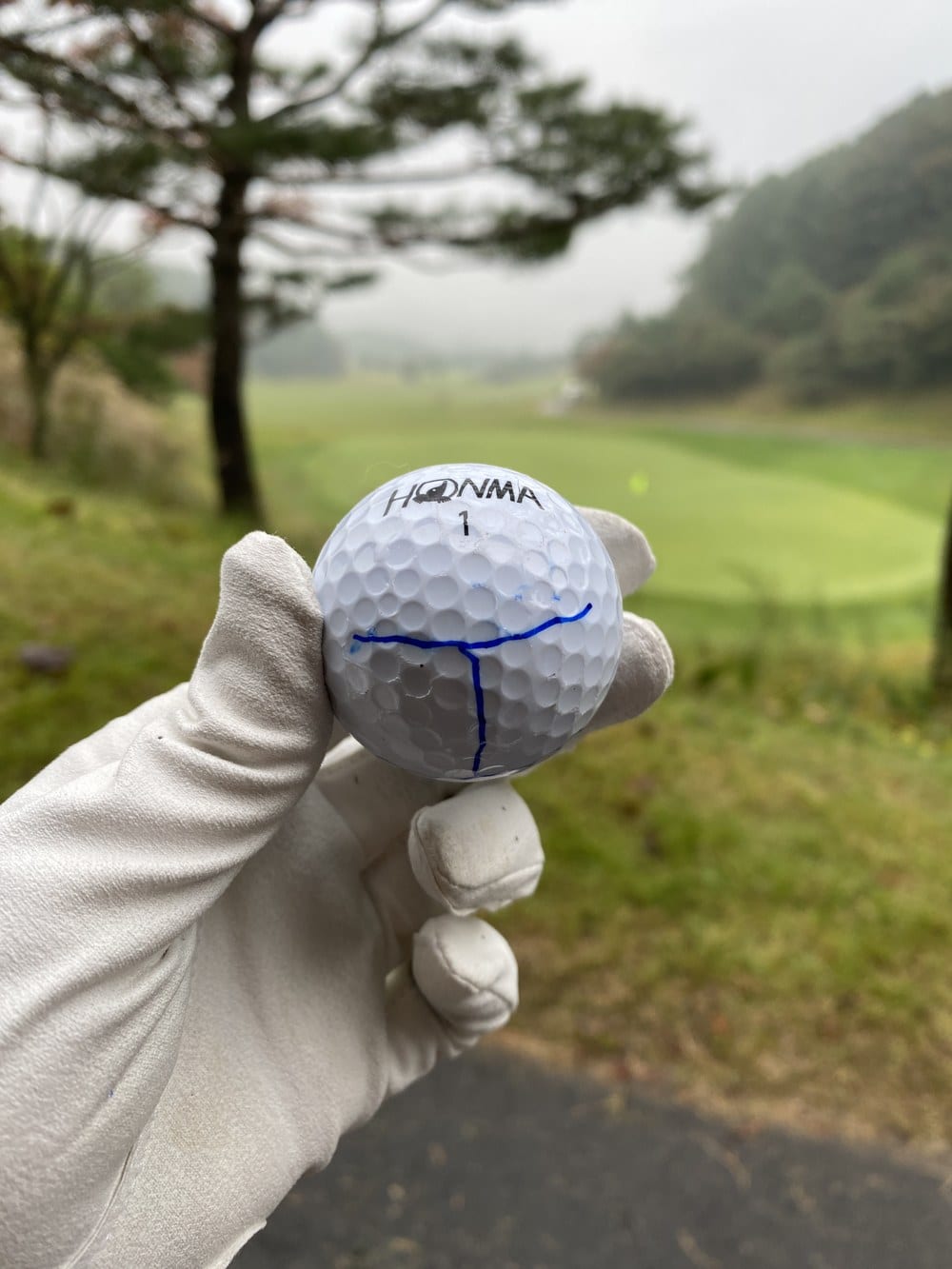
Photo: a marker line on my own ball. The free lie check uses the same line, turned so it faces the clubface instead of the target.
There is a third method and it costs nothing.
- Draw a straight line on the ball with a marker. Mine has a crossbar on it from aiming putts; either works.
- Set the ball down with the line facing the clubface, not the target.
- Hit it, and read the line the ball prints on the face.
Vertical means your lie is in a reasonable place. Tilted toward the toe means too upright; tilted toward the heel means too flat. That reads the opposite way from the board, because here you’re reading the face rather than the sole.
Both sources above describe this test, and it’s the one I can run without booking anything.
Who actually needs their lie angle checked
Not everybody, and not yet for some of you.
Look it up today if you changed sets or bought used. Five minutes, no cost. Find both models’ lie figures and see whether the number moved.
On a used set, the maker’s page is only a claim about the club as it left the factory. A previous owner could have had it bent.
Run the marker test if your iron misses are one-sided. Pulls that start left over and over, off a swing that feels fine, are the pattern lie angle explains. Scattered misses in both directions are not.
Go to the chart if you’ve never measured wrist-to-floor. That’s most people, and it’s the number that decides whether your height means what you think it means. Floor to the crease of your wrist, standing relaxed.
Wait if you’re in your first year and your strike still wanders. Both measuring methods need you to deliver the club the same way twice. The most a fitter is likely to move your lie is 2 degrees either way (Golf Monthly, as above). So you’re playing for about eight yards of start line, and a strike that moves around the face is worth more than that.
Start with the wedges if you do get it done. Face plane tilt grows with loft. The same error costs you more on a 56-degree wedge than on a 5-iron, and least of all on a driver.
Most irons can be bent afterwards, so a wrong lie is not a reason to replace a set (Practical-Golf, as above). Ask the shop about your model first. How far a head will move depends on how it was built, and I have no source that puts numbers on that.
Don’t book a fitting for lie alone. Lie is one line on a sheet that also covers length, shaft and head. If the whole fitting is worth it to you, lie comes with it; if it isn’t, the marker pen costs nothing.
As for me: I’ve got a 63.0-degree set that replaced a 61.5-degree set, and I’ve never checked either one. The marker pen is the next step.
Terms in this article
- Lie angle: The angle between the shaft and the ground when the sole rests flat. A higher number is more upright.
- Loft: The angle of the club face, published one column over. Loft is where the face points; lie is how the club sits.
- Upright: A lie angle higher than standard. The toe sits higher off the ground.
- Flat: A lie angle lower than standard. The heel sits higher off the ground.
- Toe: The far end of the club head, away from the shaft.
- Heel: The end of the head nearest the shaft, where the hosel sits.
- Hosel: The socket where the shaft enters the head. Lie angle is the angle it leaves at.
- Sole: The flat underside of the head, the part that rests on the turf.
- Leading edge: The front bottom line of the face, where it meets the sole.
- Wrist-to-floor: Floor to the crease of your wrist, standing relaxed. The second measurement PING’s chart asks for.
- Color code: PING’s dot system, mapping a height and wrist-to-floor pair to a lie angle relative to standard.
- Face plane tilt: The direction the loft points once the handle is raised or lowered. It grows as loft grows.
- Dynamic lie: The lie the club delivers at impact, not the lie in the spec table.
- Lie board: A hard board you hit off during a fitting. Tape on the sole records whether the toe or the heel touched first.
- Launch monitor: The radar or camera unit a fitting bay uses to measure what the club and ball actually did.
- Bending: The service that changes an existing head’s lie, by clamping the head and levering the hosel.