
Golfzon NX Plus: AI Cheonmunbong Is Hard, and Worth It
AI Cheonmunbong plays hard on a Golfzon NX Plus: blind holes, a course that doesn't exist, and difficulty 4 of 5. Here's how my round there went.
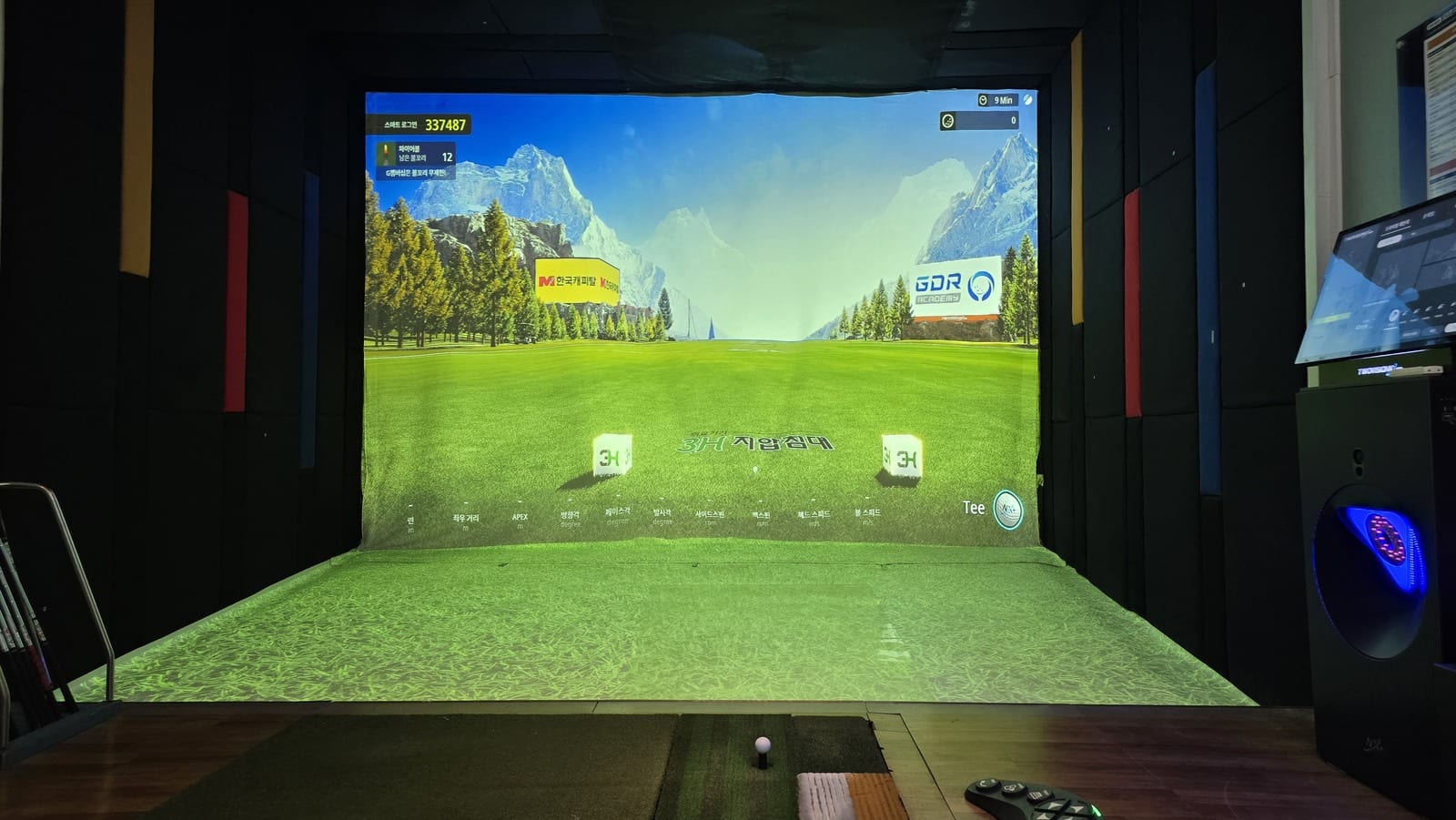
AI Cheonmunbong CC is the course Korean screen golfers have been talking about since summer. I finally played it on 2026-09-04, at a Golfzon Park store running a TwoVision NX Plus.
It’s hard. That part of the reputation is right. It was also the most entertaining map I’ve played indoors, and those two things sit together fine.
Screen golf in Korea mostly means a Golfzon box, which is the room at the top of this page. You hit a real ball off a mat into a projection screen, and a sensor works out where it would have gone.
Screen: Golfzon TwoVision NX Plus. The bay at the top of this page was photographed by the author at a Golfzon Park store, 2026-09-04.
Golfzon simulator versions aren’t explained anywhere in English, which is worth knowing before you look this up. The company’s global site doesn’t list the NX Plus at all. Its top product is the TwoVision NX, and the string “NX Plus” appears nowhere on golfzongolf.com, including the sensor technology page (checked 2026-09-18).
The machine launched on 2026-07-27 and goes only to franchised Golfzon Park stores (ZDNet Korea, 2026-07-27, in Korean, retrieved 2026-09-18). So the box you’d stand in front of in Seoul isn’t in the catalog you can read.
The short answer
- AI Cheonmunbong CC is a virtual design, not a scan of a real club. So there’s no flyover video of the place to watch before you play it (Star News, 2026-08-03, in Korean).
- Its difficulty reads 4 for the course and 4 for the greens, which is not the top of the scale. A 4.5 course was reported on the same scale in March (ZDNet Korea, 2026-03-04, in Korean).
- It’s built on blind holes, and it’s long. The selection screen lists 7160 m, about 7,830 yards.
- I shot 12 over there and 20 over on the other course I played the same day, 2026-09-04. One round each isn’t enough to call Cheonmunbong the easier one, but that’s what my card says.
- The NX Plus machine adds a ceiling spin sensor plus a rough mat, a bunker mat and a new tee (ZDNet Korea; Golfzon Newsroom, both in Korean).
- A finer sensor tends to make an amateur’s numbers look worse, not better. That’s the ruler changing, not your swing.
What AI Cheonmunbong actually is
It’s a tournament course that doesn’t exist. Star News reports it as difficulty 4 for the course and 4 for the greens. It’s a venue for G-Tour, Golfzon’s own competitive screen golf tour, and the winner there finished at 12 under (Star News, 2026-08-03, in Korean, retrieved 2026-09-18).
Most of the twenty Korean reviews I read in September treat that 4 as the top of the scale. It isn’t. ZDNet Korea reported a course at 4.5 on the same scale back in March (ZDNet Korea, 2026-03-04, in Korean, retrieved 2026-09-18), and the selection screen draws five stars, not four.
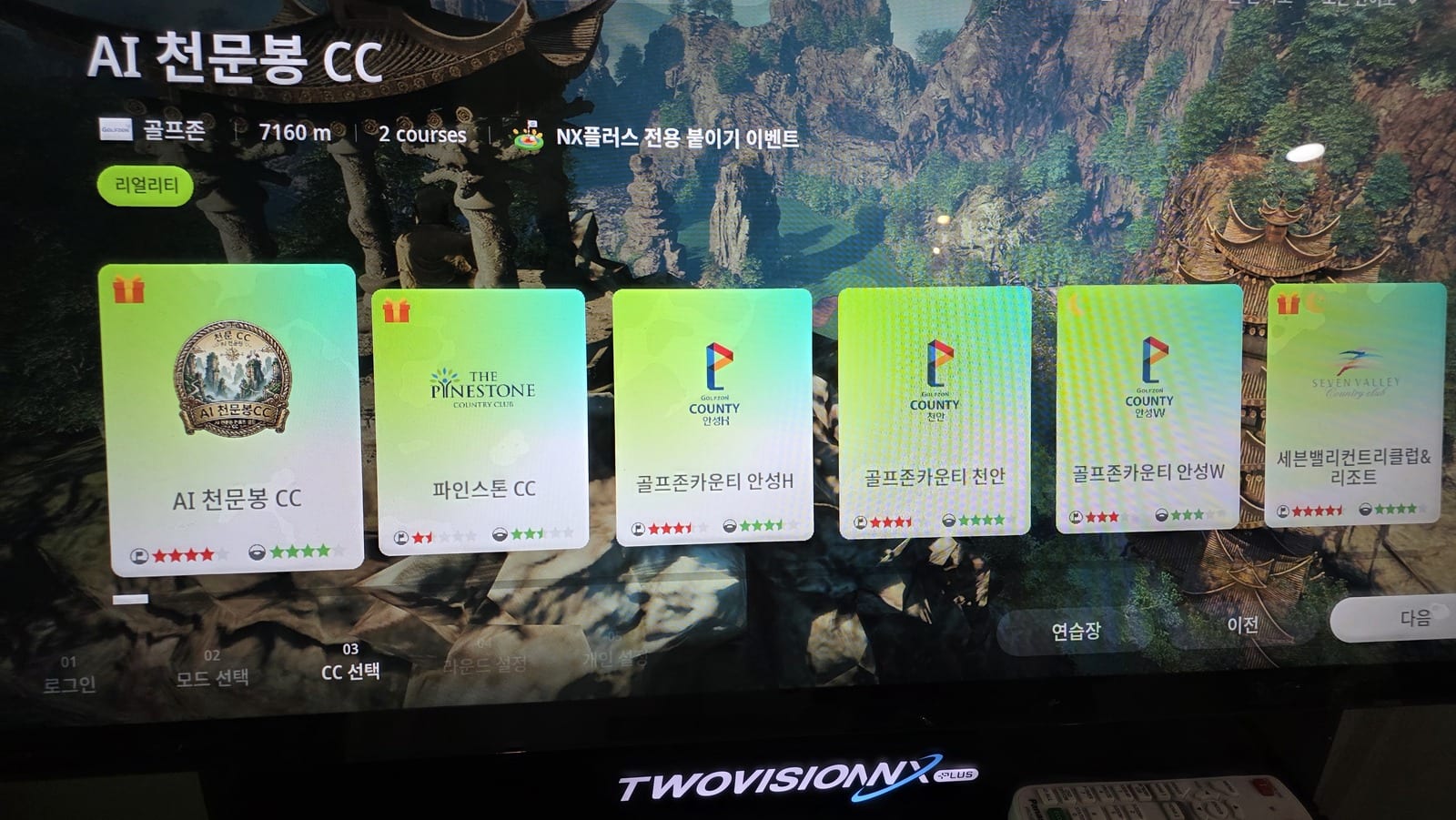
Screen: Golfzon TwoVision NX Plus, photographed by the author, 2026-09-04. The red stars are course difficulty and the green stars are green difficulty. The other cards in the row carry different counts, so the scale is visible in one frame. The line under the title reads 7160 m, about 7,830 yards.
Two things make it play hard, and neither is a setting. Star News describes it as built on blind holes. A blind hole is one where you can’t see the landing area or the green from where you’re standing.
On a real course you learn those by playing them a few times. Here you learn them by losing shots.
The second thing is that AI Cheonmunbong CC doesn’t exist. It’s a virtual design, not a scan of a club you could drive to. That means there’s no flyover video of the real place to watch beforehand. The card’s 리얼리티 (Reality) tag is Golfzon’s label for its own course series, not a claim that the place is real.
The line next to the course name reads 「NX플러스 전용 붙이기 이벤트」, an NX Plus-only sticker event. That’s the event being exclusive, and I could not confirm that the course itself is limited to NX Plus machines.
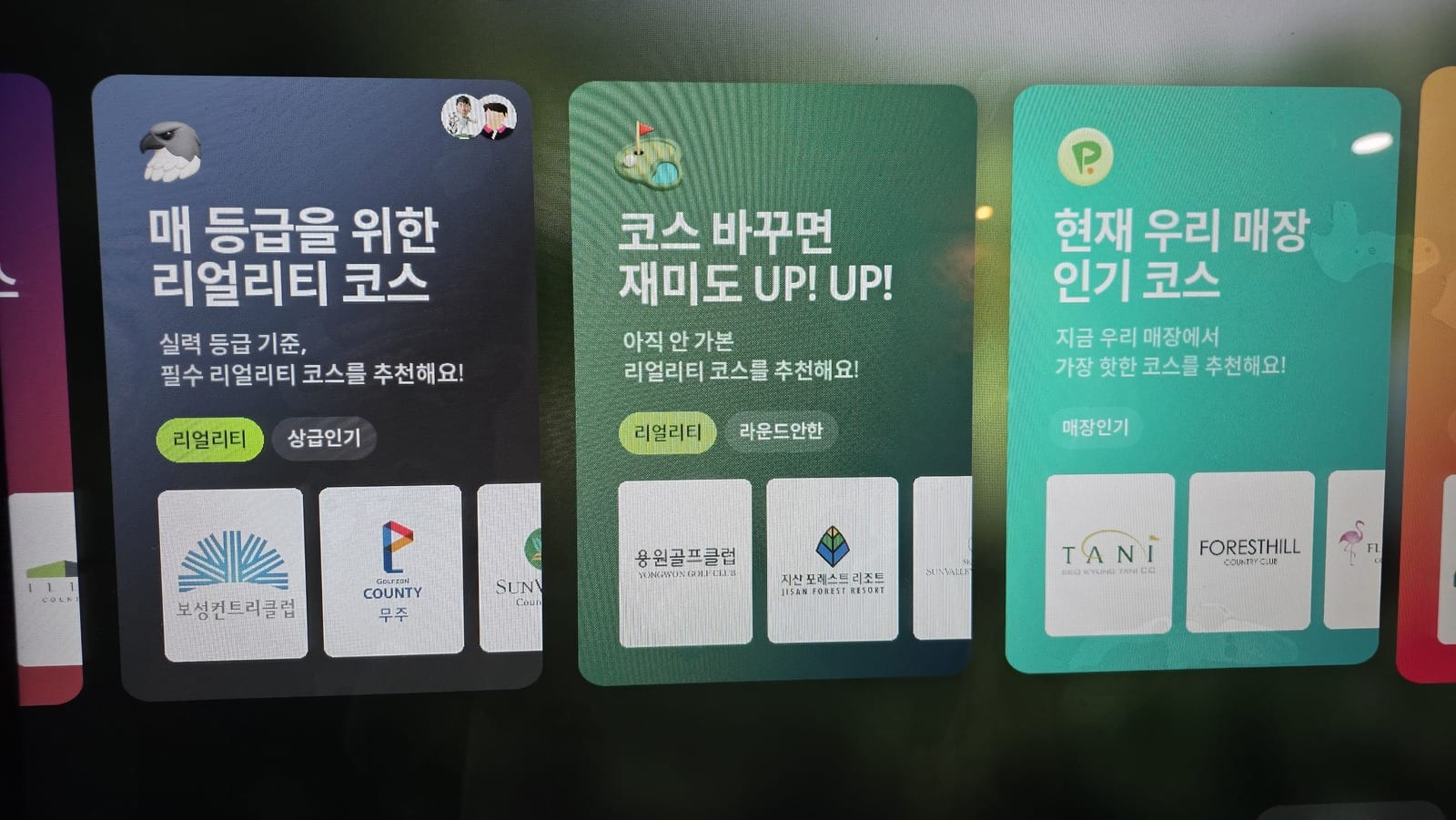
Screen: Golfzon TwoVision NX Plus, photographed by the author, 2026-09-04. The left card says out loud that it picks courses by your skill grade. The machine will suggest something easier if you let it.
How it played
Hard, and I enjoyed it, which I didn’t expect to be saying at the same time. The obstacles are laid out the way a video game lays them out, not the way a golf course does. That’s what made it fun, and it’s also why every tee shot is a decision rather than a default.
Here’s the part that surprised me. I played two rounds that day, Cheonmunbong and one other course, and I shot 12 over on Cheonmunbong against 20 over on the other one.
Eight strokes, and I can’t tell you it means Cheonmunbong is the easier course. It’s one round each, played in a different order. I also wasn’t swinging the same way at the end of the night as at the start. What I can say is that I went in knowing only the reputation and came out with the better of the two cards.
The course art above gives you the look of the place, rock spires and temple roofs. There’s no hole-by-hole advice here, because one round doesn’t earn any.
I didn’t notice this until the round was over. The green speed was set to Tour, the fastest option in the menu, at 3.4 m on screen.
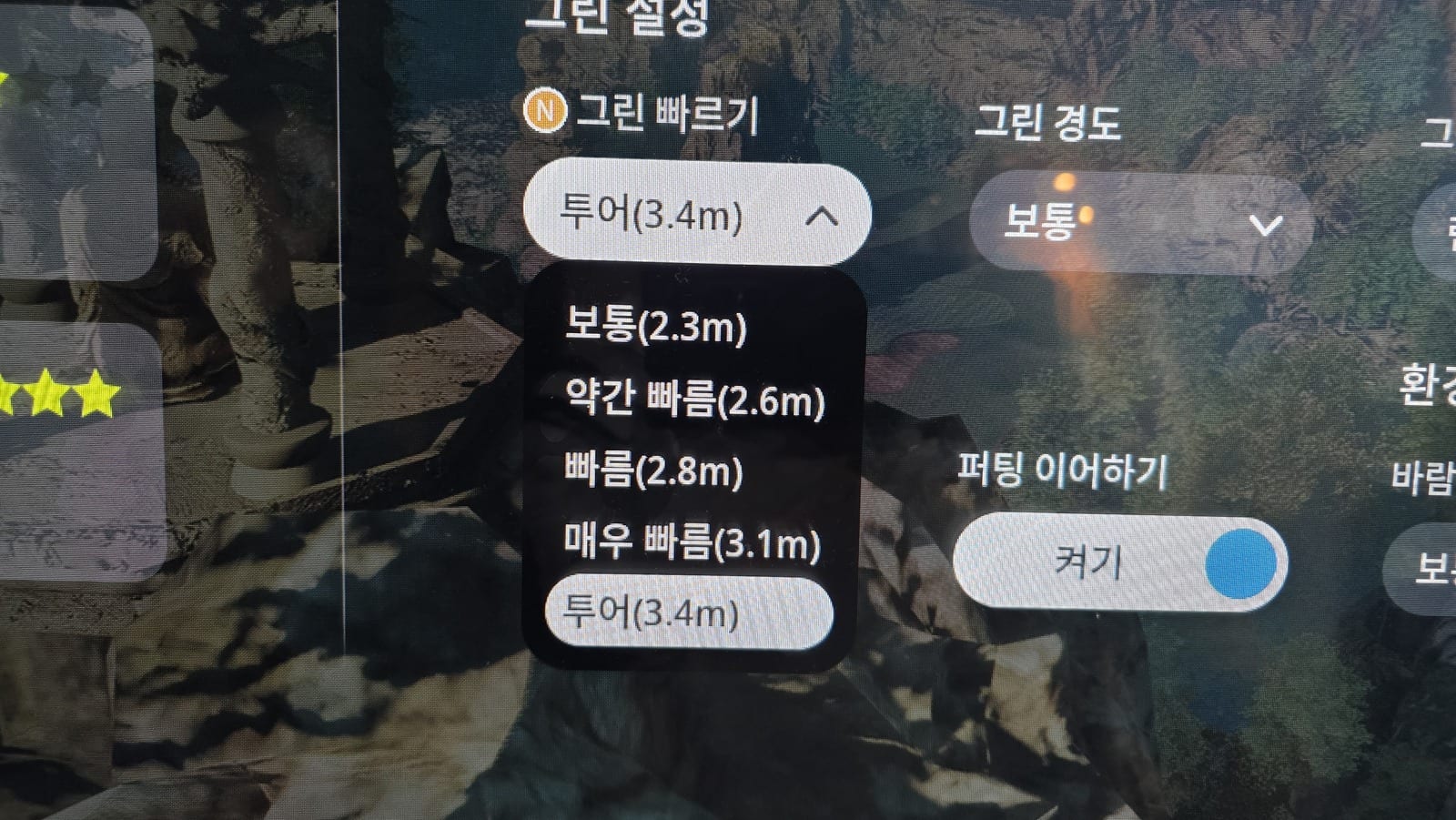
Screen: Golfzon TwoVision NX Plus, photographed by the author at a Golfzon Park store, 2026-09-04. The open list is every green speed the machine has, and the pill at the top, 투어(3.4m), is the one my round was running on. The orange N badge sits beside the 그린 빠르기 label, which is how the machine flags that setting as new. The separate claim that Tour is the newly added step comes from Golfzon’s release, not from the badge.
The green speed menu, which I only read afterwards
Worth being careful about what that setting does and doesn’t mean. Green speed is a difficulty setting somebody in the room picks, not a property of the course.
The step bar on the course screen above puts it in 04 라운드 설정, the shared round setup, before 05 개인 설정 for personal settings. So one person chooses it for everybody playing. It isn’t why Cheonmunbong is hard, and I’m recording it because it was my round, not because it explains anyone else’s.
My putts ran long, and the ball slid instead of gripping. At the time I read that as a bad stroke. It’s what one visit felt like rather than something I measured, and I’m not going to turn it into a claim about the course.
Speed is only one way a putt goes wrong, though. If yours miss sideways rather than running past, the thing to read is putts that don’t start on line.
What the screen does give you is the whole menu, with a number on every step. Green speed is how far a ball rolls once it’s on the green. On a real course it’s measured with a Stimpmeter, a small ramp that releases a ball the same way every time. The reading is how far that ball travels.
The meters below are what the screen prints. The feet are mine, converted at 1 m = 3.28084 and rounded to one decimal.
| On screen | In English | Stimpmeter, ft | On screen, m |
|---|---|---|---|
| 보통 | Normal, the default | 7.5 | 2.3 |
| 약간 빠름 | Slightly fast | 8.5 | 2.6 |
| 빠름 | Fast | 9.2 | 2.8 |
| 매우 빠름 | Very fast | 10.2 | 3.1 |
| 투어 | Tour | 11.2 | 3.4 |
Tour is the step Golfzon added, and the company says so itself. The release puts it this way: it “newly added a 3.4 m Tour option to green speed so players can experience more challenging green play” (Golfzon Newsroom, 2026-09-14, in Korean, my translation, retrieved 2026-09-18).
One more dropdown sits beside it. Green firmness decides how much the ball bites when it lands, and mine was on Normal. Speed and firmness are separate settings, so a fast green here isn’t automatically a hard one.
What’s different about the NX Plus machine
The sensor
The headline change is a spin sensor, and the first thing it will do to you is make your miss look bigger. ZDNet Korea’s launch story names it an AI spin sensor. The same sentence puts it in the ceiling of the screen booth, the spot Golfzon calls SwingTop (ZDNet Korea, 2026-07-27, in Korean, retrieved 2026-09-18).
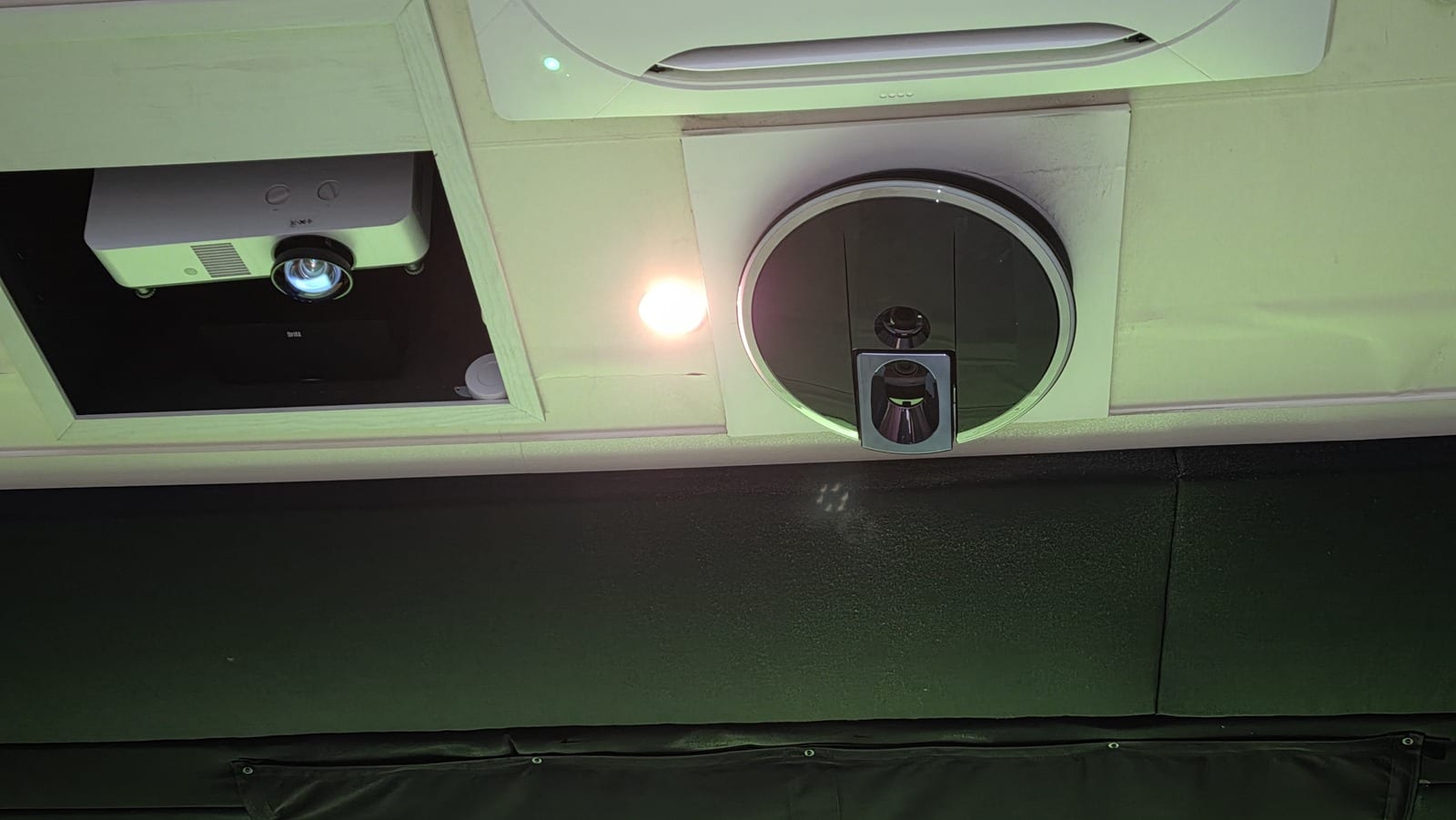
Photo taken by the author at a Golfzon Park store, 2026-09-04. The round opening on the right is where the ceiling module sits, in the position ZDNet Korea’s launch story describes. Golfzon has never published a labeled parts diagram, so I can’t tell you that this particular module is the spin sensor.
You’ll find this claim pulling two ways, and both directions come from Golfzon. The Korean release presents precise spin measurement as the new capability. The company’s English sensor page for the older TwoVision NX already lists spin axis among what that machine reads (Golfzon Global, retrieved 2026-09-18). That’s the tilt of the ball’s spin, and it’s what decides whether a shot curves left or right.
You can settle it with Golfzon’s own words. The release says the machine senses shots across all three mat areas, measures spin with high-speed capture, then applies AI-based spin-specific analysis, my translation (Golfzon Newsroom, 2026-09-14, in Korean, retrieved 2026-09-18).
Read that list and what you’re being offered is a bigger sensing area, a faster camera and new processing. Those are three ways of reading the same thing more closely.
I’d take the change as a sharper version of something the old box already did, not a new category. That matters for one practical reason: a sharper reading of a slice is a bigger slice on the screen. Your swing didn’t get worse, the ruler got finer.
So don’t compare a number from this machine against one you wrote down on a different box. If the face and path numbers on this screen are the ones you’re squinting at, face angle vs club path unpacks what they mean. The same readout’s head speed and carry line get their own treatment in the swing speed and distance post.
One number to handle carefully. Golfzon surveyed the professionals who took part in its own development test, and ball flight accuracy scored at least 4.8 out of 5, my translation (Golfzon Newsroom, 2026-09-14, in Korean, retrieved 2026-09-18).
That’s a rating from a survey the company ran, not an accuracy measurement. You won’t find an error margin or a measurement range in anything Golfzon has published. So nobody can tell you how close this thing gets to a real ball flight.
The mats and the tee
You’ll meet three of the changes underfoot rather than on screen, and the newsroom lists all three. A rough mat with longer grass, so the ball sits down and feels like real rough. A bunker mat with a sliding mechanism, so the club feels like it’s pushing sand. And a flexible folding tee built to resist the clubhead as little as possible, all my translation (Golfzon Newsroom, 2026-09-14, in Korean, retrieved 2026-09-18).
You’ll see the shot shapes claimed in two places, and the newsroom is the more specific of the two. ZDNet Korea’s launch story says you can shape a variety of ball flights, and it adds pitch shots, lob shots and running approaches (ZDNet Korea, 2026-07-27, in Korean, retrieved 2026-09-18). The last three are short shots near the green. A pitch flies high and stops, a lob flies higher and stops faster, and a running approach lands low and rolls out.
The newsroom names the full-swing shapes that ZDNet leaves general: low fade and high draw. A fade curves gently to the right for a right-hander, and a draw curves to the left.
I’m not going to tell you how those mats feel. I played two rounds that night, and I didn’t have the old machine sitting next to it to compare against. Anybody who says they felt the difference across two visits to two different stores is telling you a story, not a result.
Is it worth going out of your way for?
Go if the course is what you want, or skip it if you want a score you can compare. Here are the situations, because that’s easier to place yourself in than a list of features.
You want to play Cheonmunbong itself
Go. The blind holes that cost you shots are the same ones that make each tee shot a decision. Expect to score badly the first time. I did, and it was still the better of my two cards that day.
You have a tee time at a real course soon
Go. A lie is how your ball is sitting before you hit it, and a flat mat only ever gives you one. The rough mat and the bunker mat are aimed at the two lies that surprise people on the day.
Your short game around the green is the weak part
Go, but for the mats and the three short shots more than for the whole update. The pitch, lob and running approach ZDNet names are the part of the change that lands in your weakness. The rest of the update is full-swing shaping, and the newsroom names those: low fade, high draw.
You’re playing for money, or tracking a score across months
Don’t bother. The sensor reads your ball differently than the older box did. A score from this machine isn’t a like-for-like against one you wrote down on a TwoVision NX. Whoever sets the room up can also pick a different green speed, which moves the bar again.
You’re working on a slice
It goes both ways. A finer spin reading will show the curve bigger than you’re used to, and that’s useful only if you want to see it. If you’d rather not, stay on the machine you know.
There isn’t one near you
No rush. Screen Golf Lab, a Korean blog that counts installs, put it at 270 stores, or 9.66% of Golfzon Park locations, on 2026-09-10 (스크린골프연구소, in Korean, retrieved 2026-09-18). That’s one person’s tally rather than a company figure.
The same post has it at 126 stores twenty days earlier. Whatever number you read today will be stale by the time you drive anywhere.
How to tell whether a store has an NX Plus
Finding one is the annoying part. The official Golfzon Park site has no machine version filter, and the only hardware name on its homepage is TwoVision NX (checked 2026-09-18). Golfzon’s own guidance is to check installed stores in its app.
For the older NX, Korean players pass around a trick. The store icon in the app is supposed to show a rainbow border. You also tap the NX button twice to make the search work. That’s community practice rather than documentation, and I could not confirm that any of it applies to NX Plus.
What did work was walking in. Stores that have one put a roll-up banner in the lobby reading NX플러스 설치점, which means “NX Plus installed here”. If you’re already standing in a Korean screen golf building, that sign is easier to trust than the app.
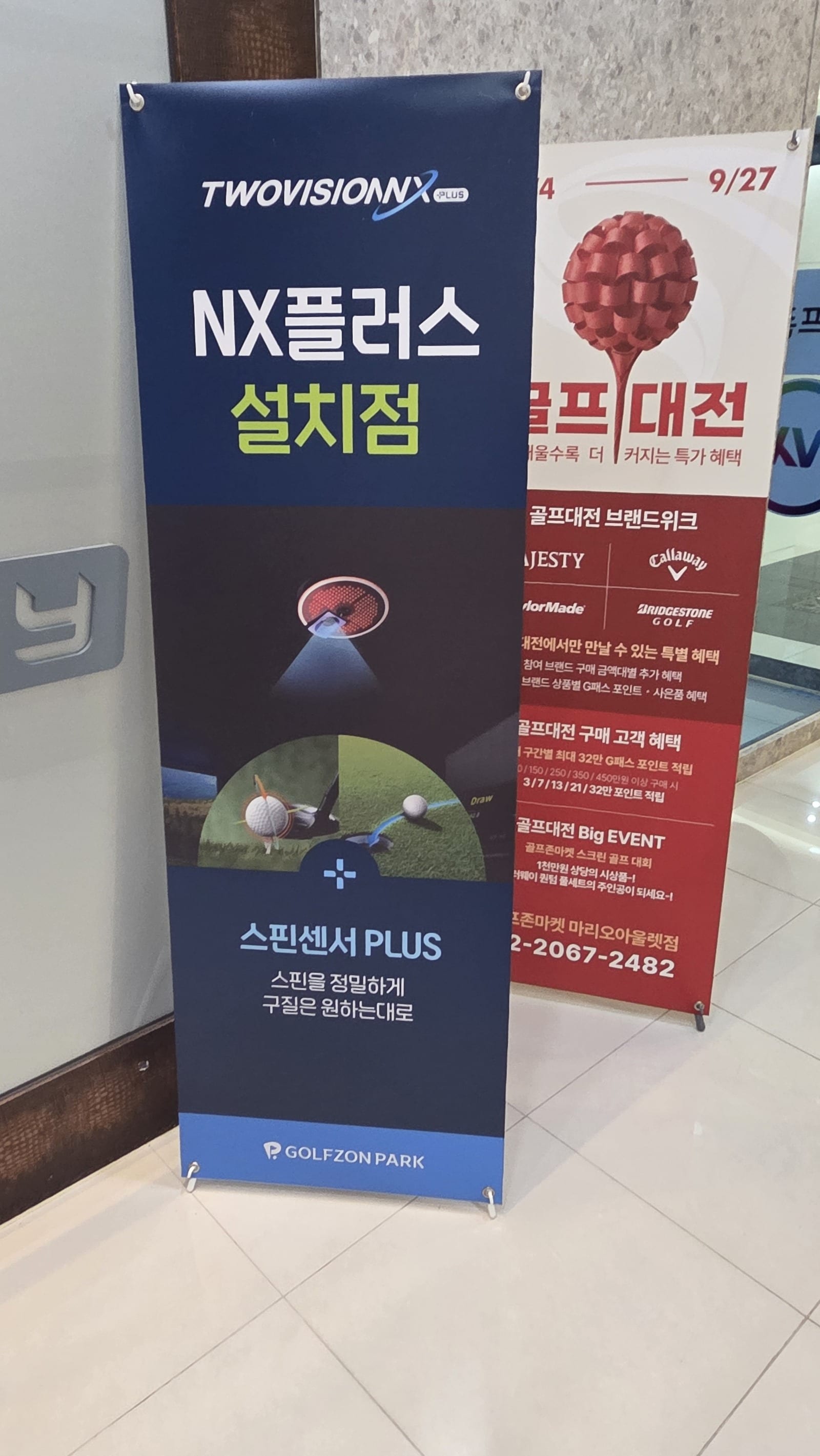
Photo taken by the author in the lobby of the store I played, 2026-09-04. This is the sign to look for. The wordmark reads TWOVISIONNX with PLUS attached. The large Korean line under it is the one that means the machine is installed here.
One round there, and the thing I’d tell a friend is short. The course is worth the trip and the machine is a nice bonus. I’d want a second round on it before reading anything into my card.
Terms in this article
- Blind hole: a hole where you can’t see the landing area or the green from where you’re standing. AI Cheonmunbong CC is built on them.
- Reality course: Golfzon’s tag for its own course series, shown as 리얼리티 on the card. It’s a product label, not a statement that the course exists.
- G-Tour: Golfzon’s own competitive screen golf tour. AI Cheonmunbong CC is one of its venues, per Star News.
- Green speed: how far a ball rolls once it’s on the green. It’s a difficulty setting the room picks, not a property of the course.
- Stimpmeter: the ramp used on real courses to measure green speed. It releases a ball the same way each time, and the reading is how far the ball rolls in feet.
- Green firmness: a separate setting from speed. It decides how much the ball bites when it lands, and it was on Normal for my round.
- Lie: how your ball is sitting before you hit it. A flat mat only ever gives you one, which is what the rough mat and the bunker mat are for.
- Spin axis: the tilt of the ball’s spin, which decides whether the shot curves left or right. Golfzon’s global site lists it for the older TwoVision NX sensor.
- Pitch, lob, running approach: the three short shots near the green that ZDNet Korea names. A pitch flies high and stops. A lob flies higher and stops faster. A running approach lands low and rolls out.
- Fade and draw: the two full-swing curves. For a right-hander a fade bends gently right and a draw bends left. Golfzon’s own release names these two.
- Screen golf: the Korean indoor format where you hit a real ball into a projection screen and a sensor calculates the flight. Golfzon is the dominant maker.
- Golfzon Park: Golfzon’s franchised store brand. The TwoVision NX Plus goes to those stores only, per ZDNet Korea’s launch report.