
Face angle vs club path: the ball curves off the difference, not the face
Your screen read the face closed and the ball still sliced. Face angle and club path are measured against the same line, and the ball curves off the gap.

I practice indoors, so every shot comes back to me as a row of numbers. For a long time I read them in the wrong order.
Here’s the reading that sends people looking this up. The screen says Face Angle -1.5. That’s a closed face, pointing left of the target.
The ball then slices right. It looks like the machine is arguing with itself.
It isn’t. Face angle and club path are measured against the same line, and the ball curves off the gap between them. A closed face and a slice sit together perfectly well once you know which number the curve comes from.
The short answer
- Face angle and club path are both measured against your target line, and a positive value means right for everybody, left-handers included (TrackMan on face angle and on club path, retrieved 2026-09-10).
- What bends the ball is face to path, which is face angle minus club path. If your screen doesn’t print it, it’s a subtraction you can do in your head.
- A closed face with a slice means the path was further left than the face, or you caught it off the heel. Nothing about that is broken.
- Some launch monitors let you show face angle against the target or against the path. The same -1.5 means opposite things in the two settings (Foresight Sports FSX 2020 manual, retrieved 2026-09-10).
- The Golfzon round readout documented in 2017 shows no face angle at all (Golfzon on the readout). Its left-right number describes where the ball finished, not where the face pointed (Golfzon’s glossary, both retrieved 2026-09-10). A screen golf bay I played in September 2026 printed one anyway, so check your own screen before you assume you don’t have it.
In this article:
- Both numbers are measured against the same line
- Your closed face and your slice aren’t a contradiction
- What your screen is actually giving you
- So which number do you look at first?
- Where I’ve got to
- Terms in this article
Both numbers are measured against the same line
Face angle is where the club face points when it meets the ball. Club path is the direction the head is traveling at that moment. Both are measured against your target line.
TrackMan defines face angle as “the horizontal club face orientation at the center-point of contact between club face and golf ball at the maximum compression of the golf ball” (TrackMan, published 2024-09-23, retrieved 2026-09-10).
The sign rule is the part worth keeping. “A positive value means the face is pointed right of the target line regardless of dexterity,” and club path reads the same way: “a positive value means the club is moving to the right of the target line regardless of dexterity” (TrackMan, published 2024-09-23, retrieved 2026-09-10).
Left-handed players, that phrase is doing real work. The machine does not flip the sign for you. Right or left is right or left.
So your -1.5 is a face pointing 1.5 degrees left of the target. You read your own screen correctly. The problem is that the face number was never the one that curves it.
That third number is face to path, “the angle difference between FACE ANGLE and CLUB PATH as defined (FACE ANGLE minus CLUB PATH).” The direction rule comes from the same page: “the ball should curve towards the face angle and away from the club path (if Face to Path is not equal to zero)” (TrackMan, published 2024-09-23, retrieved 2026-09-10).
TrackMan is blunt about which one aims the shot. Face angle “is the most important number when determining the starting direction of the golf ball,” and “the ball will launch very closely to the direction the club face (Face Angle) is pointed at impact” (TrackMan, retrieved 2026-09-10). Path gets the rest of the start line, and then the gap between the two does the curving.
The same split runs your putting, where the face gets most of the start direction and the path gets a small remainder: putts that don’t start on line.
Your closed face and your slice aren’t a contradiction
Once you put the numbers in, the argument disappears.
Face angle -1.5. Say the path on that swing was -6, an out-to-in move, meaning the head was traveling left of the target through the ball. That’s the path a slice usually keeps. Face to path is -1.5 minus -6, which is +4.5. Positive means the face was open to the path, so the ball curves away from the path and toward the face. To the right.
The face was closed to the target and open to the path in the same swing. Both statements are true, and only the second one bends the ball.
Turn it around and the point gets sharper. An open face of +3 with a path of +4.5 gives face to path of -1.5, and the ball draws. The same open face of +3 with a path of +1.5 gives +1.5, and it fades.
The face reading didn’t change. It decided neither shot on its own.
This is also why a setting on your driver that looks like loft can change where the ball starts. That sleeve in the hosel, where the shaft meets the head, moves the face angle more than it moves the loft: what a driver loft sleeve actually does.
One case the subtraction doesn’t cover is where on the face you hit it, and that one has a name: gear effect. A toe strike twists the head open and puts draw spin on the ball. A heel strike twists it closed and puts fade spin on the ball, the same spin that becomes a slice when there’s enough of it (Rapsodo, published 2026-03-26, retrieved 2026-09-10). TrackMan reports face angle at the point of contact rather than the middle of the face, and on a driver that matters: “For standard drivers, a 10 mm impact towards the toe will cause the Face Angle to be 2 degrees more open at the impact location when compared to the center of the club face” (TrackMan, published 2017-08-21, retrieved 2026-09-10). So if your numbers say the ball should have gone left and it went right, your impact marks are worth a look.
What your screen is actually giving you
Two things can be true of the number on your screen. It may not be measured against what you think, and it may not be the face at all.
Face to the target, or face to the path?
Before you trust the arithmetic above, there’s one setting you’ll want to check. The face number isn’t always measured against the target.
Foresight Sports defines face angle at impact as “the measurement of the club head’s face plane position square to either the path or the target line” (Foresight Sports, retrieved 2026-09-10). Either. The choice is yours, and it’s a menu item.
Their software manual says where: “Face measurement can be displayed either to target or to path by selecting the corresponding option in the middle of the screen” (Foresight Sports FSX 2020 user manual, retrieved 2026-09-10).
That gives the same -1.5 two opposite diagnoses:
| Setting | What -1.5 means | Fits a slice? |
|---|---|---|
| Face to target | Face 1.5 degrees left of the target | Yes, as long as the path is further left |
| Face to path | Face 1.5 degrees closed to the path | No. That should curve left |
If your bay is on the second setting and you’re still slicing, the subtraction in the section above doesn’t explain your shot. The gear-effect paragraph that closed it is where to look next.
One more thing worth knowing before you go looking. On a GCQuad, club data is a paid add-on (Foresight Sports, retrieved 2026-09-10). A bay can be running a capable unit that reports no club numbers at all.
Whether you get a face number depends on the bay
If you play Korean screen golf, whether you have ever seen your face angle depends on which bay you walked into. I practice in two that don’t agree.
Golfzon’s own guide to reading the screen describes the post-swing readout as distance, ball speed, and head speed (Golfzon, published 2017-01-04, retrieved 2026-09-10). Its glossary of the swing data terms a golfer should know runs through carry, run, total, ball speed, backspin, sidespin, launch angle, and left-right deviation. It never defines face angle or club path (Golfzon, published 2016-03-31, retrieved 2026-09-10).
That matches one of my two bays. The room at the top of this page is my own, a GDR room, which is Golfzon’s driving-range practice system. The round screens in there hand me distances and speeds. No club numbers.
What you do get is left-right deviation, which that same glossary defines as how far left or right of the target the ball finished (Golfzon, retrieved 2026-09-10). It’s a distance, not an angle, and it describes the ball rather than the club. If you have been calling that your face angle, you have been reading the result rather than the cause.
The nearest thing to it on a TrackMan or a Foresight is launch direction, which Foresight calls side angle. That one is an angle, and it is still a ball number.
The other bay doesn’t behave that way. In September 2026 I played a round in a screen golf bay that printed a face angle on the shot row. Two more club numbers sat on the mat at my feet. Same kind of room, opposite answer, and that shot gets its own section at the end of this part.
Which is not to say Korean systems can’t measure the face. Some of them advertise exactly that.
At launch, Golfzon’s TwoVision cabinet put six readings on its touch monitor. The impact zone, club path, club face, ball spin, ball speed, and launch angle (NewDaily Economy, published 2016-08-30, retrieved 2026-09-10). Kakao VX’s Friends Screen Quantum sensor is reported to measure club path, attack angle, dynamic loft, lie angle, face angle, low point, and duff point (Tech M, published 2024-04-02, retrieved 2026-09-10). Golfzon announced GDR X on 2026-08-25 with nine club data items, including club face and club path (ZDNet Korea, published 2026-08-25, retrieved 2026-09-10).
You’ll want to read those as press claims about the sensor, not as a promise about your screen. The gap between what a machine measures and what it chooses to show you is exactly the gap this part of the article is about.
Golfzon’s own beginner article gets to the same place from the other side. It says the biggest factor deciding the ball’s direction is the angle of the face at impact. Then it points readers who can’t diagnose it by eye to a swing analyzer like GDR (Golfzon, published 2016-03-28, retrieved 2026-09-10). The company is telling you the round system isn’t where you look.
If you practice somewhere else, the same split applies. You’ll want to ask which unit the bay runs, and whether its club data is switched on.
One shot of mine: the start line fit, the curve didn’t
Here’s that second bay, on one shot on 2026-09-04. It’s one shot I watched, not a measurement of anything.
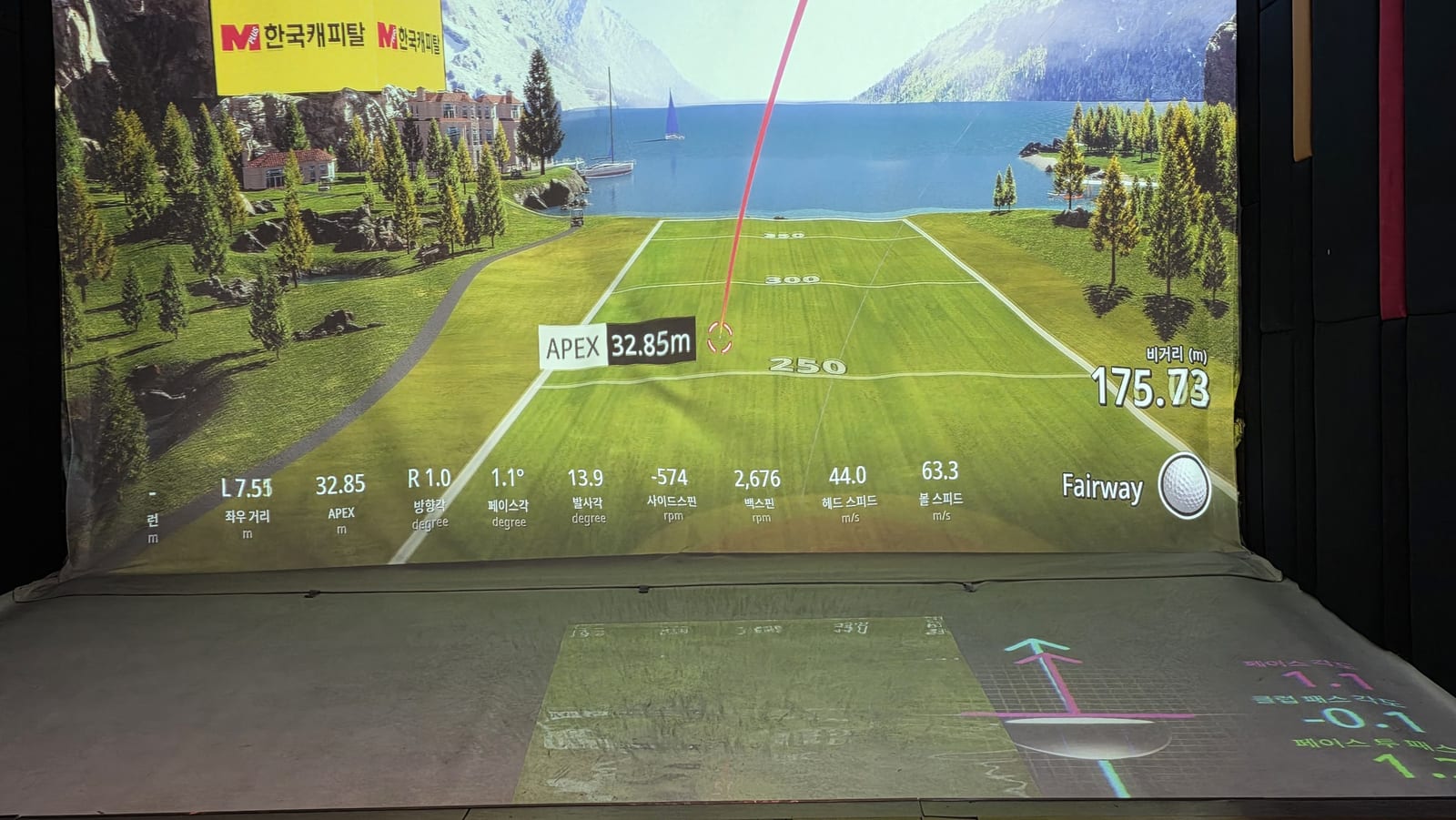 Photo: the second bay, 2026-09-04. In the bottom row of the screen, the face
angle is fifth from the left at 1.1. The three numbers on the mat at bottom right
are face angle, club path and face to path. The last one runs off the edge of my
frame.
Photo: the second bay, 2026-09-04. In the bottom row of the screen, the face
angle is fifth from the left at 1.1. The three numbers on the mat at bottom right
are face angle, club path and face to path. The last one runs off the edge of my
frame.
| What the bay printed | Value |
|---|---|
| Face angle | 1.1 |
| Direction angle | R 1.0 |
| Left-right distance | L 7.55 m (8.3 yd) |
| Sidespin | -574 rpm |
| Carry counter, ball still airborne | 175.73 m, not the final number |
| On the mat: face angle, club path, face to path | 1.1, -0.1, and a face to path whose second digit runs off my frame. 1.2 is the arithmetic fit, not a reading |
That carry row isn’t the final distance. The screen caught the shot mid-flight, APEX marker still counting up, so 175.73 m was a live number, not where the ball ended. I didn’t capture the settled figure.
The start line did what TrackMan says it does. The face pointed 1.1 degrees right, and the ball left on R 1.0, a tenth of a degree away from it. That’s the line quoted earlier in this article showing up on a screen in front of me. The ball launches very closely to where the face points.
One reading doesn’t measure anything, and there’s a second limit on it. The bay never says what direction angle is measured against, and the glossary above doesn’t define that field. I’m reading it as the ball’s start direction, which is the closest published term I found for it.
Then the numbers stop agreeing. Face to path is +1.2, a face open to the path. By the rule this whole article runs on, the ball should have bent right.
It started 1.0 right of the target and finished 7.55 m left of it. It curved the other way.
I can’t tell you why. Three things could explain it, and I ruled out none of them.
- An off-center strike. Gear effect is the escape hatch from earlier in this article. A toe strike puts draw spin on the ball, which is the direction this one went. I didn’t look at the impact mark, and I can’t go back for it now.
- Signs on the mat, not the sidespin. The sidespin reads -574, and that’s the draw side. Negative sidespin is the standard convention, so there’s no real ambiguity there. What I can’t confirm is whether the mat’s face angle and club path follow TrackMan’s positive-is-right rule; the bay doesn’t say.
- A number partly outside my photo. The face to path on the mat reads 1 and then a digit that runs off the edge of the frame. Since 1.1 minus -0.1 is 1.2, the value fits. Fitting isn’t the same as reading it.
So it stays open. The one check I could have made and didn’t is the impact mark. If your own row argues with itself like this one, look at yours while you’re still standing there.
So which number do you look at first?
This is about reading the screen, not about what to do to your swing.
Whichever number is further from zero.
At face -1.5 with a path of -6, the face is already almost square and the path is not. The gap that curved the ball is the path’s doing. Grinding on the face would be work spent on the number that was already nearly right.
That’s the opposite of the advice you’ll usually get, which is to square the face first. It’s good advice for the golfer it’s aimed at. GOLFTEC says “many golfers present the clubface 3-5 degrees open at impact, pinpointing it right of their swing path” (GOLFTEC, updated 2025-06-19, retrieved 2026-09-10). Note what that’s measured against. Open to their path, not to the target.
Which means that number describes the gap, not where either of your two numbers sits. A face of -1.5 with a path of -6 opens the same 4.5-degree gap GOLFTEC is describing. But the two numbers didn’t travel equally far to make it. The path went four times as far from square as the face did, and that is the one worth looking at first.
Two honest limits on this. You won’t find a ranking of the two at GOLFTEC, which treats face and path as one combined fault and works on the pair. That’s a fair position, and not the one I’ve taken here.
And I went looking for a study comparing face-first with path-first coaching for beginners, and found none. So this is a reading, not a method. I’m telling you which number is the outlier. What you do to your swing after that is between you and someone who watches you swing.
If you want one sentence to carry out of here, Titleist’s Learning Lab has already written it: face sends it, path bends it (Titleist, retrieved 2026-09-10).
Where I’ve got to
I’d been reading my own numbers as a scoreboard, one row at a time. The row that would have explained my misses was never printed. Face to path wasn’t on mine, and on a Foresight bay it waits behind a setting. You subtract it yourself, and it takes ten seconds.
What I can’t do yet is test the ordering on myself. The bay I practice in gives me distances and speeds, and the round that did hand me club numbers handed me one shot. I’d have to book real time on a system that reports them before I could say whether the outlier number was worth starting from. That is a later post, and I’ll say plainly if it wasn’t.
One thing I couldn’t settle. The sources that rank them agree the face gets most of the start line. The share then gets quoted as a hard percentage credited to TrackMan.
I went through TrackMan’s own pages on face angle, club path, face to path, launch direction and spin axis. Not one of them prints a percentage. So I’ve left the number out rather than pass along an attribution I can’t find. I’ve printed one myself in the driver loft sleeve article, and I now read it as the widely repeated figure rather than a measured one.
Terms in this article
- Face angle: where the club face points at impact, measured against your target line. Positive is right of the target for every player, left-handed or not.
- Club path: the direction the club head is traveling at impact, measured against the same line. Positive is in-to-out for a right-hander.
- Face to path: face angle minus club path. This is the number the curve comes from, and a screen that prints the other two often leaves this one out.
- Launch direction: the line the ball actually started on, measured against the target. Foresight calls it side angle. Korean round screens report something related but not identical, left-right deviation, which is a distance rather than an angle. The bay in the “One shot of mine” section labels that column left-right distance and prints a separate direction angle in degrees. That bay never says what its direction angle is measured against; I read it as the ball’s start direction. All of these describe the ball, not the club.
- Gear effect: the twist a clubhead takes on an off-center strike, which adds curve the face and path numbers don’t account for.