
Putts that don't start on line: the face decides most of it, not the path
Face angle explained 80% of the direction consistency of 1,301 putts by elite players. Putter path explained 17%. The 83% you'll see quoted cites nothing.
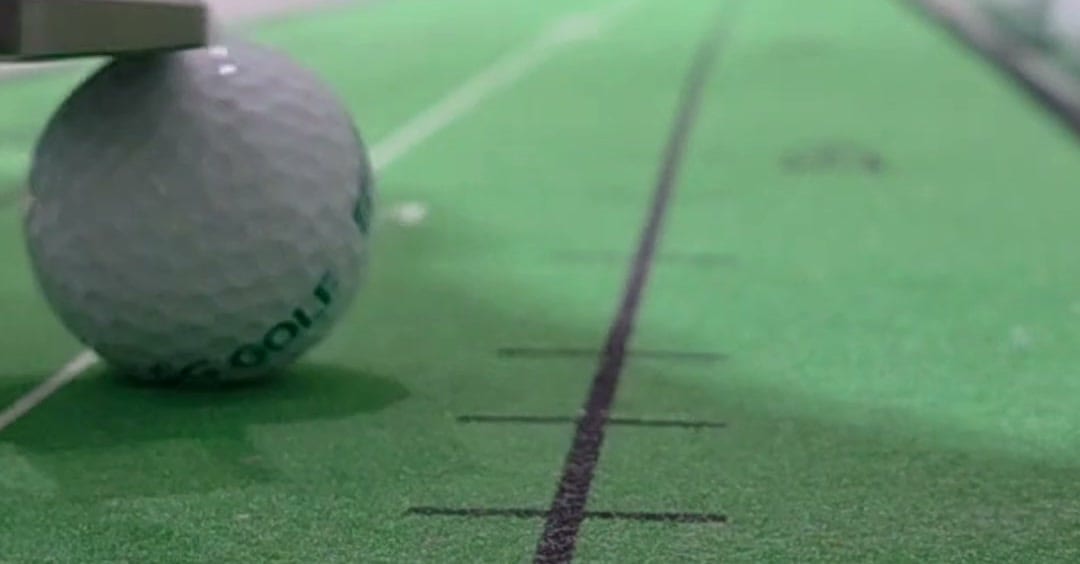
My putts leak right. I practice in an indoor screen-golf bay, so I see the start direction on every one, and it’s always the same way. A mat isn’t a green, so what I see there is the start of the putt and nothing after it.
What I didn’t know was what to fix. Search for it and you get “straight back, straight through.” Ask in a shop and you get told a mallet is better for direction. I putt with a mallet, and I still leak right.
So I went looking for what has actually been measured. This article is that search, not a lesson. I haven’t fixed my own stroke, and I’m not going to fix yours. What I can do is sort out what deserves your practice time first, because the popular answer aims at a small part.
The short answer
- Across 1,301 putts by 71 elite players, face angle explained 80% of direction consistency. Putter path explained 17%.
- The figure you’ll see quoted instead is 83%. The earliest place I could find it is a putter-lab company’s own document, which cites nothing.
- “Straight back, straight through” aims at the 17%. A stroke arcs because the shaft leans. The company that makes SAM PuttLab says forcing it straight costs face-angle consistency.
- Beginners go wrong before the stroke. In one study, novices showed a large bias in perceiving the aim line and a small one in the stroke.
- None of those three things is a piece of equipment.
In this article:
- What decides where a putt starts
- “Straight back, straight through” is aimed at the wrong 17%
- For a beginner, the aim is already wrong before the stroke starts
- So what do you work on first?
- Where I’ve got to
- Terms in this article
What decides where a putt starts
Face angle at impact. Where the face points when it meets the ball decides most of the start direction, and your path decides a small remainder.
Three terms, because the rest of this leans on them. Face angle is where the putter face points at impact, measured against your target line. Putter path is the direction the head is traveling when it gets there. Start direction is the line the ball rolls off on, before any break takes it.
The best measurement of this is old and rarely quoted. Researchers recorded 1,301 putts from about 4 meters (13 feet) hit by 71 elite players, mean handicap 1.8. Face angle accounted for 80% of stroke direction consistency, putter path for 17%, and impact point for 3% (Karlsen, Smith and Nilsson, Journal of Sports Sciences, doi 10.1080/02640410701530902, 2008, retrieved 2026-09-09). Impact point means where on the face you struck it, from toe to heel.
Two things before you carry that number around.
You can’t move it straight onto your own putting. It was measured on elite players, and it describes the spread in their directions rather than yours.
And starting a putt on line is not the same as holing it. The same study put mean stroke direction variability for a European Tour player at 0.39 degrees, enough to hole about 95% of 4-meter putts. Top professionals in tournaments hole about one in six of those 4-meter putts. Speed and green reading live in that gap.
So this article is about making your putts start where you aimed. It doesn’t promise they drop. Starting on line still matters to you, because your green reading is wasted if the ball never starts on the line you read.
The same structure runs your tee shot. It’s why a sleeve setting that looks like loft mostly moves the face: driver loft sleeves change face angle more.
Where the numbers you’ll see come from
You’ll rarely see that study cited. What you’ll see instead is the same claim with a bigger number attached, usually stated as fact with nothing after it. The table below traces each one back, the study included.
| Figure | Where it comes from | Does it cite a study? |
|---|---|---|
| 80% | Karlsen, Smith and Nilsson, peer-reviewed, sample and method published | It is the study |
| 83% | Science and Motion, the SAM PuttLab maker, 2016 instructional PDF | No |
| 90 to 92% | Quintic Ball Roll, a putting-camera vendor page | No |
The 83% is the one that spread. Its wording is flat: “The putter face angle at impact determines the initial ball direction to 83%” (retrieved 2026-09-09). There’s no sample, no method, and no citation anywhere in that document. I went through the secondary literature looking for an original experiment behind it and found none.
Both companies publishing the larger numbers sell the equipment used to measure face angle. None of that makes the idea wrong, though. Two of the three sources break out a path number: the study, and the 83% document, which calls the path “almost 5 times less important.” Both of those put the face at nearly five times the path.
The order is what to take away, not the number.
“Straight back, straight through” is aimed at the wrong 17%
This is the first thing most of us are told, and there’s a shelf of training gates built to enforce it. It isn’t a made-up idea. A path that wanders does move the ball, by that 17%.
The problem is that a putting stroke arcs for a structural reason. You stand to the side of the ball and the shaft leans in toward you, so the head swings on a tilted plane. Project a tilted circle down onto flat ground and you get an ellipse. The head is only on your target line near the ball.
To hold the head on a literal straight line, you have to push your hands out going back. Then you pull them in coming through.
A technical document from Science and Motion, the company behind SAM PuttLab, describes that trade directly. Forcing the straight path means the forearms have to suppress the natural rotation. Its own sentence: “the consequence of this manipulation is reduced consistency of face angle at impact” (Christian Marquardt, Science and Motion, 2016, retrieved 2026-09-09).
Read that against the first section. You’d be manipulating the 17% and paying for it in the 80%.
One caution before you lean on it. That’s a technical document from the company that sells the measuring system, not a peer-reviewed paper. I also looked for a figure on how many tour players arc their stroke and found none worth printing.
So there’s no percentage here. The geometry stands on its own.
For a beginner, the aim is already wrong before the stroke starts
Here’s the part that changed how I read my own miss. If you’re new, the error is more likely in what you see than in what you do.
Researchers gave 24 expert and 24 novice golfers two tasks. One was aligning a line on the ball toward the hole. The other was putting to that hole, from 1 and 4 meters (about 3 and 13 feet).
Novices showed a large perceptual aiming bias and a small bias in the putting itself. The experts showed neither (Shim, Chung and Kim, Journal of Sports Sciences, doi 10.1080/02640414.2018.1504601, 2019, retrieved 2026-09-09).
Small, not zero. Your stroke isn’t blameless. But if you’re grinding on your takeaway while your eyes point you somewhere other than the hole, you’re working the wrong end of the problem.
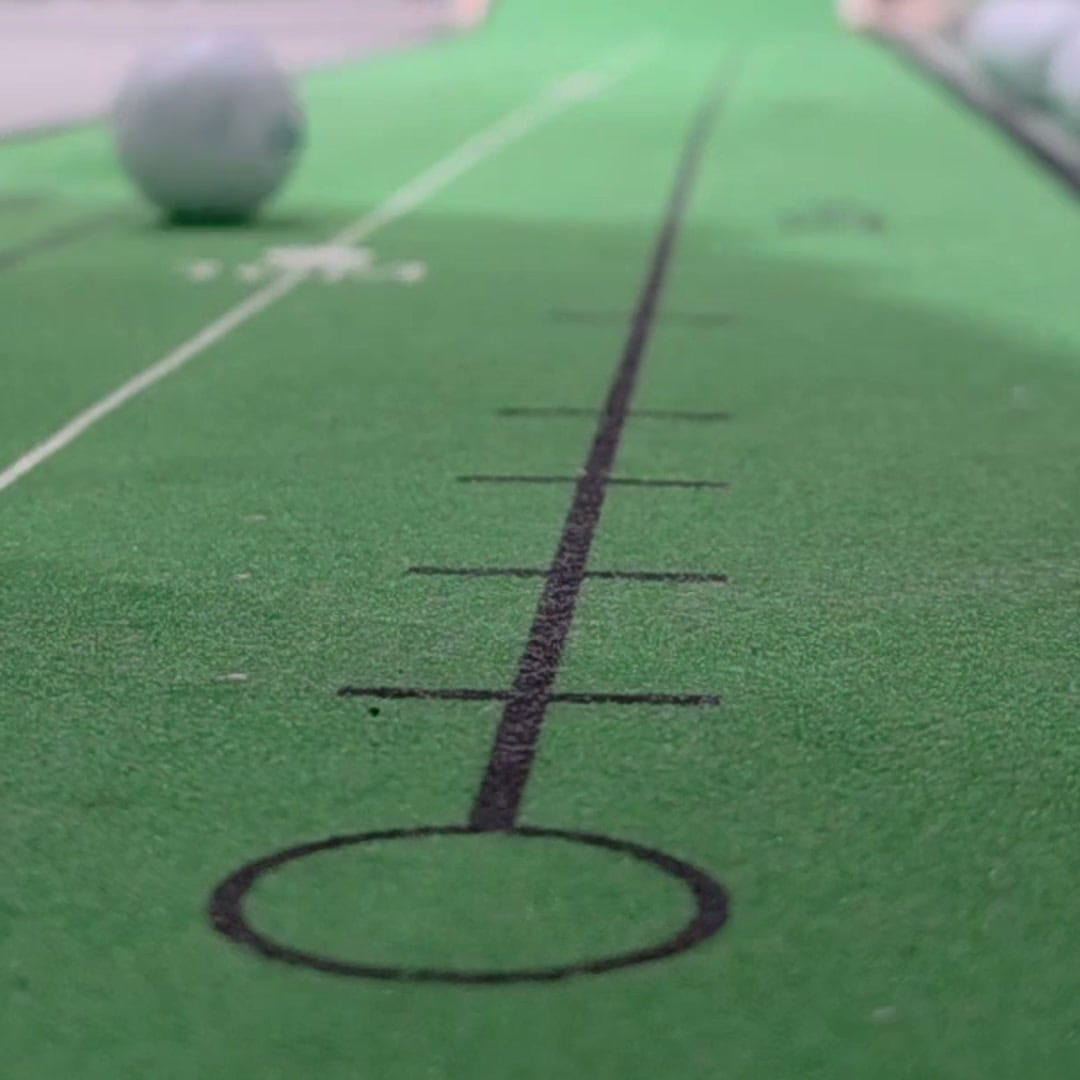
How much aim error is too much? SAM PuttLab’s manual sets the practical limit at 2 degrees from the target line. It adds that 1 degree of face-angle error points the face at the edge of the hole on a 12-foot putt (SAM PuttLab 5 Reports Manual, page 44, retrieved 2026-09-09).
The arithmetic behind that is trigonometry, and it’s worth seeing, because 1 degree sounds like nothing. A regulation hole is 4.25 inches across (R&A Rules of Golf 2023, Definitions, “Hole”), so you have 2.125 inches of room either side of center.
From 5 feet, 1 degree still leaves you inside the hole. From 10 feet it puts you on the edge, and from 15 feet you’ve missed.
The manual is a little kinder than the raw geometry. Straight trigonometry puts you on the edge at about 10 feet, not 12. Either way, 2.125 inches is the whole margin, and it’s gone before the putter moves.
So what do you work on first?
In this order: your aim, then your face at impact, then your path. Most practice starts at the end of that list.
Notice that none of the three is a piece of equipment. The shop answer I got was a mallet. Whether an alignment line or a bigger head does any of the aiming for you is a separate question. The measurements behind it are thin, so I gave it its own article: can a lined ball or a mallet aim for you.
Three things you can check at a mat or on a practice green, none of which require changing your stroke:
- Set up to a putt, then let go of the putter and step back without moving it. Look at where the face is actually pointing.
- From 5 feet, stop counting whether it went in and watch only the start direction. Where it started, not where it ended.
- Notice whether you use the line on your putter or ignore it. That’s an aim habit, and aim is first on the list.
I’d rather hand you those than a swing thought. I’m not qualified to give you a swing thought.
For the equipment side, I wrote about what a putter’s torque and balance actually change in what a zero-torque putter would cost me.
Where I’ve got to
If you’ve been grinding on a straight-back-straight-through stroke, you’ve been working the 17%. And the company that makes SAM PuttLab says that costs you face-angle consistency - and face angle is the 80%. If you’re new, the odds are your aim was off before you ever moved the putter.
I still leak right. I haven’t run these checks on myself yet, and I’m not going to write that they worked before they have. That’s a later post, and I’ll say plainly whether the order held up.
One thing I couldn’t answer at all. My miss gets worse when the putt breaks and I have to aim a hole-width outside the hole. That looks related to the research, but I found nothing measuring it, so I’ve left it alone rather than guess.
Terms in this article
- Face angle - where the putter face points at the moment it meets the ball, measured against your target line. Open means pointing right of it for a right-handed player.
- Putter path - the direction the head is traveling through impact, again measured against the target line. Not the same thing as the face.
- Start direction - the line the ball actually rolls off on, before any break takes it. This is what the whole article is about, and it isn’t the same as whether the putt drops.
- Impact point - where on the face you struck it, from toe to heel.