
Which Ventus shaft? Start from the one you already play.
Which Ventus shaft? Three moves from the one you play now: the class steps 8 to 10 grams, the letter runs out above class 7, color follows ball flight.
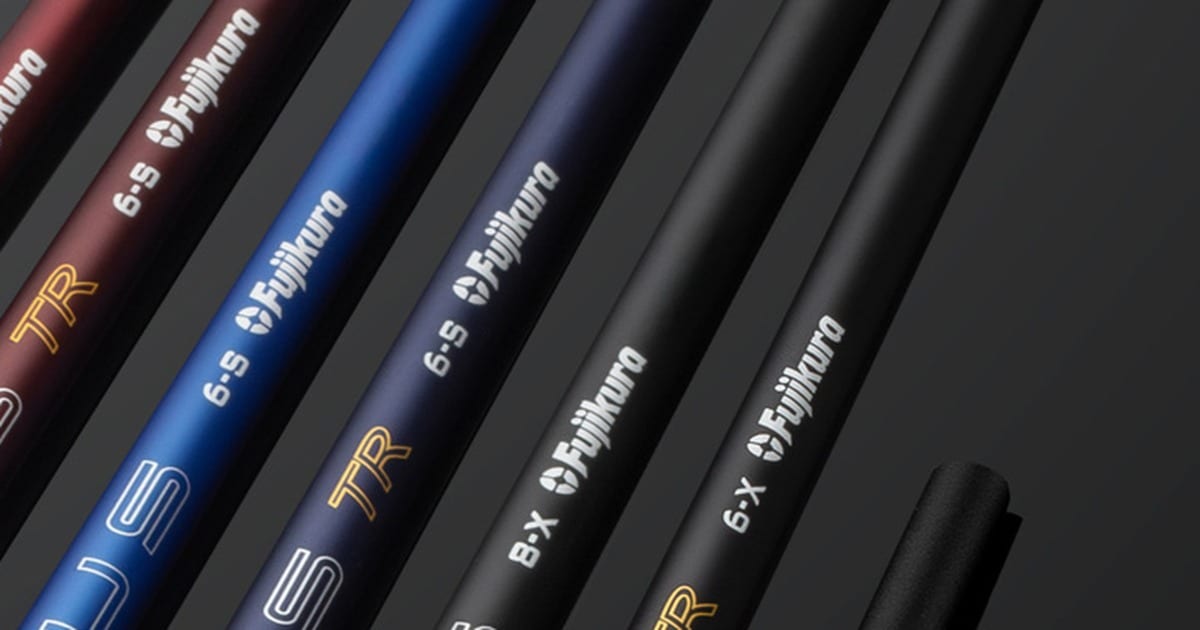
Most retail guides answer “which Ventus?” with a swing-speed table. You probably don’t know your own number, and those tables disagree with each other.
Here’s the version that works without a launch monitor. Note what you play now, then move one axis at a time. What comes out is the starting point you carry into a fitting, not the answer.
The short answer
- Each weight class is an 8 to 10 gram step. The ladder, class by class, sits in the table under move one.
- Use a lighter shaft and you buy clubhead speed, not carry. In the study cited there, head speed peaked at the lightest shaft tested and carry at a middle weight.
- Go up two classes and the letter gets picked for you: class 8 is X only, except Blue 8-S.
- The color follows your ball flight, not your speed. Fujikura publishes no speed figure for any color.
- Take aftermarket over stock and the newest test says you buy side-to-side tightness, not yards. Another disagrees.
Every figure below carries its source in the section it belongs to.
Start from what you already play
Choosing a Ventus isn’t picking three new coordinates. It’s three moves from the shaft in your driver right now.
| What you read on the band | What it sets |
|---|---|
| Color: Red, Blue, Black | Ball flight: how high, how much spin |
| Number: 5 to 9 in the TR line | Weight class, in grams |
| Letter: R2, R, S, X, TX | Stiffness |
The TR line comes in those three colors. Before anything else, write down four things you already know.
- The gram weight and flex letter printed on your current shaft
- Whether your ball climbs, and whether it spins a lot
- Where your miss goes
- Whether the top of your backswing feels like a pause or a yank
Those are questions, not a procedure. Asked by a reader how to tell his own transition, Tom Wishon answered that “words rarely can convey” the difference and that watching video is better (Tom Wishon Golf Technology, author reply in the comments, retrieved 2026-09-08).
And change one axis at a time. Korean Q&A boards ask about jumps like “Black TR 5S to Blue TR 6S,” which moves two of the three at once.
Two of the three really are independent. In the current TR+ line, 6-S weighs 69 grams in Red, Blue, and Black alike, and the 2022 TR line ran 68, 68, and 69.5 (Fujikura Golf TR+, Fujikura Golf TR, retrieved 2026-09-08).
That holds only with the class and letter fixed. Look Black up on a retail page and you’ll get one range for the whole lineup, 58 to 106 grams (Dallas Golf, retrieved 2026-09-08). Ignore both ends. Neither one lands on a TR wood class in the table below.
Weight and letter, though, aren’t independent at all. That’s move two.
Move 1: the weight class, 8 to 10 grams a step
One class number is 8 to 10 grams through class 8, so the only arithmetic you need is your current weight against the class you’re eyeing.
| Class | Weight in the current TR+ line (g) |
|---|---|
| 5 | 60-61 |
| 6 | 68-69 |
| 7 | 79 |
| 8 | 87 |
| 9 | 96-98 |
Source: Fujikura Golf, “VENTUS TR with VeloCore+” spec page, retrieved 2026-09-08.
Hold the letter still and the steps are clean. Blue S goes 60, 69, 79, then 87 grams: +9, +10, +8. So a 55-gram shaft is a bit under two steps from the 6 class, and a 62 is one.
Now the part that runs against what you’ve likely been told. In one study, twenty golfers hit driver shafts at 50, 55, 65, and 75 grams. Head speed came out best at 50 grams. Ball speed and carry came out best at 65 (Jeong and Park, Journal of the Korean Applied Science and Technology 35(1), 2018). You’ll want to read that for direction only, since half the subjects were tour professionals.
The class nearest 65 grams is the 6. If you’re in the 50s and someone told you lighter would add distance, that study says you’d get the faster swing and not the longer drive.
One adjustment sits on top, and it’s one for the fitting to confirm. If your transition turns out to be abrupt, you’d go 10 to 20 grams heavier than a chart puts you (Tom Wishon Golf Technology, 2013-06-17, retrieved 2026-09-08), which is one class step to two.
You can also work backwards from your own symptoms, which is what fitters do. There’s no measurement behind that, so treat each line as a hypothesis to test.
- Catching it thin often: too heavy. Hitting behind the ball: too light (Club Champion’s Nick Sherburne, via Plugged In Golf, 2020-01-26, retrieved 2026-09-08)
- Your swing feels “labored”: too heavy (Nippon, via Plugged In Golf, 2020-01-26, retrieved 2026-08-30)
Then the counterweight, from the same people. Plugged In Golf takes the convention head on: “slower swingers should play lighter shafts… This holds up sometimes, but is often wrong” (Plugged In Golf, 2020-01-26, retrieved 2026-08-30). Club Champion adds that its own clues are starting points and the opposite is often true.
So the arithmetic gives you the step count. Whether lighter or heavier actually helps is what the fitting settles.
One caution: the digit on the band is a rounded class, not the weight in your hands. I worked that through in the class number is not the shipped weight.
Move 2: the letter, and where it runs out
Go up in weight and your choice of letter disappears.
| Class 5 | Class 6 | Class 7 | Class 8 | Class 9 | |
|---|---|---|---|---|---|
| Red | R2, R, S | R, S, X | S, X | X | X |
| Blue | R, S, X | R, S, X, TX | S, X, TX | S, X | X |
| Black | S, X | S, X | S, X | X | X |
Source: Fujikura Golf, “VENTUS TR with VeloCore+” spec page, retrieved 2026-09-08.
Read that grid as doors closing. Through class 7 you pick a letter. At class 8 you take X, unless you take Blue, whose 8-S is the only S left. At class 9 it’s X in every color. So check the letter before you commit to a class.
Three narrower limits: R2 exists only in Red, TX only in Blue, and Black has no R at any weight. So if you play R today, Black is out before color even comes up.
If you’ve never checked whether R is still your letter, the swing-speed bands that pick it are in my golf shaft flex chart guide. Use them as a starting point, not a verdict.
Move 3: the color, from your current ball flight
Color moves off how your ball flies now, not off how fast you swing.
| Color | Bend point | Spin | Launch |
|---|---|---|---|
| Red | M | M/L | M/H |
| Blue | M | L | M |
| Black | H | L | L |
Source: Fujikura Golf, “VENTUS TR with VeloCore+” spec page, retrieved 2026-09-08.
Bend point is where the shaft flexes most along its length, rated Low to High, and a low one sits nearer the clubhead and helps the ball climb. More on what that does to your miss is in what torque and kick point do to your miss.
Fujikura’s own wording helps more than the ratings, because it describes people instead of numbers. Red is for “players who struggle to elevate the ball or generate sufficient spin.” Black is “ideal for golfers with higher swing speeds who demand maximum control,” and Blue sits between them on stability and feel (Fujikura Golf and the TR Red and Black launch releases, retrieved 2026-09-08). None of those descriptions contains an mph figure.
Put the wording and the ratings together and you get one line to act on. If your ball flies too high and spins too much, look at Black. If it won’t climb, look at Red.
There’s a catch in moving color while keeping your letter. At 6-S the published tip figure reads 87 for Black, 94 for Blue, and 96 for Red, and lower means stiffer (Fujikura Golf, retrieved 2026-09-08). So if you carry your S from Blue to Black, you change stiffness too. Read direction only, since the page gives no unit, and don’t turn one class at one letter into a fixed gap across the line.
Black drops off here again. If you swing under 105 mph, Golf.com’s fitting series with True Spec tells you not to play it at all (Golf.com with True Spec Golf, 2021-08-12, retrieved 2026-08-30), and Plugged In Golf says it doesn’t suit most golfers (Plugged In Golf, 2026-05-26, retrieved 2026-09-08). Neither is a Fujikura figure, so take them as two outside reads rather than a spec.
One Dallas Golf page caps Blue at 110 mph while another puts it at not much over 100 (Dallas Golf, retrieved 2026-09-08). Which is the last reason not to pick color by speed: you can see your ball flight without a device.
What you are paying for, and which generation
A shaft that came pre-installed in a complete club may not have VeloCore inside, even with VENTUS printed on the band.
You can settle that with the club in your garage. Fujikura’s rule is that “only shafts that have the VeloCore+ or VeloCore logo near the tip have VeloCore Technology” (Fujikura Golf, retrieved 2026-09-08).
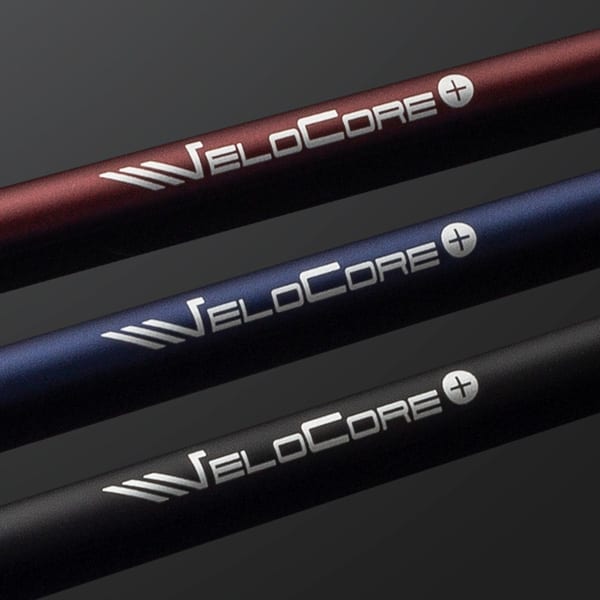
Don’t shortcut that into “OEM shafts never have VeloCore,” since Fujikura’s own page mentions “select OEM custom programs” (Fujikura Golf, retrieved 2026-09-08). The test is the logo, not the shop. The two tiers differ on materials, tolerances, fitting intent, and price, with aftermarket shafts at $125 to $350 (Fujikura Golf, retrieved 2026-09-08).
So what does the money buy? Two tests answer opposite ways. Today’s Golfer measured six aftermarket Ventus models against a stock Kai’li White. Dispersion area shrank from 1,100 to 779.6 square yards, 29.1% tighter, and every carry difference landed inside 4 yards (Today’s Golfer, updated 2026-03-16, retrieved 2026-09-08). Plugged In Golf, testing aftermarket against stock more generally, reported the opposite shape: 9.63 more yards of carry, and accuracy a 5-5 tie (Plugged In Golf, 2018, updated 2020, retrieved 2026-08-30).
Here’s how I’d read the split. The 2026 test measured Ventus shafts specifically and the older one didn’t. So I’d expect tighter dispersion rather than more yards, and I’d treat the distance finding as unreproduced on these shafts.
The generation question is simpler than it looks. Whichever color you land on, its launch, spin, and bend-point ratings are the same in the 2022 TR line and the 2026 TR+ line (Fujikura Golf TR, Fujikura Golf TR+, retrieved 2026-09-08). So if both lines carry your color and class, you can decide on price. One caveat if you landed high: in the 2022 line, class 9 exists only in Blue, with Red and Black stopping at 8.
If the core and fabric names are the confusing part, I unpicked what VeloCore, VeloCore+, and TR actually mean separately.
Your move, in one line
Take your notes in order: current weight, how many classes that is, what letters survive there, then color.
If you’re in the 50s in R and your ball flies low, you’re one to two steps heavier, so class 5 or 6, and you’re in Red. R survives in both, so your letter comes with you.
If you’re in the 50s in S and the ball climbs too much and spins, you’re at class 6 looking at Black, which offers S there. Take that branch to a launch monitor first, since Black is the one color other people put a floor under.
If your flight is already doing what you want, your color is the middle one. Blue sits between Red and Black on stability and feel (Fujikura Golf, retrieved 2026-09-08), so land there and put your decision into the class instead.
If you’re already at 70-something and thinking about one class more, look at the letter first. At class 8 you’re taking X, unless you’re in Blue and take its 8-S.
None of those is an answer. Fujikura ends its own guidance by saying the best recommendation is always to be fit by a Charter Dealer (Fujikura Golf, retrieved 2026-09-08). It also argues the case for newer golfers: “higher-handicap golfers and those who feel inconsistent often see the biggest improvements” (Fujikura Golf, retrieved 2026-09-08). That same page names the opposite risk, that “an ill-fitted shaft can exaggerate swing flaws.”
Three things to bring or ask when you go:
- Your current shaft, or its printed weight and letter, so the comparison runs against a real baseline rather than a class number
- The class you calculated and the one next to it, same letter, hit back to back
- A dispersion figure, not only carry, since that’s what the shaft data supports
Frequently asked questions
Ventus 5S or 6S, which one?
Hold S still and it’s a 9-gram decision: in the current TR line, Blue 5-S is 60 grams and 6-S is 69 (Fujikura Golf, retrieved 2026-09-08). Count from what you play now. At 55 grams today, 5-S is half a step and 6-S is closer to two.
Does Ventus Black come in regular flex?
No. Black starts at S in both the 2022 TR line and the 2026 TR+ line, at every class (Fujikura Golf TR, Fujikura Golf TR+, retrieved 2026-09-08). If R is your letter, your Ventus options are Red and Blue.
What to take away
Three moves, one at a time, each decidable from something you already know. What comes out is a starting point for a fitting, not a verdict. The generations themselves are laid out in my Ventus TR and VeloCore+ comparison.
Terms in this article
- Weight class. The single digit (5 through 9) on the band. In the TR line it stands for roughly 60, 69, 79, 87, and 97 grams.
- Flex letter. R2, R, S, X, or TX. Each maker defines its own, so it’s a label rather than a measurement.
- Bend point. Where the shaft flexes most along its length, rated Low to High. Low sits nearer the clubhead and helps the ball climb.
- Tip figure. Fujikura’s published number for stiffness near the head. Lower is stiffer, and no unit is given.
- VeloCore and VeloCore+. Fujikura’s bias-core constructions. Only the logo near the tip tells you a shaft has one.