
Titleist T150 and T100S lofts haven't changed since 2020
Four releases, one loft chart. T100S and T150 have run 19 through 48 degrees since 2020, so the loft stamp can't tell you which one you're looking at.
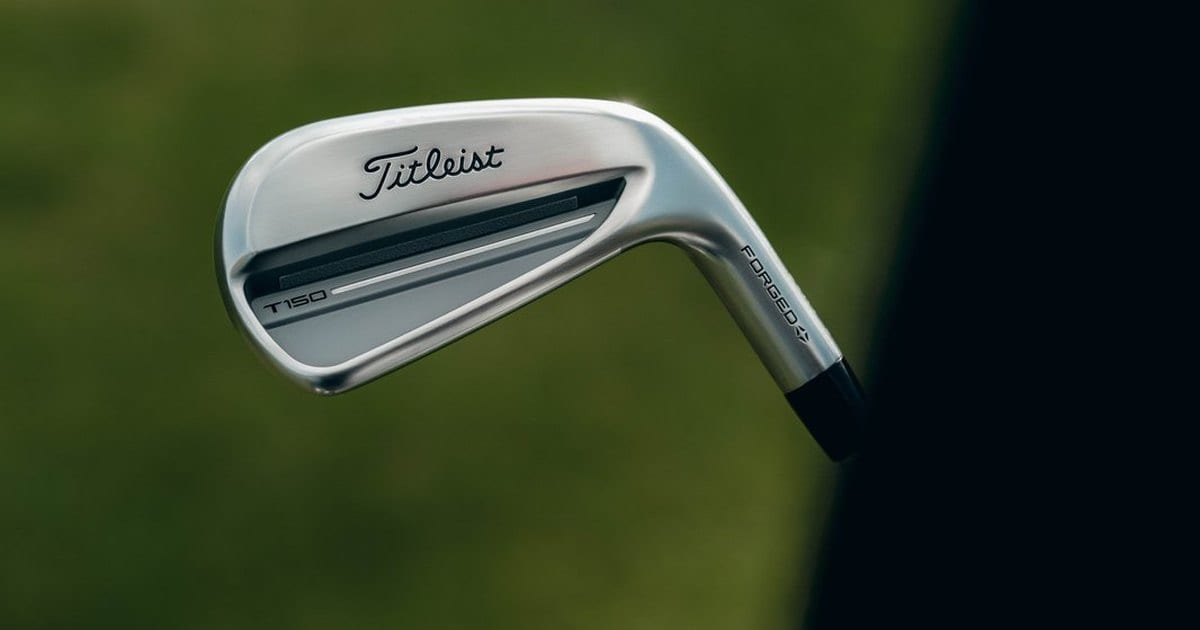
I wrote up the T100 loft chart a few weeks ago. The question that came back was about the club sitting next to it on the rack.
Is the T150 a newer T100S? Which one is older? And what are the lofts?
So I pulled Titleist’s spec tables for all four releases. The answer is shorter than I expected. The lofts have not moved once since the T100S arrived in early 2020. Not in 2021, not when the name changed to T150 in 2023, not in 2025.
That sounds like good news, and mostly it is. It also means the loft number can’t tell you which release you’re holding. That number is stamped on the sole, the bottom face of the head that slides along the turf. Reading the release off it is exactly what people try to do.
The short answer
- T100S and T150 have shared one loft set across all four releases. It runs 19° in the 3-iron through 44° in the P, the pitching wedge, and 48° in the W, the gap wedge under it (Titleist 2020, 2021, 2023, 2025, all retrieved 2026-09-20).
- The name is the only spec that splits the timeline. T100S means 2020 or 2021. T150 means 2023 or 2025.
- Lie angle moved once, in 2021, and only in the 3-iron and 4-iron. Length has never moved.
- The gap to T100 went from 2° to 1° in 2025. T150 stayed put and T100 got stronger, so the gap closed from the other side.
- The P is 44°. If your first wedge is a 52, that leaves an 8° step in the middle of your scoring clubs. The 48° W exists to close it.
The full T100S and T150 loft chart, 2020 to 2025
Titleist publishes one spec table per release, covering every model sold that year. So these four columns come from four different pages. I’ve labeled them by release year, because Titleist doesn’t number generations.
| Club | T100S 2020 | T100S 2021 | T150 2023 | T150 2025 |
|---|---|---|---|---|
| 3 | 19° | 19° | 19° | 19° |
| 4 | 22° | 22° | 22° | 22° |
| 5 | 25° | 25° | 25° | 25° |
| 6 | 28° | 28° | 28° | 28° |
| 7 | 32° | 32° | 32° | 32° |
| 8 | 36° | 36° | 36° | 36° |
| 9 | 40° | 40° | 40° | 40° |
| P | 44° | 44° | 44° | 44° |
| W | 48° | 48° | 48° | 48° |
Loft is the angle of the clubface, measured from vertical, so a lower number sends the ball lower and further. P is the pitching wedge, and W is the gap wedge that sits under it.
Sources: Titleist spec tables for 2020, 2021, 2023 and 2025, all retrieved 2026-09-20. On the 2020 and 2021 pages you’ll see the model written T100•S, with a dot in the middle.
A table where every row repeats the same number four times looks like a mistake. It isn’t. Four releases across six calendar years went by without a single degree moving, which is worth saying plainly.
The thing that did move is the relationship to T100. For three releases the S model, and then T150 after it, sat exactly two degrees stronger.
Titleist put that in writing twice. The 2021 T100S page lists “Engineered 2 degrees stronger than T100” as a feature. The 2023 launch describes T150 as “built with 2° stronger lofts compared to T100” (Titleist, retrieved 2026-09-20; Titleist Newsroom, August 3, 2023).
For 2020 you can do the subtraction yourself. That year’s T100 was the 2019 set, still on sale, and it ran 21° in the 3-iron through 46° in the P. Every club is two degrees weaker than the T100S beside it, on the same page (Titleist, retrieved 2026-09-20).
In 2025 that became one degree.
Nothing in the T150 column changed. The 2025 T100 came in one degree stronger everywhere, so its P reads 45 against T150’s 44. Both models sit on one table (Titleist, retrieved 2026-09-20). The space between the two models closed from the T100 side.
Titleist explains why in the launch release, and the explanation names T150 directly. On the PGA TOUR there was a request for slightly more bounce on the T100. Bounce is the angle of the sole that keeps the club from digging in.
On the LPGA the ask was different. Players “gravitated towards the smaller profile of T100 (compared to T150) but needed less loft for more distance” (Titleist Newsroom, July 10, 2025).
That’s the useful part. Some players wanted T100’s head with T150’s distance, and the fix was to strengthen T100. The side effect is that the two models now sit one degree apart instead of two.
I worked that gap through club by club in the T100 generation chart, where it’s the main event. Here it matters for one reason. It is the only number on this page that has ever moved.
What the generation numbers count
Titleist has never numbered these. There is no first generation T150 on any Titleist page. The company labels irons by model name and sells whatever is current.
The numbers come from the used market, and they count T-Series releases rather than releases of one model. Korean used-club shops use them constantly. One shop listed a “T150 신형 4세대” in January 2026, meaning the 2025 set (골프도라이, a Korean-language used-club blog, January 25, 2026). Another Korean used-club listing described a set as “t100s 1세대” (환상적인 뒷땅 컨트롤, July 14, 2025).
With the four releases side by side, the mapping looks like this. This is shop practice, not a Titleist standard, so it’s a rough guide rather than a spec.
| Shop label | Model on the club | Release |
|---|---|---|
| 1st generation | T100S | 2020 |
| 2nd generation | T100S | 2021 |
| 3rd generation | T150 | 2023 |
| 4th generation | T150 | 2025 |
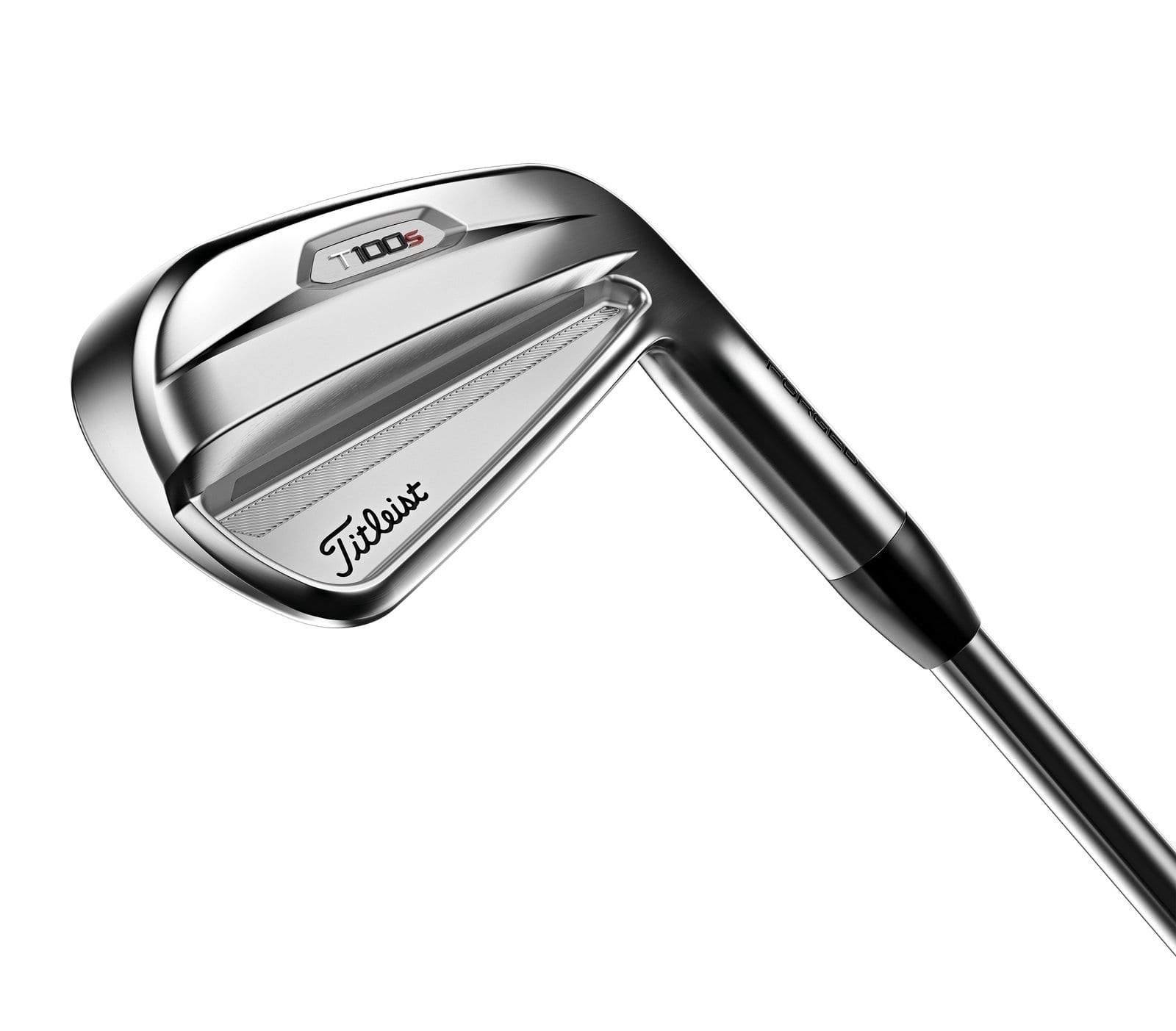
The 2021 T100S cavity. The badge reads T100 with a red lowercase s, and no set of T150 irons carries that mark. Image from the Titleist media center.
The trouble with counting this way is that shops don’t agree. A used-club listing from December 2025 sells a T100S and T200 combo set as “2023년 발표된 3세대 디자인” (세컨드골프, a Korean used-club shop, December 3, 2025). Read straight, that puts a T100S in a year when T100S was no longer sold. The shop may have meant the T200 half of the set.
Either way, that’s the problem. The number doesn’t tell you which club it’s counting. If you searched for a third generation T100S because you saw a label like that, there isn’t one. That slot is the first T150.
So the reliable move is to ignore the number and read the club. The model name is stamped in the back cavity, and it splits the timeline cleanly in half. T100S means 2020 or 2021. T150 means 2023 or 2025.
The loft stamp adds nothing here, which is the opposite of how it works on the T100, where the P tells you the era.
What actually changed: lie angle once, the body twice
Loft is the spec everyone checks, so here are the two that did move.
Lie angle is how the shaft sits relative to the ground when the sole is flat. Too upright or too flat, and the face points off line at impact. It changed in 2021, in the two longest irons only. Length has never changed at all.
| Club | Lie, 2020 | Lie, 2021 onward | Length, all four releases |
|---|---|---|---|
| 3 | 60° | 61° | 39.00” |
| 4 | 61° | 61.5° | 38.50” |
| 5 | 62° | 62° | 38.00” |
| 6 | 62.5° | 62.5° | 37.50” |
| 7 | 63° | 63° | 37.00” |
| 8 | 63.5° | 63.5° | 36.50” |
| 9 | 64° | 64° | 36.00” |
| P | 64° | 64° | 35.75” |
| W | 64° | 64° | 35.50” |
Sources: the same four Titleist spec tables, retrieved 2026-09-20.
Each page gives one lie row and one length row for the whole lineup. So if you own the T100 of the same year, these are your numbers too. And if you pull up the 2025 page and see a 2-iron at 60.5° and 39.5”, that row isn’t a T150. The set starts at the 3-iron.
That 2021 change matters if you’re buying one club to fill a hole. A 2020 3-iron sits a degree flatter than a 2021 or later set around it. A fitter can bend it, and it’s worth knowing before you pay.
If you’ve never checked this number on your own clubs, a fitting counter can put you on a lie board in a few minutes. It’s worth asking what they charge before you book.
Everything else that changed is construction. What follows is Titleist describing its own work, not anything I’ve tested.
2020 and 2021: the T100S years
Titleist announced the T100S in January 2020, as an addition to the T-Series already on sale. Titleist built it as a fully forged head with a two-level cavity in the back. Tungsten weight went into the heel and toe of the mid and long irons (Titleist Newsroom, January 16, 2020).
If you land on that press release while dating a set, its body text reads 2019. The announcement itself is dated January 16, 2020.
The 2021 refresh changed the tungsten and how it was bonded in. It also brought a brushed chrome finish, a sole shape Titleist called tour-contoured, and the lie change above. This is also the release where Titleist’s description starts mentioning a muscle channel, a slot behind the face that lets the face flex more (Titleist, retrieved 2026-09-20).
2023: the name changes and the head grows
T150 arrived in August 2023. Titleist’s release frames it as built on the same forged platform as T100, and never uses the word replacement. But Marni Ines, Titleist’s Director of Iron Development, says where the shape came from.
“We also listened to those players that felt as though the shape of T100•S was on the smaller side. With this iron, we took that feedback and increased the topline thickness and widened the sole.” (Titleist Newsroom, August 3, 2023)
The topline is the top edge you look down on at address, with the club soled behind the ball. The sole is the part defined above, and here it got wider.
So the loft chart carried over and the head did not. If you’re cross-shopping a 2021 T100S against a 2023 T150, that’s the thing to know: same numbers, bigger club.
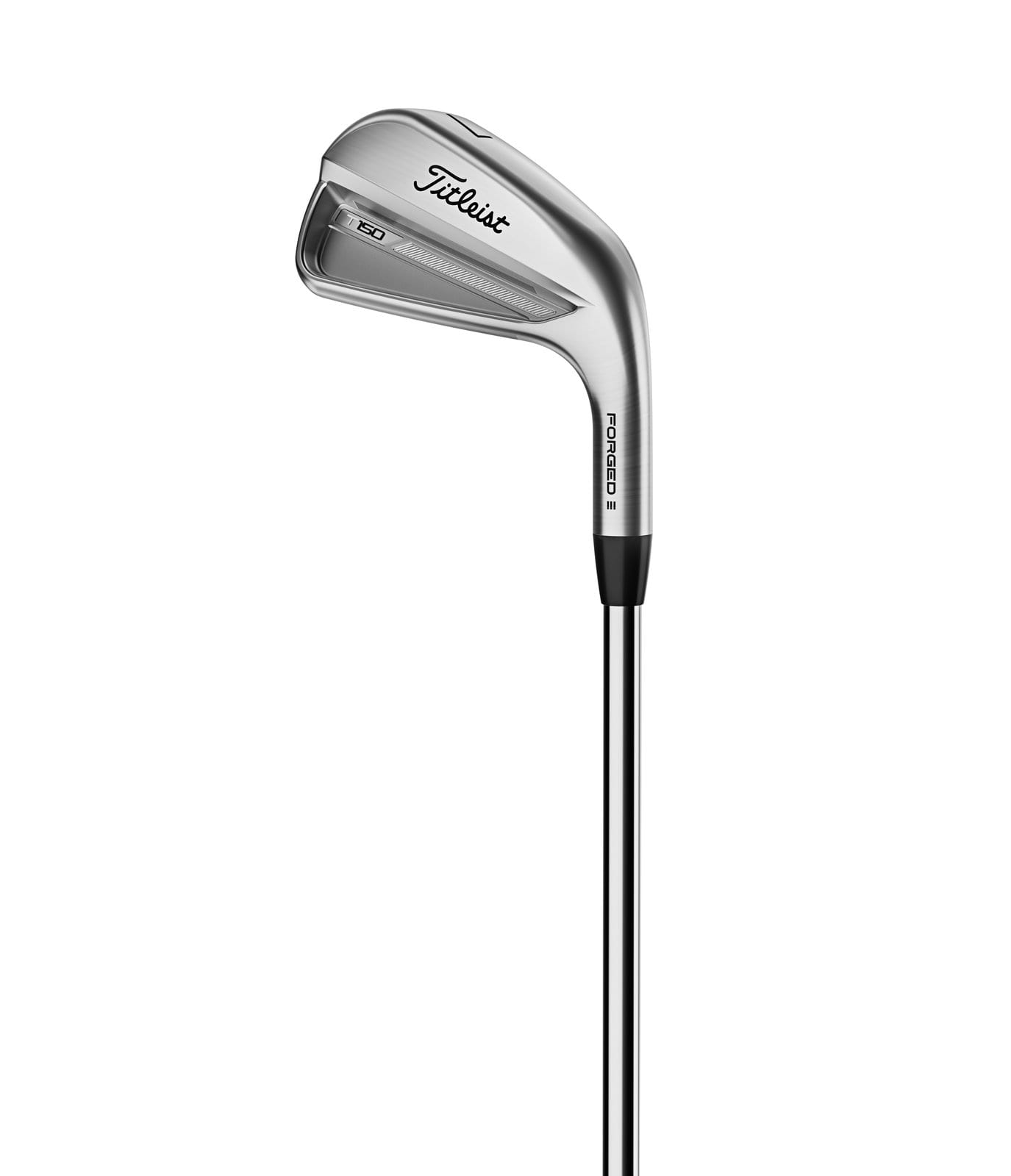
The 2023 T150 cavity, with the name on the bar running across the back. Image from the Titleist media center.
2025: same lofts, new internals
The current set keeps all nine numbers and rebuilds what’s behind them. Titleist splits the tungsten weight into two pieces, and the muscle channel now runs down to the 7-iron. It also varies the thickness of the face, so off-center strikes hold their speed better (Titleist Newsroom, July 10, 2025).
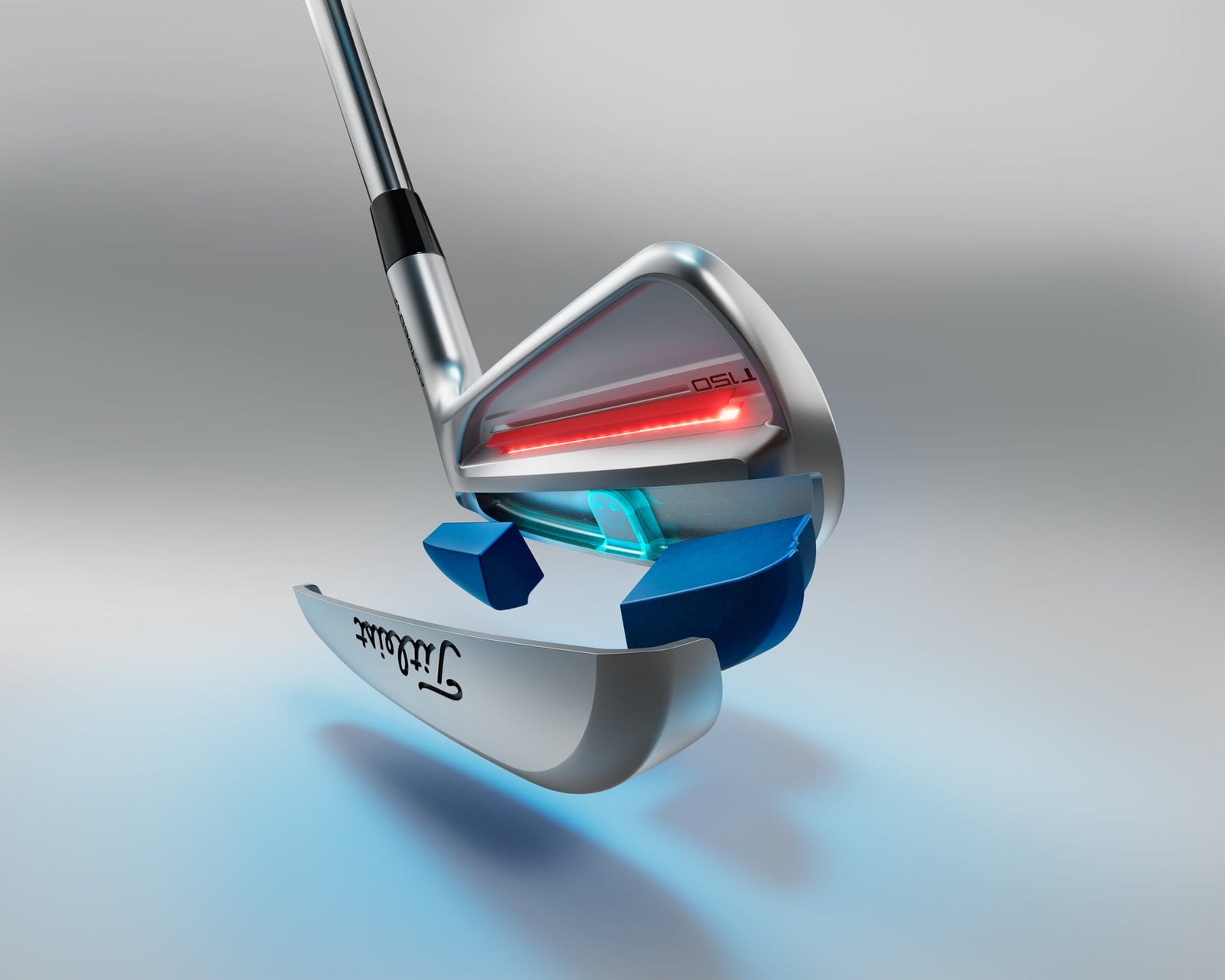
The 2025 construction as Titleist illustrates it. The blue blocks are the split tungsten weighting. Image from the Titleist media center.
From the outside there’s very little to see. Golfalot’s review of the 2025 set puts it bluntly.
“The only real difference comes in the design of the bar on the back cavity, as well as perhaps a slightly darker grey colour used.” (Golfalot, July 10, 2025)
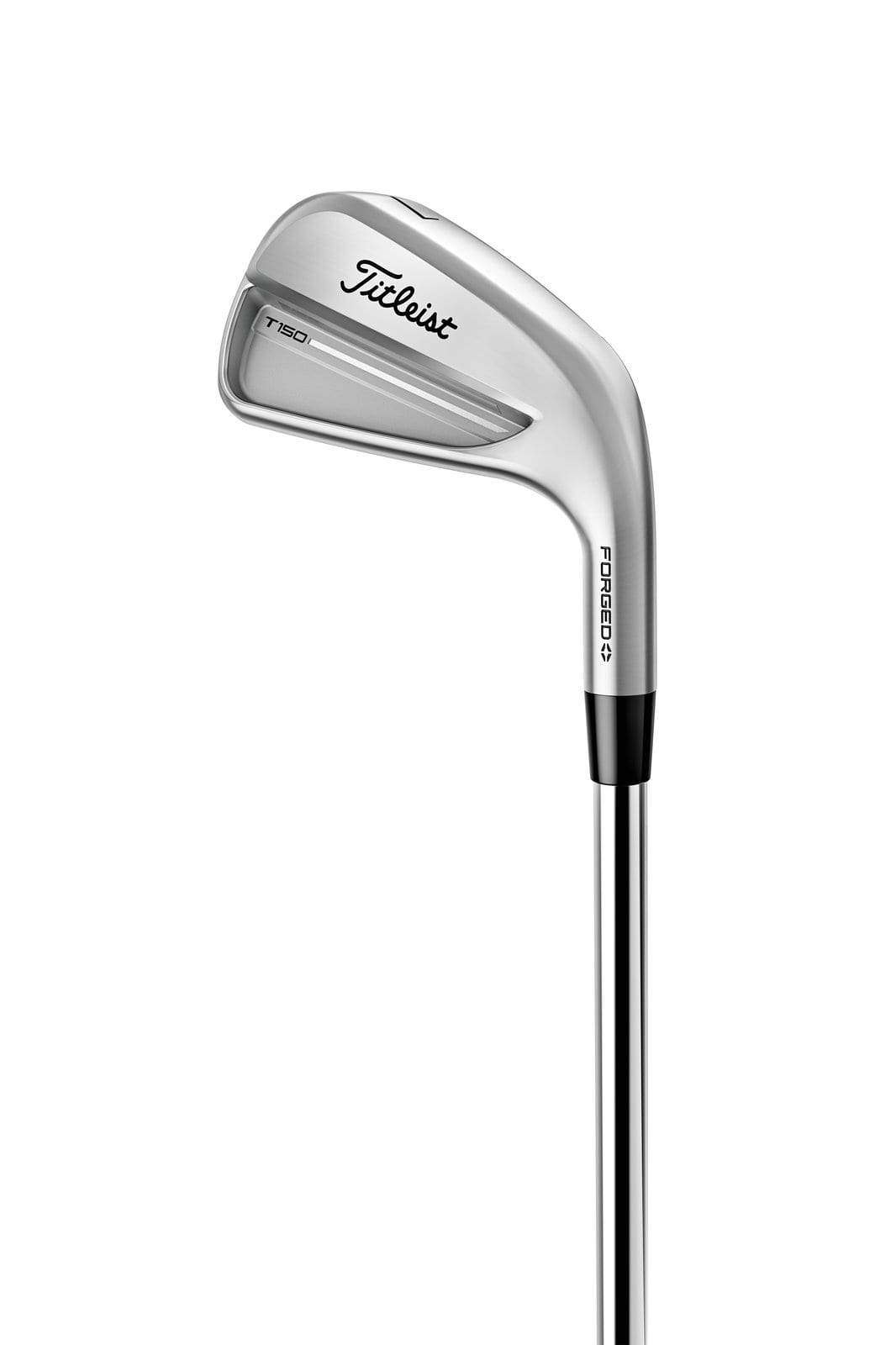
The 2025 cavity, for comparison with the 2023 photo above. The bar is the tell. Image from the Titleist media center.
Which one should you buy used?
You can throw out the loft column first. It’s identical across every set you’re choosing between. Here is what’s actually different, in the order I’d look at it.
Head size is the real fork. T100S was the smaller shape, and Titleist grew the topline and sole for T150 because players asked. If you liked the T100S profile, a T150 is not the same club with a new name. You’ll want to look at both at address before the price tag decides for you.
Next, the 3-iron and 4-iron lie, if you’re buying a single club. A 2020 set is a degree flatter in the 3-iron than everything after it. The 4-iron is half a degree flatter. Across a full set it’s internally consistent and fine.
Then what the rest of your bag is. If you already play T100, dropping a single T150 iron into the set leaves a wider step than your own set uses.
A T150 6-iron at 28° into a 2023 T100 7-iron at 34° is a 6° jump. Your own T100 6-iron is 30°, or 29° in the 2025 set, so that join steps 4° either way (Titleist 2023, 2025, both retrieved 2026-09-20). Against a 2025 T100 7-iron at 33° the jump is 5°. Neither is wrong, but it’s worth knowing which one you’re creating.
Last, the internals, and price after that. The 2023 and 2025 sets are the same nine lofts, the same lie and the same length. By Golfalot’s account they’re nearly the same club to look at. The argument for the 2025 set is the new face and tungsten layout, and that’s a thing to hit rather than to read about.
There’s one more step to check before you pay, and it’s the one that caught me out on my own set.
I play the 2023 T100, so my P reads 46 and my first wedge is a 52. That six degree jump was wide enough that I ended up buying the 50° W to close it. What that cost me, and the gap I still carry, is the long version.
A T150 P is 44. If your first wedge is a 52, that step is eight degrees, sitting right in the range you play approach shots from. That spacing through the bottom of your bag is your gapping, and eight degrees is a hole in it.
The 48° W in the set exists to fix exactly this. It turns 44 to 52 into 44, 48, 52.
If you’re buying a used T150 or T100S set that stops at the P, you’ll want to budget for the W. A wedge around 48 does the same job. How the 52 and 56 pairing works is worth reading before you pick.
Stronger lofts push this problem down the bag every time the wedges stay put. It’s the same reason two PING irons can stamp their 7-irons 8.5° apart.
Frequently asked questions
Are T100S and T150 lofts the same?
Yes, exactly. Both run 19, 22, 25, 28, 32, 36, 40, 44 and 48 degrees from the 3-iron to the W. That has been true for every release of both models since 2020.
How do I tell which T150 I have, 2023 or 2025?
Not from the lofts, the lie or the length, because all three are identical. The back cavity bar was redesigned for 2025, and Golfalot’s reviewer thought the gray looked slightly darker. For a definitive answer you need the serial number and a Titleist dealer.
Is there a third generation T100S?
No. T100S was sold in the 2020 and 2021 T-Series, and then the slot became T150 in 2023. If a used listing calls a T100S a third generation set, the shop is counting T-Series releases. Either it has the year wrong, or the label belongs to another club in the set.
What loft is the T150 pitching wedge?
44 degrees, in every release. The matching W is 48 degrees. If your set stops at the P, that leaves an eight degree gap to a 52.
Is the 2025 T150 worth upgrading to from 2023?
Nothing in the specs argues for it, because there is no spec difference. The case is the new face and tungsten layout, and the only way to judge that is to hit both.
Terms in this article
- Loft: the angle of the clubface, measured from vertical. More loft means a higher, shorter shot.
- Strong loft: a lower loft number than the traditional figure for that club number. The T150 7-iron at 32° is strong next to the 34° a 2023 T100 carries, and two current PING irons alone span 26.5° to 35°.
- Lie angle: the angle between the shaft and the ground when the sole sits flat. Too upright or too flat pushes the face off line at impact.
- At address: the position with the club soled behind the ball, ready to swing. It’s how you actually see the head.
- Topline: the top edge of the head, the part you look down on at address.
- Sole: the bottom face of the head, the part that slides along the turf.
- Bounce: the angle of the sole that keeps the leading edge from digging into turf or sand.
- Muscle channel: a slot behind the face that lets the face flex more, which Titleist uses to raise ball speed and launch.
- Tungsten weighting: dense metal placed in the heel and toe to move the center of gravity without changing the outside shape.
- Gapping: the spacing of lofts through your set, which decides whether your clubs produce evenly spaced distances.