
Are Kirkland Golf Balls Good? Yes, as a Lost Ball Upgrade
Kirkland golf balls are 3-piece urethane balls, under $2 a ball in 2025 and 2026 reviews. The newest version tested near tour balls. The catch: uneven compression.
For what I wanted, Kirkland golf balls are good. I bought them instead of lost balls, paying a little more to get new ones. About three boxes later, Kirkland is the ball I mostly play, and I’ve been very happy with it.
Independent tests add a reason, and one real catch. The newest version came out close to a Titleist Pro V1 in a robot test. The Pro V1 is a tour ball, a maker’s top urethane model. But the balls in a Kirkland box don’t all compress the same.
Verdict
- A Kirkland Signature ball is a 3-piece ball with a urethane cover, the cover type tour balls use. MyGolfSpy’s Ball Lab put the 2025 v3.0 at $19.99 per dozen (MyGolfSpy Ball Lab, September 23, 2026). That works out to about $1.67 a ball.
- In MyGolfSpy’s robot test, the v3.5 was “slightly longer and straighter than the Pro V1” off the driver and similar on 40-yard wedges. It fell behind with the 7-iron (MyGolfSpy, June 9, 2025). That was the v3.5. Costco Korea’s box image says v3.0, and the 2025 v3.0 run scored 85 in MyGolfSpy’s Ball Lab quality check.
- The catch is consistency. In one 2025 batch, compression ran from 87.0 to 97.5 across 36 balls (MyGolfSpy Ball Lab, September 23, 2026).
- It fits best if you buy lost balls and want new ones for a little more. If you need every ball to match, a tour ball is still the safer buy.
Why I switched from lost balls to Kirkland
My reasoning was simple. If I was going to spend money on lost balls anyway, I’d rather spend a bit more and get new ones. A lost ball is a used ball someone found on a course, cleaned and resold.
So far I’ve gone through about three boxes. I bought two at a Costco store and one online. I don’t remember exactly what I paid, only that it felt like good value for new balls. The prices in this article come from published reviews, not my memory.
I was very satisfied, and it’s still the ball I mostly play. That’s as far as my own verdict goes. I’m not going to put distance or spin numbers on it from memory. Those come from the tests below.
Two things I can’t tell you. I’ve never played used Kirkland balls, so I can’t say whether they beat new ones on value. And I don’t know which version my balls were. They’re all gone, and I didn’t photograph them.
What a Kirkland golf ball is
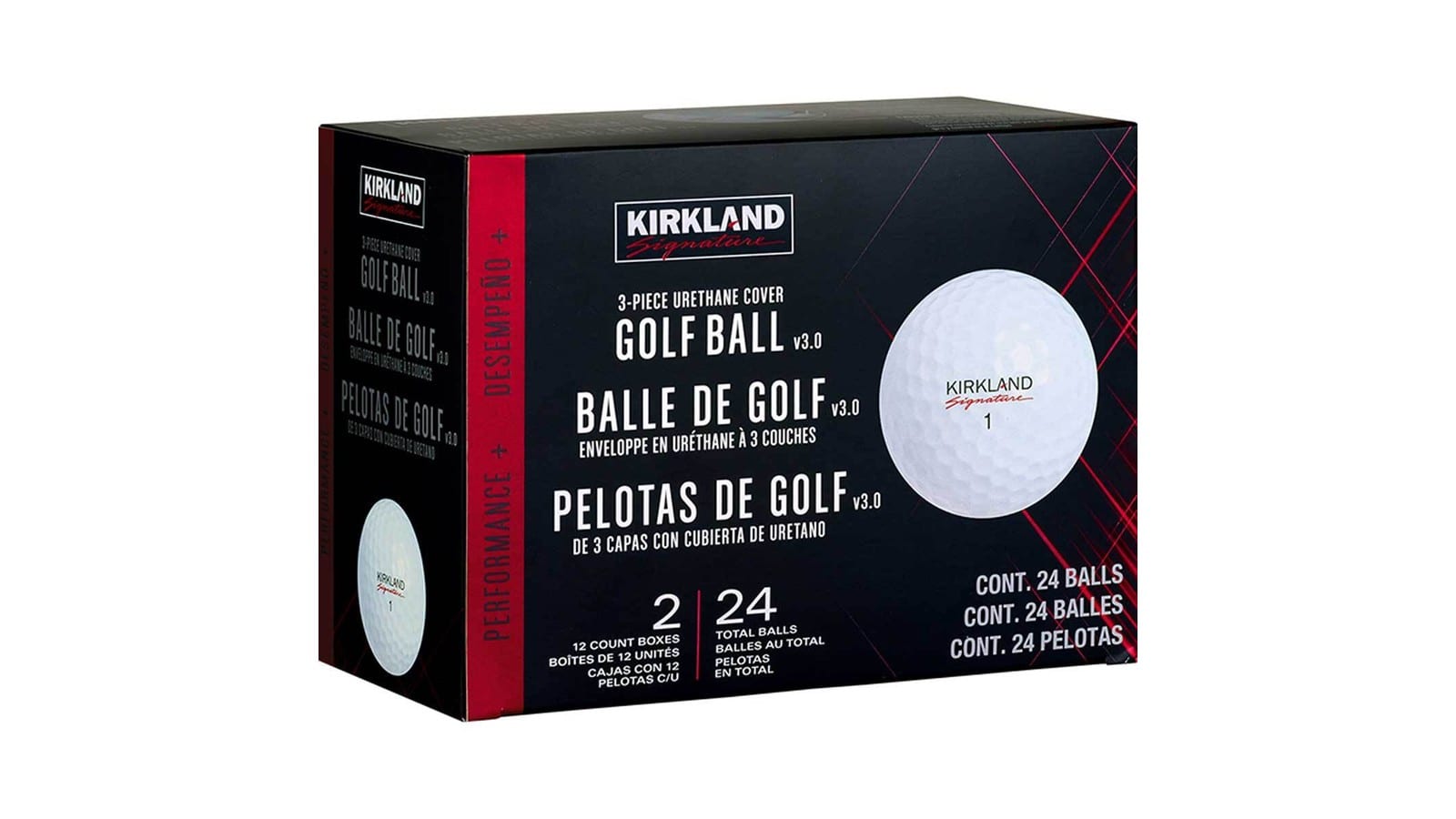
Kirkland Signature is Costco’s house brand. Here’s the ball as Costco Korea’s online listing described it on 2026-10-08. That’s the listing the cover photo comes from.
| Kirkland Signature golf ball | |
|---|---|
| Construction | 3-piece |
| Cover | Polyurethane (urethane) |
| Mantle | Ionomer |
| Core | Low compression, per Costco |
| Dimples | 338 |
| Pack | 24 balls (two 12-ball boxes) |
| Price | See prices below |
| Version on the box | v3.0 |
Source: Costco Korea, product listing read 2026-10-08.
A 3-piece ball has a core, a middle layer and a cover. The middle layer is the mantle. A urethane cover is softer and grabs the club grooves more than an ionomer cover, the hard plastic most cheap balls use. Dimples are the small dents in the cover that help the ball fly. If you want the longer version, 2-piece vs 3-piece golf balls covers it. That article recommends a low-spin 2-piece ball if you slice a lot and lose balls off the tee, because urethane spins more off the driver. Kirkland has a urethane cover, so that advice applies to it too.
Costco’s US product page didn’t list a price when I checked on 2026-10-08, so the prices here come from reviews. MyGolfSpy’s Ball Lab put the 2025 v3.0 at $19.99 per dozen (MyGolfSpy Ball Lab, September 23, 2026). That works out to about $1.67 a ball. When the v3.5 came out, Gear Patrol listed $34.99 for two dozen, about $1.46 a ball, against about $5 a ball for a Pro V1 (Gear Patrol, July 11, 2025). Prices move, so check your own Costco.
How to tell v3.0 from v3.5
Costco released a v3.5 in summer 2025. Look at the arrow on the side of the ball. A hollow, outlined arrow means v3.5. A thin line arrow means v3.0 (Gear Patrol).
The box at the top of this page is Costco Korea’s own product photo, and it says v3.0. I can’t confirm which version Korean stores actually stock today.
What independent tests found
Most of what’s known about this ball comes from MyGolfSpy, which tests golf balls with a robot and a launch monitor. A launch monitor measures ball speed, spin and distance.
The cleanest comparison is the v3.5 against the 2025 Pro V1. The robot swung the driver at 100 mph and the 7-iron at 81 mph. Swing speed is how fast the clubhead is moving at impact. If your driver swing is slower than 100 mph, your results may differ from the robot’s. The February test below covered slower swings too. The swing speed and distance post shows what the average amateur swings and carries.
| Shot | v3.5 vs 2025 Pro V1 |
|---|---|
| Driver, 100 mph | “Slightly longer and straighter than the Pro V1” |
| 7-iron, 81 mph | The one test where Kirkland fell behind (“two out of three ain’t bad”) |
| 40-yard wedge | Performed “similarly enough” |
| Compression | Kirkland 97, Pro V1 91 |
Source: MyGolfSpy, June 9, 2025. MyGolfSpy called it “the best ball Kirkland has released since the 2016 original.”
Compression is how much the ball squashes under a set load, given as a number. Higher means firmer.
MyGolfSpy’s bigger 2025 ball test, written up in February 2026, also tested the v3.5 and landed in the same place. Kirkland wasn’t the longest ball, but it trailed by a few yards at most. Driver ball speed and spin stayed “tightly grouped across all swing speeds,” fast, moderate and slow. With the 7-iron it flew a little lower than tour balls and still had enough spin. On 35-yard wedges it spun more than ionomer balls and less than the spinniest tour balls. The verdict, against $50 tour balls: “you’re giving up very little” (MyGolfSpy, February 3, 2026).
So for most of your shots with the v3.5, the tests say you’d give up little. At Gear Patrol’s July 2025 prices, about $1.46 a Kirkland ball against about $5 for a Pro V1, the Pro V1 cost more than three times as much. That’s still not the same as “a Pro V1 for less.” The iron result and the consistency problem below are why.
The catch: not every ball compresses the same
In September 2026, MyGolfSpy’s Ball Lab measured 36 balls from a 2025 batch labeled v3.0. Ball Lab is MyGolfSpy’s quality check: it measures each ball and looks for defects.
The good news: none of the 36 were defective. The ball scored 85 out of 100, “Conditionally Recommended.” The bad news is in the details. Compression ran from 87.0 to 97.5, a 10.5-point spread, which earned a C+. Compression symmetry got a D. Ball Lab defines it as “how evenly compression is distributed across three points on each individual ball.” Ball Lab warned that this can mean speed differences from one ball to the next (MyGolfSpy Ball Lab, September 23, 2026). Two balls from the same box could come off your driver at slightly different speeds.
The v3.5 test showed the same pattern on a smaller sample. Kirkland’s balls varied by 6 compression points, the Pro V1s by under 3 (MyGolfSpy).
Results also depend on which run you get. That same June 2025 article reports a Ball Lab score of 45 for an earlier v3.0 run, with large swings in compression and size. The 2025 run, also labeled v3.0, scored 85.
Same label, very different scores. The box tells you the version. It doesn’t tell you which run is inside.
Durability has a history too. MyGolfSpy described the Performance Plus balls that followed the 2016 original as “short, spinny and not terribly durable” (MyGolfSpy). I haven’t found official durability data for the current ball.
Who Kirkland suits, and who it doesn’t
The question isn’t whether Kirkland matches a Pro V1. It’s what you’re playing now and what you’d give up by switching.
| You’re playing now | Kirkland? | Why |
|---|---|---|
| Lost balls, and you’d pay a little more for new | Yes. This was me | New balls, a urethane cover, and tests that put the newest version near tour balls |
| Lost balls, and you lose several a round | Maybe stay | In the tests behind lost golf ball grades, clean used balls played close to new |
| Cheap 2-piece distance balls | Only if your tee shots stay in play | A urethane cover gives more wedge spin than ionomer, but it also spins more off the driver. If you slice a lot and lose balls off the tee, 2-piece vs 3-piece golf balls says stay with 2-piece |
| A tour ball, and you want every ball identical | Stay | Kirkland’s ball-to-ball compression varied more than the Pro V1’s in MyGolfSpy’s side-by-side test, and Ball Lab graded its consistency C+ |
| A tour ball, and your irons matter most | Stay, or test it yourself | The 7-iron was the one robot test the v3.5 lost |
If you’re in the first row, that’s the trade I made. You know you’re getting new, unhit balls of one model, for a bit more than lost balls. You don’t get a guarantee that ball 3 and ball 17 in the box play exactly alike.
If you lose balls in the water every round, you may be better off staying with lost balls. A lost new ball costs more than a lost used one. And in the tests covered in lost golf ball grades, clean, non-refinished used balls played close to new ones. Titleist’s own guide reports a 14.4% distance loss for lost balls (Titleist Korea), but it doesn’t say how it tested, so weigh that figure with care.
FAQ
Who makes Kirkland golf balls?
Not Costco itself. The 2016 original was a 4-piece ball made by Nassau in Korea. Since the 2018 3-piece version, SM Global has made them (The Golf News Net, April 3, 2018). Country of origin varies by batch. Costco Korea lists China, and the 2025 batch MyGolfSpy’s Ball Lab tested was made in Vietnam (MyGolfSpy Ball Lab).
Are Kirkland golf balls legal for tournaments?
Costco’s US listing for the neon yellow two-dozen pack says the balls conform to USGA and R&A rules (Costco US). I couldn’t open the USGA’s own conforming ball list to confirm a specific version. If you play in an event that requires listed balls, check that list for the version printed on your ball.
Terms in this article
- Lost ball: a used ball found on a course, cleaned and resold.
- 3-piece ball: a ball with a core, a middle layer (mantle) and a cover.
- Mantle: the middle layer of a 3-piece ball, between the core and cover.
- Urethane cover: a soft cover that grabs the club grooves. Tour balls use it.
- Ionomer cover: a harder plastic cover used on most cheap balls. Less wedge spin.
- Dimples: the small dents in a ball’s cover that help it fly.
- Compression: how much a ball squashes under a set load. Higher means firmer.
- Compression symmetry: in Ball Lab’s words, “how evenly compression is distributed across three points on each individual ball.”
- Tour ball: a maker’s top urethane model, like the Titleist Pro V1.
- Ball Lab: MyGolfSpy’s quality check that measures each ball and looks for defects.
- Launch monitor: a device that measures ball speed, spin and distance.
- Swing speed: how fast the clubhead is moving at impact.