
Lost golf ball grades: a low grade is fine, refinished isn't
Lost golf ball grades aren't standardized, and tests found clean used balls play close to new. Refinished balls flew shorter. Here's which grade to buy.
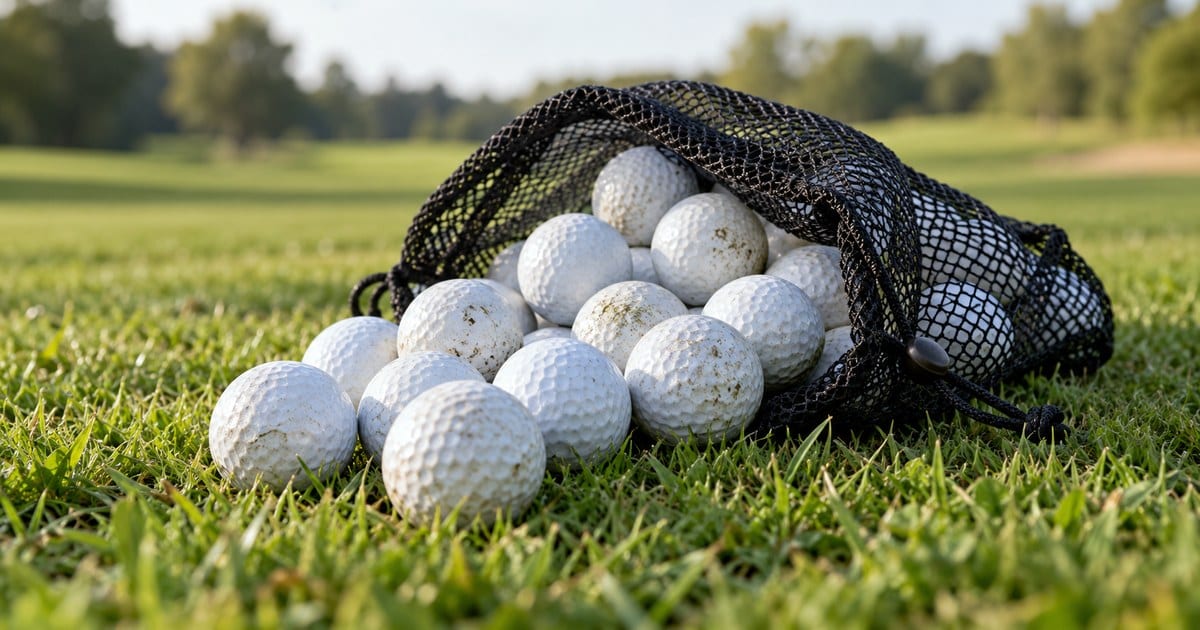
There’s no official grading system for lost golf balls. Each seller writes its own scale, and the same label can mean different things at two shops. A Korean shopping guide says it plainly: there is no unified standard, and sellers often use their own inspection rules (Dealpang).
A lost ball here means a used ball that someone found on a course or fished out of a pond, then cleaned and resold. US shops usually call them used or recycled balls.
The Rules of Golf use “lost ball” for something else: a ball you can’t find during a round. That one costs you a penalty, covered in golf penalty strokes.
The grade mostly describes how the ball looks. In the tests I found, clean used balls played close to new ones. The bigger difference came from a different question: was the ball refinished, meaning stripped and repainted? In one robot test at an 85 mph swing speed, refinished balls carried 6 yards shorter than new ones (MyGolfSpy).
Carry is how far the ball flies before it first lands. Swing speed is how fast the clubhead is moving when it reaches the ball.
The short answer
- Ball grades aren’t standardized. “AAA” means “play like new” at GlobalGolf and is the lowest grade at LostGolfBalls (GlobalGolf, LostGolfBalls).
- A peer-reviewed study left new Pro V1s in ponds for up to 12 months and found no significant distance loss (Golf Science Journal). A Titleist guide reports a 14.4% loss but doesn’t say how it tested (Titleist Korea).
- In a launch monitor test, nobody could tell new balls from three used grades, and the numbers matched too (Plugged In Golf).
- Refinished balls are the ones to skip. They carried 6 to 13 yards shorter off the driver in a robot test (MyGolfSpy).
- If you lose balls off the tee, a lower grade of a model you like is fine. You’ll want to read the seller’s own grade page and check that the balls aren’t refinished.
Lost golf ball grades: every seller writes its own scale
Here’s how three US sellers describe their grades, top to bottom. These are the sellers’ own words, retrieved 2026-10-01.
| Seller | Top grade | Middle | Lowest |
|---|---|---|---|
| LostGolfBalls | Pristine: “no wear” | Mint (5A), Factory Refinished, Near Mint (4A) | Good (3A): “slight scuffs, blemishes, minor discoloration and smudged print” |
| GlobalGolf | Mint: like “a ball that has been hit once” | AAA: “look, feel, and play like new”; AA: “small mark or possible fading to the print” | Practice: “small to moderate scuffs” |
| Golf Ball Planet | Mint: “no visible wear” | Grade A: “1-3 holes of wear”; Grade B: “9 holes of wear” | Hit Away: “practice and range use” |
Sources: LostGolfBalls, GlobalGolf, Golf Ball Planet.
Take “AAA.” At GlobalGolf it’s a ball that plays like new. At LostGolfBalls, 3A is the bottom of the scale, with scuffs and smudged print. Same letters, different balls.
I started on lost balls in Korea, where shops use a different set of letters. The common ones are S, A and B. One shopping guide describes A-grade as close to a new ball with good shine, and B-grade as having pen marks and scratches (Enuri). I couldn’t find any seller that defines S-grade in writing.
So the letter only means something next to that seller’s own description. You’ll want to read their grade page before you compare prices between shops.
Do lost golf balls fly shorter after time in water?
Two sources disagree here: a peer-reviewed study and Titleist’s own ball guide.
The newer one is a 2023 study in the Golf Science Journal. Researchers sank new 2016 Pro V1s in three ponds in Michigan and pulled them out after 1, 3, 5 and 12 months. A robot hit them with a driver. There was no significant effect on total distance, only a trend of about 1 yard shorter, or 0.5% (Golf Science Journal).
The Pro V1 is Titleist’s premium ball, the model most of these tests use.
If the balls you buy were scuffed before they went in the water, this study can’t tell you about them. It sank brand-new balls, all one model. It was also partly funded by Golf Ball Divers, a company that sells used balls.
The other side comes from Titleist. Its Korean ball guide says that in “one test,” lost balls gave up 22.3% of their spin and 14.4% of their distance (Titleist Korea). It doesn’t say which club, which ball, how long it was in water, or who tested it. A Titleist representative told Golf.com that a ball with an unknown time in water has “a high probability” of not performing as designed (Golf.com).
An older test sits between the two. A 1996 Golf Digest robot test found a three-piece ball carried 6 yards shorter after 8 days underwater, and 15 yards shorter after 6 months (US Patent 6,623,382, quoting Golf Digest). A three-piece ball is built from a core, a middle layer and a cover. That test is 30 years old, and balls have changed since.
The USGA sets golf’s rules and equipment limits in the US. Its John Spitzer told Golf.com that modern balls have a water-resistant coat. If it’s undamaged, he expects no significant loss for “one to two years” (Golf.com).
If I had to pick, I’d go with the 2023 study. It’s the newest of the three and the only one that’s peer-reviewed. Titleist’s figure may be right, but nothing in the guide lets you check it.
Does a higher grade fly farther?
In a Plugged In Golf test, a golfer hit new Pro V1s, three used grades and refinished balls from LostGolfBalls on a launch monitor. “No one was able to distinguish between the new, used, or refinished golf balls.” Ball speed, smash factor and spin matched with the driver (Plugged In Golf).
A launch monitor is a device that measures each shot’s speed, spin and distance. Smash factor is ball speed divided by swing speed. It shows how cleanly you hit the ball.
If you buy the lowest grade, you’ll get visible scuffs, and the tester thought those might matter outdoors in wind. The test was indoors, so it can’t tell you whether they do.
Recycled vs refurbished golf balls: skip the repainted ones
A recycled ball is only washed. A refinished ball, also sold as refurbished, has had its paint and clear coat, the shiny top layer, stripped off. Then it’s repainted and restamped. In Korea these are sold as non-refinished and refinished balls (GOLFZON).
MyGolfSpy put 24 refinished Pro V1s against new ones on a hitting robot. The refinished balls were slower and shorter at every speed. They were older Pro V1s, stamped 2015 and 2017, so part of the gap you’d see could be the model year, not only the paint.
With irons, the refinished balls lost 7 yards at 115 mph and 1.5 yards at 85 mph. If you don’t know your swing speed, the swing speed and distance post shows what the average amateur swings and carries.
MyGolfSpy’s explanation is the paint. Extra layers make the dimples, the small dents in the cover, shallower and smoother at the edges. The refinished balls were also heavier and firmer, averaging 1.6301 ounces, and 23 of the 24 were over the USGA’s 1.62-ounce limit (MyGolfSpy). A ball over that limit isn’t legal under the Rules of Golf.
If you’ve read that refinished balls test the same as new, that’s Plugged In’s indoor test with a person hitting. A robot removes swing-to-swing differences, so for distance I’d go with MyGolfSpy’s numbers.
Titleist’s parent company, Acushnet, and a refinisher called Nitro Leisure sued each other over repainted Titleist balls. The 2004 settlement let Nitro Leisure keep selling recycled balls, but not refinish them with a new coat of paint or the Titleist name (SGB Online).
How do you spot one? LostGolfBalls says refinished balls carry a small “Refinished” stamp on one pole (LostGolfBalls). In Korea, a buying guide suggests checking whether pond or refinished balls are mixed in (Dealpang). LostGolfBalls even lists “Factory Refinished” as a grade of its own, between Mint and Near Mint.
So which lost ball grade should you buy?
Grades are a price ladder for looks. As far as the tests show, distance doesn’t follow the letter. So the real choices are the ball model and whether it’s refinished.
Buy a lower grade if
- You lose balls off the tee. That was me. I started with B-grade lost balls in Korea, moved up to A-grade about a year later, and still lost them whenever I hit driver.
- The ball is for practice, a simulator, or a casual round.
- You can see a photo of the actual batch, so you know what the scuffs look like.
Pay for a higher grade if
- You want the ball to look new, with clean logos and print.
- You worry about the scuff caveat from Plugged In’s test. The lowest grade is the one with visible marks.
Skip these at any grade
- Refinished balls, if what you’re after is a cheap Pro V1. You don’t get the same ball back.
- Listings that don’t say which model, or whether refinished balls are mixed in. Pond balls are a smaller worry: the 2023 study found no significant loss after a year in water.
Which model to buy is a separate question. If you’re choosing between a cheaper two-piece ball and a premium ball like the Pro V1, start with 2-piece vs 3-piece golf balls.
FAQ
Are lost golf balls as good as new?
Clean, undamaged ones were close in the tests I found. A 2023 pond study found no significant distance loss after up to 12 months in water (Golf Science Journal). Titleist reports a larger loss without giving its method.
What does AAA mean on used golf balls?
It depends on the seller. At GlobalGolf, AAA balls “look, feel, and play like new.” At LostGolfBalls, 3A is the lowest grade (GlobalGolf, LostGolfBalls).
Are refinished golf balls bad?
In MyGolfSpy’s robot test, they carried 6 to 13 yards shorter off the driver than new balls, and most were over the USGA weight limit (MyGolfSpy).
What grade of lost balls should a beginner buy?
A lower grade of the model you want is fine, especially if you lose balls off the tee. You’ll want a listing that says the balls aren’t refinished.
Terms in this article
- Lost ball: a used ball found on a course or in a pond, then cleaned and resold.
- Used ball / recycled ball: the US names for a lost ball that has only been cleaned.
- Refinished ball / refurbished ball: a used ball that has been stripped, repainted and restamped.
- Carry: how far the ball flies before it first lands.
- Three-piece ball: a ball built from a core, a middle layer and a cover.
- USGA: the body that sets golf’s rules and equipment limits in the US.
- Pro V1: Titleist’s premium ball, the model most of these tests use.
- Grade: a seller’s label for a used ball’s condition. There’s no shared standard.
- Smash factor: ball speed divided by swing speed. It shows how cleanly you hit the ball.
- Swing speed: how fast the clubhead is moving when it reaches the ball.
- Dimples: the small dents in a ball’s cover that help it fly.
- Launch monitor: a device that measures each shot’s speed, spin and distance.