
Golf penalty strokes: OB is 1, bunker sand is 2, flagstick is 0
Three mistakes that feel alike carry three different penalties. Out of bounds costs one stroke, testing bunker sand costs two, and the flagstick costs nothing.
Your drive clears the boundary fence. Your wedge brushes the sand on the way back. Your putt rattles the flagstick you left in the hole.
Ask the group and you’ll get three confident answers, and at least one of them will be two strokes. The Rules of Golf charge one stroke, two strokes, and nothing at all, in that order. Here’s what each costs and what you do next.
The short answer
- A ball out of bounds or lost costs one penalty stroke and sends you back to where you played the last shot (Rule 18.2b). Some courses adopt a Local Rule letting you drop near where it was lost for two strokes instead.
- A ball in a penalty area costs nothing if you play it where it lies (Rule 17.1b). Taking relief costs one stroke, with drop options that keep you forward (Rule 17.1d).
- Testing bunker sand, brushing it in a practice swing, or grounding your club behind the ball is two strokes (Rule 12.2b). Raking to look after the course and leaning on a club are free.
- A ball that hits the flagstick left in the hole is no penalty (Rule 13.2a). That one changed in 2019.
Out of bounds, lost balls, and penalty areas: one stroke, sometimes none
One stroke. Rule 18.2b says a ball that is out of bounds or not found must be played under stroke-and-distance relief, adding one penalty stroke (R&A, Rule 18, retrieved 2026-09-01).
A penalty stroke is a stroke added to your score that you never actually hit.
The reason this feels like two is the rest of that sentence. Stroke and distance means you pay the stroke and give back the ground the shot covered. Send a tee shot out of bounds, add one, and you’re playing your third from the tee. What you actually lose is the distance that drive was worth.
Two details decide whether you’re even in this situation. A ball is out of bounds only when all of it sits outside the boundary edge. Any part touching the ground inside keeps it in play.
You get three minutes to look, timed from when you or your caddie start searching. It was five before 2019 (The R&A, 2019 Rules Modernisation archive materials, page 4, retrieved 2026-09-01).
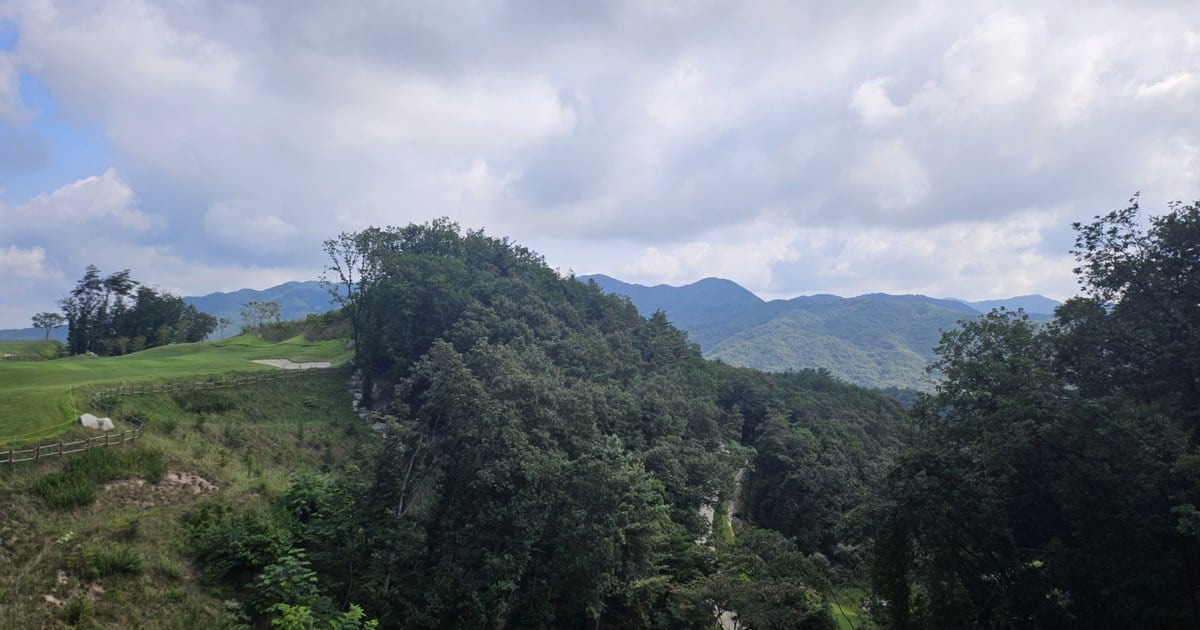
The reeds below are from a round in August 2025, at a mountain course outside Seoul. They sit between where I was standing and the fairway beyond. In grass like that the three-minute clock matters more than the penalty stroke does. Looking at it, I doubt you’d find a ball in there inside three minutes unless you saw it drop.
 My own photo. Mountain course outside Seoul, August 2025.
A penalty area is water or rough ground the course has marked with yellow or red stakes and lines. Same one stroke, better options.
You only pay that stroke if you take relief. If the ball is playable where it sits, you can play it and pay nothing. Rule 17.1d gives you two ways out of a yellow area and three out of a red one. The drops let you stay near where the ball last crossed the edge instead of walking back (R&A, Rule 17, retrieved 2026-09-01).
A Local Rule is an extra rule the committee running a course or competition adds on top of the Rules of Golf.
Model Local Rule E-5 lets a course offer a drop near where the ball was lost, for two penalty strokes. That drop can go out as far as the nearest fairway. The R&A recommends it for casual play and rules it out for elite competition (R&A, Committee Procedures, Model Local Rules, retrieved 2026-09-01).
So both numbers are right, and they buy different things. One stroke if you walk back. Two if the course lets you drop where you are.
Bunker sand is two strokes, and “you can touch it now” is only half true
Two strokes, not one.
Rule 12.2b lists four things you cannot do before playing from a bunker (R&A, Rule 12, retrieved 2026-09-01):
- Deliberately touch the sand with a hand, club, rake or anything else to test its condition
- Touch the sand with a club in the area right in front of or right behind the ball
- Touch it in a practice swing
- Touch it in your backswing
Any of those draws the general penalty. In stroke play, where you count every stroke and the lowest total wins, Rule 1.3c(2) sets that at two strokes (R&A, Rule 1, retrieved 2026-09-01).
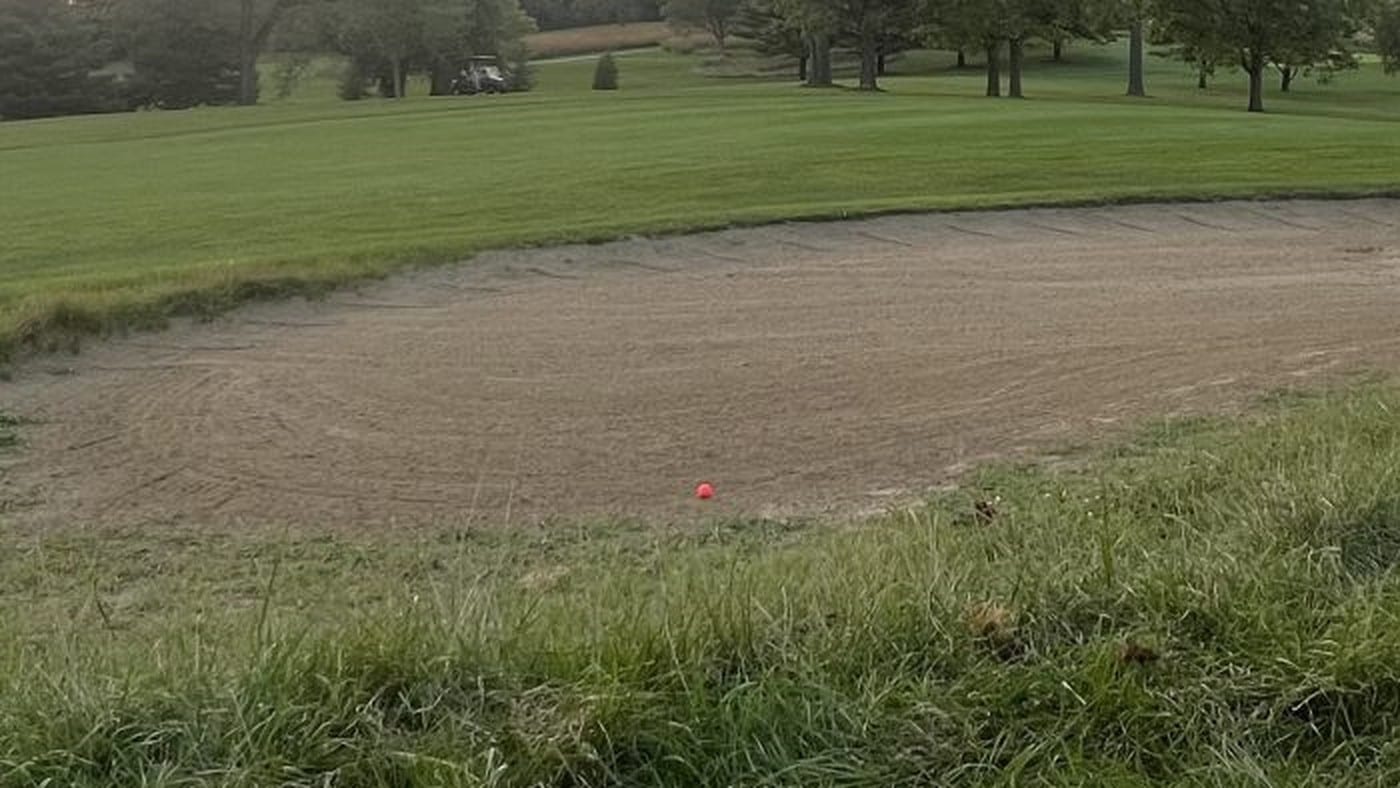 Openverse, CC0. The orange dot on the sand is the ball, sitting where you have to play it from.
The 2019 rewrite is where the shorthand started, and it did loosen real things. The same Rule lists what you may do:
- Dig in with your feet to take a stance
- Touch the sand while searching for your ball, or while moving a loose leaf, twig or stone off the sand
- Smooth the bunker to look after the course
- Put clubs or equipment down in the sand
- Lean on a club to rest, stay balanced or stop yourself falling
- Hit the sand in frustration
Read both lists together and the line is easy to see. Incidental contact stopped costing anything. Contact that tells you something about the sand, or that rehearses the shot, still costs two. “You can touch bunker sand now” flattens both lists into one sentence and drops the half with a penalty attached.
The same shape of problem shows up in shaft flex letters: a shorthand everybody repeats that the source document does not support.
A ball that hits the flagstick costs nothing
No penalty. Not one stroke, not two.
Rule 13.2a lets you play a stroke with the flagstick left in the hole. If your ball then hits it, there is no penalty and you play it as it lies.
The answer holds when someone attends the flagstick or has pulled it out. That’s Rule 13.2b, the flip side. An accidental hit on the flagstick, or on the person holding it, is free (R&A, Rule 13, retrieved 2026-09-01).
 Leaving this in has cost nothing since January 2019.
It used to be a penalty, and plenty of people learned the old version. The R&A’s own summary of the 2019 changes puts it plainly. “There is no longer a penalty if you play a ball from the putting green and it hits the unattended flagstick in the hole” (The R&A, 2019 Rules Modernisation archive materials, page 5, retrieved 2026-09-01). Leaving it in is a normal choice now, not a risk.
You have to decide before you play the stroke, and you cannot shift the flagstick off center to give yourself a better backstop.
Why three similar-looking mistakes cost different amounts
The Rules do not price a mistake by how bad it feels. They price it by how much advantage the action could have handed you. Rule 1.3c(2) sets three penalty levels and reserves the general penalty of two strokes for breaches where that potential gain is larger.
Run the three through that filter and they line up.
| Situation | Penalty | Rule | What you do |
|---|---|---|---|
| Ball out of bounds or lost | 1 stroke | 18.2b | Replay from where you played the last shot |
| Ball out of bounds or lost, where the course has adopted the Local Rule | 2 strokes | MLR E-5 | Drop near where it was lost, out to the nearest fairway |
| Ball in a penalty area | 0 or 1 stroke | 17.1b-d | Play it as it lies for free, or take relief: two drop options from yellow, three from red |
| Testing sand, practice swing, or grounding the club in a bunker | 2 strokes | 12.2b | No relief procedure. Add two strokes and play on |
| Ball hits the flagstick left in the hole | None | 13.2a | Play it as it lies |
Two things that look alike can carry different prices once you ask what each one actually changes. The same question is worth asking about equipment, in what a driver loft sleeve actually changes.
Frequently asked questions
Does my course use the two-stroke Local Rule?
Ask before you start, because it only exists where the committee has adopted it. If nobody knows, the default is the Rule in the book: one stroke, and back to where you played from.
Terms in this article
- Penalty stroke: a stroke added to your score that you never played. It counts the same as a shot you hit.
- Stroke and distance: relief that costs one penalty stroke and sends you back to where you played the last shot. Rule 18.1.
- Penalty area: water or rough ground marked with yellow or red stakes and lines. It replaced “water hazard” in 2019 and now covers dry ground too.
- General penalty: the penalty the Rules use for the more serious breaches. It adds two strokes when the round is scored on total strokes. In a format where each hole is won on its own, it costs that hole.
- Local Rule: an extra rule the committee running a course or competition adds on top of the Rules of Golf. E-5 is the common one for lost balls.