
2-Piece vs 3-Piece Golf Balls: What the Cover Changes and Which One to Play
The real difference between 2-piece and 3-piece golf balls is the cover. How ionomer and urethane covers change driver spin, wedge spin and durability, and which one fits your game.
Every weekend, cart baskets across the country carry the same contradictory cargo: a golfer who shoots 102 carrying three found Titleist Pro V1s, two scuffed TaylorMade TP5s, and a sleeve of whatever was on sale at the pro shop.
The assumption is almost universal: tour-level golf balls cost more because they are objectively better golf balls, and playing a better ball must make you play better golf.
The equipment industry does nothing to dispel that assumption. Tour ball packaging promises maximum distance, penetrating trajectory, and drop-and-stop control on every swing. What the marketing leaves out is physics: the surface property that lets a tour pro stop an 8-iron on a fast green can also add curve to an amateur’s slice.
The choice between a 2-piece ball and a 3-piece multi-layer ball is not an upgrade ladder. It is a structural trade-off between straight tee-shot dispersion and greenside stopping power.
The short answer
- The defining performance difference between modern balls is not the layer count, but the cover material: firm ionomer (Surlyn) on 2-piece balls versus soft thermoset urethane on premium 3-piece balls.
- Off the driver, 2-piece ionomer balls generally spin less than tour urethane balls. With a slice delivery, less total spin means less side spin, so the ball curves less.
- Around the green, 3-piece urethane balls spin more on partial wedge shots, so they stop sooner after landing.
- If you regularly lose balls off the tee, a 2-piece ionomer ball costs less to lose. Switch to 3-piece urethane when you need approach shots to hold firm greens.
The real dividing line is the cover, not the layer count
Golf marketing focuses heavily on the number of pieces. You will see 2-piece, 3-piece, 4-piece, and even 5-piece golf balls lined up on display shelves. But if you cut these balls in half, the true mechanical divide is simpler: ionomer covers versus urethane covers.
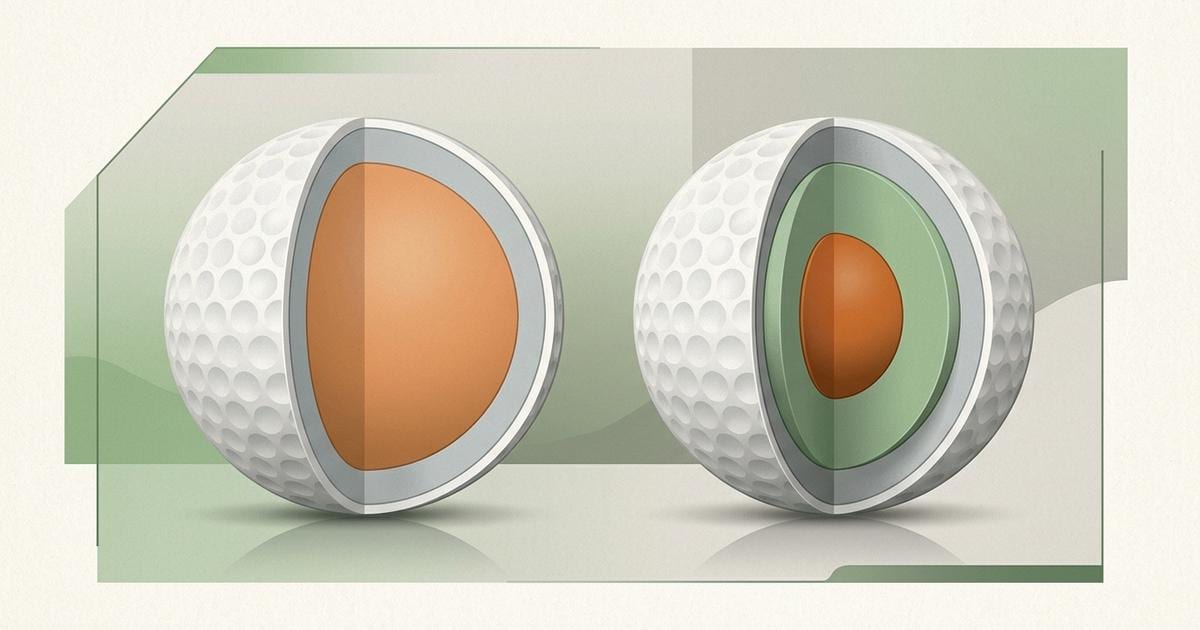
A traditional 2-piece golf ball consists of an oversized solid core (usually molded from high-energy polybutadiene rubber) wrapped directly in an ionomer cover. Surlyn, a thermoplastic resin patented by DuPont in the 1960s, is the most common ionomer blend. It is hard, slick, resilient, and inexpensive to produce.
A modern 3-piece tour ball uses a smaller central core, surrounded by an intermediate boundary layer called a mantle (or casing layer), and covered in an ultra-thin layer of cast thermoset urethane.
The mantle layer exists to create differential performance: on high-speed driver swings, the club fully compresses the core against the mantle to manage launch and rebound velocity; on partial wedge swings, only the soft cover engages the grooves.
When your club strikes the ball, the cover’s softness determines how much the face grooves “shear” the ball surface. Surlyn slips and rebounds cleanly; urethane grabs and rotates.
Off the tee: why extra spin can add curve to a slice
The primary obstacle between a 20-handicapper and breaking 90 is almost never wedge spin; it is keeping the tee shot on the golf course.
Off the driver, 2-piece ionomer balls generally produce lower backspin than 3-piece tour urethane balls at moderate swing speeds.
For the average male amateur in TrackMan’s data (TrackMan Golf, 93.4 mph club speed), the optimal driver spin is about 2,300 rpm. Extra backspin directly robs you of distance by creating a ballooning descent angle and eliminating ground rollout. (For how spin eats roll distance, see our breakdown on how spin eats roll distance).
The spin axis penalty on off-center hits
Worse than lost distance is lateral dispersion.
Aerodynamically, a golf ball does not have separate “backspin” and “sidespin” motors. It rotates around a single 3-dimensional axis called the Spin Axis. When an amateur golfer swings out-to-in with an open clubface (the classic slice delivery), the impact tilts the spin axis to the right.
The horizontal component that curves the ball through the air is directly proportional to total spin:
$$\text{Side Spin} = \text{Total Spin} \times \sin(\text{Spin Axis Tilt})$$
At the same spin axis tilt, more total spin means more side spin. So if a 3-piece urethane ball comes off your driver with more total spin than a 2-piece ionomer ball, the same slice delivery curves it farther offline.
When your driver strike is imperfect, the lower surface friction of an ionomer cover acts as an aerodynamic buffer. It slides across the face with less tangential grab, dampening both vertical backspin and lateral curvature.
Around the greens: where 3-piece urethane earns its premium
If 2-piece balls fly straighter off the tee, why does virtually every golfer on the PGA and LPGA Tour play a multi-layer urethane ball?
The answer lies entirely within 100 yards of the pin.
On short wedge shots, clubhead speed is low. At that impact energy, the golf ball does not deform down to its rubber core. The shot is dictated almost entirely by the interaction between the clubface grooves and the cover. That is why urethane balls spin more than ionomer balls on short pitch shots.
On the course, that spin gap changes how the ball behaves on landing. When a urethane ball hits a firm green, the extra backspin helps it check up close to its pitch mark.
An ionomer ball on the same shot tends to bounce forward and release farther. For a low-handicap player attempting to tuck an approach near a front-edge pin, that rollout is fatal. For an amateur who just wants to land anywhere on the green, that rollout is completely manageable.
Compression ratings: can you actually compress a tour ball?
Along with layer count, golf balls carry a compression rating: a measure of how much the ball deforms under a standardized static load.
- Low Compression: Ultra-soft balls like the Callaway Supersoft, Srixon Soft Feel, or Wilson Duo Soft.
- Mid Compression: Balanced balls like the Titleist Tour Soft, Srixon Q-Star, or TaylorMade SpeedSoft.
- High / Tour Compression: Firm tour balls like the Titleist Pro V1x, TaylorMade TP5x, or Callaway Chrome Tour X.
Low- and high-compression balls differ in feel and launch:
- Low-compression 2-piece balls deform more readily against moderate impact speeds, providing a soft, satisfying feel off the face and naturally launching slightly higher with lower spin.
- High-compression multi-layer balls feel significantly firmer (“clickier”) to slower swingers and require higher impact force to activate their internal core dynamics.
Decision Guide: Which ball should you play?
Choosing the right ball comes down to an honest assessment of your current scoring bottlenecks.
Choose a 2-Piece Ionomer Ball if:
- You’re a higher-handicap player: Your primary scoring leak is penalty strokes and lost balls off the tee.
- Your driver swing speed is moderate: You benefit from the lower backspin and higher launch characteristics of low-compression cores.
- You lose balls regularly: Tour urethane balls cost more, and every one you deposit into a water hazard adds to what you spend in a season.
- Recommended 2-piece models: Callaway Supersoft, Titleist TruFeel, Srixon Soft Feel, TaylorMade Distance+.
Choose a 3-Piece Urethane Ball if:
- You’re a low-handicap player: You consistently find fairways and your scores are determined by proximity to the hole on approach shots.
- You play courses with firm, fast greens: You need wedge spin to stop approach shots from rolling off the back fringe.
- You are willing to trade some slice forgiveness off the tee for precision control around the greens.
- Recommended 3-piece urethane models: Titleist Pro V1, Srixon Z-Star, TaylorMade TP5, Callaway Chrome Tour, or direct-to-consumer urethane options like Vice Pro or Snell Prime.
Frequently Asked Questions
Does playing a 2-piece ball hurt my putting?
No. Putting impact speeds are so low that internal layers are irrelevant. What you experience on the putter face is purely cover acoustic feel. Ionomer balls may feel slightly firmer and produce a higher-pitched click than cast urethane, but roll distance and skid phase remain virtually identical.
Are direct-to-consumer (DTC) 3-piece urethane balls a good compromise?
Yes. Brands like Vice and Snell offer 3-piece cast urethane balls at prices comparable to name-brand 2-piece balls. Kirkland Signature from Costco is another lower-cost option: MyGolfSpy’s Ball Lab listed its 2025 v3.0 at $19.99 a dozen (MyGolfSpy, September 23, 2026). More on that ball in Are Kirkland golf balls good?. If you want the greenside spin benefits of cast urethane without paying tour-ball prices, DTC balls are an attractive option, provided your tee-shot delivery is stable enough to handle the extra spin.
What about “lake balls” or refurbished golf balls?
Treat them as two different questions. On time in water, the evidence is mixed: a 2023 study found no significant distance loss after up to 12 months in ponds, though Titleist reports a larger loss without giving its method. Refurbished (refinished, meaning stripped and repainted) balls are the ones to skip, because they carried shorter than new balls in a robot test. The sources are in Lost golf ball grades: a low grade is fine, refinished isn’t.