
Golf relief area: four reference points, one gives two club-lengths
Golf relief has four reference points outside a penalty area, and only one gives two club-lengths. Work out which point applies to your ball and the distance follows.
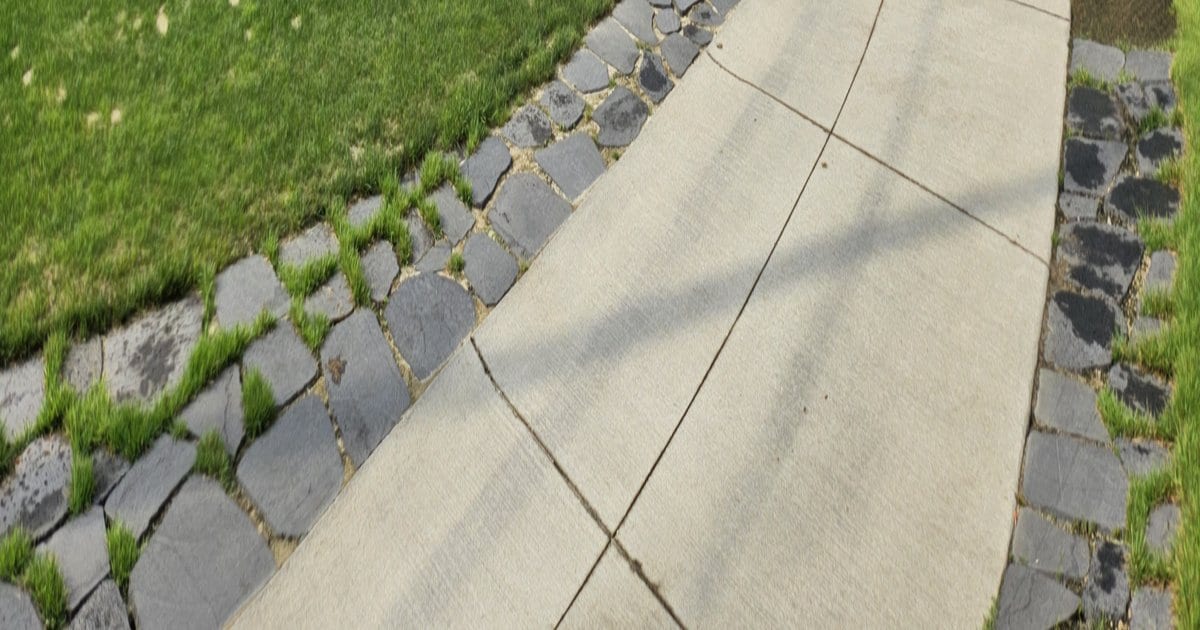
A course I played. A ball on this path is the first situation in this article, and the edge you can see is where the nearest point of complete relief gets measured from.
At the 2026 Tour Championship, Ryan Gerard’s ball plugged into the bank beside a greenside bunker. It was embedded in the face, not in the sand, so he got free relief. He measured, and dropped into the first cut on top of the bank. The first cut is the shortest band of rough, the strip just off the fairway.
On the CBS broadcast, Dottie Pepper called the new lie “exponentially easier” than the old one. Some viewers thought that was too generous, but that argument is about professional golf.
His ball ended up above the bunker instead of beside it because of the reference point. Embedded-ball relief measures from the spot right behind the ball, not from the nearest point where the trouble stops interfering.
The short answer
Outside a penalty area, the Rules use four reference points for a drop, and only one gives two club-lengths. Work out which point applies before you reach for a club to measure with. The distance follows from the reference point, never the other way around.
Most guides sort by situation, which only helps once you know which situation you’re in. Sorting by reference point is faster, and it’s how the Rules are written.
Settle the reference point first - then drop the same way every time
The four reference points below are the only ones the Rules use outside a penalty area. Each one is named in its own Rule, and the size of the relief area comes attached to it. The relief area is the patch of ground you’re allowed to drop into.
| Reference point | Rule | Relief area | When it applies |
|---|---|---|---|
| Nearest point of complete relief | 16.1b | One club-length | Cart paths, sprinkler heads, temporary water, ground under repair |
| The spot right behind the ball | 16.3b | One club-length | Embedded ball |
| Where the ball first touches the ground on the line | 17.1d(2), 19.2b | One club-length | Back-on-the-line relief |
| Where the ball lay | 19.2c | Two club-lengths | Lateral relief for an unplayable ball |
Source: The R&A, Rules of Golf, retrieved 2026-09-10: Rule 16 for abnormal course conditions and the embedded ball, Rule 17 for penalty areas, and Rule 19 for an unplayable ball.
Two club-lengths is one row out of four. That’s why “is it one club or two?” is the wrong opening question. Answer it first and you’ll guess right about half the time.
It’s tempting to compress this into a slogan, and one circulates widely: free relief gives one club-length, penalty relief gives two. It doesn’t hold. Back-on-the-line relief under Rule 17.1d(2) and Rule 19.2b both cost a penalty stroke, and both give one club-length (R&A, Rule 17 and Rule 19, retrieved 2026-09-10). There’s no rule in the book tying the penalty to the distance.
The measuring club is the same in every row: the longest in your bag that isn’t your putter. You don’t get to pick a longer one for a bigger relief area.
The drop itself is the same every time
Whichever row you land in, the drop doesn’t change. Rule 14.3b(2) requires you to let the ball go from knee height so that it falls straight down. You don’t throw it, spin it, or roll it (R&A, Rule 14, retrieved 2026-09-10).
Knee height means the height of your knee when you’re standing. You don’t have to be standing to drop. Kneel or crouch if that’s easier, as long as the ball starts from that height.
The height changed in 2019, from shoulder height at arm’s length. The two governing bodies give different reasons for it. The USGA says the lower height increases the chance the ball stays in the relief area. The R&A frames it as consistency while preserving the randomness of the drop.
Both are true at once. A shorter fall bounces less, and it also removes the variation that came from every player choosing their own posture.
A drop that came out wrong only starts costing strokes once you’ve played the ball, and untangling that is a separate subject.
Nearest point: cart paths, casual water, ground under repair
Cart paths, sprinkler heads, standing water and ground under repair sit under one name in the Rules: abnormal course conditions. The Rules call standing water temporary water now, and casual water is the old name most people still use.
This is the reference point most golfers meet first, and it’s the one people bend. Under Rule 16.1b your relief area is one club-length from the nearest point of complete relief. It has to stay in the general area and no nearer the hole (R&A, Rule 16, retrieved 2026-09-10).
The general area is the whole course except the greens, the teeing areas, the bunkers and the penalty areas. It’s most of what you play from.
The nearest point of complete relief is the closest spot to your ball where the condition stops interfering. The word doing the work is nearest. Not best, not most convenient. The R&A says so in its own guidance.
“the nearest point of complete relief will not be the nicest spot - it could even be in a bush, or in very thick rough.”
That leads to advice worth more than the definition. Work out where you’d be dropping before you lift the ball. If the nearest point puts you in a bush, playing it as it lies may be the better option. Once you’ve lifted the ball, you’ve given that choice away.
One more wrinkle: finding the reference point and measuring from it use different clubs. You picture the stance and swing you’d have made for the next stroke, with the club you’d have used. Then you measure the relief area with your longest club. Taking an actual stance isn’t required, though it makes the estimate more honest.
The spot right behind the ball: an embedded ball
Embedded-ball relief doesn’t use the nearest point at all. Rule 16.3b sets the reference point as “the spot in the general area right behind where the ball is embedded.” You get one club-length from there, staying in the general area and no nearer the hole (R&A, Rule 16, retrieved 2026-09-10).
That single difference produced the Tour Championship ruling. Gerard’s ball was plugged in the face of the bank. The spot right behind it sat above the bunker rather than beside it, so the relief area opened onto the top of the bank.
Your ball counts as embedded when it’s in its own pitch-mark from your previous stroke and part of it is below ground level. Someone else’s old pitch-mark doesn’t count, and neither does a ball that just settled into soft ground.
The relief is limited to the general area, which rules out penalty areas and bunkers. Two further exceptions catch people out:
- A ball embedded in sand gets no relief unless that part of the general area is cut to fairway height or less. Waste areas and sandy scrub outside a bunker fall here.
- There’s no relief when playing the ball as it lies would be clearly unreasonable anyway. A ball buried in a bush you couldn’t swing at is the usual example.
“If it’s in the general area, I get a drop” is close enough to true to be dangerous. The sand exception turns a free drop into a penalty.
A point on the line: back-on-the-line relief
Back-on-the-line relief works differently again, and it’s where the one-club, two-club folklore falls over.
You pick a line from the hole through where your ball lay. Then you go back as far as you like along it and drop on the line.
The relief area isn’t marked out in advance. It appears where the ball first touches the ground. Rule 17.1d(2) describes a relief area “one club-length in any direction from that point” (R&A, Rule 17, retrieved 2026-09-10), and Rule 19.2b says the same for an unplayable ball (R&A, Rule 19, retrieved 2026-09-10).
Both cost a penalty stroke. Both give one club-length.
The 2023 revision simplified this procedure, and the club-length of tolerance is the part people miss. Your ball can settle a little away from where it landed. It doesn’t have to stop dead on the line.
Where the ball lay: lateral relief
Rule 19.2c is the one row in the table that gives two club-lengths. The reference point is the spot where your ball lay, and the relief area is two club-lengths from it, no nearer the hole (R&A, Rule 19, retrieved 2026-09-10).
If the ball is off the ground, in a tree for instance, the reference point is the spot on the ground directly below it. Measuring from the branch would be generous, and the Rule closes that off.
Lateral relief is one of three options once you declare a ball unplayable. Choosing between the three turns on where you’re standing, not on the reference point, so I’ll leave it for its own article.
Which reference point applies to you right now
Five situations, in the order the Rules use.
| Situation | Reference point | Relief area | Penalty |
|---|---|---|---|
| Ball on a cart path | Nearest point of complete relief | One club-length | None |
| Ball plugged in the fairway | The spot right behind the ball | One club-length | None |
| Ball in a red penalty area, going back on the line | Where the ball first lands on the line | One club-length | One stroke |
| Ball declared unplayable, taking it sideways | Where the ball lay | Two club-lengths | One stroke |
| Ball on a cart path inside a penalty area | Rule 17’s own reference points (see the red penalty area row) | No relief for the cart path (Rule 17 only) | One stroke, or play it as it lies |
The last row is the trap. Rule 17.3 says a ball in a penalty area gets no relief for an abnormal course condition, no embedded-ball relief, and no unplayable relief (R&A, Rule 17, retrieved 2026-09-10). The cart path stops mattering the moment your ball is inside the red or yellow line.
Your only options are Rule 17 relief or playing it as it lies. Rule 17 comes with its own options, and the red penalty area row above shows one of them.
That’s also the clearest illustration of why the reference point comes first. In four of these five rows, counting club-lengths first would still land you a plausible answer. In the fifth it would land you the general penalty for playing from a wrong place - two strokes in stroke play.
Questions that come up on the course
Is relief always one or two club-lengths? No, and the split isn’t what most golfers assume. Three of the four reference points give one club-length, including the back-on-the-line point, which costs a penalty stroke. Outside a penalty area, only lateral relief under Rule 19.2c gives two (R&A, Rule 19, retrieved 2026-09-10). A ball inside a penalty area runs on Rule 17, which sets its own options.
Is my ball embedded if it is sitting in sand? Only if that sand is cut to fairway height or less. Sand in a waste area or in rough doesn’t qualify, and a bunker never does.
Can I drop again because I don’t like the lie? Not once the drop was made correctly and the ball came to rest inside the relief area. You get another drop only when the ball rolls out, or when the drop itself broke Rule 14.3b(4) (R&A, Rule 14, retrieved 2026-09-10).
What to take away
- Settle the reference point before you touch a club. The relief area size is attached to it, not decided separately.
- Three of the four reference points give one club-length. Outside a penalty area, two club-lengths is lateral relief only.
- You’ll want to see where you’d be dropping before you lift the ball. The nearest point of complete relief can be worse than where you already are.
- Inside a penalty area, most of this stops applying.
Knowing where to drop is only half of it. The other half is what the mistake costs, and the answers there are less consistent than people expect. A separate article, what each penalty actually costs, runs through the three that come up most.
Terms in this article
- Relief area - the patch of ground the Rules let you drop into. Its size comes attached to the reference point.
- The general area - the whole course except the greens, the teeing areas, the bunkers and the penalty areas. Most of your golf happens here.
- Abnormal course condition - the group name for cart paths, sprinkler heads, temporary water and ground under repair.
- Temporary water - water sitting on the surface where it isn’t meant to be, such as a puddle after rain. Casual water is the pre-2019 name for it.
- Nearest point of complete relief - the closest spot to your ball where the condition stops interfering. Nearest, not nicest.
- First cut - the shortest band of rough, just off the fairway. A course setup term, not a term from the Rules.