
4-Hybrid vs 4-Iron Distance: Why the Same Number Leaves a 20-Yard Gap
Replacing a 4-iron with a 4-hybrid often duplicates 5-wood distance. Here is the math on shaft lengths, CG depth, and how to gap your long game by loft.
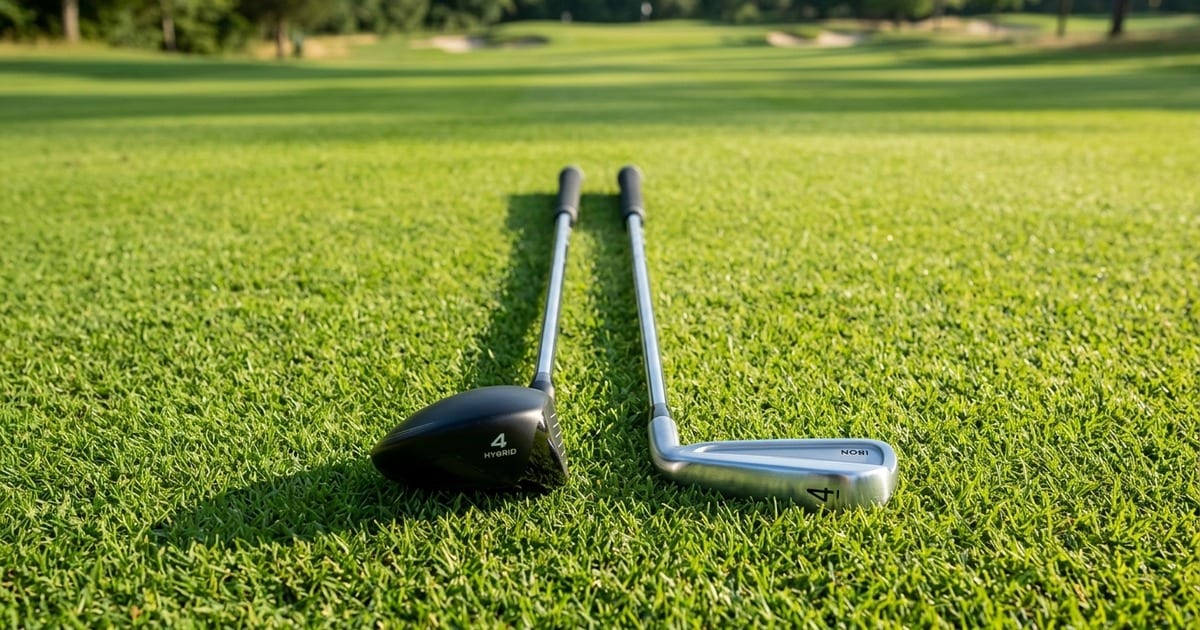
The advice is handed down in pro shops and online forums every single day: “If you can’t hit your 4-iron, just take it out of the bag and buy a 4-hybrid.”
It sounds like clean, one-to-one logic. The club has the number 4 stamped on the sole, the iron has the number 4 stamped on the sole, so the hybrid must be a 4-iron with a friendlier face.
Then the golfer takes their shiny new 4-hybrid to the course.
On the first long par-4, they pull the hybrid expecting their old 170-yard 4-iron carry. Instead, the ball takes off on a towering flight, flies 192 yards, carries over the green, and finishes in the back bunker. Three holes later, facing a 170-yard approach, they realize their 5-iron only reaches 155 yards, while the 4-hybrid flies nearly 195 yards.
They haven’t replaced their 4-iron. They have added a second 5-wood to their bag and blown a 25-yard hole right in the middle of their scoring clubs.
The short answer
- A 4-hybrid does not produce 4-iron distance. At average amateur swing speeds, a standard 4-hybrid carries 15 to 22 yards farther than a 4-iron from the same manufacturer.
- That distance jump is driven by three physical differences: the hybrid shaft is 1.25 to 1.75 inches longer, the shaft is 30 to 40 grams lighter, and the center of gravity sits much deeper behind the clubface.
- Modern game-improvement iron sets already feature aggressively strengthened lofts. A modern 5-iron often has 21° to 23° of loft, the exact same loft as a standard 4-hybrid.
- Never replace long irons by sole number. Replace them by carry distance and loft separation. To bridge a gap above a modern 5-iron, most golfers need a 24° 4-hybrid or a 25°-26° 5-hybrid, not a 21° 4-hybrid.
Quick Comparison: 4-Iron vs 4-Hybrid vs 5-Wood
| Spec / Metric | 4-Iron (Game Improvement) | 4-Hybrid (Standard Spec) | 5-Wood (Fairway Wood) |
|---|---|---|---|
| Typical Loft | 19.0°-21.0° | 21.0°-22.0° | 18.0°-19.0° |
| Standard Shaft Length | 38.50”-38.88” | 39.75”-40.25” (+1.25”-1.75”) | 42.00”-42.50” (+3.5”-4.0”) |
| Stock Shaft Material | Steel (95g-110g) | Graphite (65g-75g) | Graphite (60g-70g) |
| Face Construction | Cast or forged solid steel | High-strength maraging steel (Thin) | Carpenter steel with sole channel |
| Amateur Launch Angle | 11.5°-13.0° (Low) | 14.8°-16.5° (High) | 13.5°-15.0° (Mid-High) |
| Amateur Carry Distance | ~170 yards (If struck pure) | ~192 yards | ~204 yards |
| Stopping Power on Green | Low (Rolls 15-20 yards) | High (Descends at 48°, stops fast) | Moderate (Rolls 8-12 yards) |
Published manufacturer specs prove they are not the same club
When golfers compare a 4-iron and a 4-hybrid, they assume manufacturers align them to the same performance window. The published spec sheets from the three major clubmakers prove otherwise:
| Brand & Line | Club | Published Loft | Published Length | Length vs 4-Iron |
|---|---|---|---|---|
| Ping G430 (Ping) | G430 4-Iron | 19.0° | 38.88” | Baseline |
| G430 4-Hybrid | 22.0° | 39.75” | +0.87 inches | |
| G430 5-Wood | 18.0° | 42.50” | +3.62 inches | |
| TaylorMade Qi / P790 (TaylorMade) | P790 (2023) 4-Iron | 21.0° | 38.50” | Baseline |
| Qi 4-Rescue | 22.0° | 40.25” | +1.75 inches | |
| Qi 5-Wood | 18.0° | 42.25” | +3.75 inches | |
| Titleist T200 / TSR2 (Titleist) | T200 4-Iron | 21.0° | 38.50” | Baseline |
| TSR2 4-Hybrid | 21.0° | 40.00” | +1.50 inches | |
| TSR2 5-Wood | 18.0° | 42.00” | +3.50 inches |
In every single manufacturer catalog, the 4-hybrid is built significantly longer than the 4-iron. In TaylorMade’s lineup, the Qi 4-hybrid is 1.75 inches longer than the P790 4-iron.
A club that is nearly two inches longer with a lightweight graphite shaft cannot produce the same distance as a shorter steel-shafted iron, regardless of what number is stamped on the bottom.
The three physical reasons your hybrid flies 20 yards farther
If the loft on a 4-iron is 21° and the loft on a 4-hybrid is 22°, why does the club with more loft carry almost two clubs farther?
Three mechanical factors compound at impact:
1. Shaft length and swing speed (+8 to 10 yards)
In club fitting physics, every additional inch of shaft length adds approximately 2.0 to 2.5 mph of clubhead speed.
Because a 4-hybrid is 1.5 inches longer than a 4-iron, the clubhead naturally travels on a wider swing arc. Combined with a graphite shaft that is 30 to 40 grams lighter than steel, average amateurs swing a 4-hybrid roughly 3.5 to 5.0 mph faster than a 4-iron. That speed delta alone accounts for 8 to 11 yards of extra carry.
2. Center of gravity depth and launch
An iron head is thin, so its center of gravity (CG) sits close behind the clubface. To launch a 20° long iron into the air with that shallow CG, a golfer needs tour-level clubhead speed (over 90 mph with an iron) to create adequate dynamic loft and spin. Most amateurs swing long irons at 78 to 83 mph, producing low, knuckleball trajectories that fall out of the sky at 150 yards.
A hybrid has a hollow, wood-like head, so its center of gravity sits much farther back behind the face. That deeper CG helps it launch the ball higher than an iron of similar static loft.
3. Face flexibility and trampoline effect (COR)
Coefficient of restitution (COR) is the efficiency of energy transfer from face to ball. Iron faces are solid forgings or cast steel plates.
Hybrids are engineered like miniature fairway woods. They feature thin, flexible maraging steel faces backed by internal perimeter ribs and sole channels (such as TaylorMade’s Speed Pocket or Ping’s FaceWrap), built to return more energy to the ball than a solid iron face.
When you combine 4 mph more club speed, higher launch geometry, and higher face trampoline efficiency, the result is an inevitable 15 to 22-yard carry increase.
The loft creep trap: check your 5-iron first
The problem is made worse by the aggressive loft strengthening across modern golf equipment. (For a deep dive on how modern lofts shifted, see our analysis of 7-iron lofts across brands).
In the 1990s, a 4-iron had 24° to 25° of loft, and a 5-iron had 28°.
Today, in popular game-improvement sets like the Ping G430, Callaway Paradym Ai Smoke, or TaylorMade Qi, lofts have been cranked down significantly:
- A modern 5-iron has 21.5° to 23.5° of loft.
- A standard 4-hybrid has 21.0° to 22.0° of loft.
If you play a game-improvement iron set and buy a standard 22° 4-hybrid, your 4-hybrid has the exact same loft as your 5-iron.
Because of its longer shaft and hotter face, that 4-hybrid will fly 190 yards, while your 5-iron flies 165 yards. You end up with a 25-yard scoring void between two consecutive clubs in your bag, while your 4-hybrid and your 5-wood fight for the exact same 195-to-205-yard yardage.
I ran into the same overlap from the other direction. My 24° Titleist T100 4-iron went about as far as my TS3 4-hybrid, so the hybrid was duplicating a club I already had. I replaced it with an 18° Titleist TSR2 3-hybrid. That was a judgment from how the shots felt on the course, not a launch monitor measurement.
Decision Guide: How to properly gap your hybrids
To build a long game that actually works on the course, follow this rule: Replace by loft and carry distance, never by the number on the sole.
Step 1: Find the loft of your longest reliable iron
Pull up your iron manufacturer’s spec sheet online and check the loft of the longest iron you actually enjoy hitting (for most amateurs, this is the 5-iron or 6-iron):
- If your 5-iron has 21° to 23° of loft (Game Improvement): You do not need a 4-hybrid. You need a 5-hybrid (25°-26°) or a high-lofted 24° hybrid.
- If your 5-iron has 25° to 27° of loft (Players / Classic Spec): A standard 22° to 23° 4-hybrid will gap cleanly above it.
Step 2: Maintain 3° to 4° of loft separation
A healthy distance gap between clubs is 10 to 14 yards. In the long game, that typically requires:
- 3° to 4° of loft difference between fairway woods and hybrids.
- 3° to 4° of loft difference between your lowest-lofted hybrid and your highest-lofted iron.
Ideal Long-Game Gapping Ladder (Amateur Example):
- Driver: 10.5° (220 yards)
- 5-Wood: 18.0° (195 yards)
- 4-Hybrid: 23.0° or 5-Hybrid 25.0° (180 yards)
- 5-Iron: 24.0° - 25.0° (168 yards)
- 6-Iron: 28.0° (155 yards)
Frequently Asked Questions
Can I carry both a 7-wood and a 4-hybrid?
Yes, but check their lofts. A 7-wood typically has 21° of loft, while a 4-hybrid has 21° to 22°. However, a 7-wood has a longer shaft (approx. 41.5”) and a larger head, launching even higher and flying roughly 8 to 12 yards farther than a 4-hybrid of the same loft. Many mid-handicappers carry a 21° 7-wood for 195-yard fairway shots and a 24° 5-hybrid for 180-yard rough recoveries.
Should I get an adjustable hosel hybrid?
Yes. Hybrids with adjustable hosels (like the Ping G430 or Titleist TSR/GT lines) allow you to adjust loft by plus or minus 1.0° to 1.5°. This adjustability is invaluable for fine-tuning your yardage gap once you test the club on a launch monitor. (For how hosel sleeves tilt face angles, see our breakdown in driver loft sleeves).
Are hybrid-irons or driving irons better than standard hybrids?
Utility irons (driving irons) suit golfers with high swing speeds (over 100 mph driver speed) who want a penetrating, low-spin flight off the tee on tight holes. For amateur golfers with moderate swing speeds who need height and green-stopping descent angles on approach shots, standard high-MOI hybrids are vastly superior.