
Golf club length chart: standard lengths, and who needs longer or shorter
Titleist's standard lengths from driver to wedge, driver and 7-iron lengths from six makers, the height charts behind longer or shorter clubs, and how makers size a putter.
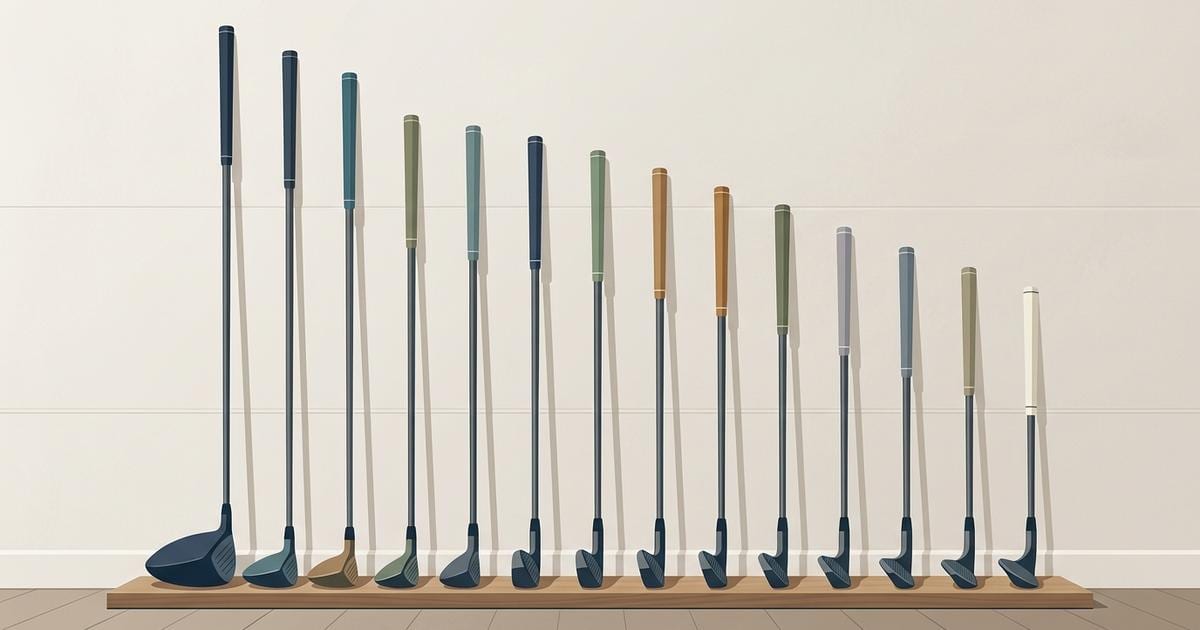
A standard men’s driver is 45.5 to 46 inches long, and a standard men’s 7-iron is 37 to 37.25 inches. That’s the whole golf club size chart in two lines, across the makers checked for this article (Titleist, PING, Callaway). Women’s standard clubs run about an inch shorter (Titleist, TaylorMade).
Your height is what moves you off those numbers. Golfers between 5’7” and 6’0” (170-183 cm) generally land in the standard-length section of PING’s chart, as golf retailer TGW reads it (TGW). Shorter golfers get shorter clubs, taller golfers longer ones, in half-inch steps.
Wrist-to-floor is the distance from the floor to the crease of your wrist, standing relaxed with your arms hanging. It mostly sets your lie angle, the angle between the shaft and the ground when the sole sits flat. It also confirms whether your height is telling the whole story. Putter makers don’t hand you a height-to-length chart. They size putters by how you stand over the ball.
The short answer
- Standard men’s drivers are 45.5-46” and men’s 7-irons 37-37.25” at the six makers checked (Titleist, TaylorMade, Callaway, PING, Mizuno, Cobra), wherever a figure was found (maker pages linked in the tables below, retrieved 2026-09-28).
- Women’s standard is about 1” shorter. Titleist says its women’s hybrid length “is 1” under standard” (Titleist).
- Listed lengths aren’t all measured the same way. Mizuno says a change of method made its published lengths “approximately 1/4 inch longer” with the club unchanged (Mizuno).
- Height mainly sets length. Clubmaker Hireko keeps 5’10” (178 cm) at standard and moves about half an inch for every 3 inches of height (Hireko).
- Wrist-to-floor mainly sets lie, and confirms the length when your arms are long or short for your height.
- Putters are sized by posture, not height. Odyssey’s method is your wrist height minus 2” (Odyssey). None of the putter makers checked publishes a height-to-putter table.
- If you’re 5’7” to 6’0”, start at standard. Outside that band, change length in half-inch steps and have lie checked at the same time.
Golf club length chart: standard lengths by club
In one maker’s current lineup, clubs step down from 45.5 inches at the driver to 35.25 inches at a 56° wedge. The chart below uses Titleist, because it publishes a length for every club from driver to wedge.
Standard length is the length a maker builds a club to when you buy it off the rack, without asking for anything custom.
| Club | Titleist model | Men’s standard | Women’s standard |
|---|---|---|---|
| Driver | GTS2 | 45.5” | 44.5” |
| Fairway wood, 15° | GTS2 | 43.0” | 42.0” |
| Hybrid, 21° | GT2 | 40.0” | 39.0” |
| 4-iron | T100 (2025) | 38.5” | not listed |
| 7-iron | T100 (2025) | 37” | not listed |
| 9-iron | T100 (2025) | 36” | not listed |
| Pitching wedge | T100 (2025) | 35.75” | not listed |
| 56° wedge | Vokey SM11 | 35.25” | 34.25” |
Sources: GTS2 driver, GTS2 fairway, GT2 hybrid, T100 and Vokey SM11, all retrieved 2026-09-28. The women’s fairway and wedge figures apply Titleist’s own rule that women’s length is 1” under the men’s standard.
A fairway wood is a wood with a smaller head than a driver, built to hit off the grass as well as a tee. A hybrid is a club with a small, wood-shaped head on a shaft about as long as an iron’s. The pitching wedge is the shortest club in most iron sets.
The pattern is easy to carry in your head. In the T100 set, you lose an inch and a half from the 4-iron (38.5”) to the 7-iron (37”), then another inch to the 9-iron (36”). That’s half an inch per club on average. From the 9-iron to the pitching wedge (35.75”) the step is only a quarter inch, and Titleist’s Vokey wedges keep going in quarter inches. What those clubs do in degrees of loft is in the golf club loft chart.
Every maker’s standard is a little different
Other makers land within a quarter inch of Titleist at the 7-iron and within half an inch at the driver. Here are the two clubs most charts compare.
| Maker | Men’s driver | Men’s 7-iron | Women’s driver | Women’s 7-iron |
|---|---|---|---|---|
| Titleist | 45.5” (GTS2) | 37” (T100) | 44.5” (GTS2) | not listed |
| TaylorMade | 45.75” (Qi4D) | 37.00” (P790) | not confirmed | 36.00” (P790) |
| Callaway | 45.75” (Quantum Max) | 37.25” (Quantum Max) | 44.5” (Quantum Max Fast) | 36.50” (Quantum Max Fast) |
| PING | 46” (G440 Max) | 37” (G440) | 45” (G Le4) | 36.5” (G Le4) |
| Mizuno | not found | 37.25” (Pro 243, JPX925 Hot Metal) | not found | not found |
| Cobra | 45.50” (DS-ADAPT Max-K) | not checked | 44.00” (DS-ADAPT Max-K) | not checked |
Sources, all retrieved 2026-09-28: Titleist GTS2, Titleist T100, TaylorMade Qi4D, TaylorMade P790, Callaway Quantum Max driver, irons, Women’s Quantum Max Fast driver and irons, PING G440 Max, G440 iron, G Le4 driver, G Le4 iron, Mizuno Pro 243, Mizuno JPX925 Hot Metal, Cobra DS-ADAPT Max-K and Women’s DS-ADAPT Max-K.
If you’re looking at a PING driver, check the shaft. PING says standard length with some of its shafts “is 45 1/2”,” so 46” isn’t the only answer there (PING).
Junior clubs follow their own charts and aren’t covered here. For scale, Titleist’s junior GTS2 driver is 42.5” (Titleist).
“Standard” isn’t measured with one ruler
A quarter inch on paper may not be a quarter inch in your hands. Mizuno said so on its own spec page:
“Mizuno will soon be changing its official iron measurement method to match the USGA / R&A standard. As a consequence our published USGA/R&A club lengths are now approximately 1/4 inch longer (when actual club length is unchanged).” (Mizuno Pro 243)
GOLF.com’s Jack Hirsh made the same point across brands in March 2026. Makers measure from different spots on the sole, and some measure before the lie is bent, others after. So a 37” 7-iron and a 37.25” 7-iron can be the same club (GOLF.com).
The Rules of Golf do define a method. The club sits on a flat surface with its sole against a 60-degree plane, and length runs from where the two planes meet “to the top of the grip” (R&A). Not every maker’s published number uses it, which is exactly what Mizuno’s note is about.
For you, that means a quarter-inch gap between two brands isn’t a reason to pick one. If a set feels long or short, the tape measure and the fitter are the tie-breakers, not the spec sheet.
Golf club length by height
Height is the main input for length. Clubmaker Hireko’s chart keeps a man of 5’10” (178 cm) at standard and moves the clubs half an inch for roughly every 3 inches of height.
| Height | Length versus men’s standard |
|---|---|
| 5’1” (155 cm) | 1 1/2” shorter |
| 5’4” (163 cm) | 1” shorter |
| 5’7” (170 cm) | 1/2” shorter |
| 5’10” (178 cm) | Standard |
| 6’1” (185 cm) | 1/2” longer |
| 6’4” (193 cm) | 1” longer |
Source: Hireko Golf, “Length is ground zero when fitting”, retrieved 2026-09-28. Hireko’s full table runs from 4’7” to 7’1” in the same steps. Hireko measures the offsets against a standard 5-iron.
PING’s chart adds a second measurement
PING builds its fitting around a published height chart. It asks for “two simple variables, a golfer’s height and their wrist-to-floor measurement.” From those it gives your “PING Color Code (lie angle) and recommended length” (PING).
The grid on PING’s page is an image, so the example rows below come from TGW’s guide to reading it.
| Height | Wrist-to-floor | Length on PING’s chart |
|---|---|---|
| 5’6” (168 cm) | 32” | Half an inch shorter |
| 5’10” (178 cm) | 34” | Standard |
| 6’2” (188 cm) | 36.5” | Half an inch longer |
Source: TGW’s guide to the PING color code chart, updated 2026-02-26, retrieved 2026-09-28.
TGW sums up the length side in one line: “Golfers between 5’7” and 6’0” generally fall into the standard length segment.” Below 5’7”, shorter shafts are the usual recommendation, and above 6’0”, longer ones.
The same rows also give you a lie angle. That half, and what PING’s colored dots mean, is covered in iron lie angle.
Callaway’s pre-owned store posts a similar height and wrist-to-floor guide (Callaway Pre-Owned). No height-to-length chart from Titleist or TaylorMade turned up for this article.
Height sets length; wrist-to-floor mostly sets lie
You measure your wrist too because your arms may not match your height. Hireko puts it this way:
“Statistically, the average WTF measurement is 48.9% of the person’s height. If everyone was proportional to this percentage, then height-based charts would have the same effect.” (Hireko)
It goes on to say that people whose arms aren’t proportional may need a different length than their height suggests, and a different lie too.
Clubmaker Wishon Golf’s chart shows how that split works out. At 5’8” (173 cm), wrist-to-floor from 28” to 37.5” swings the starting lie from 5 degrees flat to 4 degrees upright. Across those rows, the 7-iron stays at 37” (Wishon).
Height moves the length instead. At 6’4” (193 cm), the same chart gives a 38” 7-iron whether your wrist-to-floor is 34.5” or 40”. So your wrist-to-floor number mostly decides lie, and it confirms the length your height gave you.
How to measure wrist-to-floor
You’ll need a tape measure and a second person. Callaway’s guide is blunt about the helper: “Measurements should be performed by someone other than yourself” (Callaway Pre-Owned).
- Stand on a hard, flat floor. Golf Monthly says to “wear street shoes without heels” (Golf Monthly), while TGW prefers golf shoes (TGW). Whichever you pick, write it down next to the number.
- Let your arms hang relaxed at your sides.
- Have your helper measure “from the floor up to the crease on the inside of your wrist” (Golf Monthly).
Use the point your chart asks for. Mizuno’s older fitting system, for example, measured to the knuckles of a closed fist instead of the wrist (Mizuno UK).
Putter length by height: makers size it by posture
None of the putter makers checked for this article (Scotty Cameron, Odyssey, TaylorMade, PING) publishes a height-to-putter table. Makers size putters by how you stand over the ball, and stock putters come at 33, 34 or 35 inches (Scotty Cameron, TaylorMade Spider Tour X, PING Anser 2).
Odyssey says men’s putters are “typically around 33-35 inches” and women’s “typically around 33-34 inches” (Odyssey). Height charts for putters do circulate online, but the ones found for this article trace back to forums and blogs, not to a maker.
Scotty Cameron: length sets your eyes
Scotty Cameron sizes a putter by where it puts your eyes. “The ideal putter length sets your eyes 1-2” inside of the target line” (Scotty Cameron). The target line is the line from the ball to where you’re aiming.
The same page explains what goes wrong either way. Too long, and your posture turns “too upright with your eyes set too far inside the target line.” Too short, and you’re “too hunched over with your eyes set too far outside.”
Odyssey: wrist height minus two inches
Odyssey gives a number you can work out at home:
- “Stand up straight with your arms at your side and have someone measure your height from the ground to your wrist.”
- “Subtract two inches from your wrist height measurement to determine your baseline putter length.”
- Try it, then “adjust the length up or down in one inch (or half-inch) increments.”
Source: Odyssey Putter Buying Guide, retrieved 2026-09-28.
That’s nearly the same measurement as your wrist-to-floor. Worked through Odyssey’s method, a 34” wrist height gives a 32” baseline.
A 35-inch putter is an American default
Scotty Cameron has said the standard putter length in Japan “is 34-inches versus our 35-inch standard in the United States” (Scotty Cameron Q&A, 2016). So a 35” stock putter reflects a market, not your body. If you bought yours off the rack in the US, it’s the length most worth checking against the method above.
Cutting a putter down changes more than length. Cameron notes that “shorter putters demand a little more weight in the head,” so ask the shop about head weight too.
So what length should you play?
Start with standard if you’re between 5’7” and 6’0” (170-183 cm). Outside that band, change length in half-inch steps and have lie checked at the same time. Here’s the path in order.
Step 1: take two measurements
Measure your height, then have someone measure your wrist-to-floor using the steps above. It takes a tape measure and a helper, and costs nothing. The second number checks whether your arms match your height.
Step 2: inside the band, play standard
If your height is inside 5’7” to 6’0”, standard length is the sensible start. That’s where TGW’s reading of PING’s chart puts you, and Hireko’s chart treats 5’10” as standard.
Both of my iron sets have been standard length, and I’ve never had a club lengthened or cut down.
Near the edge, the two charts above disagree. At 5’7” (170 cm), Hireko says half an inch shorter, while TGW puts you in PING’s standard band. I’d start at standard there, and let a fitting settle that half inch if it ever feels wrong.
Step 3: outside the band, go in half-inch steps
If you’re shorter than 5’7” or taller than 6’0”, both charts point you away from standard. The steps are half an inch at a time. In the rows shown above, Hireko’s table reaches an inch and a half shorter at 5’1” (155 cm).
Longer or shorter shafts change how the club sits on the ground. So ask for length and lie to be set together, which is what PING’s chart is built to do. How lie works is covered in iron lie angle.
A fitting is a session where a shop measures you and your swing and sets up clubs to match. If you’re outside the band, it’s the place to settle this.
Step 4: size the putter separately
Your height chart stops at the putter. Take your wrist height and subtract 2”, as Odyssey does. Then try putts at that length before you buy or cut one. Then check at address that your eyes sit 1-2” inside the target line, as Scotty Cameron suggests.
What a length change also changes
Length doesn’t move alone. GolfWorks, a clubmaking supplier, says that when you change length, “total weight, swingweight, shaft flex, and lie” are “directly affected” (GolfWorks). Shaft flex is how much the shaft bends during the swing.
Swingweight is a measure of how heavy the head feels as you swing, written as a letter and number such as D3. PING lists its G440 Max driver at D3 (PING).
Clubmaker Ralph Maltby says a shortened driver’s swingweight gets “much lighter,” by “about 3 points for every 1/2 inch you shorten it” (Maltby). So a cut-down club can feel light in the head, and a shop may add weight back. How a few grams change a driver is its own topic, in 50g vs 60g driver shaft.
If you’re thinking about a shorter driver, the best-documented test found for this article is old. MyGolfSpy had six testers hit a 43.75” and a 45.75” driver in 2012 (MyGolfSpy).
- Carry, how far the ball flies before it lands, was 233.75 yards with the longer driver and 232.35 with the shorter one. That’s a 1.4-yard gap.
- Ball speed, how fast the ball leaves the face, was “a relatively insignificant .55 MPH” higher with the longer driver.
- The shorter driver finished 4.63 yards closer to the target line on average, 11.97 against 16.6 yards. MyGolfSpy calls that 28% closer.
To lean on that result, you’d be trusting six golfers swinging 2012 drivers. Two newer tests turned up, but neither is solid enough to lean on. MyGolfSpy’s 2017 page wouldn’t load, and the tester count and launch monitor behind Today’s Golfer’s 2020 test couldn’t be confirmed. A launch monitor is a device that measures the ball’s speed, launch and flight after impact. Read the 2012 result as a direction worth trying at a fitting, not a promise.
FAQ
What is the standard length of a driver?
For men, 45.5” to 46” at current models: 45.5” at Titleist and Cobra, 45.75” at TaylorMade and Callaway, 46” at PING (Titleist, PING). Women’s drivers run 44” to 45” (Cobra, PING G Le4).
Should I get shorter clubs if I’m short?
Below 5’7” (170 cm), the charts in this article point shorter. Hireko’s table gives one inch shorter at 5’4” (163 cm) and an inch and a half at 5’1” (155 cm) (Hireko). Measure your wrist-to-floor first, since long arms can change the answer.
What length putter do I need for my height?
No maker checked here turns your height into a putter length. Odyssey starts from your wrist height minus 2”, and Scotty Cameron from where the putter puts your eyes (Odyssey, Scotty Cameron). Stock putters come at 33”, 34” and 35”.
Is there a maximum length for a golf club?
Yes. A club must be at least 18 inches and, “except for putters, must not exceed 48 inches” (R&A). A local rule is an extra rule a competition adds on top of the Rules of Golf. Since 2022, organizers of professional or elite amateur events can adopt one that caps clubs other than putters at 46 inches (USGA). Unless you play in those events, it doesn’t apply to you, and every standard driver in this article is at or under 46”.
Terms in this article
- Standard length: the length a maker builds a club to when you buy it off the rack, without asking for anything custom.
- Wrist-to-floor: the distance from the floor to the crease of your wrist, standing relaxed with your arms hanging.
- Lie angle: the angle between the shaft and the ground when the sole sits flat.
- Color code: PING’s system that turns a height and wrist-to-floor pair into a lie angle and a recommended length.
- Fairway wood: a wood with a smaller head than a driver, built to hit off the grass as well as a tee.
- Hybrid: a club with a small, wood-shaped head on a shaft about as long as an iron’s.
- Pitching wedge: the shortest club in most iron sets.
- Target line: the line from the ball to where you’re aiming.
- Fitting: a session where a shop measures you and your swing and sets up clubs to match.
- Swingweight: a measure of how heavy the head feels as you swing, written as a letter and number such as D3.
- Shaft flex: how much the shaft bends during the swing.
- Launch monitor: a device that measures the ball’s speed, launch and flight after impact.
- Carry: how far the ball flies before it lands, not counting the roll.
- Ball speed: how fast the ball leaves the clubface.
- Local rule: an extra rule a competition adds on top of the Rules of Golf.