
Golf glove size chart: measure your palm, try smaller first
Measure around your palm, check the brand's chart, and try the smaller size first if you're between two. Letter and numbered (22) sizes, fit checks, cadet gloves.
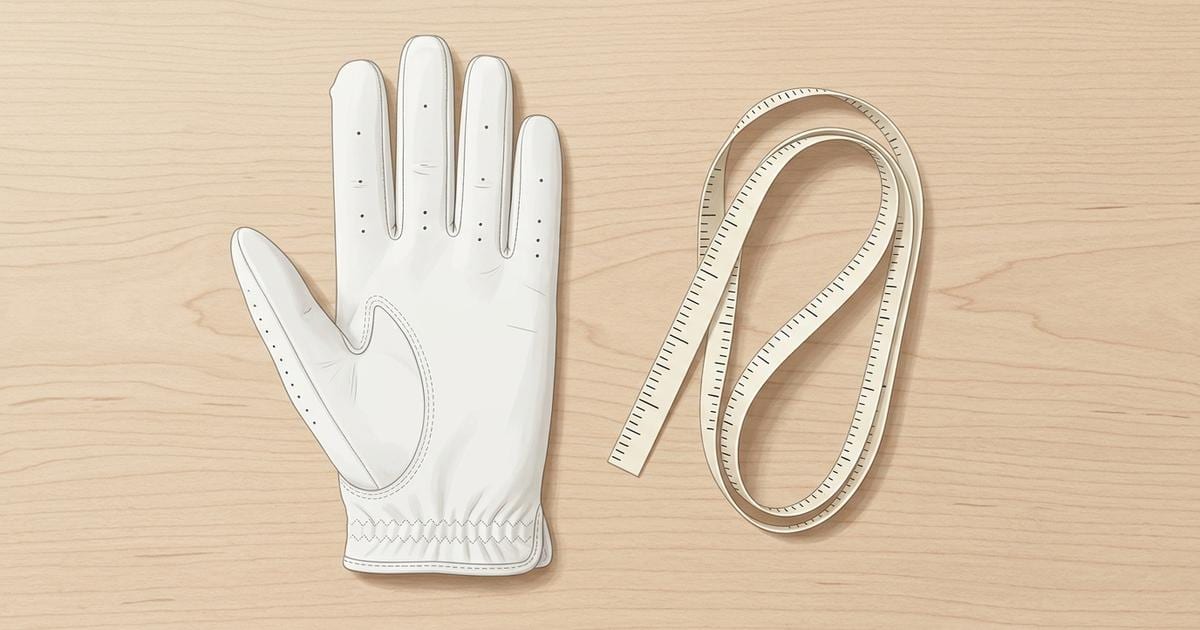
Most golf glove size charts start from the same measurement: the loop around your palm. FootJoy adds a second one, the length of your middle finger. If you land between two sizes, FootJoy’s advice is “try the smaller size first” (GolfOnline UK, FootJoy sizing guide, retrieved 2026-09-27).
You’ll run into two kinds of label. American brands sell by letter: S, M, ML, L and so on. Japanese brands, and gloves in Korean shops, use a number like 22. That number is centimeters around your palm, measured along a line the makers define.
My own glove is a 22 on that numbered scale, as I mentioned in the golf grip size chart. This post puts both systems side by side. Then it covers how to measure, how the glove should feel, and what to do between sizes.
The short answer
- Measure the loop around the palm of your glove hand, the left hand for a right-handed golfer (Bruce Bolt). Where the tape goes depends on the brand’s chart.
- On a numbered glove, the number is that loop in centimeters. Dunlop and Bridgestone both define it this way (Dunlop, Bridgestone).
- No maker I found publishes a conversion from 22 to S, M or L. Treat forum conversions as a first guess and try the glove on.
- A glove fits when the fingertips reach the ends with nothing spare, the palm has no wrinkles, and the tab closes with a little Velcro left over (Haggin Oaks, Bruce Bolt).
- Between two sizes in leather, try the smaller one. A synthetic glove stretches less, so buy the size that fits today.
- If the palm fits but the fingertips flap, try a cadet glove in your size instead of dropping a size (Tsuruya Golf).
Golf glove size chart: letters in the US, centimeters in Japan and Korea
Which chart you read depends on the tag. Letter sizes come with each brand’s own chart. Numbered sizes follow nearly the same definition at the Japanese makers.
Letter sizes: FootJoy’s chart uses two measurements
FootJoy sizes its gloves on a grid. One side is palm width, which FootJoy measures as a loop around the hand, not straight across. The other side is the length of your middle finger. Your size sits where the two meet.
| FootJoy line | Sizes | Palm width on the chart |
|---|---|---|
| Men’s | S, M, M/L, L, XL, XXL | 19.5-23 cm |
| Women’s | S, M, M/L, L | 18-20 cm |
| Cadet (shorter fingers) | S, M, M/L, L, XL | within the chart’s 18-23 cm |
Sources: GolfOnline UK, FootJoy sizing guide for men’s and women’s, and Scheels, FootJoy glove size chart for women’s, cadet and the overall range. Both retrieved 2026-09-27. The men’s finger-length columns run 6.6-9.0 cm (GolfOnline UK).
M/L is medium-large, the size between M and L. Some brands write it ML.
I read these numbers from those two retailer copies because footjoy.com didn’t load for me. The copies don’t line up the grid cells cleanly, so I’ve left the grid out rather than guess. To find your own cell, you’ll want FootJoy’s glove fitting guide itself.
Callaway, Titleist and TaylorMade also sell by letter. I couldn’t open a chart with measurements from Titleist or TaylorMade. A retailer copy of Callaway’s chart lists centimeters but doesn’t say what was measured, so those numbers aren’t here. For those brands, trying the glove on is your most reliable check.
Numbered sizes like 22: centimeters around your palm
If you buy a Japanese-brand glove, or shop for one in Korea, the tag shows a number instead of a letter. Korean golfers say “22 ho”, and ho here simply means size number.
That number is a circumference in centimeters. Dunlop defines it as the loop around the palm through two points. One is the start of the life line. The other sits on the little-finger edge, one third of the way up from the wrist (Dunlop, glove guide, retrieved 2026-09-27).
The life line is the curved crease that runs around the base of your thumb.
Bridgestone describes nearly the same loop. It also says the number on the tag isn’t the length from palm to fingertip (Bridgestone FAQ, Bridgestone, 2025-12-24). Golf Digest Japan traces this method to the Japan Glove Industry Association (Minna no Golf Digest, 2020-04-29).
Srixon’s GGG-S028, for example, comes in 12 sizes from 15 to 26 cm, one per centimeter (Dunlop Sports store, retrieved 2026-09-27). Some Japanese makers also group those numbers into letters.
| Descente letter | Men’s | Women’s |
|---|---|---|
| S | 21-22 cm | 17-18 cm |
| M | 23-24 cm | 19-20 cm |
| L | 25-26 cm | 21-22 cm |
Source: Descente, Munsingwear glove size guide, retrieved 2026-09-27.
These are Japanese letters, and they don’t match American ones. Descente’s men’s M starts at 23 cm (Descente), which is the top of FootJoy’s men’s range (GolfOnline UK, FootJoy). The two tapes cross your hand on different lines (see the measuring table below), so you can’t carry a centimeter figure from one chart over to the other.
I wear one glove, a 22 on this scale, on my left hand only. That’s the lead hand for a right-handed golfer.
One Korean listing reads the number differently, and it matters if you’re shopping there. Costco Korea sells a PGA Tour men’s glove as 22 (18 cm) up to 25 (21 cm). It defines those centimeters as the length from the edge of the palm to the tip of the middle finger (Costco Korea listing, retrieved 2026-09-27).
That’s one product, against the makers who define the scale. I’d measure the palm loop first, since that’s what the number means at Dunlop and Bridgestone. If a listing gives a length instead, check your hand against that too.
22 in S, M or L: what players report
No maker I found publishes a table from numbered sizes to letters. What you’ll find are players’ reports on Korean forums.
- One member of Dealbada, a Korean community forum with a golf board, lined them up as 22 = S, 23 = M, 24 = ML and 25 = L. In the same thread, one player found FootJoy’s Cadet M slightly big on a 22 hand, and another said Costco’s XS fit a 22 (Dealbada, 2023-12-10).
- One player wears a 24 in two brands and a 23 in Titleist and FootJoy, on the same hand (Dealbada, 2021-07-26).
So a conversion gets you to the right shelf, not the right glove. You’ll still want to try it on, and again each time you change brands.
In that 2021 Dealbada thread, 22 was the most common answer, and the person who asked had expected 23. It’s a self-selected forum thread, not a survey of hands. What it tells you is that a 22 isn’t an unusually small men’s size among Korean golfers.
Your glove size doesn’t set your grip size either. That check is your fingertips on the grip, covered in the golf grip size chart.
How to measure your hand for a golf glove
Measure the hand the glove goes on. For a right-handed golfer, that’s the left hand (Bruce Bolt, a glove maker, sizing guide, 2026-03-04). Then wrap the tape the way the chart you’re reading asks, because the makers don’t put it in the same place.
| Chart | Around the hand | Finger length |
|---|---|---|
| FootJoy | “wrapping the tape around the first knuckle and inner palm excluding your thumb” | “middle finger from the top edge of your palm to the tip of your finger” |
| Bruce Bolt | “around your knuckles (excluding the thumb)” | from the base of the palm to the tip of the middle finger |
| Dunlop (numbered sizes) | through the start of the life line and the one-third point on the little-finger edge | not used |
| Bridgestone (numbered sizes) | through a point about 1 cm below the base of the index finger and the same one-third point | not used |
Sources: GolfOnline UK, FootJoy sizing guide, Bruce Bolt, Dunlop and Bridgestone, retrieved 2026-09-27.
A couple of habits help. Tsuruya Golf, a Japanese retailer, says to let the tape rest on the skin rather than pulling it tight (Tsuruya Golf, 2026-06-01). FootJoy’s printable fitting sheet has a finger-length page and a cut-out ruler for the loop. Scheels notes it has to print at 100% on US letter paper (Scheels).
If you’re shopping both systems, measure twice, once each way. A FootJoy number turned into a Japanese one, or the reverse, is a guess about two different lines on your hand.
How should a golf glove fit?
A glove fits when it’s snug everywhere with nothing to spare. The chart gets you close. Three checks with the glove on decide.
Three checks with the glove on
Fingertips. Each finger “should reach the end of each slot with no excess material” (Bruce Bolt). Bridgestone says the common miss is a glove that fits the palm but leaves the fingertips baggy (Bridgestone).
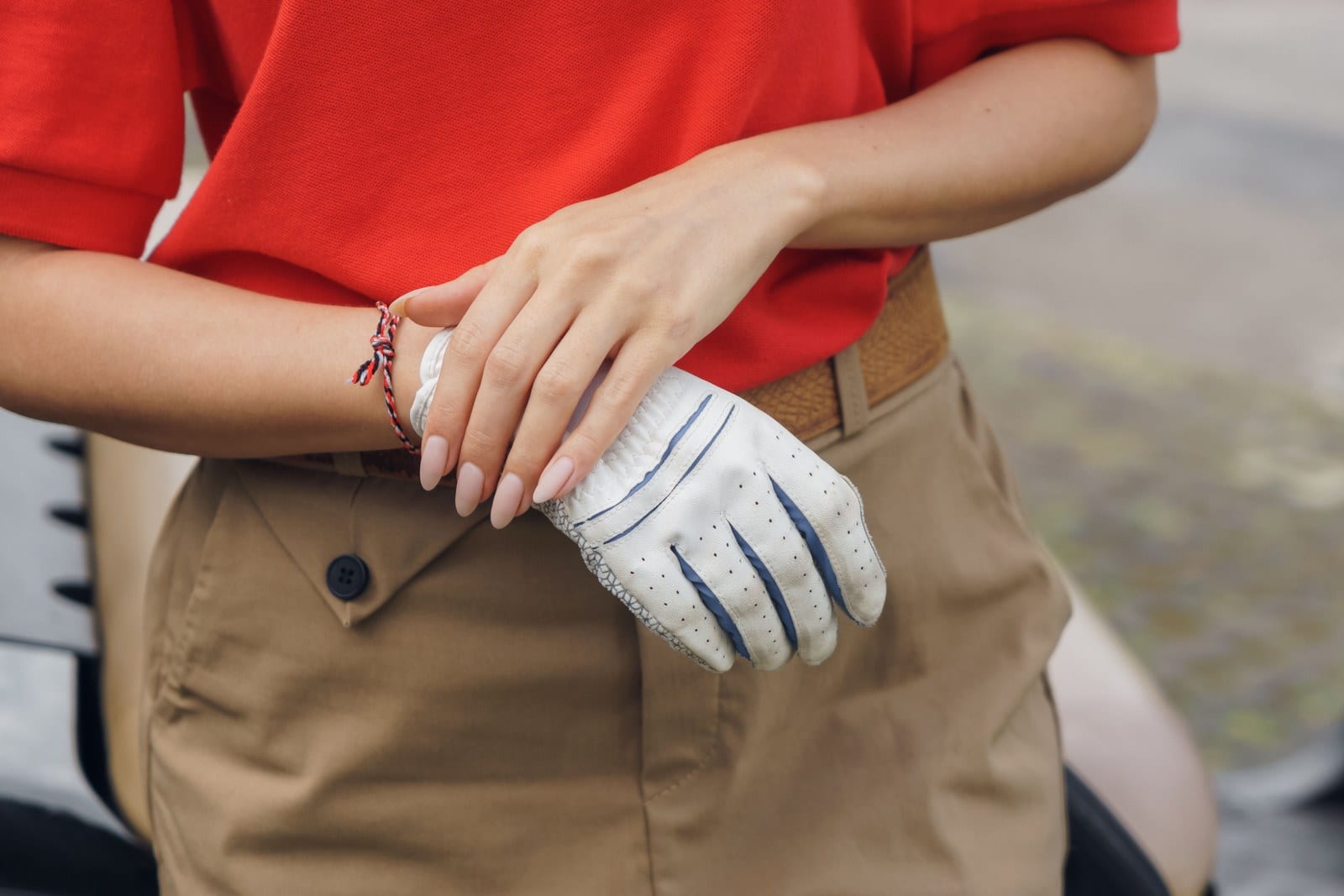
Palm. Haggin Oaks, a golf fitter, puts it this way: “Wrinkles across the palm or fingers are a strong indicator of poor fit” (Haggin Oaks, 2026-02-16). Tsuruya adds that the palm should feel taut when you open your hand, with nothing spare when you grip (Tsuruya Golf).
Tab. The tab is the Velcro strap that closes the glove on the back of your hand. Haggin Oaks says it “should close comfortably with only slight stretching” (Haggin Oaks). Bruce Bolt says it “should fasten with slight overlap. If it leaves a gap, you are in the wrong size” (Bruce Bolt).
Vice Golf suggests leaving some Velcro uncovered, so you can retighten “when the leather gets worked in and expands” (Vice Golf, 2025-03-12).
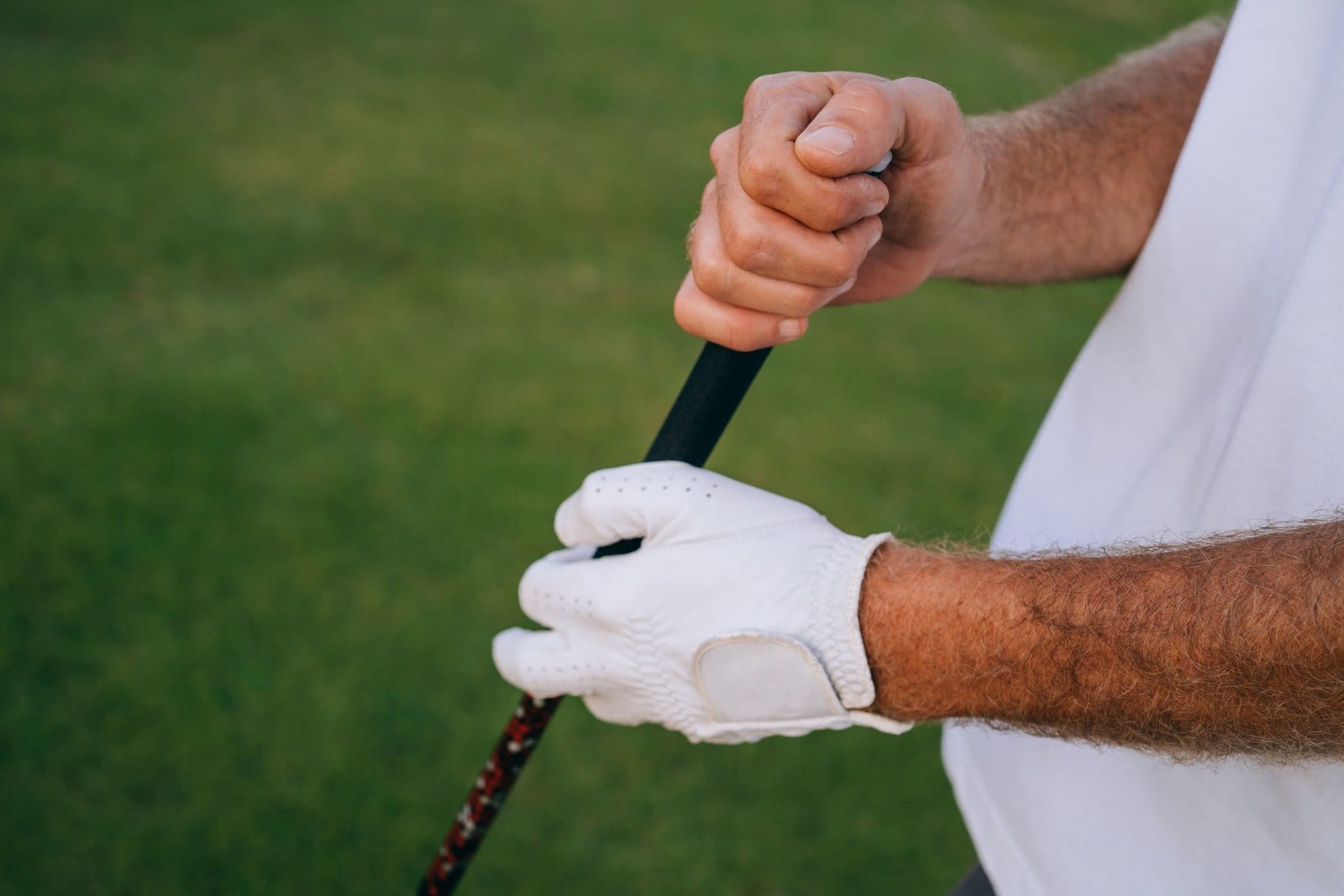
Between two sizes: leather smaller, synthetic as it fits
If you’re between two sizes, the material decides which way you go. FootJoy’s rule is “If you fall between two sizes, try the smaller size first” (GolfOnline UK, FootJoy).
The reason is that leather gives. Bruce Bolt says a cabretta glove “will conform to your hand over a few rounds”. It also says “A synthetic glove has less stretch and should fit correctly out of the package” (Bruce Bolt).
Cabretta is the sheep leather most leather golf gloves use. What the word means, and how it compares with synthetic, is in cabretta vs synthetic golf gloves.
Japanese sources agree. Descente’s guide says to fit natural leather slightly tight and give synthetic a little more room (Descente). Golf Digest Japan and Tsuruya both say to go snug when unsure (Minna no Golf Digest, Tsuruya Golf).
No maker I found says how much a leather glove stretches. So the smaller size only works for you if it passes the checks above today: the tab closes and the palm doesn’t pull.
Korean forum players lean the same way. One Dealbada member with more than ten years of golf moved from 22 to 21 and found it fit far better. Others in that thread reported the same (Dealbada, 2024-05-17). On the Golf Monthly forum, nobody in one sizing thread recommended going up a size (Golf Monthly forum, 2020).
Cadet golf gloves: when the palm fits and the fingers don’t
A cadet glove is cut for a wider palm and shorter fingers. Haggin Oaks says it’s “designed for golfers who have wider palms and shorter fingers compared to traditional sizing” (Haggin Oaks).
FootJoy gives a rule for spotting it: “If your Finger Length number is LESS than your Palm Width number, try a Cadet glove in your size” (GolfOnline UK, FootJoy). You read both of those numbers off FootJoy’s printed ruler, so compare them there, not in centimeters.
Japanese makers sell the same idea as a short-finger glove. Bridgestone’s version keeps the same palm loop and makes the fingers 5 mm shorter (Bridgestone).
Here’s the trap it solves. If your fingertips flap, dropping a size shortens the fingers but also squeezes the palm. Tsuruya says that when the smaller size is too tight in the palm, you’ll want a cadet instead (Tsuruya Golf). A cadet fixes the fingers and leaves the palm alone.
You may read that a large share of golfers need a cadet. I couldn’t find a measured figure behind that, so it isn’t in this post.
So which golf glove size should you buy?
Here’s the order I’d follow, from tape to shop.
- Measure the palm loop of your glove hand, the way the brand you’re buying asks. FootJoy also needs your middle-finger length.
- Find your starting size. On a numbered glove, start at your loop in centimeters. Tsuruya puts it simply: a 23 cm hand starts at a 23 glove (Tsuruya Golf). On a letter glove, use that brand’s chart.
- Put it on and run the three checks: fingertips to the ends, no palm wrinkles, tab closing with some Velcro to spare.
- Between two sizes, go by material. Leather: take the smaller one if the tab still closes and the palm doesn’t pull. Synthetic: take the one that fits now.
- Palm right, fingertips loose: try a cadet in the same size before you drop a size.
A few situations change the order.
You’re buying online from a brand you haven’t worn. Measure the way that brand says, and don’t carry over a size from another brand. One Dealbada player wears a 23 in one brand and a 24 in another on the same hand (Dealbada, 2021).
You have a numbered size and a letter-only shop, or the reverse. Forum conversions like 22 = S get you to the right shelf. The glove on your hand still decides.
You’re a man whose hand sits at the bottom of the men’s chart. Some golfers in that spot fit women’s sizes better, as players in the Golf Monthly thread mention (Golf Monthly forum). It’s worth trying one on before settling on a men’s S that’s loose in the fingers.
FAQ
What does 22 mean on a golf glove?
It’s the loop around your palm in centimeters, on the scale Japanese makers use and Korean shops follow. Dunlop runs that loop through the start of the life line and a point on the little-finger edge, and Bridgestone’s loop is nearly the same (Dunlop, Bridgestone). At least one Korean listing uses hand length instead, so check the listing’s own note.
Should a golf glove be tight?
Snug, not tight. You want no wrinkles in the palm, fingertips reaching the ends, and a tab that closes “with slight overlap” (Bruce Bolt). Leather can start a little snug because it gives. Synthetic should fit correctly on day one.
Are men’s and women’s golf glove sizes the same?
No. They’re separate scales. FootJoy’s women’s chart covers 18-20 cm of palm width, against 19.5-23 cm for men’s (GolfOnline UK, FootJoy). Descente’s women’s M is 19-20 cm, while its men’s M is 23-24 cm (Descente).
Do you size a pair of gloves differently from a single glove?
I couldn’t find a maker that gives a separate rule for gloves sold as a pair. Measure and check each hand the same way you would for a single glove.
Terms in this article
- Palm width: FootJoy’s name for the loop around your hand at the knuckles, thumb left out. It’s a circumference, not a width across.
- Finger length: the length of your middle finger from the top edge of the palm to the tip, the second measurement on FootJoy’s chart.
- Glove hand: the hand that wears the glove. For a right-handed golfer, it’s the left.
- Numbered size (ho): the Japanese-style glove size used in Japan and Korea. The number is the palm loop in centimeters. Korean golfers say “22 ho”.
- Life line: the curved crease around the base of your thumb. Dunlop starts its measuring loop there.
- M/L: medium-large, the size between M and L on letter charts. Some brands write it ML.
- Cadet: a glove cut for a wider palm and shorter fingers than regular sizing. Japanese makers sell the same idea as a short-finger glove.
- Tab: the Velcro strap that closes the glove on the back of your hand.
- Cabretta: the hair-sheep leather most leather golf gloves use. It gives a little with wear.
- Synthetic glove: a glove made from man-made fabric. It stretches less than leather, so it should fit out of the package.