
Golf grip size chart: standard is 0.900 in, and how to check yours
Four grip diameters from GolfWorks' sizing table, Golf Pride's hand-length bands and heel-pad check, and why a size 22 glove golfer stayed on standard.
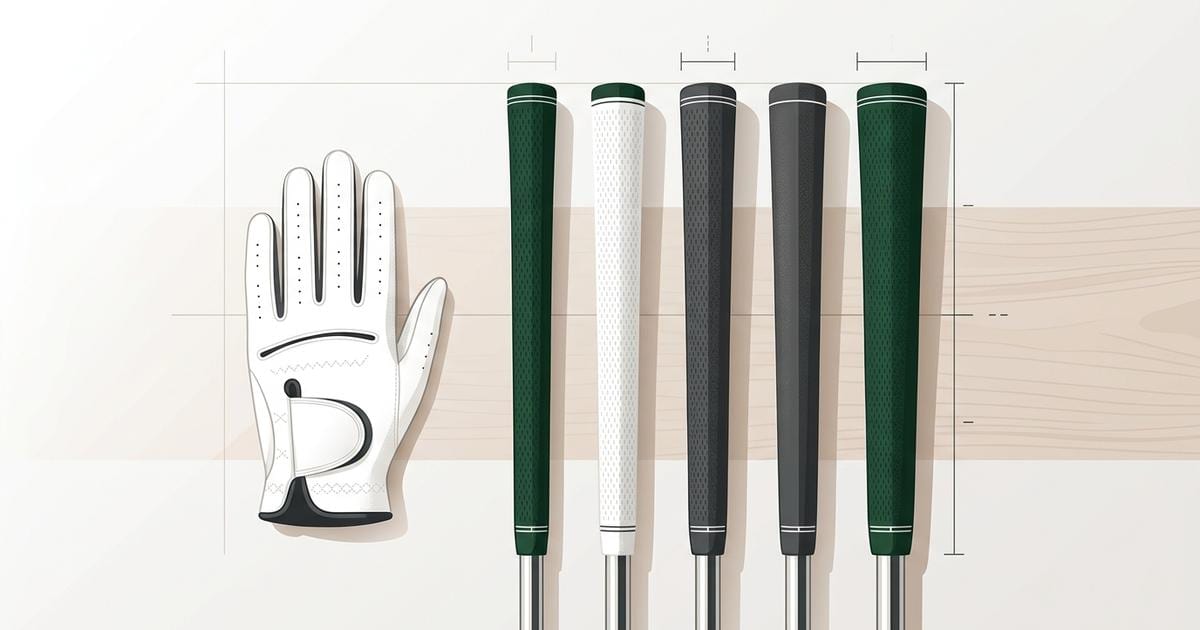
If you wear a size 22 glove and your irons came with standard grips, you probably don’t need a different size. You need a thirty-second check, and the check is your own fingertips, not the glove.
I wear a 22. My first iron set came with plain black rubber grips already on it, and I’ve since regripped six of its nine irons. I never changed the diameter. What I did change turned into a side-by-side comparison I hadn’t planned, and that story is in the decision section further down.
First the chart, because “standard” is a number and the number is easy to find.
The short answer
- Men’s grips come in four sizes on GolfWorks’ sizing table. Undersize is 0.885 in (22.5 mm), Standard 0.900 in (22.9 mm), Midsize 0.960 in (24.4 mm) and Jumbo 1.020 in (25.9 mm). All four are measured 2 inches below the grip cap (GolfWorks, Grip Sizing chart (PDF), retrieved 2026-09-18).
- Golf Pride’s size guide sorts you by hand length, wrist crease to middle fingertip. Standard is 6.6-7.5 in (Golf Pride, Swing Grip Size Guide, retrieved 2026-09-18).
- The check that beats both tables: with your upper hand alone on the club, your middle and ring fingertips should barely touch the heel pad. Wrapped under it, the grip is too small. Not touching, too large.
- “Smaller for a slice, bigger for a hook” is a real fitting convention. Nobody has published a test that puts a number on it, and the fit check comes first.
- My split set has old rubber on the 4, 5 and 6 and Elite Grips on 7 through SW. As far as I can tell both halves are standard, so the squeezing I felt wasn’t a size problem. Different grip, less tension.
The four grip sizes in inches and millimeters
Grip size means the outside diameter of the grip after it’s on the club. The measuring point is 2 inches below the grip cap, the closed end at the top. That’s the convention GolfWorks uses for its sizing table, and it’s the one the numbers below assume.
| Size | Diameter (GolfWorks) | Hand length (Golf Pride) | Glove letters (Golf Pride) |
|---|---|---|---|
| Undersize (-1/64 in) | 0.885 in (22.5 mm) | 5-6.5 in | Men’s S, Cadet S, Women’s S or M |
| Standard | 0.900 in (22.9 mm) | 6.6-7.5 in | Men’s M or M/L, Cadet M or M/L, Women’s M/L or L |
| Midsize (+1/16 in) | 0.960 in (24.4 mm) | 7.6-9 in | Men’s L or XL, Cadet L or XL |
| Jumbo (+1/8 in) | 1.020 in (25.9 mm) | over 9 in | none listed |
Diameters from GolfWorks’ printable grip sizing chart (GolfWorks, Grip Sizing chart (PDF)). Hand length and glove letters from Golf Pride, Swing Grip Size Guide, both retrieved 2026-09-18. The two publishers use the same four size names, so I lined the columns up. Cadet in that last column is a glove cut for shorter fingers on the same palm width, a glove-industry label rather than a grip size. Golf Pride also lists a Junior band under 5 in, which GolfWorks’ men’s table doesn’t carry.
The +1/16 and +1/8 labels in the first column are the trade’s names for the steps rather than exact arithmetic off 0.900 in. A full 1/16 in over standard would be 0.9625 in, and a full 1/8 in would be 1.025 in. GolfWorks’ own table lists 0.960 in and 1.020 in.
The -1/64 label is the exception, and it lands almost exactly. 0.900 in minus 1/64 in is 0.884375 in, within a thousandth of the 0.885 in GolfWorks lists. GolfWorks’ decimals are the ones I’ve used throughout.
One number on that GolfWorks chart trips people up. It lists a separate women’s standard at 0.850 in (21.6 mm) (GolfWorks, Grip Sizing chart (PDF), retrieved 2026-09-18). That column gets copied around as the men’s Undersize. Men’s Undersize is 0.885 in.
The step from Standard to Midsize is 0.060 in on that table, about 1.5 mm. On a ruler that’s nothing. The reason it matters is that all of it lands on your fingers, and the check in the next section makes it visible.
Two grips that both say standard can still feel different, and core size is why. Core size is the inside diameter of the grip before it goes on, and it has to match the shaft. Golf Pride says a .58 core standard grip on a .600 shaft “will feel thicker than a .60 core standard size grip on a .600 shaft” (Golf Pride, Swing Grip Size Guide, retrieved 2026-09-18). Same name on the label, a different feel in your hands.
The outside diameter is the steadier part. Elite Grips, the grip on six of my nine irons, lists its standard Y360s at 23 mm on an M60 shaft (Elite Grips, Y series, retrieved 2026-09-18). M60 is one of the shaft-bore codes the grip’s core is made for. That 23 mm is GolfWorks’ 22.9 mm rounded to the millimeter, not a different size.
So “standard” on the box is close to 0.900 in without being a promise. An R on a shaft works the same way, which is its own story in the golf shaft flex guide.
Korean gloves are sold by number instead of letter, which is where my 22 comes from. The rough shop convention is that 21 and 22 sit around a US Small, 23 and 24 around Medium, and 25 and up around Large. I couldn’t find that mapping published or measured anywhere, so it’s a first guess, and the next section is what decides.
Putter grips are sized on their own scale and aren’t in this table. If putting is what you’re sorting out, lined ball and mallet aim covers aim rather than grips.
How to check your grip size at home
Two steps. Hand length gets you a starting row on the table. Your fingertips against your heel pad make the decision.
Step 1, hand length. Golf Pride’s instruction: “Using your upper grip hand, measure from the crease of your wrist to the tip of your middle finger” (Golf Pride, Swing Grip Size Guide, retrieved 2026-09-18). Your upper hand is the one nearer the grip cap, the left hand for a right-handed golfer. Then the hand-length column of the table above gives you a starting row.
Step 2, the heel-pad check. You’d take your normal hold on any iron with the upper hand only, then look at where your fingertips land. The heel pad is the firm cushion at the bottom of your palm, on the little-finger side.
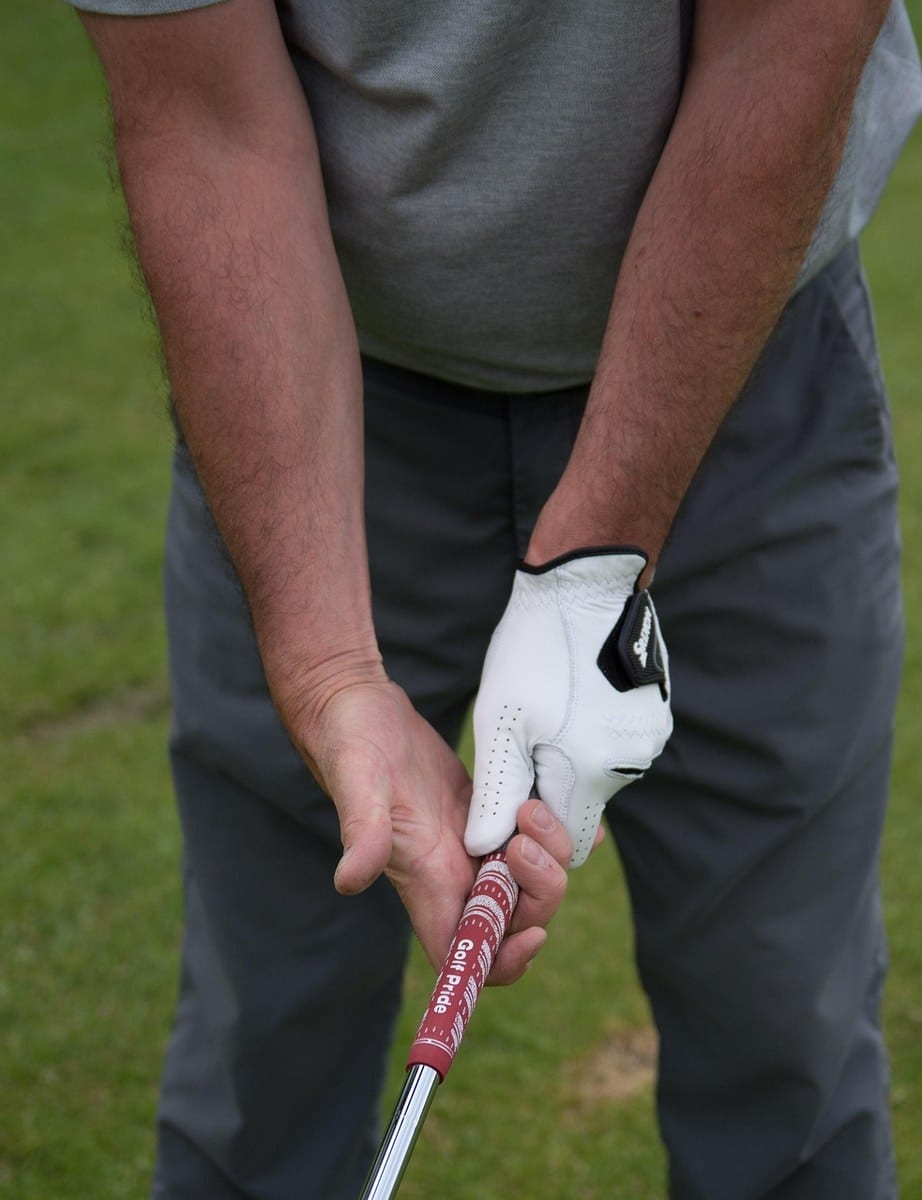
Photo: Pixabay, Pixabay Content License. A finished two-handed hold like this one covers the fingertips, which is why the check uses the upper hand on its own. You’re looking at whether the middle and ring fingertips just brush the heel pad.
Golf Pride gives three readings, and I’m quoting them because the wording is the test (Golf Pride, Swing Grip Size Guide, retrieved 2026-09-18):
- Right size: “Your fingers will barely touch the heel pad of your upper hand.”
- Too small: “Your fingers will wrap underneath the heel pad of your hand.”
- Too large: “Your fingers will not touch the heel pad of your hand.”
When the two steps disagree, the fingers win. Britt Lindsey at Ralph Maltby’s shop puts it flatly: “we never go by hand sizing charts, etc. The best and only way, in our opinion, is to use the fingertip to palm method” (Ralph Maltby, Grips: correct sizing, retrieved 2026-09-18). The reason is simple from your side. Your hand length says nothing about how thick your fingers are, and the grip only meets your fingers.
If you land between two sizes, that’s what build-up tape is for: extra layers under the grip. GolfWorks says each layer of its 2 in single-coated masking tape will increase the grip diameter by 0.010 in, which is 0.25 mm (GolfWorks, Grip Sizing chart (PDF), retrieved 2026-09-18). That’s smaller than any step on the table, which is why a builder can put you between rows. A builder is the person who assembles or regrips your clubs.
What grip size does and doesn’t do to your ball flight
The convention comes first, because you’ll hear it in any shop. A fitter is the person who measures you and specifies the club before it’s built, and the session itself is a fitting. Golf Digest’s fitters put it this way: “Typically (although not always), larger grips, like those listed as Midsize or even larger, can help a player who is struggling with a hook. Smaller grips can help a player who is fighting a slice to help the hands to release more efficiently to square the clubface at impact” (Golf Digest, Why grip size is way more important than you think, retrieved 2026-09-18).
Release is your hands and forearms turning the clubface back to square through impact. That word carries the mechanism in the quote above. Golf Digest’s fitters reason that a thinner grip lets the hands release more freely to square the face. That’s why a slice gets pointed thinner.
For the hook side those fitters give the recommendation without saying why. PING’s fitting page doesn’t offer a mechanism either. It says only that “If a grip is too small or too large, it can have a detrimental effect on your ball flight direction” (PING, Color code chart, retrieved 2026-09-18), without naming a direction or a cause.
That convention is real, and I’m not going to call it a myth. Three things sit next to it, though, and all three are about you rather than the grip.
First, the fit check comes before any steering. Before you buy a smaller grip to chase a slice, you’d want to know the one you have passes the heel-pad check. MyGolfSpy’s instruction piece says grip size “can tip an existing tendency one way or the other but it’s rarely the root cause on its own” (MyGolfSpy, Can a midsize grip cause a slice?, retrieved 2026-09-18). Maltby’s shop, quoted above, won’t even start from a chart, so the fit comes first and the steering after that, if you still want it.
Second, a grip that’s too small makes you squeeze. GolfWorks: “A grip that is too small can cause the player to squeeze the grip too tightly, creating tension and inhibiting wrist action before impact” (GolfWorks, Golf Grip Sizing, retrieved 2026-09-18). That runs the opposite way from the convention. The same page adds that a too-small grip with proper pressure can produce “overactive wrist action causing the golfer to pull the ball.” So a small grip can go either way, depending on what your hands do with it. Sizing down isn’t a slice fix on its own.
The too-large side has its own failure. MyGolfSpy again: “If your fingers can’t reach the heel pad, you don’t have full control of the club through impact and the face has a much easier time staying open” (MyGolfSpy, Can a midsize grip cause a slice?, retrieved 2026-09-18).
Third, nobody has published a test that puts a number on it. I looked for a controlled test of grip size against curvature and didn’t find one. The pieces above are fitter experience, and I’m quoting them as that. So there are no percentages in this article, and any you see elsewhere are worth asking about.
If your slice is a swing path problem, grip size is the wrong tool. Ball construction is another spec people change hoping to fix curvature: 2-piece vs 3-piece golf balls.
Which grip size should you actually play
Your glove number is where you’d start, and the heel pad is what overrules it. By the shop convention for Korean glove numbers above:
- Glove 21 or 22. You’re on the line between Undersize and Standard on Golf Pride’s letters. Standard is where you’d start, since that’s what your clubs came with, and then you’d run the heel-pad check. If your fingers wrap under the heel pad, that’s the case for Undersize, or for asking a builder about a thinner grip model.
- Glove 23 or 24. Standard is where the letters point. The heel pad is still worth a check.
- Glove 25 and up. Midsize is where the letters point. If your fingers don’t reach the heel pad on your current standard grips, that’s the confirmation.
- Sore hands or joints. Shops suggest thicker grips for this, and that’s a convention I’ve heard rather than something I can measure. If your hands hurt, a doctor before a grip.
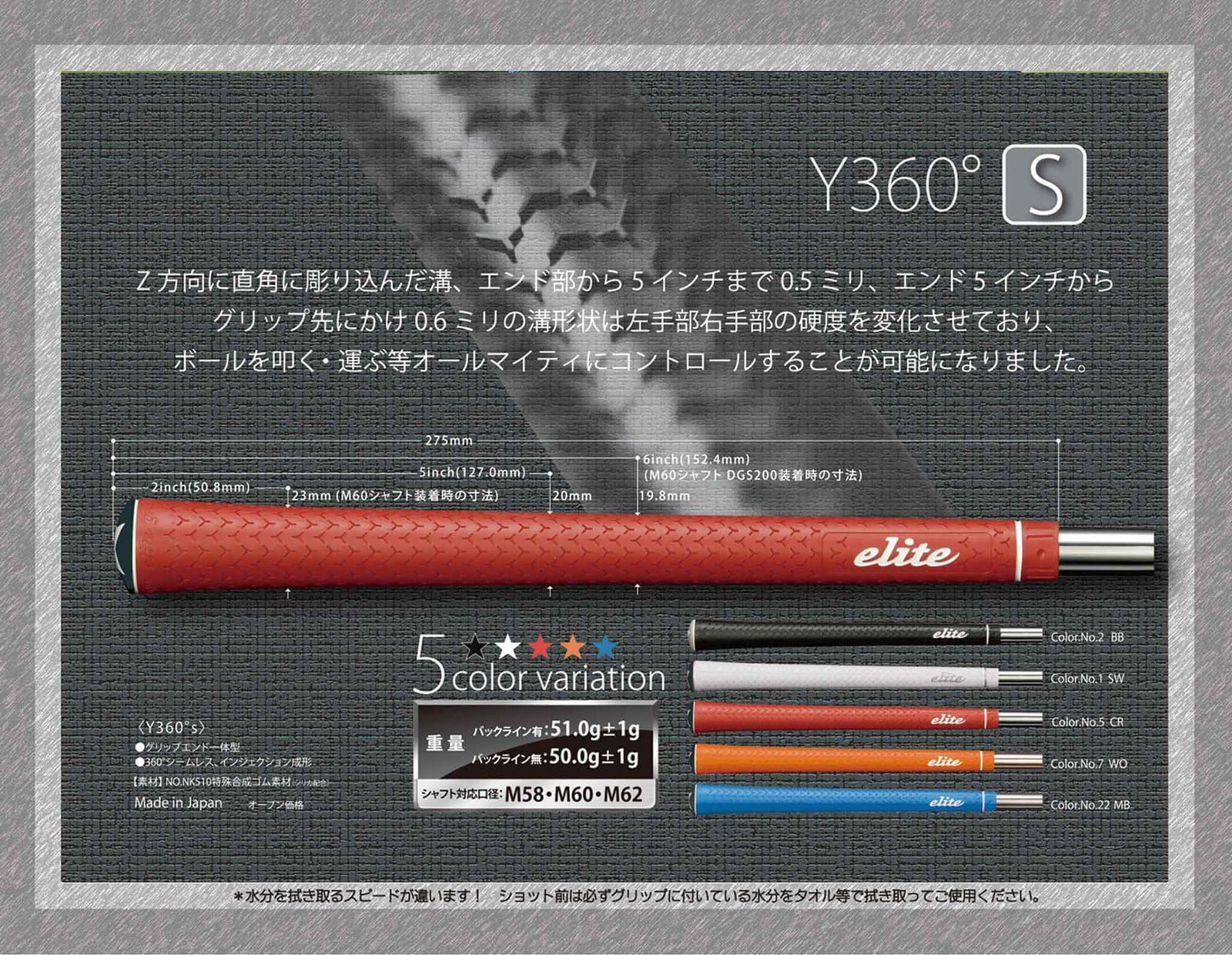
Image: the maker’s Japanese spec sheet for the Y360s, from Elite Grips, Y series, retrieved 2026-09-18. The 2 inch (50.8 mm) callout is where grip diameter is measured; this standard reads 23 mm on an M60 shaft.
Here’s what I actually did, so you can weigh it. My first set was a used Tourstage V300 III, 4 through PW plus PS and SW. It came with plain black rubber grips the previous owner had put on, and I played them as they were.
When the short-iron grips wore down I had 7, 8, 9, PW, PS and SW regripped with Elite Grips, an elastomer grip in standard size. Elastomer is the family of rubber-like synthetics; Elite describes its material as a special synthetic rubber compound with silica (Elite Grips, Y series, retrieved 2026-09-18).
The 4, 5 and 6 kept the old rubber because they were less worn. That wasn’t a plan. It was me not paying for three grips I didn’t need yet.
What it left me with is a split set I hit side by side every session. On the Elite clubs I squeeze less, and my forearms are looser at address. On the rubber 4, 5 and 6 I still catch myself holding on harder.
The diameter didn’t change. As far as I can tell both halves are standard, so whatever I’m feeling isn’t a size story. It’s the material and the age of the grip, and that comparison gets its own post next. The narrower takeaway: a size 22 glove on standard grips was never the problem in my bag.
If you do decide to change size, the cheap version is one club first. You’d regrip the 7-iron, the club most of us hit most on the range. Then you’d play it next to your 6-iron for a couple of sessions.
Golf Digest’s Woody Lashen warns that “many times what feels good does not work” (Golf Digest, Why grip size is way more important than you think, retrieved 2026-09-18). So you’d watch where the ball goes as well as how your hands feel. If the new size passes the heel-pad check and the ball behaves, the rest of the set follows. If it doesn’t, you’ve spent one grip finding out.
Terms in this article
- Grip size (grip diameter): The outside diameter of the installed grip, measured 2 inches below the grip cap. Undersize, Standard, Midsize and Jumbo are names for four of those diameters.
- Grip cap: The closed end at the top of the grip.
- Women’s standard: A separate 0.850 in column on GolfWorks’ table. It is not the men’s Undersize.
- Upper hand (lead hand): The hand nearer the grip cap. The left hand for a right-handed golfer.
- Heel pad: The firm cushion at the bottom of your palm on the little-finger side. Your fingertips should barely touch it when the grip fits.
- Cadet: A glove cut for shorter fingers on the same palm width. A glove-industry label, not a grip size.
- Core size: The inside diameter of the grip before installation, written .58 or .60. It has to match the shaft butt, and the same outside size feels different on a different core. Makers also print a bore code on the grip: Elite lists the Y360s for M58, M60 and M62 (Elite Grips, Y series, retrieved 2026-09-18).
- Build-up tape: Extra tape layers under the grip to thicken it. GolfWorks puts one layer of its 2 in masking tape at 0.010 in.
- Release: Your hands and forearms turning the clubface back to square through impact.
- Elastomer: The family of rubber-like synthetic materials. The Elite grips in my bag are one example.
- Fitting: The session where a shop measures you and specifies the club before it’s built.