Rules & Play
Golf Scoring Terms: Birdie, Bogey, Eagle Are Counted From Par
Golf scoring terms name the gap to par, not the stroke count. Birdie is 1 under, eagle 2 under, bogey 1 over. Plus albatross, condor and the handicap cap.
The short answer
Golf scoring terms name how far your score is from the hole's par, not how many strokes you took. Birdie is 1 under par, eagle 2 under, bogey 1 over. Once you have a Handicap Index, the most you can post on a hole is net double bogey.
- 1 under par
- a birdie Merriam-Webster, "birdie", checked 2026-11-16
- 1 over par
- a bogey Merriam-Webster, "bogey", checked 2026-11-16
- par + 2 + handicap strokes
- net double bogey, the most you can post on a hole once you have a Handicap Index Rules of Handicapping, Rule 3.1b, checked 2026-11-16
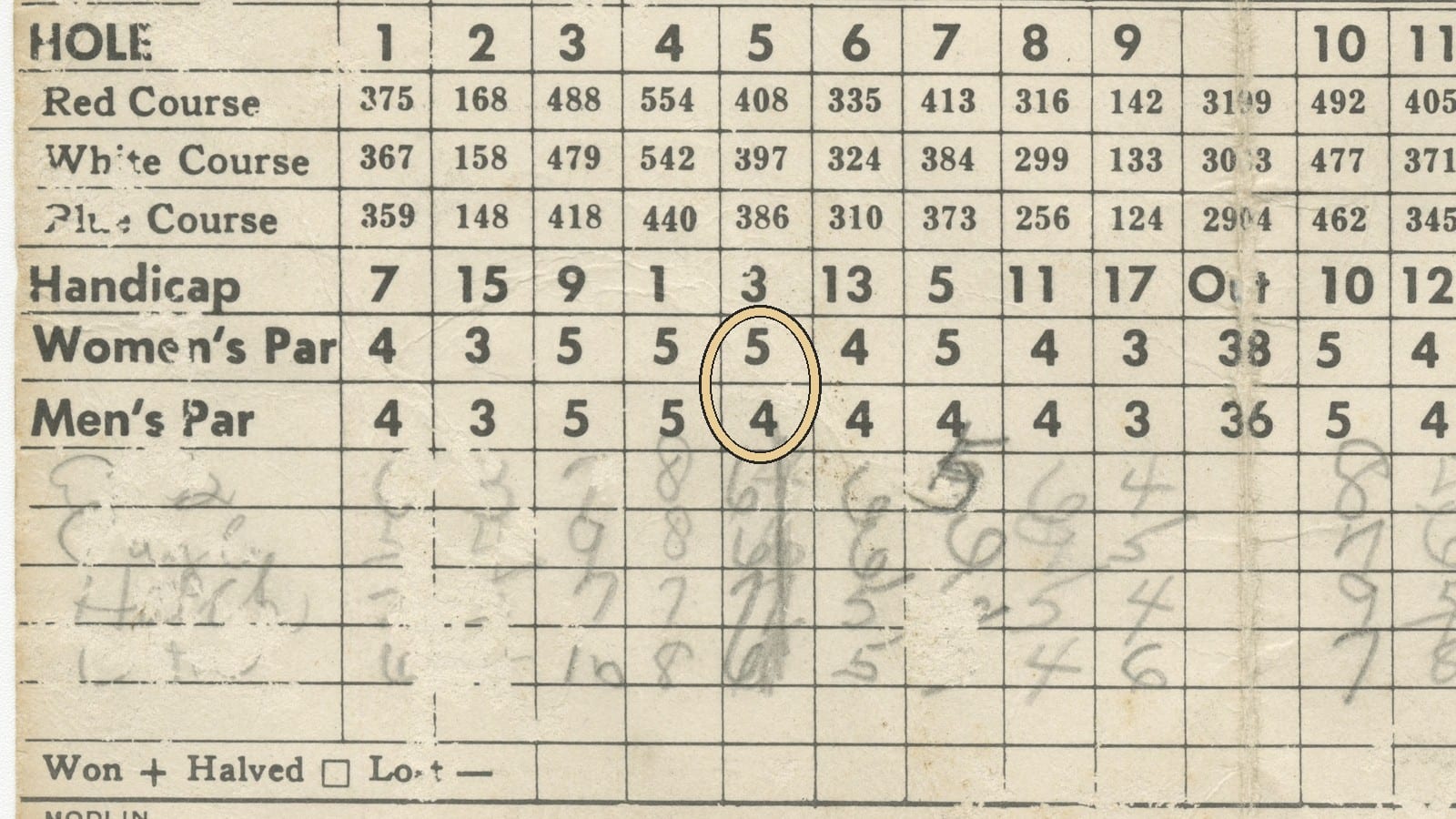
Look at hole 5 on the old Benvenue Country Club scorecard at the top of this page. The card prints two pars for that one hole: 5 for women and 4 for men.
So a 5 on that hole has two names. For a woman playing it as a par 5, it’s a par. For a man playing it as a par 4, it’s a bogey, with the same strokes and a different par.
That’s the whole system. Golf scoring terms don’t name how many strokes you took. They name how far your score sits from the hole’s par.
Read par first
- The habit: check the hole’s par, count the gap, then name the score.
- Under par: birdie is 1 under, eagle is 2 under, albatross (also called double eagle) is 3 under, condor is 4 under.
- Over par: bogey is 1 over, double bogey is 2 over, triple bogey is 3 over.
- For your handicap: once you have a Handicap Index, the most you can post on a hole is net double bogey.
The names, from condor to triple bogey
Merriam-Webster defines par as “the score standard for each hole of a golf course” (Merriam-Webster). Every name below is a distance from that standard.
| Name | Vs. par | On a par 3 | On a par 4 | On a par 5 |
|---|---|---|---|---|
| Condor | 4 under | not possible | not possible | 1 |
| Albatross (double eagle) | 3 under | not possible | 1 | 2 |
| Eagle | 2 under | 1 | 2 | 3 |
| Birdie | 1 under | 2 | 3 | 4 |
| Par | even | 3 | 4 | 5 |
| Bogey | 1 over | 4 | 5 | 6 |
| Double bogey | 2 over | 5 | 6 | 7 |
| Triple bogey | 3 over | 6 | 7 | 8 |
The “vs. par” column comes from the definitions linked in the sections below. The stroke columns are my arithmetic: par plus or minus the gap. “Not possible” means the math would need zero strokes or fewer.
What is a birdie in golf?
A birdie is “a golf score of one stroke less than par on a hole” (Merriam-Webster). A 3 on a par 4 is a birdie. So is a 4 on a par 5.
You’ll also hear it said as a number. GOLF.com notes that a player who “makes a birdie is said to be ‘one under par,’ or ‘one under’” (GOLF.com).
The name’s origin is a story more than a record. The USGA says the golf meaning, “according to legend, traces to Atlantic City (N.J.) Country Club.” The club put up a plaque “that puts the date at 1903” (USGA).
Golf Digest reports that A.B. Smith, the player in that story, later put it at 1899, after a “bird of a shot” (Golf Digest). Two dates for one tale. I’d enjoy it as a legend and not lean on either year.
What is an eagle in golf?
An eagle is “a golf score of two strokes less than par on a hole” (Merriam-Webster). That’s a 3 on a par 5 or a 2 on a par 4.
On a par 3, an eagle means one stroke. That’s a hole-in-one, which gets its own section below.
What is a bogey in golf?
A bogey is “one stroke over par on a hole” (Merriam-Webster). On a par 4, that’s a 5.
The word didn’t always mean that. The USGA says “bogey originally meant what par does today in the sense that it represented the target score for any given hole.” Merriam-Webster still lists that older sense, marked chiefly British and dated: “an average golfer’s score used as a standard for a particular hole or course.”
Then, the USGA says, U.S. golfers “began to use bogey as a term meaning 1 over par.” Par itself “didn’t gain official recognition until 1911, when the USGA codified a rating standard.”
Each extra stroke moves the name one step. A double bogey is “a golf score of two strokes over par on a hole” (Merriam-Webster). GOLF.com gives the plain example: “On a par-3, a double bogey is five strokes.” Three over is a triple bogey, by the same pattern. I couldn’t find a dictionary entry for that one.
What is an albatross in golf? Double eagle and condor
Albatross and double eagle are two names for one score, 3 under par. Merriam-Webster defines double eagle as “a golf score of three strokes less than par on a hole” (Merriam-Webster). Its albatross entry gives the same meaning and labels the word “chiefly British” (Merriam-Webster).
The USGA ties double eagle to the same birdie story: A.B. Smith and his companions “used double eagle for 3 under.” On a par 5, that’s a 2.
A condor goes one step further. GOLF.com puts it simply: “It’s when you score four under on a single hole” (GOLF.com). On a par 5, 4 under means a hole-in-one.
It’s rare, and the counts are loose. A 2021 PGA.com article said “there have been 5 recorded condors in history,” and that “bookmakers don’t even offer odds on such a feat” (PGA.com). Other counts disagree, and there’s no official registry to check them against. Five is PGA.com’s tally as of 2021, not a record book.
A hole-in-one has two names
An ace is “a golf score of one stroke on a hole” (Merriam-Webster). That name describes what happened. The scoring term still depends on par.
- Par 3: 1 is 2 under par, so an ace there is also an eagle. That’s my arithmetic from the two definitions.
- Par 4: GOLF.com says “the only other way to record an albatross is with a hole-in-one on a par-4.”
- Par 5: 1 is 4 under par, so an ace there is a condor.
How to mark birdies and bogeys on a scorecard
GOLF.com describes the usual marks. For a birdie, you’re “drawing a circle around the number.” An eagle “is usually noted with a double circle around the number.” For a bogey, you “draw a square around the number.”
I couldn’t find a governing body that sets these marks, and you don’t need them to post a score (add a round to your handicap record).
The Benvenue Country Club card shown above is a reminder of how loose those habits are. Its legend row pairs “Won” with a plus sign, “Halved” with a square and “Lost” with a dash, all match play marks.
Match play is a format where you win or lose each hole against an opponent. A halved hole is a tie. So on that card, a square meant a tied hole, not a bogey.
The highest score you can post: net double bogey
If you keep a handicap, a blowup hole doesn’t go on your record in full. Rule 3.1b of the Rules of Handicapping says (Rules of Handicapping, Rule 3):
For a player with an established Handicap Index, the maximum score for each hole is limited to net double bogey
For most players, the rule spells out the math: “Par of the hole + 2 strokes + Any handicap stroke(s) that the player receives on that hole.” Your Course Handicap is your Handicap Index converted into strokes for the course you’re playing. Handicap strokes are the extra strokes it gives you on certain holes.
Here’s my arithmetic for one case. On a par 4 where you get one handicap stroke, the cap is 4 + 2 + 1 = 7. Take a 9 there, and you post a 7. The rule adds that “there is no limit to the number of holes in a round” where you can apply it.
Before you have a Handicap Index, the cap is different. Rule 3.1a limits each hole to “par + 5 strokes” for the scores you submit to get one. On a par 4, that’s 9.
Don’t mix this up with Maximum Score, a competition format in the Rules of Golf. Under Rule 21.2a, the score for a hole “is capped at a maximum number of strokes set by the Committee.” The rule’s examples are “two times par, a fixed number or net double bogey” (R&A Rules of Golf, Rule 21). The Committee, meaning the people running the event, picks that cap. The posting cap applies to every hole you post. My guide to how a Handicap Index is calculated shows where the capped scores go next.
Go back to hole 5 on the Benvenue card. The same 5 is a par for one player and a bogey for the other. Read par, count the gap, and name it. The number in pencil stays the same; only its name moves with par.