
How many clubs in a golf bag: up to 14, with no minimum
The rules allow up to 14 clubs and set no minimum. The eight boxed sets I checked hold 7 to 11. Here's what a 15th club costs and how a beginner picks a number.
You can carry up to 14 clubs in your golf bag, and your putter counts as one of them. There’s no minimum. The rule is Rule 4.1b of the Rules of Golf (R&A, Rule 4).
Fourteen is a ceiling, not a target. The eight boxed beginner sets I checked hold 7 to 11 clubs, and the advice I found for new golfers runs from six to ten. What matters more than the count is whether your clubs cover the shots you actually play.
The short answer
- The Rules of Golf let you carry up to 14 clubs, putter included, and set no minimum. If you start with fewer, you can add clubs during the round up to 14 (R&A Rule 4, USGA).
- In stroke play, a 15th club costs two penalty strokes for each hole you played with it, four at most. In match play the match score drops by one hole for each hole, two at most (R&A Rule 4).
- Once you notice the extra club, you have to take it out of play before your next shot. If you don’t, you’re disqualified.
- The eight boxed sets I checked from Callaway, Wilson and Cobra hold 7 to 11 clubs. None holds 14. “Piece” counts the bag and headcovers too, so Callaway’s Strata 12-Piece has 9 clubs (Callaway).
- No golf association I could find recommends a number for beginners. Golf Digest says six clubs max, and a club maker’s blog says 7-10. Both lists cover the same five jobs: tee shots, long approaches, mid approaches, the short game and putting.
- My bag holds 14 today. My first round on a real course was played with a used iron set exactly as it came. The bag changed club by club from there.
How many clubs allowed in a golf bag: 14, and no minimum
The limit is 14 clubs, and it covers every club you bring. Rule 4.1b(1) says a player must not start a round with more than 14 clubs or have more than 14 during it. “This limit includes all clubs carried by or for the player” (R&A, Rule 4, retrieved 2026-09-28).
The Rules of Golf are the one rule book that golf’s two governing bodies, the R&A and the USGA, publish together. Rule 4.1b is the part of it that sets the 14-club limit.
There’s no minimum at all. The USGA’s own summary puts it in brackets: “You are allowed to carry up to 14 clubs for play (but you can have fewer)” (USGA Rules Hub). And if you start short, the R&A says “you may add clubs during the round up to the 14-club limit” (R&A Players’ Rule Finder).
So nothing in the rules asks you to fill the bag. You’ll see below that most beginner sets don’t come close.
Where the 14 came from
The limit dates to the late 1930s. The USGA adopted a 14-club limit in 1938, and the R&A followed a year later (USGA, A Brief History).
Before that, some players carried 25 clubs or more. Two-time U.S. Amateur champion Lawson Little was one of them (USGA, 2014, World Golf Hall of Fame). The USGA says the rule “was designed to restore shotmaking to the game.” As I read it, the point was to make one club play several shots, instead of carrying a club for each.
The penalty for a 15th club
The penalty for a 15th club depends on how you’re playing. Stroke play is the format where you count every shot for the whole round. Match play is a hole-by-hole contest against an opponent.
| Format | Penalty for each hole with too many clubs | Most in a round |
|---|---|---|
| Stroke play | Two penalty strokes | Four strokes |
| Match play | The match score drops by one hole | Two holes deducted |
Source: R&A, Rule 4, penalty for breach of Rule 4.1b, retrieved 2026-09-28.
In stroke play you get “the general penalty (two penalty strokes) for each hole where a breach happened, with a maximum of four penalty strokes in the round.” The general penalty is the standard two-stroke penalty the rules use for most breaches. How it differs from a one-stroke penalty is in golf penalty strokes.
Here’s what the cap means for you. Say you notice a 15th club on the 6th tee, after five holes. Two strokes a hole would be ten, but the cap holds it to four.
When the penalty lands depends on when you notice. Noticed during a hole, it goes on at the end of that hole. Noticed between holes, it goes on the hole you just finished (same source).
Take the extra club out of play right away
The penalty isn’t the end of it. Rule 4.1c(1) says you have to take the extra club out of play before your next stroke (R&A, Rule 4). That means you declare you won’t use it for the rest of the round.
You do that by telling your opponent in match play, or your marker in stroke play. The marker is the person who records your score. You can also show it by an action, such as “turning the club upside down in the bag.”
If you skip this step, or use that club again, the penalty is disqualification. That means your round no longer counts in the competition.
If you catch it before the round starts, it’s simpler. Rule 4.1c(2) lets you leave the extra club behind with no penalty.
How many golf clubs in a set: 7 to 11, not 14
A boxed beginner set holds fewer clubs than the rules allow. In the eight current sets I checked from Callaway, Wilson and Cobra, the count runs from 7 to 11. None of them holds 14.
A complete set is a beginner package sold as one box: clubs, a bag, and usually headcovers. A headcover is a padded cover that slips over a club head.
“Piece” is not the number of clubs
The number on the box counts everything in it, not just the clubs. Callaway lists its men’s Strata Ultimate 16-Piece as “Driver, 3 Wood, 4 & 5 Hybrid, 6 - 9 Iron, PW & SW, Putter, Stand Bag, and 4 Headcovers” (Callaway). That’s 11 clubs plus five other pieces.
So when you’re comparing sets, you’ll want to count the clubs in the listing yourself. In every set I checked, the piece number reads higher.
| Set | Clubs in the box | Clubs | Name on the box |
|---|---|---|---|
| Callaway Strata, men’s | Driver, 3-wood, 5-hybrid, 6-9 irons, PW, putter | 9 | 12-Piece |
| Callaway Strata Plus, men’s | Driver, 3-wood, 5-hybrid, 6-9 irons, PW, SW, putter | 10 | 14-Piece |
| Callaway Strata Ultimate, men’s | Driver, 3-wood, 4- and 5-hybrid, 6-9 irons, PW, SW, putter | 11 | 16-Piece |
| Callaway Strata, women’s | Driver, 5-wood, 5-hybrid, 7- and 9-iron, SW, putter | 7 | 11-Piece |
| Callaway Strata Ultimate, women’s | Driver, 3-wood, 4- and 5-hybrid, 6-9 irons, PW, SW, putter | 11 | 16-Piece |
| Wilson Profile, men’s stand bag | Driver, 5-wood, 5-hybrid, 6-9 irons, PW, SW, putter | 10 | Not listed in pieces |
| Cobra Fly-XL, men’s stand bag (2025) | Driver, fairway wood, 4- and 5-hybrid, 6-9 irons, PW, SW, putter | 11 | 12-piece |
| Cobra Fly-XL, women’s cart bag (2024) | Driver, 3-wood, 5-wood, 5-hybrid, 6-9 irons, PW, SW, putter | 11 | Not listed in pieces |
Sources: the maker pages linked in each row, retrieved 2026-09-28. Callaway’s Strata sets carry a 2019 model year and were still on sale that day. Club counts are my own count of each maker’s listing.
A few terms from the table. PW is the pitching wedge and SW the sand wedge, the two wedges most sets include. A hybrid is a club with a small, wood-shaped head on a shaft about as long as an iron’s. A fairway wood (3-wood, 5-wood) has a smaller head than a driver and is built to hit off the grass as well as a tee.
What the sets leave out, and what fills a full 14
Read across the table and the same slots are missing each time. None of these sets has a 3-, 4- or 5-iron; hybrids cover that end. None has a wedge between the PW and the SW. Only the women’s Cobra set carries two fairway woods, and the men’s Strata 12-Piece has no sand wedge at all.
Those empty slots are where a 14-club bag gets its extra clubs. A gap wedge is the wedge that sits between the pitching wedge and the sand wedge. Longer irons or a second hybrid, a second fairway wood and more wedges make up the rest. My own bag, further down, is one example of how that plays out.
How many clubs a beginner needs: five jobs, not 14
No golf association I could find recommends a number of clubs for beginners. PGA.com’s equipment explainer stops at the rule: “Rule 4 states that you can have only 14 clubs in your bag during a round” (PGA.com). What exists is advice from golf media and club makers, and it doesn’t agree on a number.
| Source | How many to start with |
|---|---|
| Golf Digest, 2020 | “That’s six clubs max” |
| GOLF.com, 2022 | “A half set consists of 8 or fewer clubs” |
| Lynx Golf blog, 2026 | “Start with 7-10 clubs, not 14” |
Retrieved 2026-09-28. Lynx is a club maker, so read its range as a seller’s advice, not a neutral finding. None of the three shows data behind its number.
A half set is a bag with roughly half the clubs of a full one, built for beginners or casual rounds.
The numbers differ, but the jobs are the same
Golf Digest and Lynx split on the count, six against seven to ten. Look at what each list is for, though, and they describe the same five jobs. Lynx puts it most plainly: “A smart first golf set covers five jobs: tee shots, long approaches, mid approaches, short game around the green, and putting.”
| Job | Clubs the sources name for it |
|---|---|
| Tee shots | “A driver or 3-wood” (MyGolfSpy) |
| Long approaches, about 200 yards | A hybrid (Golf Digest) |
| Mid approaches, about 150 yards | A 7-iron (Golf Digest) |
| Short game | Pitching wedge for about 100 yards, plus a sand wedge (Golf Digest). Wedges: “Two, at a minimum” (MyGolfSpy) |
| Putting | A putter |
Golf Digest’s distances are its “basically 100-, 150- and 200-yard increments,” a rough guide rather than your numbers. An approach is a shot you hit toward the green.
Where the sources differ is how many clubs each job gets. Golf Digest gives most jobs one club. Lynx’s wider range leaves room for a second club in a job. It also argues that “more clubs usually means more confusion for a new player.”
If I were building a first bag from scratch, I’d go by the five jobs and skip both numbers. Give each job one club you trust, and add a second only when a shot keeps coming up that nothing covers. I didn’t do it that way myself, as you’ll see below.
My bag: from a used iron set to 14 clubs
My bag holds exactly 14 clubs today, but it didn’t start there. When I first played a real course, my irons were a used Tourstage V300 III set. I used it exactly as it came: 4-iron through pitching wedge, then a PS and a sand wedge. PS stands for pitching sand, the Japanese and Korean name for a gap wedge.
Since then the bag has changed club by club. Two of those changes explain most of how it looks now. When I bought a 3-wood, I thought about a 5-wood as well. I didn’t buy one, because I already had a 4-hybrid.
Later a Titleist T100 4-iron joined the bag. It seemed to go about as far as my 4-hybrid, so two clubs were doing one job. I swapped the 4-hybrid for an 18° 3-hybrid. That’s a feel, not a measured gap.
Loft is how far the clubface tilts back from straight up, in degrees; more loft sends the ball higher and shorter.
Here’s what’s in the bag now.
- Driver: Titleist TSR, 9°
- 3-wood: 15°
- 3-hybrid: 18°
- Irons: Titleist T100, 4 through 9
- P and W: 46° and 50°, the two wedges that come with the T100 set (golf club loft chart)
- Wedges: 52° and 56°
- Putter
That’s 13 clubs plus the putter, so 14. Between the P and the 56° I carry two clubs, the W at 50° and the 52°, in the stretch the boxed sets leave empty. They’re 2° apart, the smallest step in my bag (golf club loft chart).
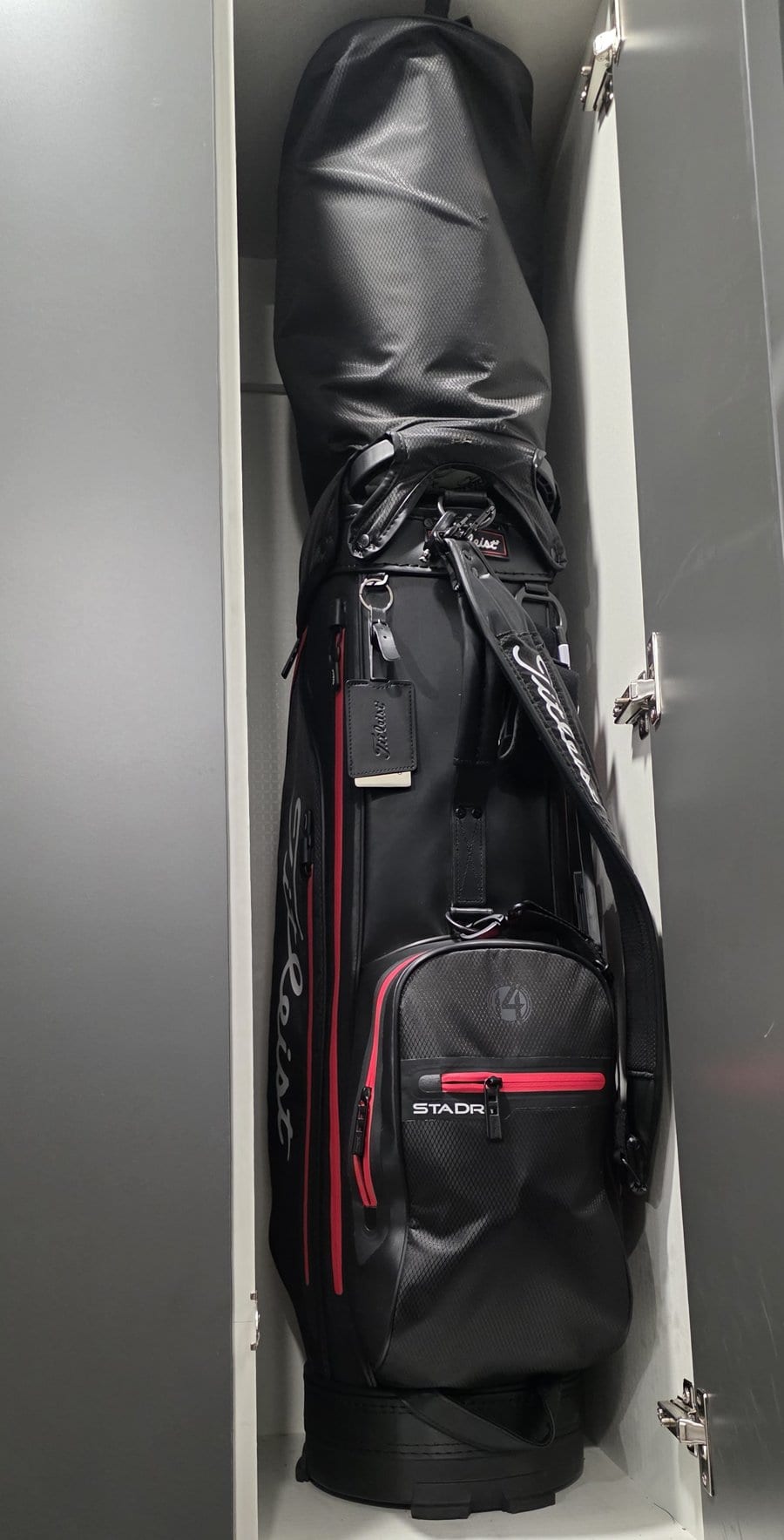
The club I hit most is the 56°. When I practice, I work from the highest number down, and the 56° gets more swings than anything else (my grip replacement notes). That’s one golfer’s practice habit, not a statistic. Still, it’s why the wedges would be the last clubs I’d take out.
How these 14 space out by loft, and where the biggest step sits, is in the golf club loft chart. Each long club has its own post: 3-wood, 3-hybrid and 4-iron.
So how many clubs should you carry?
Start by counting your clubs, putter included. Then you’re choosing one of three moves: keep the bag as it is, take a club out, or fill an empty slot.
Keep what you have if
- You’re at 14 or fewer, and each of the five jobs has a club. Nothing in the rules rewards a full bag, and none of the boxed sets above reaches 14.
- You’re still learning which club to hit where. Fewer clubs means fewer choices over each shot. More clubs won’t help until you know what each one does for you.
Take a club out if
- You count 15 or more. Leave the extra one at home or in the car. Before you start the round there’s no penalty. Once you’ve started, it’s the penalties above.
- Two clubs do the same job. That’s how my 4-hybrid left the bag once the 4-iron went about as far.
Fill a slot if
- One of the five jobs has no club. If your set came without a sand wedge, like the men’s Strata 12-Piece, that’s the slot I’d fill first. Both Golf Digest’s six and MyGolfSpy’s “two, at a minimum” include one.
- Your long approaches have no club you trust. The choice between a 5-wood, a 3-hybrid or a 4-iron is in those posts. 7-wood vs 4-hybrid and hybrid vs iron distance and lofts explain why clubs at the same loft, or with the same number, fly differently.
- You have only a PW and an SW, and the gap between them keeps catching you. Which wedges to add is in 52 and 56 wedge setup.
To find where your empty slot sits, line your clubs up by degree with the golf club loft chart.
FAQ
Does the putter count toward the 14 clubs?
Yes. The limit “includes all clubs carried by or for the player,” so the putter is one of the 14 (R&A, Rule 4).
Can you play golf with fewer than 14 clubs?
Yes. The USGA says you can carry up to 14 “(but you can have fewer),” and you can add clubs during the round up to 14 (USGA, R&A Players’ Rule Finder).
What happens if you have 15 clubs in your bag?
In stroke play it’s two penalty strokes for each hole you played with it, up to four. In match play the match score drops by one hole for each hole with the extra club, two at most. You also have to take the extra club out of play, or you’re disqualified (R&A, Rule 4).
Can you share clubs with a playing partner?
Not with anyone else playing on the course. Rule 4.1b(2) says you “must not make a stroke with a club being used by anyone else who is playing on the course.” The exception is formats where two partners play as a side. The USGA says “you can share clubs, provided that the total number of clubs between the two of you is no more than 14” (R&A, Rule 4, USGA).
How many clubs are in a half set?
GOLF.com defines it as “8 or fewer clubs” (GOLF.com). That’s a media definition, not a rule.
Terms in this article
- Rules of Golf: the one rule book that the R&A and the USGA, golf’s two governing bodies, publish together.
- Rule 4.1b: the part of the Rules of Golf that limits you to 14 clubs.
- Stroke play: the format where you count every shot for the whole round.
- Match play: a hole-by-hole contest against an opponent.
- General penalty: the standard two-stroke penalty the rules use for most breaches.
- Out of play: a club you’ve declared you won’t use for the rest of the round.
- Marker: the person who records your score in stroke play.
- Disqualification: your round no longer counts in the competition.
- Complete set: a beginner package sold as one box, with clubs, a bag and usually headcovers.
- Piece: anything in a complete set’s box, including the bag and each headcover. It isn’t the number of clubs.
- Headcover: a padded cover that slips over a club head.
- Half set: a bag with roughly half the clubs of a full one. GOLF.com puts it at 8 or fewer.
- PW (pitching wedge) and SW (sand wedge): the two wedges most sets include.
- Gap wedge: the wedge that sits between the pitching wedge and the sand wedge.
- PS (pitching sand): the Japanese and Korean name for a gap wedge.
- Hybrid: a club with a small, wood-shaped head on a shaft about as long as an iron’s.
- Fairway wood: a wood with a smaller head than a driver, built to hit off the grass as well as a tee.
- Approach: a shot you hit toward the green.
- Loft: how far the clubface tilts back from straight up, in degrees. More loft sends the ball higher and shorter.