
3 wood loft and distance: 15°, and when to carry a 5-wood
Most 3-woods are 15°, and a typical tracked amateur hits one 203 to 214 yards. Who keeps a 3-wood for tee shots, and who's better off with a 5-wood?
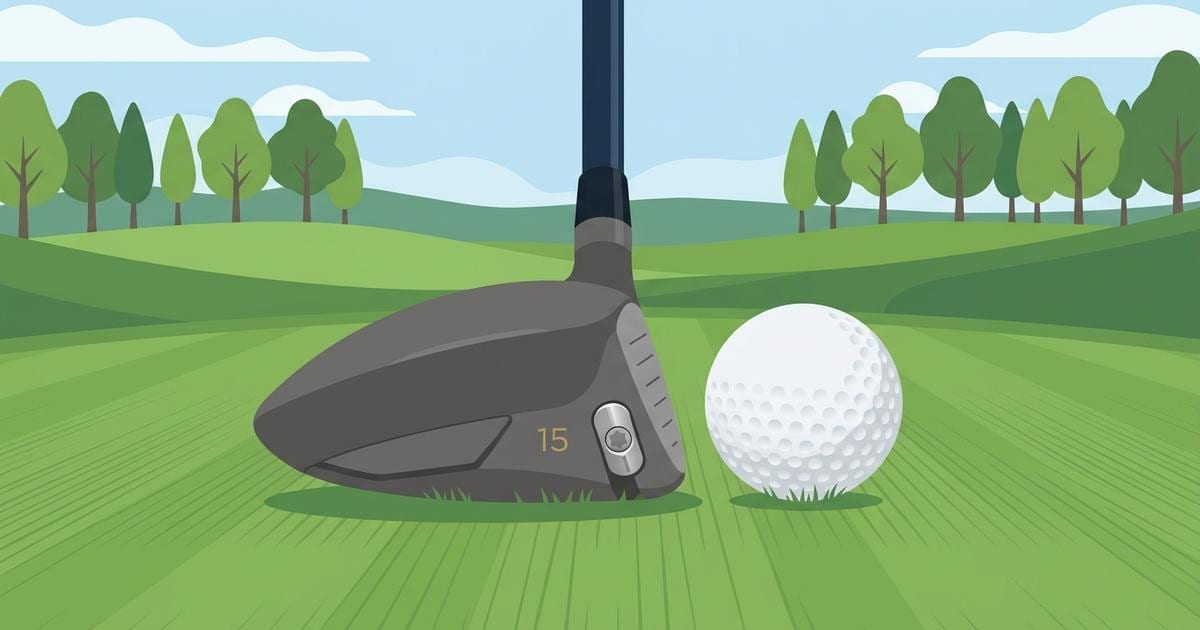
A standard 3-wood has 15° of loft. That’s the loft of the 3-wood at all five makers in the table below, including PING and Callaway. Counting low and high versions, current 3-woods run from 13.5° to 16.5°.
Loft is how far the clubface tilts back from straight up, in degrees. More loft sends the ball higher and shorter.
On distance, the average amateur 3-wood shot is 203 yards (186 m) in Shot Scope’s data. In Arccos’s data, the median is 214 yards (196 m) (Shot Scope, Arccos).
Whether you should carry one depends on the job you give it. A 3-wood earns its place as a tee club when the driver would reach trouble. If its main job is a long shot off the grass, a 5-wood or 7-wood is often the better club.
The short answer
- Most current 3-woods are 15°. With low-loft and high-loft versions, the range is 13.5-16.5° (Titleist GTS, Callaway Quantum Max).
- Tracked amateurs average 203 yards with a 3-wood in Shot Scope’s data, and Arccos’s median golfer hits it 214 yards (Shot Scope, Arccos). No measured source I found breaks that down by handicap or swing speed.
- Off the tee, a 3-wood hits the fairway less than one percentage point more often than a driver in both datasets. Its real use is staying short of a hazard.
- For a beginner, a 3-wood is worth carrying only as a tee club for holes where the driver reaches trouble. Off the grass, Callaway says 3-woods “aren’t as easy to hit from the fairway or the rough for some golfers” (Callaway guide).
- In a Golf Digest panel, 8 of 22 players did as well or better with a 4-wood or 5-wood than with a 3-wood (Golf Digest).
- If your 3-wood mostly plays off the grass and doesn’t go clearly farther than a 5-wood, the 5-wood is the easier pick.
3 wood loft: 15° at almost every maker
Every loft below is a standard loft, the loft a maker lists for the club as sold. Most makers also sell a 3HL or 3HF, a higher-loft 3-wood at about 16.5°. PING sells a 4-wood instead.
| Model | 3-wood | Higher-loft 3 or 4-wood | 5-wood | 7-wood |
|---|---|---|---|---|
| PING G440 Max | 15°, 43” | 4-wood 17°, 43” | 19°, 42.5” | 21°, 42” |
| PING G440 LST | 15°, 43” | 19°, 42.5” | ||
| PING G440 SFT | 16°, 43” | 19°, 42.5” | 22°, 42” | |
| Callaway Quantum Max | 15°, 43.25” | 16.5°, 43.25” | 18°, 42.75” | 21°, 42.25” |
| Titleist GTS2 | 13.5° or 15°, 43” | 16.5°, 43” | 18°, 42” | 21°, 41.5” |
| TaylorMade Qi4D | 15°, 43.25” | 16.5°, 43.25” | 18°, 42.25” | 21°, 41.75” |
| Cobra OPTM X | 15°, 43.25” | 16.5°, 43.25” | 18°, 42.5” | 21°, 42” |
Sources: PING G440 Max, PING G440 LST, PING G440 SFT, Callaway Quantum Max, Titleist Newsroom for GTS2 lofts and Fairway Jockey for lengths, GolfWRX, Fairway Jockey and Today’s Golfer for TaylorMade, and Fairway Jockey and Today’s Golfer for Cobra. All retrieved 2026-09-26. Lengths for Titleist, TaylorMade and Cobra come from retailers and outlets, because Titleist’s and TaylorMade’s own sites didn’t load.
Two things stand out. First, “3-wood” means 15° almost everywhere, but not everywhere. Titleist’s GTS2 also comes at 13.5°, and PING’s SFT 3-wood is 16°. So you’ll want to read the loft on the sole, not just the number.
Second, the 3-wood is the longest and lowest-lofted club on the ladder. Going from 3-wood to 5-wood to 7-wood adds loft and takes shaft length away. That trade is the whole 3-wood vs 5-wood question, covered below.
Callaway’s own buying guide puts the ranges a little wider. It says “3 wood lofts range from 14-16.5 degrees.” A 5-wood is “typically between 18-20 degrees,” and a 7-wood “between 21-24 degrees” (Callaway guide). Where the 3-wood sits among every other club in the bag is in the golf club loft chart.
3 wood distance: what tracked amateurs actually hit
A typical amateur’s 3-wood goes 203 or 214 yards, depending on whose data you read. Two shot-tracking companies publish these figures from their users’ rounds.
| Dataset | Driver | 3-wood | Gap |
|---|---|---|---|
| Shot Scope, average of 80 million shots | 225 yd (206 m) | 203 yd (186 m) | typical gap “20-30 yards” (18-27 m) |
| Arccos, median of all golfers | 226 yd (207 m) | 214 yd (196 m) | 12 yd (11 m) |
Sources: Shot Scope, Arccos, 2025-09-08. Retrieved 2026-09-26.
A median is the middle value when every golfer is lined up from shortest to longest. Half hit it farther and half hit it shorter.
The two datasets disagree on the gap to your driver. Arccos says 12 yards, Shot Scope says 20-30. I’d plan on a gap somewhere between those two, 12 to 30 yards. Arccos adds that scratch golfers open a bigger gap, 15 yards.
Golf.com puts it more bluntly, in a piece built on PING’s engineering data. It points to “hundreds of other golfers that can’t get their 15° fairway to carry more than 200 yards” (Golf.com). Carry is how far the ball flies in the air before it lands, not counting the roll.
My own 3-wood goes about 190-210 m (roughly 210-230 yd) in total. I don’t track carry, so that’s the whole distance with roll, and it’s a range I’ve seen, not a measured average. Most of that range is longer than both numbers above, so please don’t read it as a target.
You may have seen 3-wood distance charts by handicap or by swing speed. I couldn’t find one from a measured source. The ones I could open give no method, and the ones from bigger outlets wouldn’t load for checking, so I’ve left them all out. If you want a feel for how your speed maps to distance in general, the swing speed and distance post covers the average amateur numbers TrackMan publishes.
3 wood vs driver off the tee
Hitting a 3-wood off the tee barely makes you straighter. In Shot Scope’s data, golfers hit 46.6% of fairways with a driver and 47.4% with a 3-wood, a 0.8-point difference (Shot Scope). Arccos found almost the same: 45.5% and 46.4% (Arccos).
So if you reach for the 3-wood “to be safe,” you’re giving up 12-30 yards for less than one extra fairway in a hundred. Shot Scope also found golfers were “12-15% more likely to hit the green” on the next shot after a driver (Shot Scope).
Where the 3-wood does earn its tee shots is length control. A hazard is water, a bunker or any trouble you don’t want to reach. My rule is simple: when my driver’s carry would reach a hazard, I tee off with the 3-wood. That’s a reason about where the ball stops, not about hitting it straighter.
3 wood vs 5 wood: when more loft keeps up
3 wood for beginners: only with a tee-shot job
If your fairway wood will mostly play from the grass, you’ll want to start with a 5-wood instead.
For more golfers than you’d expect, a 4-wood or 5-wood does as well as a 3-wood. Golf Digest tested this with its equipment panel on a Rapsodo launch monitor.
“Of the 22 players on our Hot List panel who hit 3-woods, 4-woods and 5-woods, eight produced similar or better results with a more lofted 4-wood or 5-wood” (Golf Digest). Of those eight, “six had driver swings slower than 100 miles per hour, a speed that is comfortably above average for recreational golfers.”
You can’t read a switch-over speed from this. Golf Digest didn’t give one, and 100 mph (45 m/s) isn’t a cutoff. What it does suggest is that if your swing isn’t fast, your 3-wood may not be buying you much over a 5-wood.
Why a 3-wood is harder off the grass
Two things work against a 3-wood when the ball sits on the ground: less loft and a longer shaft. Golf.com’s Ryan Barath explains the loft side: “The less loft a club has, the harder it is to get into the air with enough spin to maintain carry” (Golf.com).
Spin here is the backspin that keeps the ball in the air. Without enough of it, a low-lofted shot drops early.
On length, he wrote that “3-wood length has increased from 42.5″ up to 43.5″ in some cases, and hitting a low lofted club at that length is extremely difficult” (Golf.com). In the table above, current 3-woods are 43-43.25”, and 5-woods 42-42.75”.
Callaway says the same thing on its own buying guide. “The one downside to 3 woods is they aren’t as easy to hit from the fairway or the rough for some golfers” (Callaway guide). The guide adds that “Beginner golfers and those who have a slower swing speed should opt for at least 15 degrees of loft (or more).” A standard 15° 3-wood already meets that floor, so it rules out the 13.5° versions, not the 3-wood itself.
How you strike it matters too
Titleist sells two 3-wood heads for two kinds of swing. It calls the GTS2 “ideal for players with more sweeping deliveries with their fairway metals,” with a shallower face. The GTS3 is “ideal for players who hit down on the golf ball more,” with a deeper face (Titleist Newsroom).
A sweeping strike brushes the ball off the grass with a shallow, level swing. Hitting down means the club is still descending when it meets the ball, the way most people hit irons. A shallow face is a clubface that’s shorter from top to bottom.
So a maker is telling you a 3-wood off the grass isn’t one club for everyone. If you sweep, a shallow-faced 3-wood is built for you. If you’re not sure how you strike it, that’s one more reason the 5-wood is the lower-risk choice.
My 3-wood, and the hybrid in my 5-wood slot
My 3-wood is a Titleist TSi2 at 15°. My driver is a Titleist TSR at 9°.
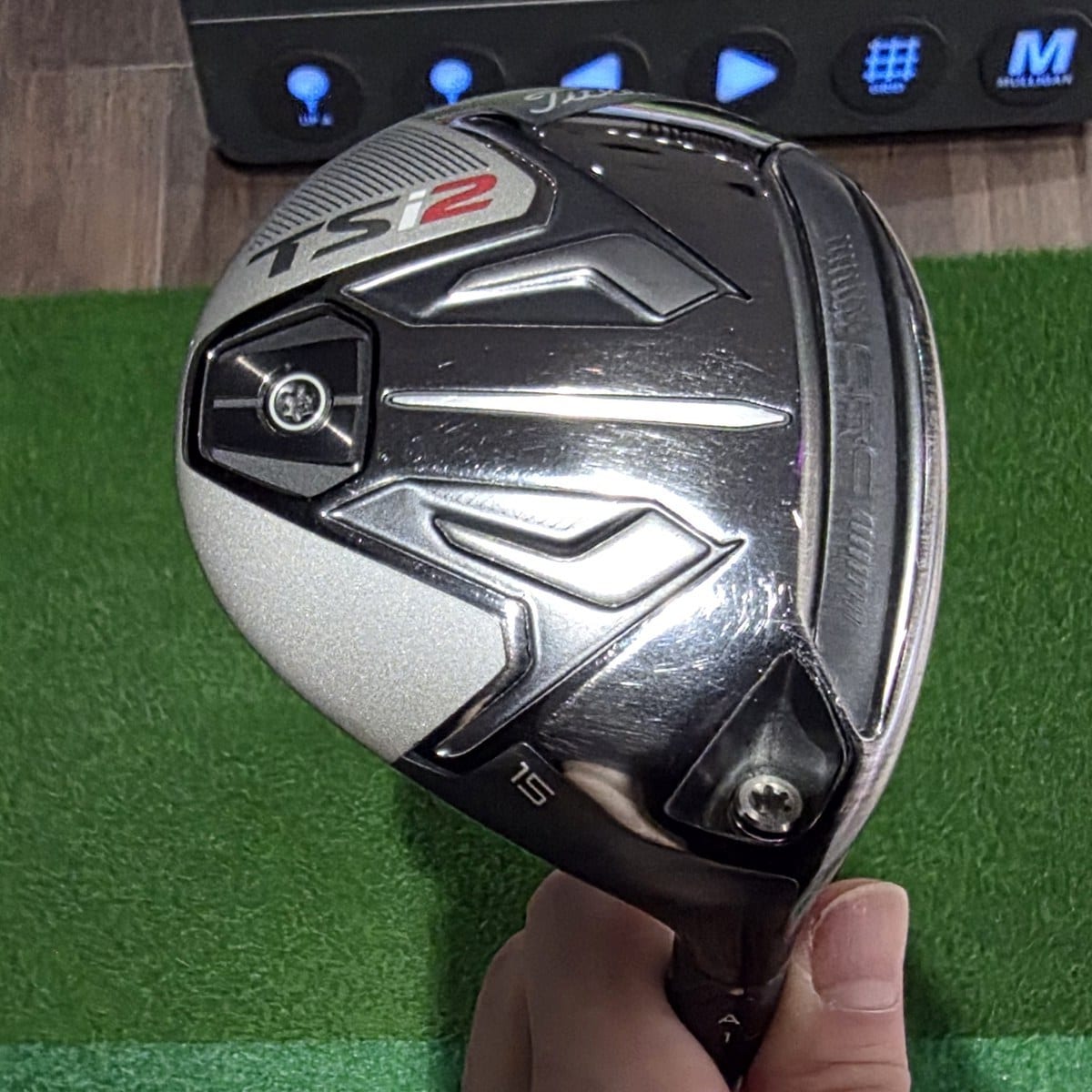
I use the 3-wood for two jobs. The first is the tee shot I described above: when the driver would carry into a hazard, the 3-wood comes out. The second is the par-5 second shot. When I have about 200 m (about 220 yd) left, I try to reach the green in two with it.
A par 5 is a long hole where the standard score is five shots. Reaching it “in two” means getting on the green with your second shot.
When I bought the 3-wood, I thought about a 5-wood too. I didn’t buy one because I already had a 4-hybrid. A hybrid is a club with a small, wood-shaped head on a shaft about as long as an iron’s.
Later I got a 4-iron, a Titleist T100 at 24°. It seemed to go about as far as my 4-hybrid, so the two clubs were doing one job. I swapped the 4-hybrid for an 18° 3-hybrid. That’s a feel, not a measured gap.
So my long clubs now go 3-wood at 15°, 3-hybrid at 18°, 4-iron at 24°. The 18° hybrid sits right where a 5-wood would go. Why a hybrid and an iron with the same number fly differently is in hybrid vs iron distance and lofts.
My 3-wood has the same kind of adjustable sleeve as my driver, which changes the loft. What the settings do is covered in Titleist driver settings.
So should you carry a 3-wood or a 5-wood?
It comes down to the shot you need the club for most. Here’s how I’d sort it.
Keep the 3-wood if
- You have holes where the driver reaches trouble. A 3-wood that stays short of water or a bunker is doing a job no other club does as well.
- Your 3-wood goes clearly farther than a 5-wood would. If you have the speed to open a real gap, the 3-wood gives you a club the 5-wood can’t.
- You sweep the ball off the grass. That’s the strike Titleist designs its shallow-face 3-wood for.
Go to a 5-wood or 7-wood if
- Your 3-wood’s main job is long shots off the grass. That’s the shot Callaway says a 3-wood isn’t easy to hit for some golfers.
- Your 3-wood doesn’t go clearly farther than a 5-wood. 8 of the 22 Golf Digest panelists got similar or better results with more loft. If the extra length isn’t there, the extra difficulty isn’t worth it.
- You’re newer to the game or swing slower. Callaway’s 15° floor only rules out the lowest-lofted 3-woods. The stronger signal is the Golf Digest panel: six of the eight players who did as well with a 4- or 5-wood swung driver under 100 mph.
How a 21° 7-wood and a 21° 4-hybrid fly differently at the same loft is in 7-wood vs 4-hybrid.
If you’re stuck in the middle
There’s a club between the two. A higher-loft 3-wood at 16.5° comes from Callaway, Titleist, TaylorMade and Cobra, and PING’s SFT 3-wood is 16°. PING also makes a 17° 4-wood. Each gives you a little more loft than a standard 3-wood at the same 43-43.25” length (table above).
FAQ
What degree is a 3 wood?
Usually 15°. Current models run from 13.5° to 16.5° when you count low-loft and high-loft versions (Titleist Newsroom, Callaway Quantum Max). The loft on the sole tells you more than the number.
How far should a 3 wood go?
Shot Scope’s average amateur hits it 203 yards (186 m), and Arccos’s median golfer 214 yards (196 m) (Shot Scope, Arccos). Behind your driver, I’d plan on a gap somewhere between the two datasets’ figures, 12 to 30 yards.
Is a 3 wood harder to hit than a 5 wood?
Off the grass, for many golfers, yes. It has less loft and a longer shaft, and Callaway says it isn’t as easy to hit from the fairway or rough for some golfers (Callaway guide).
Is a 3 wood worth it for beginners?
Only if you have a tee-shot job for it. Callaway says 3-woods aren’t as easy to hit from the fairway or rough for some golfers (Callaway guide), and six of the eight Golf Digest panelists who did as well with more loft swung driver under 100 mph (Golf Digest). If your fairway wood mostly plays from the grass, a 5-wood is the easier start.
Terms in this article
- Loft: how far the clubface tilts back from straight up, in degrees. More loft sends the ball higher and shorter.
- Standard loft: the loft a maker lists for a club as sold, before any adjustment.
- 3HL or 3HF: a higher-loft 3-wood, about 16.5° in current models.
- Fairway wood: a wood with a smaller head than a driver, built to hit off the grass as well as a tee. The 3-, 5- and 7-wood are all fairway woods.
- Median: the middle value when every golfer is lined up from shortest to longest.
- Carry: how far the ball flies in the air before it lands, not counting the roll.
- Spin: the backspin that keeps the ball in the air.
- Hazard: water, a bunker or any trouble you don’t want to reach.
- Sweeping strike: brushing the ball off the grass with a shallow, level swing.
- Hitting down: meeting the ball while the club is still descending, the way most people hit irons.
- Shallow face: a clubface that’s shorter from top to bottom.
- Par 5: a long hole where the standard score is five shots. Reaching it “in two” means getting on the green with your second shot.
- Hybrid: a club with a small, wood-shaped head on a shaft about as long as an iron’s.