
4 iron loft and distance: 18.5-23°, and when to skip it
Current 4-irons run 18.5-23°. No readable source gives an amateur distance average, and tracked data favors a 4-hybrid for most golfers.
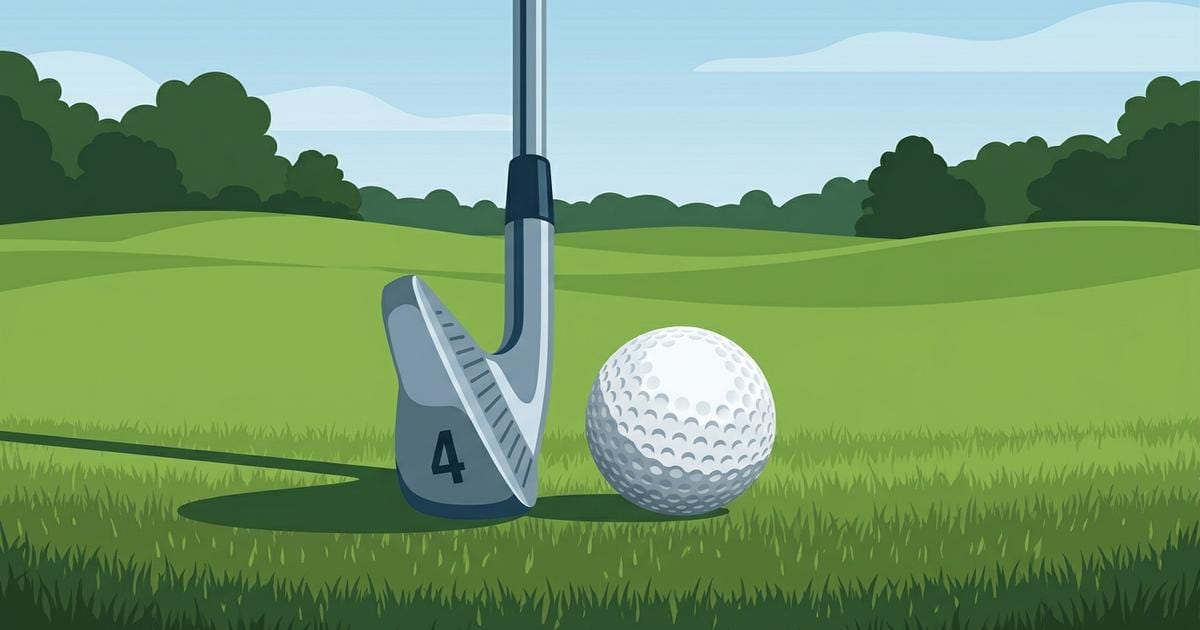
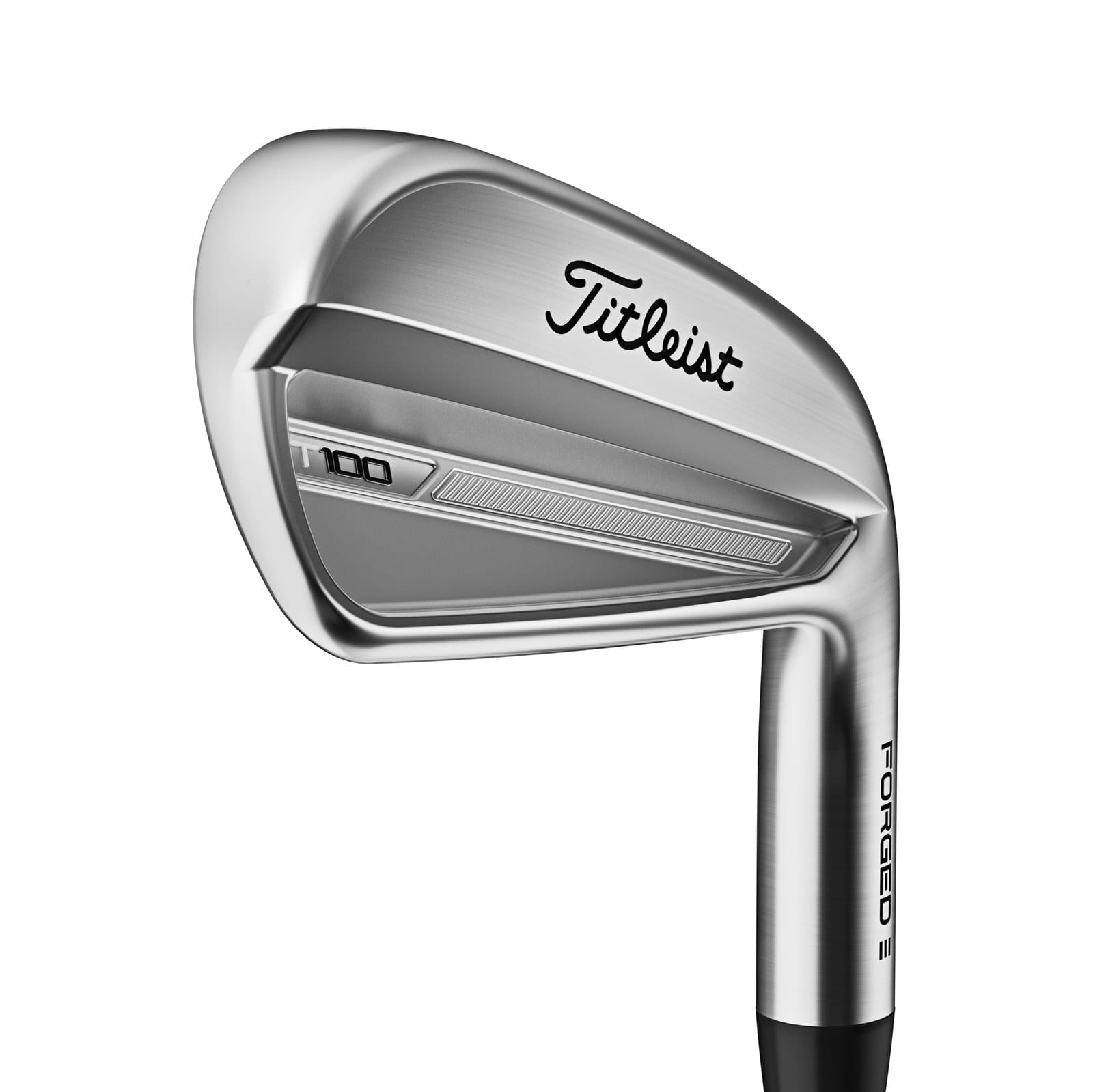
Current 4-irons have between 18.5° and 23° of loft. The low end is TaylorMade’s Qi Max (Today’s Golfer), and the high end is the 2025 Titleist T100 (Titleist Newsroom). My own 4-iron, a 2023 T100, is 24° (Titleist).
Loft is how far the clubface tilts back from straight up, in degrees. More loft sends the ball higher and shorter.
On distance, there’s no number I can give you for the average amateur. None of the shot-tracking pages I could open publishes one. What they do publish is how a 4-iron compares with a 4-hybrid, and that’s the more useful answer anyway.
Whether you need a 4-iron depends less on the “4” than on the loft of your 5-iron. On some sets, the 5-iron already has the loft of another maker’s 4-iron.
The short answer
- Current 4-irons run 18.5-23°. Game-improvement sets sit at the low end, players sets at the high end (Callaway Quantum Max, PING Blueprint S).
- A game-improvement 5-iron (21-23.5°) can have the same loft as a players 4-iron (22-23°). Titleist’s own T350 5-iron and 2025 T100 4-iron are both 23° (Titleist Newsroom, PING G740, Today’s Golfer). Read the degrees, not the number.
- I couldn’t find a readable average for how far amateurs hit a 4-iron. Tour players carry it 203 yards (PGA) and 169 yards (LPGA) in TrackMan’s older tour table (TrackMan PGA, TrackMan LPGA).
- In Arccos’s 2020 data, golfers hit more greens with a 4-hybrid than a 4-iron in every handicap bracket (Arccos).
- Keep a 4-iron if you want a low tee shot in the wind or you hit down steeply. For most newer golfers, a hybrid is the easier club.
- If your 4-iron and 4-hybrid go about the same distance, keep one and move the other up a slot. That’s what I did.
4 iron loft: 18.5° to 23°, depending on the set
Every loft below is a standard loft, the loft a maker lists for the club as sold. The table groups the sets into three kinds.
A game-improvement iron has a bigger, more forgiving head and stronger lofts. A players iron has a smaller head built for control. A players-distance iron sits between the two. Stronger loft means less loft, so the ball flies lower and farther.
| Model | Type | 4-iron loft | 4-iron length | 5-iron loft |
|---|---|---|---|---|
| TaylorMade Qi Max (2026) | Game-improvement | 18.5° | 39.125” | 21° |
| Callaway Quantum Max (2026) | Game-improvement | 19° | 39.125” | 22° |
| Mizuno JPX925 Hot Metal | Game-improvement | 19° | 38.75” | 22° |
| Cobra KING (2026) | Game-improvement | 19° | 21.5° | |
| Titleist T350 (2025) | Game-improvement | 20° | 38.5” | 23° |
| PING G740 | Game-improvement | no 4-iron | 21° | |
| TaylorMade Qi Max HL | Game-improvement | no 4-iron | 23.5° | |
| TaylorMade P790 (2025) | Players-distance | 20° | 38.5” | 23° |
| Titleist T250 (2025) | Players-distance | 22° | 38.5” | 24° |
| Srixon ZXi5 | Players-distance | 22° | 38.75” | 24° |
| Titleist T150 (2025) | Players | 22° | 38.5” | 25° |
| Mizuno Pro 243 | Players | 22° | 38.75” | 25° |
| PING Blueprint S | Players | 22.5° | 38.5” | 26° |
| Titleist T100 (2025) | Players | 23° | 38.5” | 26° |
| Callaway Apex CB (2024) | Players | 23° | 26° | |
| Titleist T100 (2023), mine | Players | 24° | 38.5” | 27° |
Sources: Today’s Golfer for both Qi Max sets, Callaway Quantum Max, Mizuno JPX925, Fairway Jockey for Cobra, Titleist Newsroom and Titleist for the 2025 T-Series, PING G740, Fairway Jockey for P790, Fairway Jockey for ZXi5, Mizuno Pro 243, PING Blueprint S, Callaway Apex CB and Titleist T100 2023. Retrieved 2026-09-27, except the Titleist pages, retrieved 2026-08-29. Blank length cells are ones I couldn’t confirm.
Three things stand out.
A game-improvement 5-iron can have the loft of a players 4-iron. The G740 and Qi Max 5-irons are 21°, and the Quantum Max and JPX925 Hot Metal 5-irons are 22°. The T150, Pro 243 and Blueprint S 4-irons are 22-22.5°. Titleist’s own T350 5-iron and 2025 T100 4-iron are both 23°. If you’re comparing sets, the “4” and the “5” can be the same club.
My 24° 4-iron has more loft than every game-improvement 5-iron here. Those run 21-23.5°. So when someone tells you to “drop the 4-iron,” it matters which 4-iron they mean. Titleist strengthened the T100 4-iron to 23° in 2025, and the full history is in Titleist T100 lofts by generation.
Some sets don’t include a 4-iron at all. PING says the G740 is “Available 5-9, PW, UW, 50°, 56°” (PING). In other words, the set starts at the 5-iron. TaylorMade’s Qi Max HL starts there too (Today’s Golfer).
Length barely changes. Every 4-iron with a listed length is 38.5-39.125”, and the two longest are game-improvement models. Why the degree on the club tells you more than the number is covered in 7 iron loft degrees. Where the 4-iron sits in the whole bag is in the golf club loft chart.
4 iron distance: no readable amateur average
I couldn’t find a readable average for how far amateurs hit a 4-iron. I looked at Arccos, Shot Scope and TrackMan, the companies that publish measured numbers. None of the pages I could open gives one, overall or by handicap.
You’ll see 4-iron distance charts elsewhere. The ones from bigger outlets wouldn’t load fully for checking, so I’ve left them all out rather than pass on a number I couldn’t verify.
What TrackMan does publish is tour averages:
| Tour | Club | Club speed | Carry |
|---|---|---|---|
| PGA Tour | 4-iron | 96 mph | 203 yd (186 m) |
| PGA Tour | 5-iron | 94 mph | 194 yd (177 m) |
| LPGA Tour | 4-iron | 80 mph | 169 yd (155 m) |
| LPGA Tour | 5-iron | 79 mph | 161 yd (147 m) |
Sources: TrackMan tour averages, PGA and LPGA, from a copy posted in March 2019. TrackMan updated its tour averages on 2024-05-02, but those values are in images I couldn’t read. Retrieved 2026-09-27.
Club speed is how fast the clubhead is moving when it meets the ball. Carry is how far the ball flies before it lands, not counting the roll.
To hit even the LPGA row, you’d need about 80 mph of club speed with a 4-iron, and tour-level contact. The table doesn’t list the lofts either. If you don’t know your own speed, read these rows as the far end of what a 4-iron does, not as your target.
On both tours, the 4-iron carries only 8-9 yards past the 5-iron. If your 4-iron doesn’t clearly outcarry your 5-iron, the real question is whether a hybrid would do that job better. How your speed maps to distance in general is in the swing speed and distance post.
4 iron vs hybrid: what tracked golfers show
For most handicaps, the tracked data leans toward the hybrid. A hybrid is a club with a small, wood-shaped head on a shaft about as long as an iron’s. Current 4-hybrids run 21-23° (golf club loft chart, Callaway Quantum Max hybrid).
How the two clubs are built differently is covered in hybrid vs iron distance and lofts. Here I’ll stick to what the tracking data shows.
Distance: the two clubs land close
Arccos compared 4-irons and 4-hybrids across “more than 200 million shots taken in 3.8+ million rounds,” published 2020-05-06 (Arccos). A handicap is a number showing roughly how many strokes over par a golfer shoots. Lower means better.
- Off the tee: 0-5 handicaps hit the 4-iron “more than four yards farther.” 20+ handicaps hit it “almost two yards longer.” The other brackets showed little difference.
- Into the green: “most handicap brackets are appreciably longer with 4-hybrids.” 11-15 handicaps went “almost 5 yards longer” with the hybrid, while 20+ handicaps went “almost 2 yards longer with a 4-iron.”
Shot Scope’s 2021 article puts the gap wider. It says “a hybrid will travel 8 to 12 yards further than the corresponding iron” (Shot Scope).
So the two datasets disagree: a few yards either way, up to about 5, or 8-12 yards to the hybrid. My pick is to expect a small gap and check your own two clubs. A small gap is also what I felt with mine, which I’ll get to below.
Greens and scores: the hybrid wins for most handicaps
A green in regulation, or GIR, means reaching the green with two strokes left for par. It’s the usual measure of a good approach shot.
In Arccos’s data, “The data favors the 4-hybrid in every handicap bracket” for approach shots. Off the tee, golfers scored lower when they teed off with the 4-hybrid in every bracket. For 11-15 handicaps, that was 4.46 strokes with the hybrid against 4.64 with the 4-iron (Arccos).
Shot Scope found the same direction. Pooling 3-, 4- and 5-clubs, 20-handicap golfers hit 1% more greens and finished 16 feet closer with hybrids. From the rough, they hit them 11 yards longer (Shot Scope). That page is undated.
The one place the 4-iron comes out ahead is the best players off the tee. Arccos found 0-5 handicaps hit 46.20% of fairways with a 4-iron against 43.50% with a 4-hybrid. If you’re newer to the game, that isn’t your bracket, and both sources point you to the hybrid.
Do you need a 4-iron?
Most newer golfers don’t, and the tracked data leans the same way. But start with the loft of your 5-iron, not with the number 4.
Start with your 5-iron’s loft
If your set is game-improvement, its 5-iron is probably 21-23.5° (table above). Starting your set at the 5-iron still gives you a club at roughly the loft of a players 4-iron.
If your set is a players set, the 5-iron is 25-27°. Taking out a 22-24° 4-iron there leaves a bigger hole above your longest iron. You’ll want something to fill it, and a hybrid is the usual choice.
Keep the 4-iron if
- You want a low tee shot in the wind or on firm ground. Today’s Golfer notes “A low flighted iron can also be a great option off the tee when the fairways are firm” (Today’s Golfer).
- You hit down steeply and struggle to sweep a hybrid off the grass. The same article says those golfers “sometimes struggle to ‘sweep’ a fairway wood or hybrid off the deck and therefore prefer to use an iron.”
- You’re a low handicap who uses it off the tee. That’s the one bracket where Arccos found more fairways with the 4-iron. Even there, scores off the tee were lower with the hybrid, so you’ll want to compare your own.
- You have real speed and want a lower flight. Today’s Golfer says long irons suit “a skilled golfer with plenty of speed.” None of the sources gives a speed number, so you won’t find a cutoff to check yourself against.
Hitting down means the club is still descending when it meets the ball. Sweeping means brushing the ball off the grass with a shallow, level swing.
Go with a hybrid if
- The club’s main job is approach shots into greens. That’s where Arccos found the hybrid better in every bracket.
- You’re a beginner or mid handicap. GOLFTEC puts it bluntly: “Hybrids are a no brainer” (GOLFTEC).
- Your set already starts at the 5-iron. Then the question is only which hybrid goes above it.
You wouldn’t be unusual either way. Shot Scope’s 2021 article says “a 4 iron/4 hybrid use is now 50-50 among club golfers” (Shot Scope).
If your 4-iron and 4-hybrid go the same distance
Keep one and move the other up a slot. That’s what I did.
I had a Titleist TS3 4-hybrid before I had a 4-iron. Then I got a 4-iron, a 2023 Titleist T100 at 24°. It seemed to go about as far as the 4-hybrid, so the two clubs were doing one job.
That’s a feel, not a measured gap. I didn’t track the two clubs side by side. But it matched what the Arccos brackets suggest: a 4-iron and a 4-hybrid can land within a few yards of each other.
I kept the 4-iron and swapped the 4-hybrid for an 18° 3-hybrid. My long clubs now go 3-wood at 15°, 3-hybrid at 18°, 4-iron at 24°. The 18° to 24° step is the biggest jump in my bag, and the golf club loft chart walks through it.
You could just as easily go the other way: keep the hybrid and drop the 4-iron. Arccos’s line fits either choice: “clubs have to earn their way into your bag.”
FAQ
What degree is a 4 iron?
Current models run 18.5-23°. Game-improvement 4-irons are 18.5-20°, and players 4-irons 22-23° (Today’s Golfer, Titleist Newsroom). Older players models can be 24°, like my 2023 T100 (Titleist).
How far should a 4 iron go?
I couldn’t find a readable amateur average. In TrackMan’s older tour table, PGA Tour players carry a 4-iron 203 yards (186 m) and LPGA players 169 yards (155 m) (TrackMan PGA, TrackMan LPGA). Read those as the far end, not a target.
Is a 4 iron harder to hit than a hybrid?
For most golfers, the data says yes. Arccos found more greens with the 4-hybrid in every handicap bracket (Arccos), and Shot Scope found 20-handicap golfers finished 16 feet closer with hybrids (Shot Scope).
Should a beginner carry a 4 iron?
Usually not, unless you need a low tee shot or hit down steeply. If your set comes with one, check whether it goes clearly farther than your 5-iron and your hybrid. If it doesn’t, one of those clubs can take its place.
Terms in this article
- Loft: how far the clubface tilts back from straight up, in degrees. More loft sends the ball higher and shorter.
- Standard loft: the loft a maker lists for a club as sold.
- Stronger loft: less loft, so the ball flies lower and farther.
- Game-improvement iron: an iron with a bigger, more forgiving head and stronger lofts.
- Players iron: an iron with a smaller head built for control.
- Players-distance iron: an iron between the two, with a players look and more distance.
- Club speed: how fast the clubhead is moving when it meets the ball.
- Carry: how far the ball flies before it lands, not counting the roll.
- Hybrid: a club with a small, wood-shaped head on a shaft about as long as an iron’s.
- Handicap: a number showing roughly how many strokes over par a golfer shoots. Lower means better.
- Green in regulation (GIR): reaching the green with two strokes left for par.
- Hitting down: meeting the ball while the club is still descending.
- Sweeping: brushing the ball off the grass with a shallow, level swing.