Rules & Play
Golf Hole Size: 4.25-Inch Diameter, at Least 4 Inches Deep
A regulation golf hole is 4.25 inches (108 mm) across and at least 4 inches deep. What the rule says about the cup, and where 4.25 inches came from.
The short answer
A golf hole must be 4.25 inches (108 mm) in diameter and at least 4 inches (101.6 mm) deep. The cup inside it can't be wider than the hole and normally sits at least 1 inch below the green.
- 4.25 in (108 mm)
- diameter of the hole R&A Rules of Golf, Definitions, "Hole", checked 2026-11-14
- at least 4 in (101.6 mm)
- depth of the hole R&A Rules of Golf, Definitions, "Hole", checked 2026-11-14
- 1891
- the year the R&A's rules first set the size 1891 R&A rules, reprinted in The World of Golf, checked 2026-11-14
Under the Rules of Golf, a hole is 4.25 inches across. In metric that’s 108 mm. It has to be at least 4 inches deep, and there’s no maximum depth.
What the rule book says
- Diameter: 4.25 inches (108 mm in the rule’s metric).
- Depth: at least 4 inches (101.6 mm).
- The cup: no wider than the hole, and its top sits at least 1 inch (25.4 mm) below the green unless the soil requires otherwise.
- Why 4.25: it matches a hole cutter bought at Musselburgh, Scotland, in 1829. Why that tool cut 4.25 inches, nobody knows.
Sources: R&A Rules of Golf Definitions and golf history sources linked below, checked 2026-11-14.
Golf hole dimensions in the Rules of Golf
The size lives in the Definitions section of the Rules of Golf, under “Hole.” The wording is short (R&A Rules of Golf, Definitions):
The hole must be 4 ¼ inches (108 mm) in diameter and at least 4 inches (101.6 mm) deep.
The cup, which the rule calls a lining, is the sleeve set inside the hole. Golf Monthly says liners came in to stop holes getting damaged and enlarged. The rule has two lines for it:
| Part | What the rule requires |
|---|---|
| Hole diameter | 4 ¼ inches (108 mm) |
| Hole depth | At least 4 inches (101.6 mm) |
| Cup, outer diameter | No more than 4 ¼ inches (108 mm) |
| Cup, top edge | At least 1 inch (25.4 mm) below the putting green surface |
There’s one exception to that last line. The cup can sit closer to the surface if “the nature of the soil requires” it.
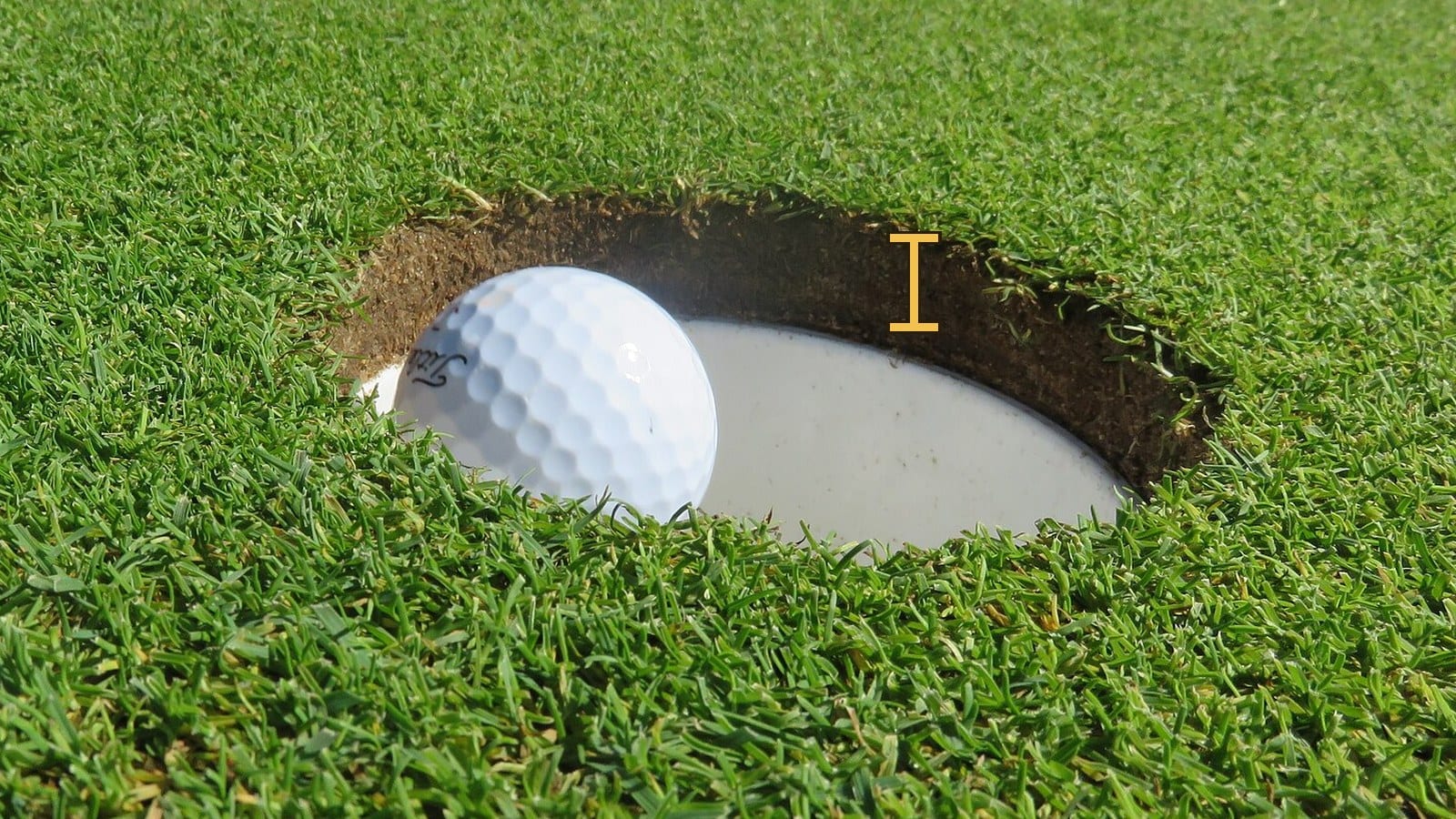
The cover photo shows the normal case. The top of the white cup sits below a band of bare soil. A ball at the edge touches turf and dirt first.
Two small points trip people up. First, 108 mm is a rounded number. The rule started in inches, and 4.25 inches works out to 107.95 mm. Second, the depth has a floor and no ceiling. National Club Golfer’s rules column reads the same definition and finds “nothing other than common sense” to stop a deeper hole (National Club Golfer).
A Musselburgh hole cutter from 1829 set the size
Early holes weren’t cut with a tool made for the job. Golf Monthly describes them being dug with a trowel, and players scooped sand out of them to tee up. So a hole could grow during a day of play.
Each club also picked its own size. Golf Monthly gives Royal Aberdeen’s holes as 6 inches across, against 4.25 inches at Royal Musselburgh. The article quotes an 1888 letter to The Field magazine. The writer complained that holes at Sandwich were “so small that they add at least five strokes to the round.”
The usual answer points to Musselburgh, Scotland. Royal Musselburgh Golf Club says it bought a hole cutter in 1829, “which subsequently became the standard hole in golf” (Royal Musselburgh history).
That’s the club’s own claim, so here’s an outside one. When the National Library of Scotland put the tool on display, its curator vouched for it. She said it “was bought by Musselburgh Golf Club for £1 in 1829 and may well be the oldest in existence. It makes holes of 4¼ inches in diameter” (Edinburgh Guide).
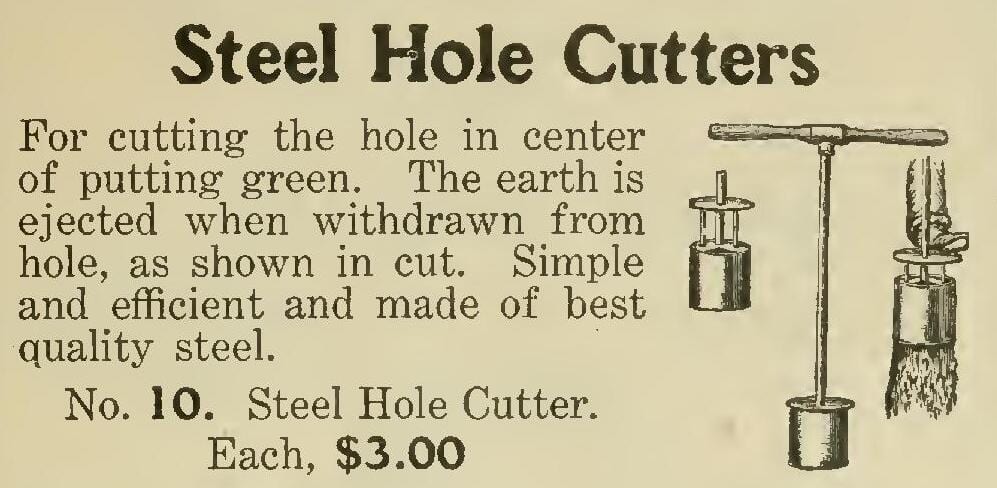 Steel hole cutters in a 1907 American golf book, nearly 80 years after Musselburgh’s. This isn’t the 1829 tool. Image: How to Play Golf (1907), via Wikimedia Commons, public domain.
Scottish Golf History adds a caution: “other clubs make similar claims” to the first standard hole (Scottish Golf History).
1891: the R&A writes 4.25 inches into the rules
The rule itself came 62 years after the cutter. The R&A adopted a new code of rules in 1891. Its third rule includes this line (1891 rules, reprinted in The World of Golf):
The hole shall be 4 1/4 inches in diameter, and at least 4 inches deep.
That’s the same diameter and the same minimum depth as today.
Did the R&A copy Musselburgh? The careful answer is “probably.” National Club Golfer summarizes Kenneth Chapman’s history of the rules, The Rules of the Green. By that account the size wasn’t standardized until 1891, and it “was probably related to the size of the first known hole-cutter.”
You’ll also see 1894 given as the year. The National Library of Scotland curator said the 4¼-inch size “was confirmed as the official diameter in 1894.” The Crail Golfing Society’s history page says the same (Crail Golfing Society). Neither says what happened in 1894.
My pick is 1891. The 1891 rule text is there to read, and Chapman’s history and Golf Monthly both date the standard to 1891. Whatever 1894 refers to, the size was already in the written rules by then.
The drainpipe story is a legend
Search for why the hole is 4.25 inches and you’ll find a drainpipe. The story says Musselburgh cut its holes with a piece of old drainpipe that happened to be 4.25 inches wide, and the cutter copied it.
Golf Monthly tells it with its own hedges: “it is believed another tool was used,” “thought to be an old bit of drainpipe.” In its version the pipe came first, and the 1829 cutter was made later to match it by a blacksmith it names Robert Gay. The Society of Golf Historians newsletter tells it differently. A man it calls Robert Gray built the cutter using a section of the drainpipe (Society of Golf Historians, Newsletter #85).
So the two retellings disagree on the blacksmith’s name and on which tool was the pipe. Neither retelling points to a record for the pipe. National Club Golfer’s rules column, right after its summary of Chapman, asks “Why was it that size? Who knows?” Crail says the reason is “lost to history.”
| On record | Told, not shown |
|---|---|
| Musselburgh bought a hole cutter for £1 in 1829 | The cutter’s size came from a drainpipe |
| That cutter makes 4¼-inch holes | The blacksmith was Robert Gay, or Robert Gray |
| The R&A’s 1891 rules set the hole at 4 1/4 inches | The R&A picked 4.25 because of Musselburgh |
The drainpipe might be true. Nobody has shown it, so I’d call it a story.
Golf ball vs hole: how much room the ball has
The other number in this picture is the ball. Under the Equipment Rules, a ball “must not be less than 1.680 inches (42.67 mm)” across, with “no maximum size” (R&A Equipment Rules, Part 4).
Drawn to scale, a minimum-size ball in a regulation hole looks like this:
By my arithmetic, the hole is about 2.5 times the ball’s width. Measured by area, the opening is about 6.4 times the ball’s cross-section. A ball that arrives dead center has 1.285 inches of hole on each side of it.
That gap is measured edge to edge. My post on putts that don’t start on line counts from the center of the hole instead, which gives 2.125 inches each way. Both come from the same 4.25-inch hole.
 A ball next to the hole on a putting green. The camera angle makes the ball look bigger than it is next to the hole. Photo: tyler hendy via Wikimedia Commons, CC0.
The next time you pick a ball out of the cup, you can check the rim. Unless the soil forced the course to set the cup higher, its top edge sits at least an inch below the green.