Wedges & Putting
How to Measure Putter Length: Wrist Height Minus 2 Inches
Measure your putter from the top of the grip to the sole. For your own length, Odyssey starts at wrist height minus 2 inches, then your eyes at address decide.
The short answer
Measure a putter from the top of the grip down the shaft line to the sole. To find your own length, take your wrist height in golf shoes and subtract 2 inches, then check that your eyes sit just inside the ball at address.
- Wrist height minus 2 in
- Odyssey's baseline putter length Odyssey Putter Buying Guide, checked 2026-11-13
- 1-2 in
- how far inside the target line Scotty Cameron wants your eyes Scotty Cameron, The Art of Putting, checked 2026-11-13
- 35 in
- the US standard putter length (34 in Japan) Scotty Cameron Q&A, 2016, checked 2026-11-13
Most stock putters come in 33, 34 or 35 inches. None of those numbers was picked for your body. Finding yours takes two measurements and one look down at the ball.
Three steps, in this order
- Measure the putter you have. The rules measure from the top of the grip, down the line of the shaft, to the sole.
- Measure yourself. Odyssey’s starting point is your wrist height in golf shoes, minus 2 inches.
- Check your eyes at address. Scotty Cameron wants them 1-2 inches inside the target line. PING accepts anywhere from right over the ball to just inside it.
Sources: USGA Equipment Rules, Odyssey, Scotty Cameron and PING, checked 2026-11-13.
How to measure putter length on the club you own
The rule book has its own method for putters. The USGA’s Equipment Rules say putter length “is taken from the top of the grip along the axis of the shaft or a straight line extension of it to the sole of the club” (USGA Equipment Rules, Part 2).
That “straight line extension” matters on a bent shaft. You follow the straight part of the shaft above the bend and carry that line down to the sole.
The same rule sets a 48-inch limit on clubs “except for putters.” Woods and irons are measured against a 60-degree plane. Putters aren’t.
Not everyone measures to the same spot, though.
| Who | From | To |
|---|---|---|
| USGA Equipment Rules | Top of the grip | The sole, along the shaft line |
| Scotty Cameron Custom Shop | Butt end of the grip | Bottom center of the face |
| PGA TOUR Superstore guide | End of the grip | The heel of the head, or the ground with the putter soled |
Scotty Cameron’s FAQ says putter length “should be measured from the butt end of the grip to the bottom center of the putter face.” It asks you to measure that way before ordering a custom length (Scotty Cameron FAQ).
None of these sources says how far apart the three methods land on the same putter. So if you’re ordering a new length, measure the way the shop taking the order measures.
What length putter do I need? Start at wrist height minus 2 inches
Odyssey gives a starting number you can find at home (Odyssey Putter Buying Guide):
- Stand up straight with your arms at your sides, wearing your golf shoes.
- Have someone measure from the ground to your wrist.
- Subtract 2 inches. That’s your baseline putter length.
- Try putters at that length, then move “up or down in one inch (or half-inch) increments” on a putting green or mat.
So a 35-inch wrist height gives a 33-inch baseline, by Odyssey’s method.
Odyssey also says the right length depends on “height, arm length, and putting style.” The wrist number covers the first two. The third step below covers the last one.
Then check where your eyes sit at address
Address is the moment you’ve set the putter behind the ball and you’re ready to stroke it. The target line is the line from the ball toward where you’re aiming.
Scotty Cameron’s fitting guide starts at address. “The ideal putter length sets your eyes 1-2” inside of the target line” (Scotty Cameron, The Art of Putting).
The same page lists the two ways it goes wrong:
- Too long: your posture gets “too upright with your eyes set too far inside the target line.”
- Too short: you get “too hunched over with your eyes set too far outside the target line.”
Cameron added one more sign in a 2016 interview. With a putter that’s too long, “the toe of the putter comes up,” meaning the far end of the head lifts off the ground. With one that’s too short, “the eyes go over the ball.”
PING draws the line a little differently. Its fitting advice puts the eyes “somewhere in the region between over the ball to just inside the ball” (PGA TOUR, PING Q&A, 2019).
So the two makers split at one spot. Eyes right over the ball are fine by PING and a short-putter sign to Cameron. Neither wants your eyes outside the ball.
Length also sets how the head sits. Cameron’s guide says the key to the right lie angle “is finding the correct putter length.”
Putter length by height: a store chart vs. Scotty Cameron
No maker I checked publishes a height chart for putters. Retailers do. Here’s PGA TOUR Superstore’s, which it calls “a general guide” (PGA TOUR Superstore):
| Your height | Their suggested length |
|---|---|
| Under 5’0” | 31-32 in. |
| 5’0” to 5’2” | 32-33 in. |
| 5’3” to 5’6” | 33 in. |
| 5’7” to 5’9” | 33.5 in. |
| 5’10” to 6’0” | 34 in. |
| 6’1” to 6’4” | 34.5-35 in. |
| Over 6’4” | 35+ in. |
The chart assumes “a traditional putting stance with eyes over the ball,” and the store adds, “If you use a more upright or bent posture, your ideal length may vary.” That’s the eyes-over-the-ball stance from the section above, the one PING and Cameron read differently.
Cameron’s own example shows how much that posture caveat matters. Talking about his 33-inch Cameron & Crown line in the same interview, he described players who “could be 5’9” or 5’10”, but the way they set up, they like arms down low, and they want a shorter length putter.” The chart puts a 5’10” golfer at 34 inches, for a stance those players don’t use.
PING’s testing points the same way. “No more than one single length of putter was best for more than 20% of people,” PING’s Dr. Paul Wood said in the 2019 interview.
I’d treat a height chart as a guess about your arms. The wrist measurement checks your arms directly, so I’d start there. For driver-to-wedge lengths, see my golf club length chart.
Standard putter length is 35 inches in the US
In that 2016 interview, Cameron called 35 inches “our 35-inch standard in the United States.” In Japan, he said, the standard is 34.
Odyssey puts men’s putters at “typically around 33-35 inches” and women’s at “typically around 33-34 inches.”
Scotty Cameron’s current spec tables list 25 Studio Style and Phantom models. Every one comes in 33, 34 and 35 inches. The long-design models are 38.
So “standard” describes the shelf in a given country. It says nothing about your wrists. Cameron also noted that a 33-inch putter on the market usually “starts as a 35-inch putter,” and “usually, the head weight isn’t adjusted at all.”
34 vs 35 inch putter: what an inch does to head weight
A shorter putter needs a heavier head to feel the same. “Shorter putters demand a little more weight in the head,” Cameron said. Skip that, and you get “either a stiff or soft putter.”
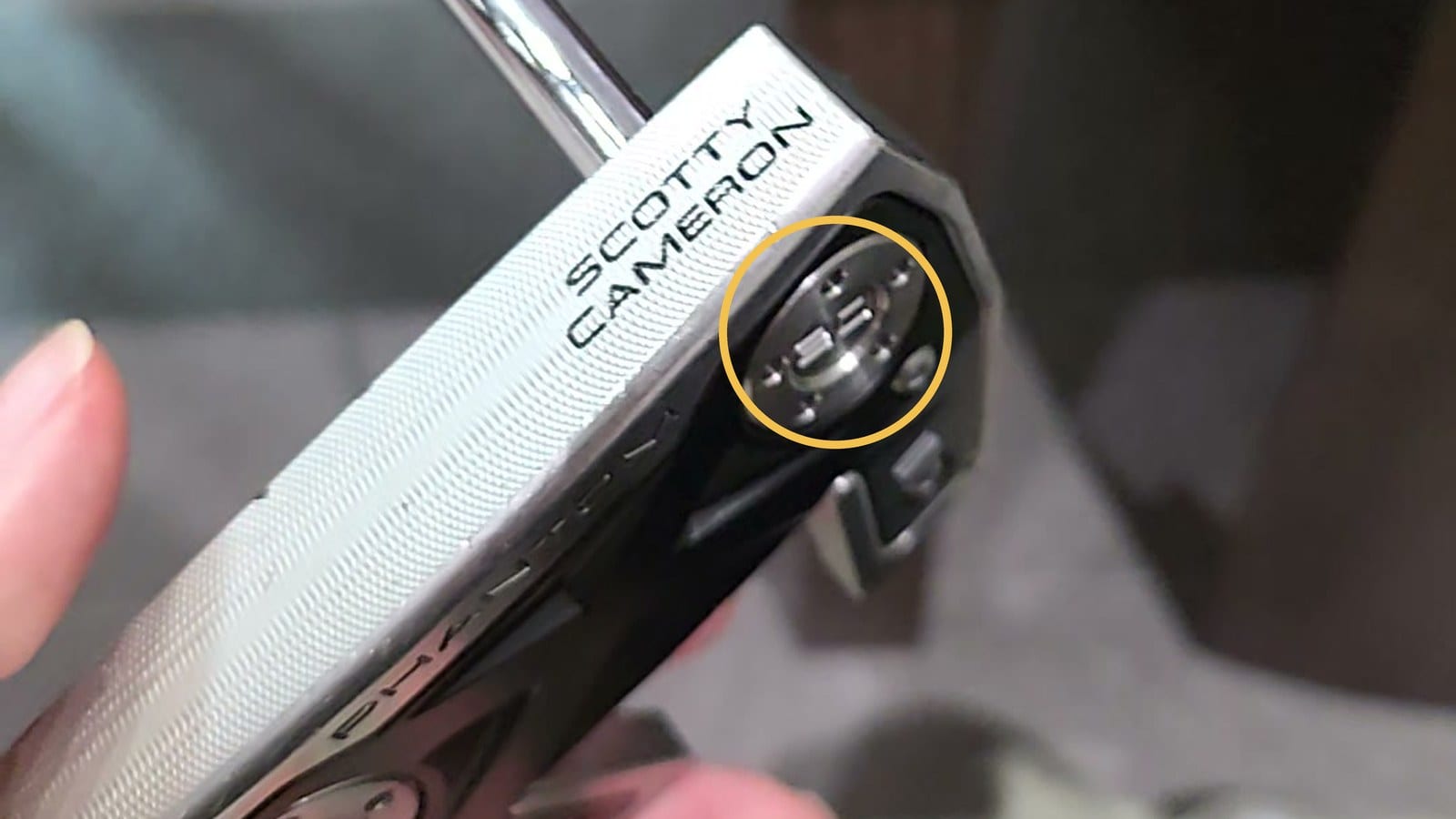
You can see it in Cameron’s own spec sheet. The 2022 Phantom X 5 carries two sole weights, and their size changes with length (Scotty Cameron archive, 2022 Phantom X 5).
That works out to 10 grams more for every inch shorter, by my arithmetic. A 34-inch Phantom X 5 carries 10 grams more than a 35-inch one.
Other makers use a different number. Evnroll tells owners of its putters, “For every 1 inch you cut off, you should add 15g of head weight” (Evnroll). Over the same 2 inches, that’s 30 grams against Cameron’s 20.
PING is less strict about small changes. Wood said “the same head weight is often used for different lengths,” and over a small range “the effects will be somewhat minor.”
I use a 33-inch Phantom X 5 myself, the putter on the cover of this post. Going by Cameron’s table, that length takes two 20-gram weights. I wrote about the same putter in my zero torque vs low torque post.
Changing length isn’t the same job in both directions, either. Cameron’s Custom Shop says, “When adding length to a putter, a new shaft and grip is required. When shortening, we can cut the existing shaft, but a new grip is required.” So a cut-down putter still needs a grip. My grip replacement post covers that part.
If I were changing my putter’s length, I’d ask the shop how they’ll put the head weight back before they cut anything. At the 10 grams per inch from Cameron’s table, even half an inch is 5 grams.