Irons & Loft Charts
P770 Lofts by Year: The 7-Iron Never Moved, but the PW Did
TaylorMade P770 lofts for 2017, 2020, 2023 and 2024: the 7-iron is 33° and the 8-iron 37° in all four. The 2024 pitching wedge is 45°, every older PW 46°.
The short answer
The P770 7-iron is 33° and the 8-iron 37° on all four releases: 2017, 2020, 2023 and 2024. The pitching wedge is what changed. It's 45° on the 2024 model and 46° on the three before it.
- 33°
- 7-iron loft of every P770: 2017, 2020, 2023 and 2024 TaylorMade spec tables (2020 archived), checked 2026-11-12
- 45°
- PW loft of the 2024 P770 (46° on 2017, 2020 and 2023) TaylorMade P∙770 product page, checked 2026-11-12
- 41°
- 9-iron loft on the 2023 and 2024 P770 (41.5° on 2017 and 2020) TaylorMade spec tables (2020 archived), checked 2026-11-12
The pitching wedge (PW) is the P770 club whose loft tells the releases apart. TaylorMade lists the 2024 PW at 45°. The 2017, 2020 and 2023 PWs are all 46°.
The 7-iron is no help here. Every P770 7-iron TaylorMade has listed is 33°, and every 8-iron is 37°, across all four releases: 2017, 2020, 2023 and 2024.
Loft is the angle of the clubface, in degrees. A lower number sends the ball lower and usually farther, and golfers call that a stronger loft.
What moved and what didn’t
- 7-iron 33°, 8-iron 37° on all four P770 releases.
- PW 46° on 2017, 2020 and 2023, and 45° on 2024. The approach wedge (AW), the wedge right below the PW, follows it: 51°, then 50° in 2024.
- No change has ever touched the 7- or 8-iron. The 2020 3- to 6-irons got 0.5-1° stronger, the 2023 9-iron 0.5°, and in 2024 the 3- and 4-irons 0.5° and the PW and AW 1°.
- The 2017 shares the name, not the build. It’s a cavity back, and its 3-iron through PW are 1/4” shorter than every later set.
Sources: TaylorMade spec tables for each release (2020 from an archived page), checked 2026-11-12. Differences are my subtraction.
P770 iron lofts side by side, 2017 to 2024
Here are TaylorMade’s published lofts for each release, in degrees. A bold cell changed from the release before it.
| Release | 3 | 4 | 5 | 6 | 7 | 8 | 9 | PW | AW |
|---|---|---|---|---|---|---|---|---|---|
| 2017 | 20.5 | 23 | 26 | 29.5 | 33 | 37 | 41.5 | 46 | 51 |
| 2020 | 19.5 | 22.5 | 25.5 | 29 | 33 | 37 | 41.5 | 46 | 51 |
| 2023 | 19.5 | 22.5 | 25.5 | 29 | 33 | 37 | 41 | 46 | 51 |
| 2024 | 19 | 22 | 25.5 | 29 | 33 | 37 | 41 | 45 | 50 |
Sources: TaylorMade product pages for the 2017 P770, the 2022 P∙770 and the current P∙770. The 2020 row comes from TaylorMade’s 2020 product page, archived by the Wayback Machine on September 23, 2020. The live address now returns an error page with no spec table. All checked 2026-11-12.
The 2017 AW figures are what TaylorMade’s 2017 page lists.
The 2023 was announced in December 2022 and reached stores on January 20, 2023 (GolfWRX, December 6, 2022). TaylorMade’s own page calls it the “2022 P∙770.” Most reviews call it the 2023, and so does this post.
The middle of the set has barely moved. The 5-iron has been 25.5° and the 6-iron 29° since 2020. If you want to see how far 7-iron lofts spread across other irons, my 7-iron loft post lays that out.
“Same lofts as the 2020”: right for eight clubs out of nine
GolfMagic’s comparison of the 2023 and 2020 models put it plainly: “These irons have the same lofts as the previous P770 irons” (GolfMagic, December 8, 2022).
For eight of the nine clubs, TaylorMade’s tables agree. The 9-iron is the exception. It’s 41.5° on the archived 2020 page and 41° on the 2023 page. Plugged In Golf’s spec charts for those two releases show the same 41.5 and 41.
That half degree moves the steps on either side of it. A gap is the loft difference between two neighboring clubs. On a 2020 set, the 8-iron to 9-iron gap and the 9-iron to PW gap are both 4.5°. On a 2023 set they’re 4° and 5°, by my subtraction.
I’d trust the two spec tables over the review line here. Half a degree on one club makes “same lofts” close enough for most readers. If you’re replacing a 9-iron from the other year, though, it’s the number you need.
2024 lofts are “largely unchanged,” apart from the 3- and 4-irons, PW and AW
Plugged In Golf’s 2024 review says the lofts are “largely unchanged from the previous generation” (Plugged In Golf). For the 5-iron through 9-iron, that’s exact. Both the 2023 and 2024 tables read 25.5°, 29°, 33°, 37° and 41°.
“Largely” covers four clubs that did move. The 3- and 4-irons each dropped 0.5°, to 19° and 22°. The PW and AW each dropped a full degree, to 45° and 50°.
So if you’re looking up your P770 pitching wedge loft, the year matters more here than anywhere else in the set. The 2024 PW is 45°. The 2017, 2020 and 2023 PWs are all 46°.
Because the 9-iron stayed at 41°, the 2024 gap from 9-iron to PW shrank to 4°. It was 5° on the 2023 set and 4.5° on the 2017 and 2020 sets.
If you don’t know which year you have, the head is the quicker check.
The 2017 P770 is a different iron with the same name
TaylorMade said so itself. Its 2020 release introduced the new P770 as “Only carrying the name of the previous generation,” built from “a forged hollow body with SpeedFoam™ injection” (TaylorMade’s August 10, 2020 release, reposted by Driving Range Heroes).
A hollow body head is closed at the back with a space inside. SpeedFoam is TaylorMade’s name for the foam it injects into that space.
The 2017 was built another way, with a cavity back. A cavity back has a recess cut into the back of the head.
TaylorMade’s 2017 product page describes a forged 1025 carbon steel face and hosel. It adds tungsten weighting in the 3- to 7-irons and a one-piece forged cavity back from the 8-iron to the AW.
Every P770 since 2020 is hollow. Today’s Golfer calls the 2024 model “the 3rd generation hollow body P770” in its review of the 2024 model, which counts only the hollow ones.
The specs show the split too. The 2017 has the weakest long irons, with a 20.5° 3-iron. Its 3-iron through PW are also 1/4” shorter than the later sets. Only the AW, at 35.5”, matches.
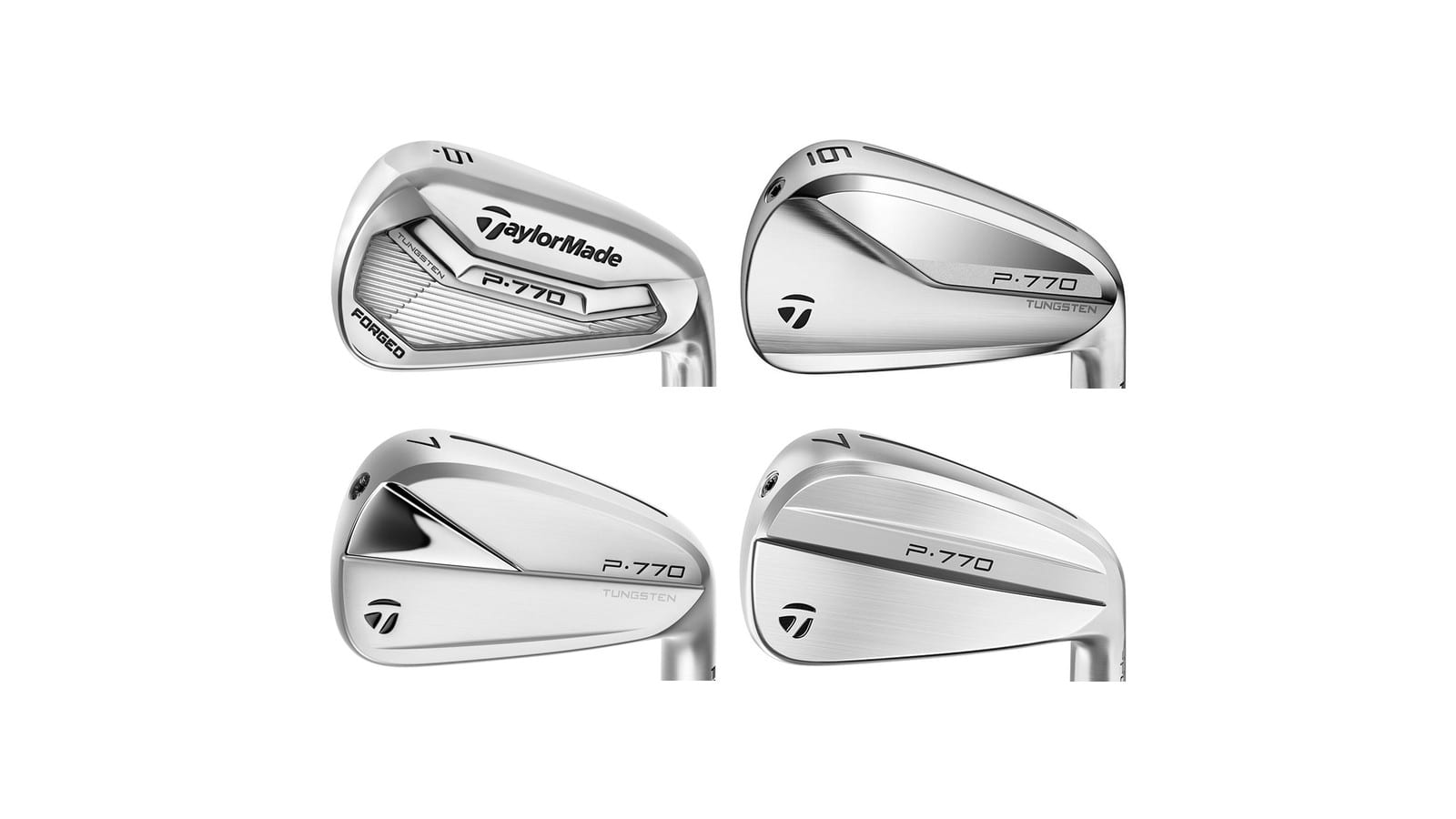
The four heads at the top of this page are TaylorMade product photos (Images: TaylorMade), running 2017, 2020, 2023 and 2024 from top left. Here’s what to look for on the back, going by those photos:
| Release | What the back shows |
|---|---|
| 2017 | Grooved cavity, a large “TaylorMade” wordmark with “P·770” under it, “FORGED” below the toe |
| 2020 | Smooth back, a diagonal mirror strip running down from the top of the toe, “TUNGSTEN” under “P·770” on the heel side |
| 2023 | A mirror triangle at the top of the toe, “TUNGSTEN” under “P·770” |
| 2024 | Two matte panels split across the middle, “P·770” in the center, and no “TUNGSTEN” lettering or mirror triangle in TaylorMade’s photo |
The 2024 is the one TaylorMade sells now. Its product page showed it “In Stock” on 2026-11-12, and Golf Digest’s 2026 Hot List entry for the P·770 links to the same model.
P770 specs: lie, length, offset and swing weight
Lie angle never changed. Length changed once. On the three tables that list offset (2017, 2020 and 2023), it changed only in the 2023 long irons.
| Spec | 3 | 4 | 5 | 6 | 7 | 8 | 9 | PW | AW |
|---|---|---|---|---|---|---|---|---|---|
| Lie, all four releases (°) | 60.5 | 61 | 61.5 | 62 | 62.5 | 63 | 63.5 | 64 | 64 |
| Length, 2017 (in.) | 38.75 | 38.25 | 37.75 | 37.25 | 36.75 | 36.25 | 35.75 | 35.5 | 35.5 |
| Length, 2020-2024 (in.) | 39 | 38.5 | 38 | 37.5 | 37 | 36.5 | 36 | 35.75 | 35.5 |
| Offset, 2017 and 2020 (mm) | 3.6 | 3.3 | 3.0 | 2.7 | 2.4 | 2.2 | 1.9 | 1.6 | 1.6 |
| Offset, 2023 (mm) | 3.3 | 3.0 | 2.8 | 2.6 | 2.4 | 2.2 | 1.9 | 1.6 | 1.6 |
| Swing weight, 2017, 2020, 2024 | D2 | D2 | D2 | D2 | D2 | D2 | D2 | D3 | D3 |
| Swing weight, 2023 | D1 | D1 | D1 | D1 | D1 | D1 | D1 | D2 | D2 |
Source: the same TaylorMade spec tables as the loft table, checked 2026-11-12. The 2024 offset is not listed on TaylorMade’s table.
Lie angle is the angle between the shaft and the ground when the sole sits flat. All four releases use the same numbers, club for club.
Offset is how far the leading edge sits behind the hosel, the neck that joins the head to the shaft. On the 2023 set, the 3- to 6-irons have 0.1 to 0.3 mm less than the 2017 and 2020 sets, by my subtraction. From the 7-iron down, the numbers match. My iron offset post explains what offset does.
Swing weight is a letter-and-number scale for how head-heavy a club feels, where D2 reads heavier than D1. TaylorMade’s 2023 table sits one step lighter than the other three releases on every club. The page doesn’t say why.
Adding a club from another year
Inside any one release, the PW to AW gap is 5°. Mixing years breaks that.
An approach wedge (AW) is the wedge that sits right below the PW. Some makers call it a gap wedge.
Put a 2024 PW (45°) with an older AW (51°) and the gap opens to 6°. Put an older PW (46°) with a 2024 AW (50°) and it closes to 4°. Neither is broken, but the spacing is no longer the one TaylorMade built.
A 2017 club in a 2020-or-later set is off in two ways at once. A 2017 6-iron is 29.5° and 37.25”, while the 2020, 2023 and 2024 6-irons are 29° and 37.5”. Even the 2017 7-iron, at the same 33°, is 1/4” shorter.
Going the other way, below the PW, the question is which wedge fits under a 45° or 46° pitching wedge. My 48 degree wedge post covers that range.
If you’re also weighing the P790, loft is the first difference. Plugged In Golf’s 2023 review says the P770’s lofts are “as much as 2.5 degrees weaker than the P790 with the gap shrinking to 1 degree in the scoring irons” (Plugged In Golf, 2023).
Before you buy a single replacement iron or a wedge to sit under your set, I’d find the year of your PW on the table above.
Terms in this article
- Loft: the angle of the clubface, in degrees. A lower number launches the ball lower and is called stronger.
- Gap: the loft difference between two neighboring clubs in a set.
- Approach wedge (AW): the wedge right below the pitching wedge, also called a gap wedge.
- Lie angle: the angle between the shaft and the ground when the sole sits flat.
- Offset: how far the leading edge sits behind the hosel, in millimeters on TaylorMade’s tables.
- Swing weight: a letter-and-number scale for how head-heavy a club feels. D2 reads heavier than D1.
- Hollow body: an iron head closed at the back with a space inside. TaylorMade fills that space with SpeedFoam.
- Cavity back: an iron head with a recess cut into the back, like the 2017 P770.