Irons & Loft Charts
Titleist Irons, Ranked on Titleist's Own Scale: T350 to 620
Titleist's own comparison charts score its seven current irons from 10 (620 MB, 620 CB) to 2 (T350). Here's what changes at each step, in Titleist's words.
The short answer
Which Titleist iron fits you? Start with Titleist's own scale. The comparison charts on its product pages give each of its seven current irons a Performance number, from 2 for the T350 at the "Distance and Forgiveness" end to 10 for the 620 MB and 620 CB at the "Control and Workability" end. The T100 is a 9, the T150 a 7 and both T250 models a 5. One oddity: the T250 Launch Spec 7-iron is 35°, the same as the 620s, while the other four models are stronger. Price won't decide it: all seven list at the same $215 per iron.
- 10 to 2
- Titleist's Performance numbers, from the 620 MB and 620 CB down to the T350 Compare charts on Titleist's US product pages, checked 2026-11-25
- $215
- list price per iron for all seven models Titleist US irons list, checked 2026-11-25
- 35°
- T250 Launch Spec 7-iron loft, weaker than the T100's 33° Titleist US T100 spec table and 2025 T-Series press release, checked 2026-11-25
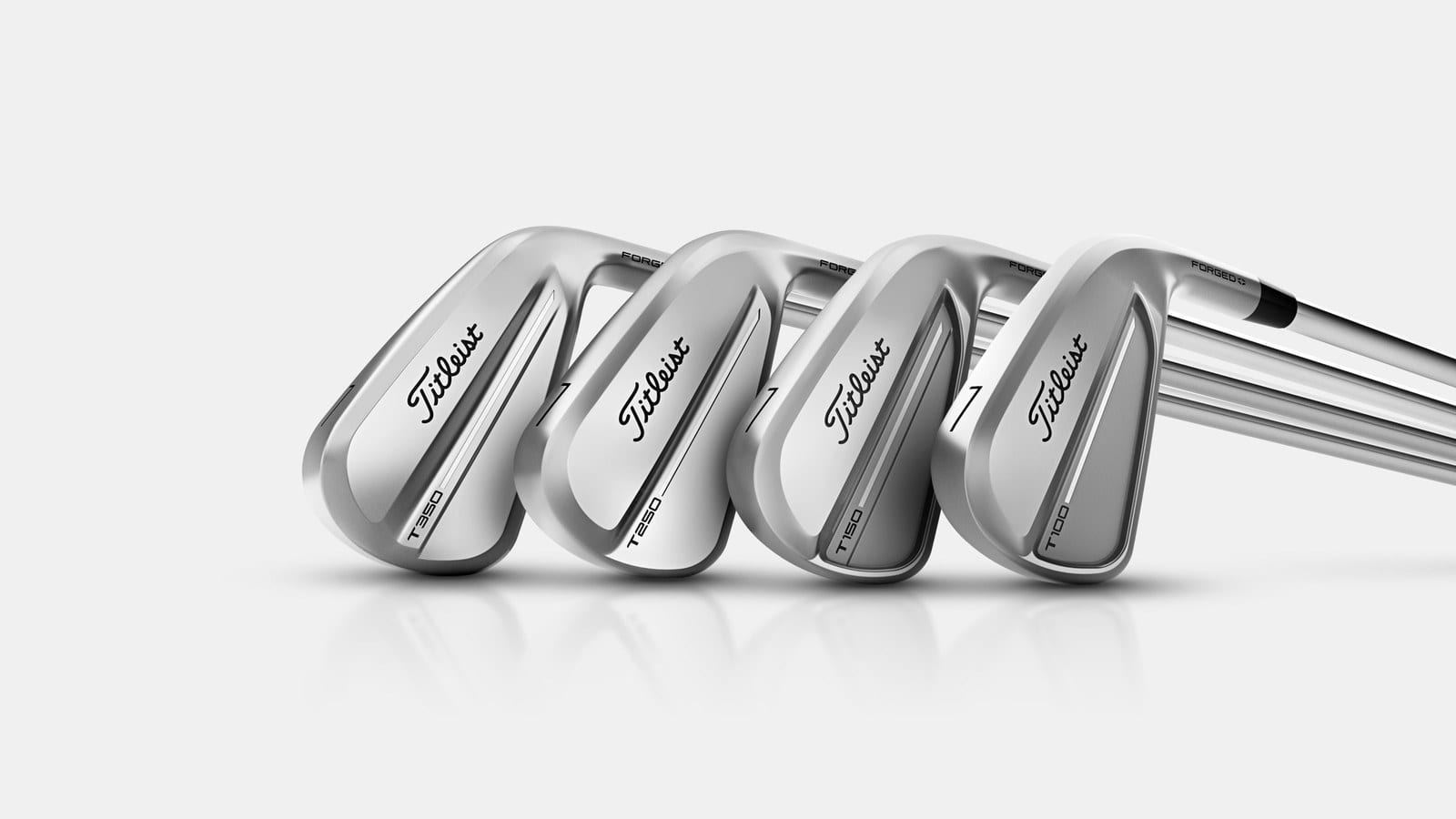
A T250 Launch Spec 7-iron has 35° of loft. That’s the same as the 620 MB and 620 CB at the control end of Titleist’s lineup, and the other four models are all stronger.
Titleist puts its seven current irons in order itself. Each product page has a comparison chart that sets that model beside a neighbor, and every model gets a Performance number on the same scale. That’s 10 for the 620 MB and 620 CB, 9 for the T100, 7 for the T150, 5 for both T250 models and 2 for the T350.
One end of that scale is labeled “Distance and Forgiveness” and the other “Control and Workability.” So what you need to find is the step you belong on, and what changes when you move one step over.
I play a 2023 T100, so I read this chart from the T100’s 9.
| If you want | Where Titleist’s chart points |
|---|---|
| The most control and shot shaping | 620 MB or 620 CB (10) |
| The model Titleist calls the most played iron on the PGA Tour | T100 (9) |
| A step more forgiving than the T100 | T150 (7) |
| The most forgiveness | T350 (2) |
Price won’t split them. On the Titleist irons list, all seven sell for $215 per iron (list price, checked 2026-11-25).
Titleist’s comparison charts, all seven irons in one table
Each product page has a “Compare - Find My Irons” chart that shows that model beside one neighbor. Lined up from all seven pages, the entries fit in one table. Nothing in it is my rating.
| Model | Type | Launch | Performance | 7-iron loft | Available irons |
|---|---|---|---|---|---|
| 620 MB | Player’s | Low | 10 | 35° | 3-9, P |
| 620 CB | Player’s | Low | 10 | 35° | 3-9, P |
| T100 | Player’s | Low | 9 | 33° | 3-9, P, W |
| T150 | Player’s Distance | Mid-Low | 7 | 32° | 3-9, P, W |
| T250 | Player’s Distance | Mid-High | 5 | 30.5° | 2-9, P, W |
| T250 Launch Spec | Player’s Distance | High | 5 | 35° | 5-9, P, W |
| T350 | Game Improvement | High | 2 | 29° | 4-9, P, W, W2 |
Loft isn’t on the charts. I took the 7-iron number from the spec table on each product page.
Titleist sorts the seven into three types. Player’s covers the three irons at the control end. Player’s Distance is the middle type, home to the T150 and both T250s. The T150’s chart entry calls it the iron for “golfers seeking players iron performance with extra speed.”
Game Improvement is built mainly for forgiveness, meaning it holds up better on hits away from the center of the face. Launch, the other column, is how high the ball starts off the face.
None of the pages says what the top of the scale is, so I read these numbers as an order, not a grade. The irons list also sells two utility irons, the T250•U and U•505. I’ve left them out to keep this to the seven irons.
The same list answers a common question: “Are Titleist irons only designed for low handicap golfers? No. Titleist designs irons for a wide range of players.”
620 MB and 620 CB: the two 10s are a 2019 design
The two irons at the top of the chart aren’t part of the T-Series. Titleist’s menu lists them separately as “620 Forged.” They reached golf shops on August 30, 2019, according to Titleist’s 620 press release. The 620 MB page still calls them “the new 620 MB irons.”
On the chart the two are identical: Player’s type, Low launch, a 10, sold 3-9 and P. The difference is the back of the head.
- The MB is a muscle-back: the back of the head is one smooth, solid piece. Titleist’s 2019 press release calls it a “one-piece forging from 1025 carbon steel.”
- The CB is a cavity back. Its page lists “co-forged tungsten in 3- and 4-iron.”
Forged means the head is pressed from a solid piece of hot metal instead of poured into a mold. Tungsten is a heavy metal that lets designers move weight around the head.
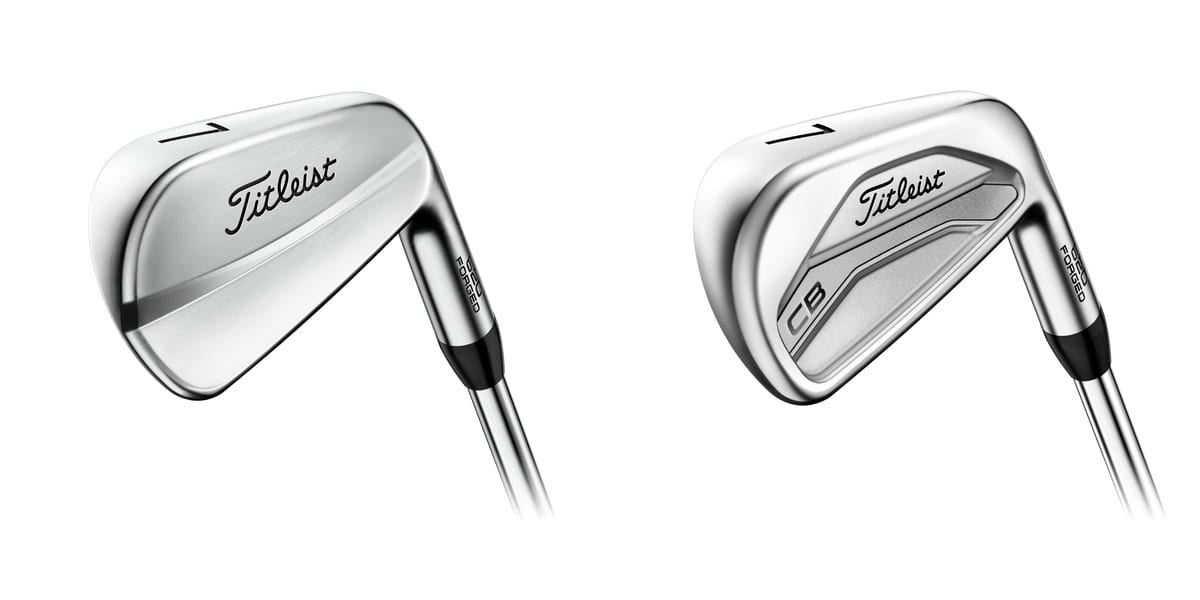
In 2019 Titleist’s minimum advertised price was $175 per club with steel shafts. Today both list at $215 per iron on titleist.com, the same as the 2025 T-Series. So if you want the 10 end of the scale, you’re choosing between two 2019 designs.
T100 to T150 to T250: one step at a time
The rest of the chart is the 2025 T-Series, in golf shops since August 21, 2025, per Titleist’s T-Series press release. Moving down from the T100, the numbers go 9, 7, 5. Titleist’s FAQ describes each step, so I’ll use its words.
T100 to T150: 9 to 7
The T100 page describes what the T150 adds. It says the T150 gives “slightly more distance and forgiveness with 1° stronger lofts, increased ball speed, and a slightly larger, confidence-inspiring head size.” Both heads are forged.
A stronger loft means less loft on the face for the same number on the club. The T150’s own loft history is in my T150 and T100S loft article.
Titleist’s handicap wording shifts with that step. The T100 is “ideal for low-handicap players and competitive golfers.” The T150 is “especially preferred by low-to-mid handicap golfers.”
T150 to T250: 7 to 5
This is the bigger step. The T250 page promises “significantly more ball speed, height, distance, and forgiveness compared to T150,” with “a larger head, stronger lofts.”
The build changes too. The T250 uses a “hollow-body construction,” meaning the head is hollow inside rather than solid. Titleist describes “high-strength steel” with a “forged L-Face,” plus a “thicker topline and wider sole than T100 and T150.” The topline is the top edge of the blade you see at address.
The T250 page says it suits “mid-handicap golfers” most commonly. It also calls the T250 “one of the most popular irons for blended sets.” A blended set mixes two models, usually a more forgiving one in the long irons.
If you remember the T200, the T250 is its replacement. Titleist calls it “a transformative redesign from its predecessor (T200) as well as a name change.” The old model’s specs are in my T200 vs T100 comparison.
Two T250s at the same 5, and the one that launches higher
The T250 Launch Spec shares the T250’s 5, but its Launch rating is High instead of Mid-High. Titleist’s press release says it has “the same construction as T250 but with a lighter headweight and added loft.”
The numbers behind that line: the Launch Spec 7-iron is 35°, “4.5 degrees weaker than the standard T250 7-iron (30.5).” Its head is 6 grams lighter. Sets start at the 5-iron.
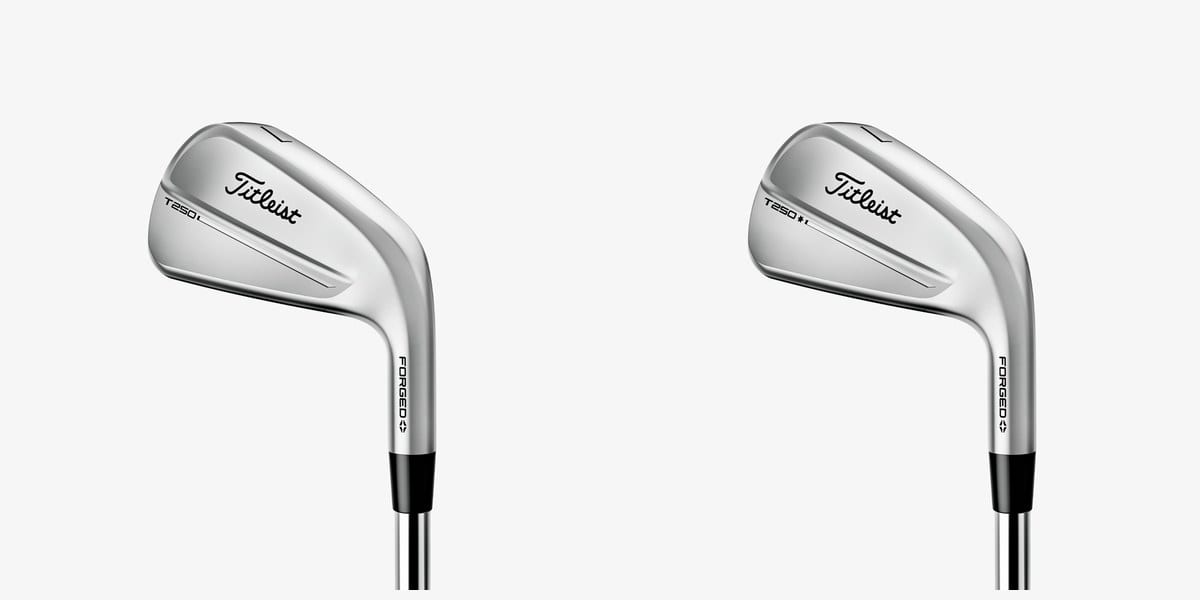
From behind, the two look almost the same. The Launch Spec carries a small star after “T250,” and Titleist’s spec tables list it as T250✶.
That 35° means a 7-iron rated 5 on the scale has as much loft as one rated 10.
Titleist says the Launch Spec is “optimized for players with moderate swing speeds or who struggle with achieving higher trajectories.” Its page says it suits “mid-to-high handicap golfers or those with moderate swing speeds.”
Where my T100 sits, and the one step I’d look at
The last step on the chart is the T350, at 2. The T350 page compares it with the Launch Spec. It offers “a larger head size to deliver maximum forgiveness, lower CG for higher launch, and a faster face.” CG is the center of gravity, the head’s balance point.
Titleist’s irons list says: “T350 is Titleist’s most forgiving iron model in T-Series.” Marni Ines, Titleist’s Director of Iron Development, says the T350 “has the largest clubhead, it’s got the fastest face, and it has a deeper CG.”
Its 7-iron is 29°, the strongest of the seven. Titleist says the T350 caters “primarily to mid-to-high handicap golfers seeking maximum forgiveness.” If you searched for Titleist irons for beginners, that’s the closest wording. Titleist’s handicap lines don’t use the word “beginner.”
Before my T100, I played a Tourstage V300 III. The chart rates the current T100 a 9. Titleist’s full loft table by number, and what changed in 2025, is in my T100 loft article.
I once went looking for something a little easier than my T100. At a golf store, I tried four irons from other brands: a TaylorMade P790, a Srixon ZXi7, a Romaro C101 and a Bridgestone 242CB. All four looked easier than my T100 at address, but hitting them felt about the same.
Those were other brands, so they say nothing about Titleist’s irons. Titleist’s own answer to that question is one row down: the T150, with 1° stronger lofts and “a slightly larger, confidence-inspiring head size.” Since the address look was the first thing that changed for me, that larger head is the line I’d check first.
If one step weren’t enough, I’d read the T150-to-T250 step next. It’s the one Titleist itself calls “significantly” more forgiving.
Find the row your game fits in the chart above, then read Titleist’s FAQ line for the row just below it.