
TaylorMade Loft Sleeve: Pick a Half of the Clock First
Pick the half of the clock your miss belongs on, then how far around. All 12 Qi4D sleeve positions, and why loft and face angle always move together.
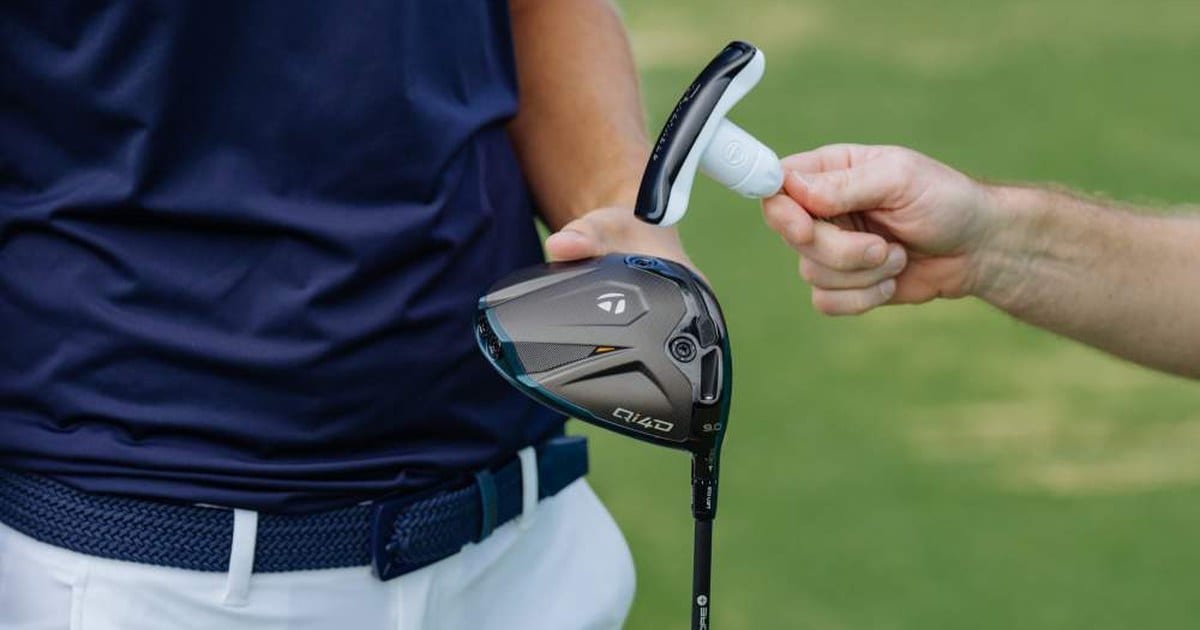
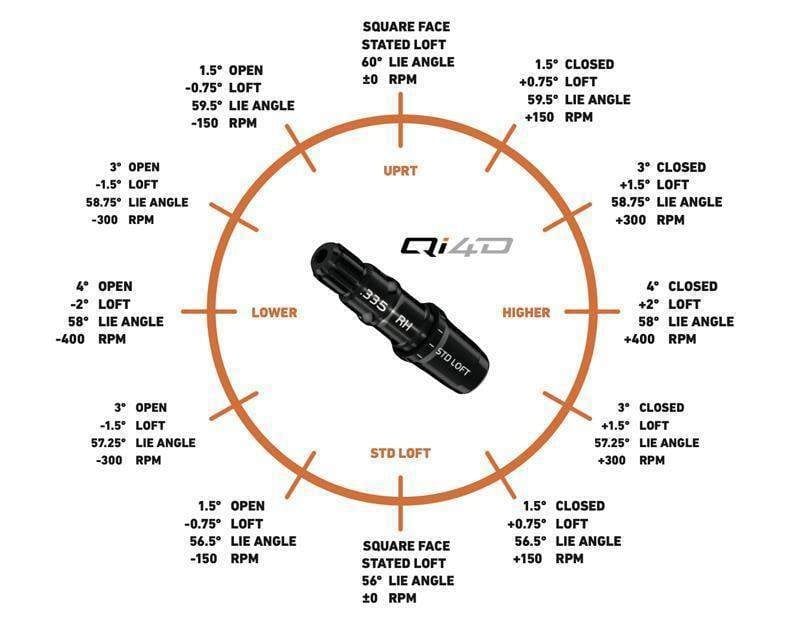
The settings chart for a TaylorMade driver isn’t a grid. It’s a clock face with twelve positions, and each one prints four numbers. That’s 48 numbers for a single part.
You don’t have to learn them. The twelve positions sit in two halves, and the half you want depends on where you lose the ball. After that you only pick how far around to go.
The short answer
- Loft and face angle are one lever. The first notch is 0.75° of loft and “closes the face by 1.5°.” Two notches give 1.5° of loft and 3.0° of face angle, three notches 2.0° and 4.0° (TaylorMade, 2026-03-07).
- The right half of the dial adds loft and closes the face. The left half does the reverse. Pick the half first.
- 12 and 6 o’clock are the only square-face positions, and they differ in lie alone: 60° against 56°.
- Lie is printed as an absolute angle, 56° to 60°, not as a change from standard.
- Ask for more face angle and your lie choice shrinks: 4° of spread, then 3°, then 1.5°, then none.
- All four 2026 Qi4D heads use the same 4-degree sleeve, meaning 2 degrees of loft either way. TaylorMade’s current wrench pages give no torque figure, so the click is the spec you have.
Every notch moves loft, lie and face angle at once
Turn the sleeve one notch and three specifications move at once. No position on this chart changes loft and leaves the face angle alone.
Five words carry the chart. The hosel is the collar where the shaft meets the head. The loft sleeve is the part seated inside it, and the wrench turns it. Loft is the angle of the face, which sets how high the ball launches and how much it spins.
Two more. Lie angle is the angle between the shaft and the ground with the club soled. Face angle is where the face points against your target line, and closed means left of it for a right-hander.
TaylorMade puts a number on the trade. “Increasing loft by one notch (0.75°) closes the face by 1.5°,” it writes. Two notches read +1.5° of loft with the face 3.0° closed, three notches +2° with the face 4.0° closed (TaylorMade, 2026-03-07).
The ratio is flat across the dial and runs the same in reverse: the face always travels twice as far as the loft.
The notch itself isn’t one fixed step, though. Going from two notches to three adds 0.5° of loft rather than another 0.75°, and the face moves 1.0° rather than 1.5°.
TaylorMade’s guide covers the Qi4D line rather than one head. Qi4D, Qi4D LS, Qi4D Max and Qi4D Max Lite all take the same 4-degree sleeve (TaylorMade Qi4D product pages, retrieved 2026-09-22).
Publishing that rate is unusual. Of the four brands I checked for an earlier article, TaylorMade was the only one printing a face angle number.
Whether those printed numbers survive a measuring machine is a separate question, and I worked through it in what a loft sleeve actually moves. That older article quotes a range per click from the M5 guide, where this Qi4D chart prints a single value at each position. This article is about which position to pick.
Four labels on the Qi4D sleeve, not twelve addresses
Four of the twelve positions carry a name, and those four names orient you. The other eight are tick marks with numbers beside them.
- UPRT at 12 o’clock: square face, stated loft, the most upright lie on the chart at 60 degrees.
- HIGHER at 3 o’clock: the most loft on offer, +2 degrees, with the face 4 degrees closed.
- STD LOFT at 6 o’clock: square face, stated loft, 56 degrees of lie.
- LOWER at 9 o’clock: the least loft, -2 degrees, with the face 4 degrees open.
Two of those four hand you the loft stamped on your head. UPRT and STD LOFT both read square face and stated loft, and lie is all that separates them.
The sleeve body also carries .335, RH and STD LOFT. The first two
identify the part rather than the setting.
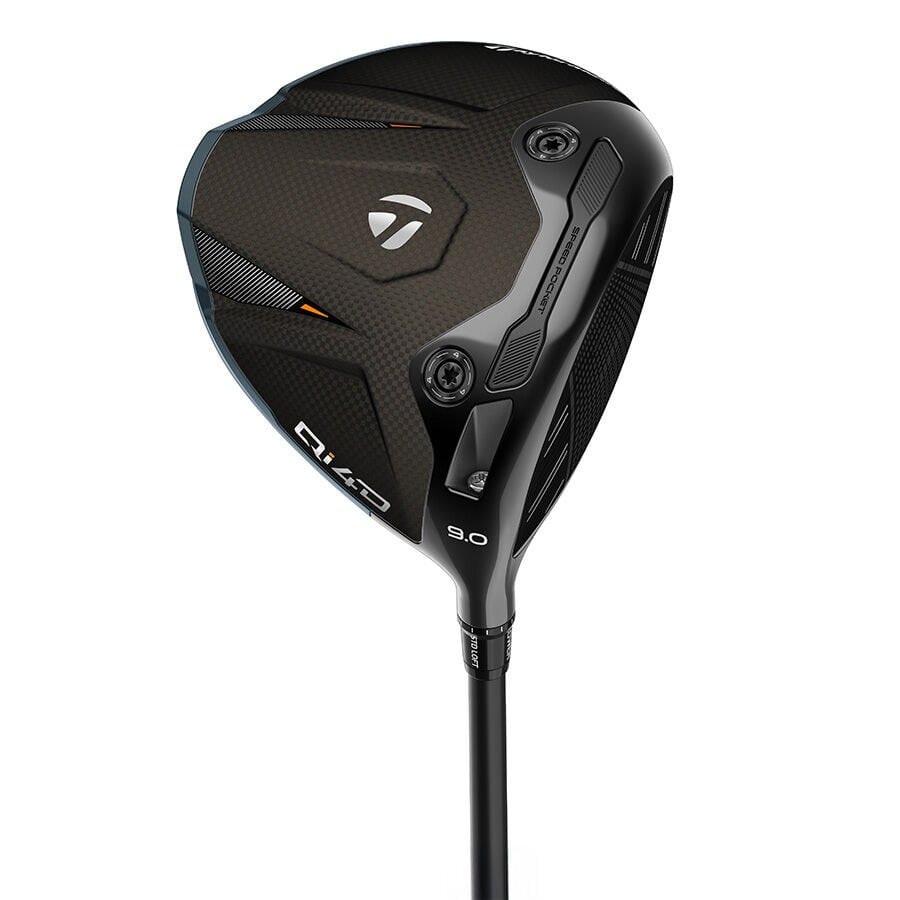
So the line you need isn’t on the sleeve. It’s on the back of the hosel, and whichever marking faces it is your setting.
Pick the half of the clock, then how far around
This is the part worth saving to your phone. You’ll want to settle which half of the dial your miss belongs on, then how far around to travel.
Two words the chart assumes you have. For a right-hander, a draw curves the ball left and a fade curves it right. A hook is an oversized draw and a slice an oversized fade.
| Clock position | Face angle | Loft | Lie angle | Spin |
|---|---|---|---|---|
| 12 o’clock, UPRT | Square face | Stated loft | 60° | 0 |
| 1 o’clock | 1.5° closed | +0.75° | 59.5° | +150 |
| 2 o’clock | 3° closed | +1.5° | 58.75° | +300 |
| 3 o’clock, HIGHER | 4° closed | +2° | 58° | +400 |
| 4 o’clock | 3° closed | +1.5° | 57.25° | +300 |
| 5 o’clock | 1.5° closed | +0.75° | 56.5° | +150 |
| 6 o’clock, STD LOFT | Square face | Stated loft | 56° | 0 |
| 7 o’clock | 1.5° open | -0.75° | 56.5° | -150 |
| 8 o’clock | 3° open | -1.5° | 57.25° | -300 |
| 9 o’clock, LOWER | 4° open | -2° | 58° | -400 |
| 10 o’clock | 3° open | -1.5° | 58.75° | -300 |
| 11 o’clock | 1.5° open | -0.75° | 59.5° | -150 |
All twelve positions as printed on TaylorMade’s Qi4D loft sleeve chart (TaylorMade, 2026-03-07).
One note on the last column. The chart gives no test conditions for those spin figures. Read them as more spin and less spin, not as measurements.
TaylorMade connects the halves to misses itself. “If you have a tendency to lose your shots to the right (for a right-handed golfer), increasing loft may very well help you keep your long shots more online,” its guide says. Going the other way, “decreasing loft also opens the face at address,” with “a little more left-to-right movement” (TaylorMade, 2026-03-07).
So the four common misses sort into two halves:
- You lose it right: the right half, 1 through 5 o’clock. More loft, face closing.
- You hook it left: the left half, 7 through 11 o’clock. Less loft, face opening.
- It won’t climb: the right half again, out to HIGHER at 3 o’clock.
- It balloons: the left half, out to LOWER at 9 o’clock.
Ten of the twelve positions come in pairs. Set aside 3 and 9 o’clock, which stand alone at the extremes. The remaining ten pair off by identical loft and identical face angle.
Take +0.75 degrees of loft. It sits at 1 o’clock and at 5 o’clock, both with the face 1.5 degrees closed, and the lie reads 59.5 against 56.5. Those two differ by 3 degrees of lie and nothing else.
That’s your tiebreaker, and it’s why two settings that look identical can feel different. Fitting convention treats an upright lie as sending a right-hander’s ball further left. If you’re fighting a hook, the flatter twin is the one to try first.
One more thing to expect. Choose by loft alone and you’ll get a direction change you didn’t order.
Direction isn’t the only thing that moves: the sleeve changes carry too, and a robot has measured how much. Golf Digest ran a Qi4D through a Golf Laboratories robot at 95 mph, with each of its 21 configurations a 54-shot average. Turning the sleeve up one or two degrees added 0.7 degrees of launch, 263 rpm and 7.3 yards of carry.
A 9-degree head turned up two notches gained 12.8 yards of carry (Golf Digest, Australian edition, retrieved 2026-09-22). Those aren’t the same setting: two notches is 1.5 degrees on the chart above. That’s a robot repeating one swing, though, not you repeating yours.
Where the sleeve runs out of room
Ask for more face angle and your lie choice disappears. That’s the real ceiling on this dial, and the twelve rows above show it.
| Face angle | Lie angles on offer | Spread |
|---|---|---|
| Square | 60° or 56° | 4° |
| 1.5° | 59.5° or 56.5° | 3° |
| 3° | 58.75° or 57.25° | 1.5° |
| 4° | 58° only | 0 |
The arithmetic comes off the chart: 60 minus 56 is 4, 59.5 minus 56.5 is 3, and 58.75 minus 57.25 is 1.5. At 4 degrees of face angle there’s one position per side, so nothing is left to choose. The open side mirrors the closed side.
TaylorMade sums the sleeve up as 4 degrees of lie, standard to upright (TaylorMade, 2026-03-07). The chart agrees at exactly one place, the square-face pair at 12 and 6 o’clock.
So if you want the face 4 degrees closed, you take 58 degrees of lie with it. The chart prints the 58. What it never tells you is that it’s the only lie left.
When the dial runs out, this stops being a sleeve question and becomes a model question. Only one of the four current heads moves weight toward the heel or the toe.
The base Qi4D lists a front toe weight and a front heel weight. The Qi4D LS, Qi4D Max and Qi4D Max Lite list both as NA in the same spec tables (TaylorMade product specifications, retrieved 2026-09-22). That’s three of the four models with no heel-to-toe weighting.
The Max moves weight front to back only. The Max Lite’s 4 gram weight sets swing weight, the club’s balance feel, and doesn’t bend a ball flight. Both readings come from the same spec tables (TaylorMade product specifications, retrieved 2026-09-22).
The diagram below marks four ports on the base Qi4D. The front heel and front toe are two of the four, and the back pair makes up the rest.
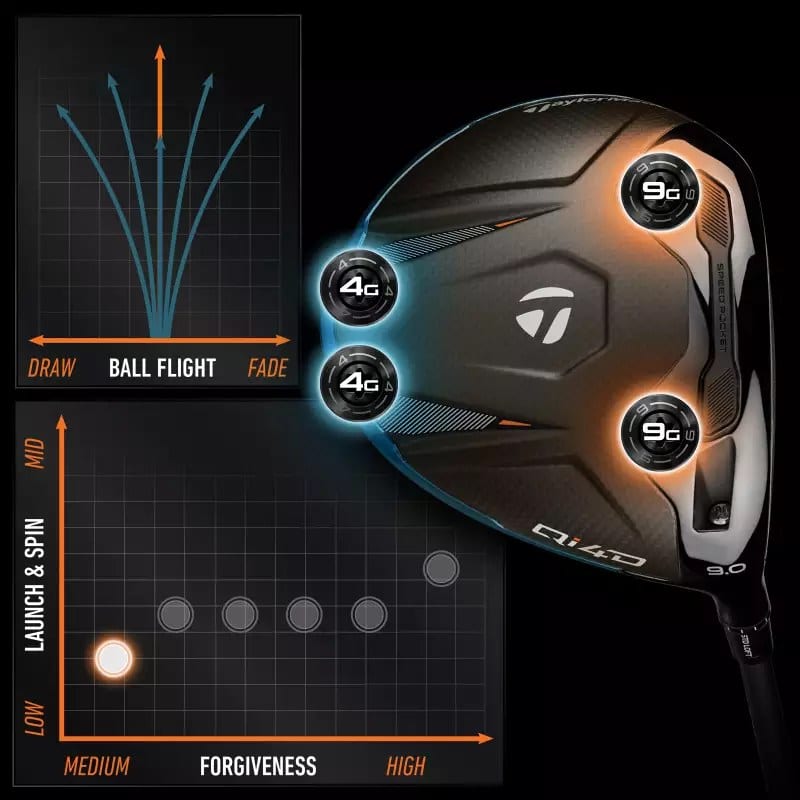
That’s worth holding onto, because of the advice you’ll meet everywhere. You slice it, so move the weight toward the heel. On three of these four heads there’s no heel weight to move.
Where the ports exist, they do move the ball. With both 9 gram weights in the toe, one measured session saw shots finish 20 to 30 yards right of center. The head was the base Qi4D, not one of the other three (Plugged In Golf, 2026-03-12).
Maybe the answer is a different head rather than a different notch. My roundup of this year’s drivers puts the Qi4D line beside the rest of the 2026 field.
Turning the sleeve without guessing at torque
You don’t need to take the screw all the way out. Loosen until the head lifts off the shaft, line your marking up with the hosel line, then tighten until it clicks.
Torque is where this gets thin. TaylorMade’s current wrench pages don’t publish a torque figure. So the click is your spec, and you’ll want the wrench that came with the club.
You’ll also see this sleeve sold as one part across generations. The parts trade treats it as a single adapter fitting TaylorMade drivers from different model years. TaylorMade doesn’t publish a compatibility list, so that’s trade practice rather than a manufacturer statement.
One rules point comes from the rulebook rather than from TaylorMade. You can’t deliberately change a club’s playing characteristics during a round (R&A Rule 4.1a). So this is a range job: settle it on the mat, then leave the wrench alone.
Every brand splits this job differently. Titleist runs a four by four grid with two rings that turn separately: how the SureFit chart reads. PING puts its draw and fade wording on a sole weight instead of the hosel: where PING keeps the shape lever. Cobra prints left and right inside the hosel itself, alongside loft and lie: the shape axis on Cobra’s grid.
If you take one thing from this, it’s the order of the two questions.
- Which half of the clock? The right half if you lose it right, the left half if you hook it.
- How far around? As far as your miss needs, out to HIGHER at 3 o’clock or LOWER at 9 o’clock. The lie angle then breaks the tie between the two positions that share a loft.
Then you’ll want to find out where you’re starting. The marking sitting against the line on the back of the hosel is your current setting.
Terms in this article
- Hosel: the collar where the shaft meets the clubhead. It holds the sleeve and the alignment line.
- Loft sleeve: the part seated in the hosel that the wrench turns. Turning it re-seats the shaft, which is why loft, lie and face angle move together.
- Loft: the angle of the clubface, which mostly sets how high the ball launches and how much it spins.
- Lie angle: the angle between the shaft and the ground with the club soled. TaylorMade prints it here as an absolute angle, not a change from standard.
- Face angle: where the face points against your target line. Closed points left of it for a right-hander, open points right.
- Draw and fade: for a right-hander, a draw curves the ball left and a fade curves it right. A hook is an oversized draw, a slice an oversized fade.