Shafts & Fitting
Dynamic Gold S200 vs S300: Same Stiff Flex, 3 Grams Apart
S200 and S300 are both stiff Dynamic Gold. True Temper lists 127 g vs 130 g and rates both Low spin, Low trajectory. Match the shafts already in your set.
The short answer
S200 and S300 are the same stiff Dynamic Gold shaft in two weight classes. True Temper lists S200 at 127 g and S300 at 130 g, and every other column on its table matches, including Low spin and Low trajectory. Pick the one that matches the shafts already in your set.
- 127 g / 130 g
- raw weight of Dynamic Gold S200 and S300 on True Temper's spec table True Temper Dynamic Gold product page, retrieved 2026-11-10
- 1.8°-1.5°
- torque Titleist lists for both S200 and S300 in its Vokey SM11 shaft table Titleist Vokey SM11 product page, retrieved 2026-11-10
- Low / Low
- spin and trajectory True Temper assigns to every Dynamic Gold flex and length, S200 and S300 included True Temper Dynamic Gold product page, retrieved 2026-11-10
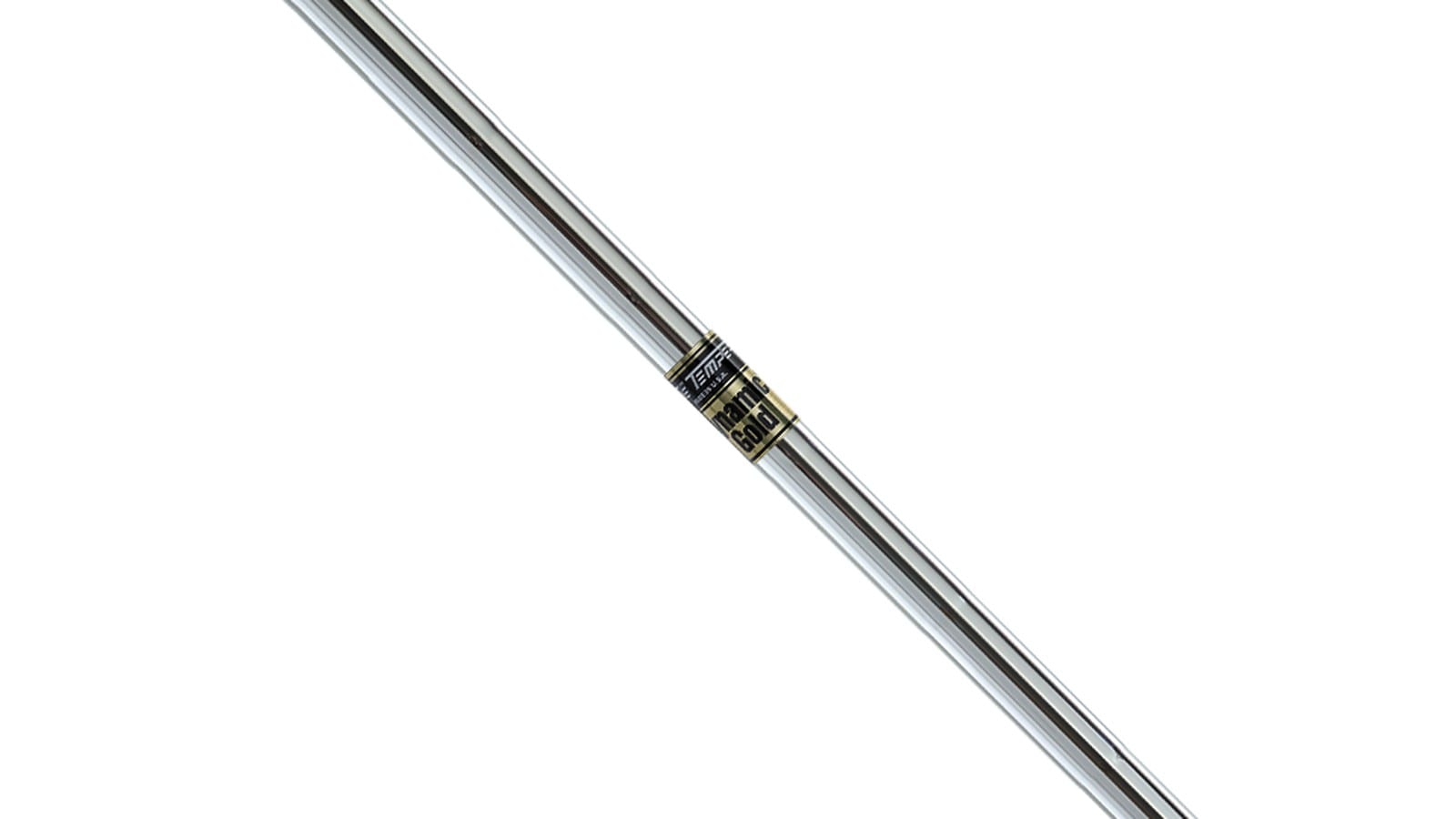
If one listing says S200 and another says S300, you’re looking at the same stiff Dynamic Gold model. The only number that changes on True Temper’s own spec table is the weight, and it changes by 3 grams.
What the label is telling you
- Both are stiff. True Temper lists S200 at 127 g and S300 at 130 g. Tip, butt, torque, spin and trajectory are the same.
- The 200 and 300 are weight steps. True Temper Japan says a bigger number means a heavier shaft, and that S300 is the standard stiff.
- The gap depends on who you ask. 3 g on True Temper’s US table, “about 2 grams” in True Temper Japan’s FAQ, 2 g on Titleist’s Vokey SM11 table.
- Choose by your set, not your swing speed. True Temper describes the same golfer for both.
Sources: True Temper, Dynamic Gold, True Temper Japan FAQ and Titleist, Vokey SM11, all retrieved 2026-11-10.
Dynamic Gold S200 vs S300, column by column
Two companies print numbers for these shafts. True Temper makes and sells them. Titleist installs them in its Vokey SM11 wedges and publishes its own shaft table. Here are both, row by row.
| S200 | S300 | Source | |
|---|---|---|---|
| Weight | 127 g | 130 g | True Temper |
| Weight | 128 g | 130 g | Titleist SM11 |
| Torque | Low | Low | True Temper |
| Torque | 1.8°-1.5° | 1.8°-1.5° | Titleist SM11 |
| Launch | Low | Low | Titleist SM11 |
| Spin / trajectory | Low / Low | Low / Low | True Temper |
| Tip diameter | 0.355 in (0.370 in at 41 in raw) | 0.355 in (0.370 in at 41 in raw) | True Temper |
| Butt diameter | 0.600 in | 0.600 in | True Temper |
Sources: True Temper Dynamic Gold spec table and Titleist Vokey SM11 shaft table, retrieved 2026-11-10.
Torque is how much a shaft twists, measured in degrees. A smaller number means less twist. True Temper only writes the word “Low” for every Dynamic Gold flex, so Titleist’s table is the only place I found a number.
Tip and butt are the two ends of the shaft: the tip goes into the head and the butt sits under the grip. Their diameters decide what the shaft fits. They’re identical here.
The spin and trajectory row comes from data built into True Temper’s product page. All 41 flex and length options carry the same two ratings, Low spin and Low trajectory. True Temper doesn’t rate S300 any differently from S200.
The same table lists the extra-stiff X100 at 130 g, the same weight as S300. So weight alone doesn’t tell you the flex.
What the 200 and 300 actually mean
They’re weight steps. True Temper’s US product page doesn’t explain the numbers, but its Japanese site does. The FAQ says the sub-codes “are differences in weight. The bigger the number, the heavier.” It adds that the standard stiff is S300 (True Temper Japan FAQ, my translation from Japanese, retrieved 2026-11-10).
A sub-flex is a step inside one flex. S200, S300 and S400 are all S.
The same FAQ makes one claim about feel: once the shaft is built into a club, “the heavier one feels slightly stiffer.” That’s True Temper’s description of how it feels, not a measured flex difference.
GOLF.com says the same thing from the production side. In 2019, Jonathan Wall wrote that standard Dynamic Gold has a “weight sorting tolerance” of “plus-or-minus two grams per shaft.” The stiff flex is then “broken out into three sub-flexes: S200 (127 grams), S300 (130 grams) and S400 (134 grams).” Shafts that come in lighter or heavier than the 130 g standard become S200 or S400 (GOLF.com, 2019-08-20).
The S400 number has moved. GOLF.com wrote 134 g. True Temper’s table lists it at 132 g today. I’d go with True Temper’s figure, since the article is seven years old and the maker’s page is current.
The 200-and-300 system isn’t only a stiff thing. R300, the regular flex, is also listed at 127 g, the same weight as S200. Why a regular and a stiff shaft can weigh the same is in my regular vs stiff shaft post.
3 grams is 2.4 percent, and the tables stop there
By my arithmetic, 3 g on a 127 g shaft is about 2.4 percent. That’s the largest of the three gaps I found in official sources:
- 3 g on True Temper’s US spec table (127 vs 130 g)
- “About 2 grams” in True Temper Japan’s FAQ
- 2 g on Titleist’s Vokey SM11 table (128 vs 130 g)
None of the three sources explains the others.
There’s one more limit on those weights. True Temper’s table gives the same weight at every raw length, from 37.0 to 41.0 inches. Raw length is the length of the shaft as it leaves the factory, before it’s cut to fit a club. True Temper Japan’s FAQ separates “uncut weight,” the full-length shaft, from the weight after it’s cut for a club. My reading is that the US table lists the uncut kind. If so, neither 127 nor 130 g is what ends up in your installed club.
Here’s what neither maker publishes for S200 vs S300:
- Frequency (CPM), the usual measure of how stiff a shaft is
- Kick point, where along its length the shaft bends most
- Swingweight change, how much heavier the head feels with 3 g more shaft
- Spin or launch numbers, in rpm or degrees. True Temper uses words only
None of the eleven stock shaft pages I checked for my stock iron shafts post publishes a CPM. So any claim that S300 flies a set amount lower or spins a set amount less than S200 isn’t coming from either maker’s published numbers.
Pick the one that matches your set
True Temper describes one golfer for the whole Dynamic Gold line. Its FAQ says the shafts are “best suited for golfers with moderate to aggressive swing speeds who prioritize precision and shot shaping” (True Temper, Dynamic Gold FAQ). It doesn’t send S200 to one swing and S300 to another.
So pick by what’s already in your bag. If you’re replacing a single iron shaft or adding a wedge to a Dynamic Gold set, I’d match the sub-flex printed on the rest of the set. Then the new club’s shaft lands in the same weight class as its neighbors.
A shaft labeled “Dynamic Gold WEDGE” needs one extra step. True Temper Japan says it’s the same product as regular Dynamic Gold, and only the sticker differs. The WEDGE label is a grouping club makers set themselves, and it puts S200, S300 and S400 under one name, so the band won’t tell you which weight you have. To reshaft with the same product, the FAQ says to buy regular Dynamic Gold. The same FAQ notes that some products are sold only as S200 in Japan and only as S300 in Europe and the US, so the sub-flex you can buy locally may not be the one in your bag (True Temper Japan FAQ, my translation from Japanese, retrieved 2026-11-10).
If you’re hoping S200 is the easier, softer option, it isn’t. It’s the same stiff shaft. For golfers who want more height, True Temper points to “lighter weight options that help moderate swing speed players increase launch and distance.” On the SM11 page, Titleist’s lighter steel choice is Dynamic Gold 105, with the S300 at 103 g.
Whether your wedges should carry the same shaft as your irons at all is a separate call, covered in my golf shaft flex chart guide.
Two other names show up in listings, and neither is a sub-flex of the regular shaft:
- Dynamic Gold Flighted comes in R300, S300, X100 and a “Proto.” There’s no S200. True Temper describes it as a “sequential trajectory set,” with long irons launching higher and scoring irons lower (True Temper, Dynamic Gold Flighted).
- Dynamic Gold Tour Issue comes in S400 and X100 only (True Temper, Tour Issue). GOLF.com wrote that it’s measured to “plus-or-minus half a gram,” so “there’s no need for sub-flexes.”
If you’re holding a club right now, check the band on the shaft before you shop. If it says S300, buy S300, and you won’t have to think about the other 3 grams again. If it says WEDGE, go back to the WEDGE paragraph above first.
Terms in this article
- Sub-flex: a step inside one flex. S200, S300 and S400 are all stiff.
- Torque: how much a shaft twists, in degrees. A smaller number means less twist.
- Tip / butt: the end that goes into the head, and the end under the grip.
- Raw length: the shaft’s length from the factory, before it’s cut for a club.
- Launch / trajectory: how high the ball starts, and the shape of its flight.
- Frequency (CPM): cycles per minute when a clamped shaft vibrates; the usual stiffness measure.
- Kick point: where along the shaft it bends most.
- Swingweight: how heavy the head feels when you swing, on a letter-number scale such as D3.