
Driver shaft replacement: check the head, then 3 prices
Before a driver shaft replacement, check whether the head is the real problem. Then it's a wrench swap, a new sleeve or a new shaft, each with its own price.
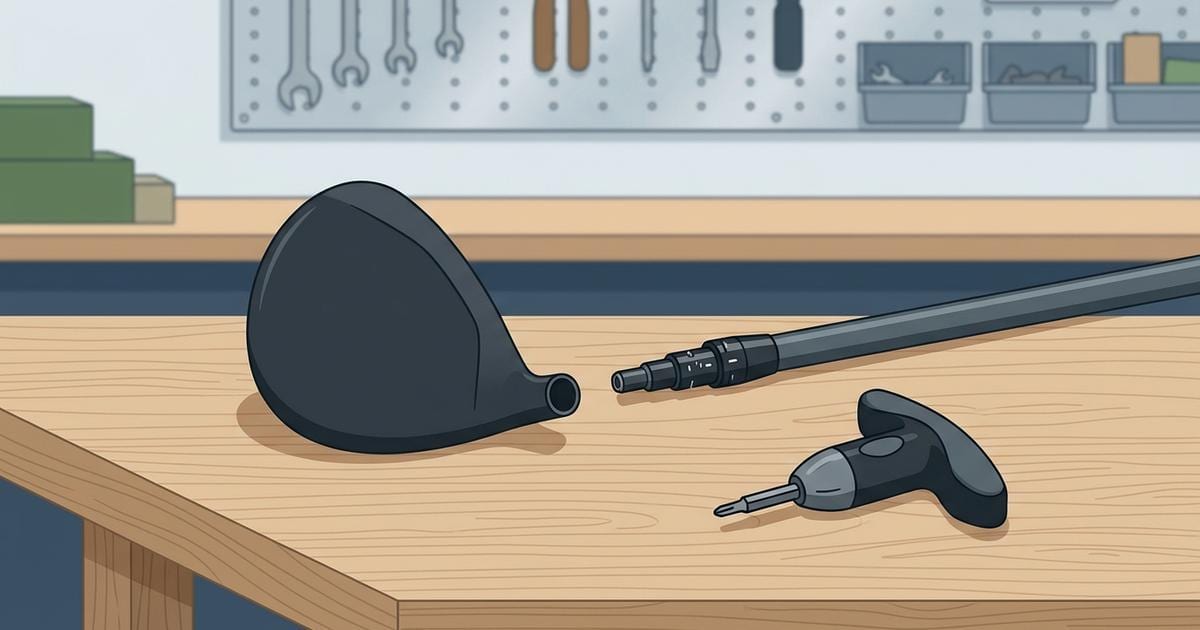
Before you replace a driver shaft, you’ll want to know whether the shaft is really the problem. Fitters split the club’s work in two. The head shapes “speed, launch, spin and shot shape,” and the shaft shapes “dispersion, efficiency and control” (Golf.com, 2025-01-31).
Dispersion is how widely your shots scatter around the target. Launch is how steeply the ball leaves the clubface, measured as an angle.
If it does turn out to be the shaft, the replacement is one of three jobs. Moving a shaft that already has the right sleeve into another head is a wrench job and costs nothing. Putting a new sleeve on the shaft you have is a small shop job. A new shaft is the expensive one, because the shaft itself is most of the bill.
A sleeve, also called an adapter, is the metal fitting glued to the tip of the shaft. It plugs into the head and is held there by one screw. That’s why most current drivers, fairway woods and hybrids can come apart at all.
Turning that sleeve to change loft is a different job. That’s covered in Titleist driver settings. This post is about taking the shaft out and putting something new in.
Loft is how far the clubface tilts back from straight up, in degrees. More loft sends the ball higher and shorter.
The short answer
- You’ll want to check the head before the shaft. Fitters tie speed, launch and shot shape to the head, and dispersion and control to the shaft (Golf.com). If the head looks or sits wrong to you, a new head on your old shaft may be the fix.
- Your shaft fits a new head only if its sleeve matches the brand, the club type and the generation. At the five big brands, hybrids always take their own sleeve.
- Job 1, moving a shaft whose sleeve already fits: your own wrench, no cost.
- Job 2, a new sleeve on your shaft: GolfWorks lists sleeves for four of the five big brands at $22.99-28.99. It charges $10.00 to install one (TaylorMade Rescue sleeve, Cobra sleeve, service menu, undated).
- Job 3, a new shaft: the listings I found ran $75-365 at one retailer (Fairway Jockey), plus labor such as GolfWorks’s $19.95 reshaft fee (GolfWorks, undated).
- I couldn’t find a torque number for the screw from any of the five makers. You tighten with the club’s own wrench until it clicks. Anything that needs glue goes to a shop, because the epoxy needs about a day (GolfWorks epoxy).
Driver shaft or head: which one is the problem?
A new shaft won’t rebuild your swing. A True Spec fitter told Golf.com that a shaft on its own won’t “magically change ball flight or your golf swing” (Golf.com, 2024-06-11). What the right one can give you is “more efficient contact,” with “longer shots and improved dispersion.”
The same fitter named three signs that point at the shaft:
- Your shots scatter a lot from swing to swing. The fix there is a shaft whose weight and profile match your speed and your transition.
- The ball spins too much and climbs. A stiffer tip can bring it down.
- The ball spins too little and drops early. A lighter, more flexible shaft can help.
The profile is where along its length a shaft is stiff or soft. The tip is the narrow end that goes into the head. Your transition is the moment your backswing turns into your downswing. Spin here means backspin, which holds the ball in the air.
Spin shows up on both the head’s list and the shaft’s list, so it’s the one symptom that doesn’t point one way. Launch, speed and a curve you can’t straighten point at the head. And no shaft can change how the head looks to you at address.
Address is the moment you set the club behind the ball, just before you swing.
Fitters don’t fully agree on which part matters more. Eric Chung of Impact Golf puts the head first. “Heads to me has always been paramount to any fit,” he says, and the right head gets you “85, 90% of where it needs to be” (Golf.com, 2026-09-05). True Spec’s Kris McCormack says both matter, and that neither upgrade is worth buying untested (Golf.com, 2025-01-31).
I’d check the head first. If your shaft already suits your swing, keeping it means you keep the part your timing is built around.
When you do shop for a shaft, the flex letter won’t carry over between brands. McCormack notes that “there is no industry standard for shaft flex among any of the shaft manufacturers” (Golf.com, 2025-01-31). Picking a shaft by weight is in driver shaft 50g vs 60g.
Flex is how much a shaft bends in the swing, labeled with letters such as R for regular and S for stiff.
You may also read that shafts lose their snap with age. I couldn’t find a measured source for that, so I wouldn’t replace a shaft for age alone.
My hybrid: a head change, not a shaft change
My old 4-hybrid was a Titleist TS3. The head looked small to me. If it turned even a little at address, it bothered me.
So I kept the shaft and changed the head. I put a Titleist TSR2 3-hybrid head, 18°, on the shaft from the TS3. The TSR2 head is bigger, and I feel calmer standing over it.
I bought the TSR2 head used and did the swap myself with the wrench. The shaft went in and clicked tight, with no shop involved. That makes my club an example of Job 1 below, a shaft whose sleeve already fits moved into a new head.
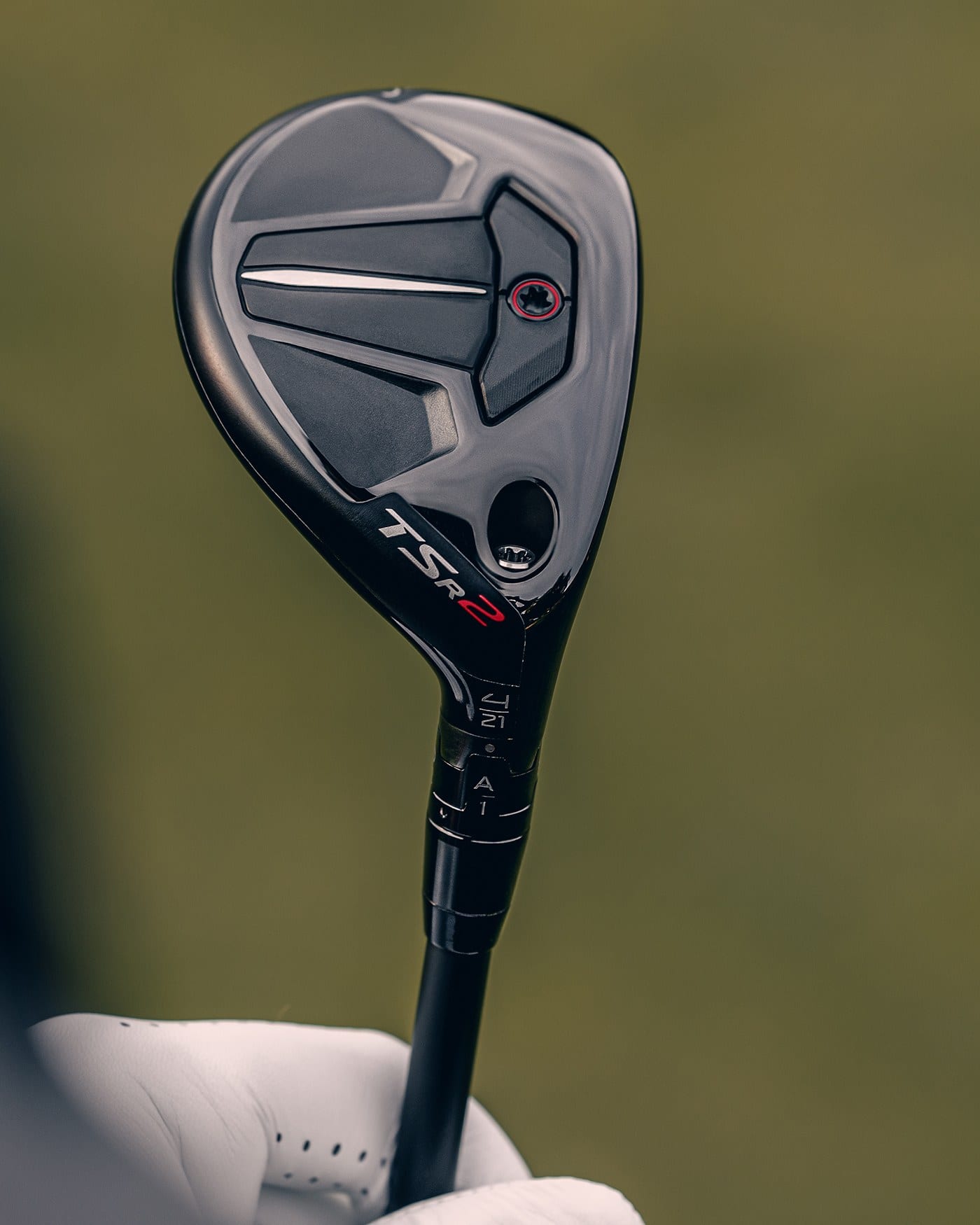
The shaft came out of a 4-hybrid, so the club is a little shorter than a 3-hybrid usually is. It feels comfortable to me, but that’s a feel, not a measurement. Moving a shaft between heads can change a club’s playing length. Titleist says “a 43-inch fairway shaft (stock 3-wood length) plugged into a GT280 clubhead will play a half inch longer at 43.5 inches” (Titleist, 2025).
I’ve played it for about a week now. It has settled, and I plan to keep it this way. What changed was how the club looked to me, and that was a head problem.
Will your shaft fit a new head? Sleeves by brand
Your shaft fits a new head only when the sleeve matches three things: the brand, the club type and the generation. Across the five brands below, hybrids always use their own sleeve. Drivers and fairway woods share one at some brands and not at others.
| Brand | Driver | Fairway wood | Hybrid | The catch |
|---|---|---|---|---|
| Titleist | “GTS, GT, TSR, TSi, TS, 917, 915, 913 and 910 driver shafts are interchangeable” | Its own sleeve. The GT280 and GTS300 mini drivers take the fairway sleeve | Its own sleeve. Sellers list TSR, TSi, TS, 818, 816, 915 and 913 hybrids on one adapter | Hybrid sharing is seller-stated, not a Titleist statement |
| TaylorMade | One sleeve for drivers and fairway woods “from 2015 to present” | Same as driver | Rescue sleeve. The factory listing names models up to SIM2 | Newer Rescue fit isn’t factory-confirmed |
| Callaway | “All Drivers 2013 to present,” except the 2013 X-Hot | 2013-2018 share the driver sleeve. 2019-2025 need another. 2026 Quantum is “Not compatible with past 2025 and prior Callaway fairway woods” | Its own sleeve | The fairway sleeve changed twice |
| PING | G410, G425 and G430 share one. G440 has its own | Same as driver in each generation | Its own sleeve | PING advises against crossing G440 with 2024 and earlier |
| Cobra | FutureFit33 for DS-ADAPT (2025) and OPTM (2026) | Same as driver | Its own sleeve | “not compatible with 2024 and prior club heads” |
A mini driver is a driver with a smaller head and a shorter shaft, sitting between a driver and a 3-wood. Rescue is TaylorMade’s name for its hybrids.
Sources: Titleist SureFit page (retrieved 2026-09-21), Titleist GT280, Titleist GTS300, Shaft Connect and Alpha Golf for Titleist hybrids, TaylorMade Loft Sleeve PDF, updated 7/15/24, GolfWorks TaylorMade Rescue, GolfWorks Callaway driver, GolfWorks Callaway 2026 fairway, Callaway hybrid guide, 2025-01, GolfWorks PING G440, GolfWorks PING G410-G430, GolfWorks PING G440 hybrid and GolfWorks Cobra. Retrieved 2026-09-27 unless noted.
TaylorMade is the easy one. Titleist is the one that catches people, because its driver, fairway and hybrid sleeves differ even within one generation, according to one parts seller (Alpha Golf). My TS3 shaft went into a TSR2 head, as sellers describe. If you’re planning the same swap, you’ll want a shop to confirm your two generations, because Titleist’s own page wouldn’t load for me.
If you have a G440, you’ll want a G440 sleeve, and an older PING head wants the older one. A G440 sleeve will physically fit an older head, but PING advises against it, as GolfWorks relays: “Although the G440 adaptor will technically ‘fit’ into previous 2024 and earlier models PING does not recommend using the 2025 Trajectory Tuning Hosel Sleeve pre 2025 PING drivers and fairway metals” (GolfWorks). The same goes the other way, for a 2024 sleeve in a G440 head.
If you buy a bare shaft, one sold without a sleeve or grip, you’ll also need its tip size. At the five brands here, driver and fairway sleeves take a .335-inch tip, and hybrid sleeves a .370-inch tip (TaylorMade Loft Sleeve PDF, GolfWorks PING G440, GolfWorks Cobra). PING’s G440 hybrid sleeve also comes in .355 (GolfWorks).
To change the settings on a sleeve you already have, see the posts for TaylorMade, Callaway, PING and Cobra.
Golf shaft replacement cost, and who does each job
What you pay depends on which of the three jobs you need. The first is free, the second costs a sleeve and a small fee, and the third is mostly the price of the shaft.
Job 1: moving a shaft whose sleeve already fits
This is the head swap. If your shaft’s sleeve fits the new head (table above), you loosen the screw, pull the shaft out, push it into the new head and tighten. It costs nothing beyond the head itself, and the wrench came with your club.
Job 2: a new sleeve on the shaft you have
You need this when the new head is another brand, or a generation your sleeve doesn’t fit. A shop heats the old sleeve off the shaft and glues a new one on.
GolfWorks lists TaylorMade, Callaway, PING and Cobra sleeves at $22.99-28.99 (TaylorMade Rescue, Cobra). Its service menu, which carries no date, charges $10.00 to install one, $12.00 with cutting to length, and $16.95 with a new grip too (GolfWorks).
The only Titleist sleeves I found came from an aftermarket seller, at $24.99 (Shaft Connect). Titleist says its system “is only compatible with genuine Titleist components.” Mixing parts may void the warranty or let the head “loosen or disengage from the shaft during a swing” (Titleist, retrieved 2026-09-21).
If you’re in Korea, as I am, you’ll see this job priced in won. One fitting shop in Icheon lists sleeve installation at 25,000 won (IGFA). In a 2024 forum thread, golfers called a 60,000 won quote high and put the usual charge nearer 20,000-30,000 won (Dealbada, 2024-08-22). That’s one shop and one thread, so you’ll want to ask your own shop before you go.
Job 3: a new shaft
The shaft is most of this bill, and shaft prices spread wide. At one retailer, UST Mamiya shafts ran from $75 to $365 (Fairway Jockey). Fujikura lists its Ventus TR Blue at $350 (Today’s Golfer, 2026-03-23), and Mitsubishi its Tensei 1K Pro Orange at $360 (Golf Retailing, 2026-07-17). I won’t give you a typical price, because I couldn’t find anyone who publishes one. If a used Ventus is on your list, you can learn to tell a 2022 TR from the newer shafts in Ventus TR vs VeloCore+.
Labor is the smaller part. GolfWorks charges $19.95 to pull the old shaft and install a new one with a new grip, plus parts (GolfWorks, undated). To reshaft a club is to take the old shaft out and put a new one in. Keith Lee Golf in Oregon estimates “$20.00/club” (Keith Lee Golf). True Spec listed $125 for a “Shaft Only service” into your existing head, “subject to change based on location” (True Spec, 2018-10-02). That page is almost eight years old, so treat it as one fitter’s past price.
There’s a way to skip the shop. Some shaft retailers build the shaft with your brand’s sleeve already on it. Fairway Jockey lists the maker’s adapter at ”(+$0)” with installation included on its Ventus TR Blue (Fairway Jockey). The shaft then arrives ready for Job 1 at home.
A new shaft usually means a new grip as well. When a grip is worth replacing on its own is in golf grip replacement.
Clubs with no sleeve
Irons and non-adjustable woods have the head glued straight onto the shaft. The glue has to be heated until it lets go, and then the head comes off with a shaft puller. “If the epoxy bond is not broken, the head will not pull off” (Mitchell Golf, 2008-09-22).
Epoxy is the two-part glue that holds a sleeve or a head on the shaft. A shaft puller is a shop tool that pulls a heated head off a glued shaft.
That’s a shop job. GolfWorks charges the same $19.95 reshaft fee plus parts (GolfWorks, undated). Irons are a different decision, covered in stock iron shafts.
Doing it yourself: the click is the spec
A head swap on a sleeve is a job you can do at home. Titleist’s instructions say to “tighten clockwise until you feel and hear the wrench ‘click’. If the screw feels like it is binding, stop and realign components” (Titleist, retrieved 2026-09-21). Callaway’s hybrid guide uses the same words, “until you feel and hear the wrench ‘click’” (Callaway, 2025-01).
I couldn’t find a torque number from any of the five makers. You’ll see one quoted online, but not from a maker. The click is the spec, so you’ll want the wrench that came with the club rather than a hex key.
Torque, here, is how hard the screw is turned when you tighten it.
Glue is where you stop. GolfWorks says its epoxy “sets in 18 hours and cures in 24 hours” (GolfWorks). A shop that gets the glue wrong risks, in Mitchell Golf’s words, “your club head flying off mid-swing” (Mitchell Golf, 2022-07-08). A new sleeve or a new bare shaft belongs with someone who does this daily.
One rule to know: you can’t adjust a club or change its parts during a round, under Rule 4.1a.
So which job is yours?
Start from what bothers you, then read across.
| If this is you | The job | Who does it | What it costs |
|---|---|---|---|
| The head looks or sits wrong to you, and your shaft’s sleeve fits the new head | Job 1, head swap | You, with the club’s wrench | Nothing but the head |
| You like your shaft, but the new head is another brand or generation | Job 2, new sleeve | A shop | $22.99-28.99 sleeve + $10.00 install |
| Your shots scatter, or your spin is off, and a fitting points to the shaft | Job 3, new shaft | A shop, or a retailer that builds it with your sleeve | $75-365 for the shafts I found + $19.95 labor |
| Your club has no sleeve | Heat, pull, re-glue | A shop | $19.95 labor + parts |
| Nothing’s wrong, the shaft is just old | Nothing | Nobody | None |
Prices are GolfWorks’s undated service menu and sleeve listings, and one retailer’s shaft range, all linked in the section above.
If you can’t tell whether it’s the head or the shaft, I’d try another head on the shaft you have before buying anything. A fitting bay or a friend’s same-brand club is the cheapest test there is. If the new head fixes it, you’ve saved the shaft. If it doesn’t, you’ve narrowed it to the shaft.
FAQ
How much does it cost to replace a driver shaft?
It depends on the job. Moving a shaft whose sleeve already fits is free. A new sleeve is $22.99-28.99 plus a $10.00 install at GolfWorks (TaylorMade Rescue sleeve, Cobra sleeve, service menu, undated). A new shaft is the shaft’s price, $75-365 in the listings I found (Fairway Jockey), plus about $20 of labor at two US shops (GolfWorks, Keith Lee Golf).
Can I put any shaft in my driver?
Only one with a sleeve for your brand, club type and generation, or a bare shaft that a shop fits with one. At the five big brands, hybrid shafts won’t go into drivers, because hybrids take their own sleeve.
Can I replace a driver shaft myself?
You can swap a shaft that already has the right sleeve. You tighten with the club’s own wrench until it clicks (Titleist). Gluing on a new sleeve or shaft is a shop job, because the epoxy needs about a day to cure (GolfWorks).
Do golf shafts wear out?
I couldn’t find a measured source that says they do. I’d change a shaft for a symptom you can see, like scattered shots or spin that’s off, not for age.
Terms in this article
- Sleeve (adapter): the metal fitting glued to the tip of the shaft that plugs into the head and is held by one screw.
- Dispersion: how widely your shots scatter around the target.
- Launch: how steeply the ball leaves the clubface, measured as an angle.
- Loft: how far the clubface tilts back from straight up, in degrees. More loft sends the ball higher and shorter.
- Flex: how much a shaft bends in the swing, labeled with letters such as R for regular and S for stiff.
- Mini driver: a driver with a smaller head and a shorter shaft, sitting between a driver and a 3-wood.
- Rescue: TaylorMade’s name for its hybrids.
- Reshaft: to take the old shaft out of a club and put a new one in.
- Profile: where along its length a shaft is stiff or soft.
- Tip: the narrow end of the shaft that goes into the head.
- Transition: the moment your backswing turns into your downswing.
- Spin: the backspin that holds the ball in the air.
- Address: the moment you set the club behind the ball, just before you swing.
- Bare shaft: a shaft sold without a sleeve or grip.
- Tip size: the diameter of the shaft’s tip. Driver and fairway sleeves take .335 inches, hybrid sleeves .370. PING’s G440 hybrid sleeve also comes in .355.
- Torque: how hard the screw is turned when you tighten it.
- Epoxy: the two-part glue that holds a sleeve or a head on the shaft.
- Shaft puller: a shop tool that pulls a heated head off a glued shaft.