
Rubber vs elastomer golf grips: choose by squeeze, then check the weight
Standard rubber and elastomer grips both weigh about 50 g, so you're choosing feel. Change size and the head feels different, at 4 or 5 g per swingweight point.
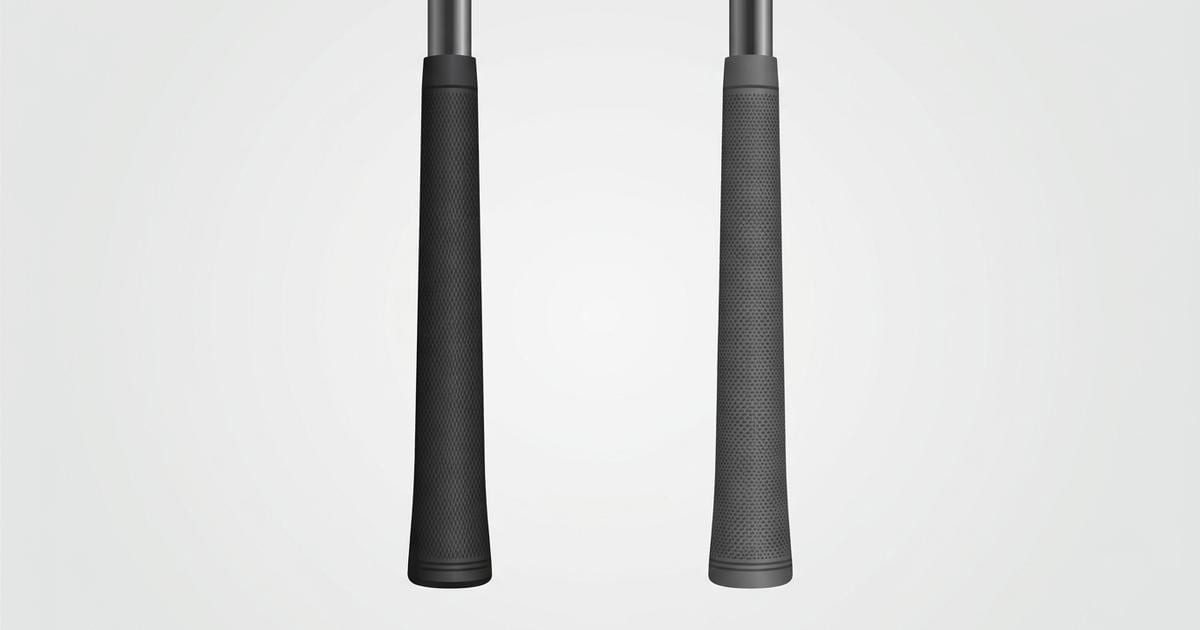
The shop asks “rubber or elastomer?” about a minute after you say you want new grips. Size is the first question, and the golf grip size chart covers that one. This is the second question, and it has a part the counter usually skips.
The feel part I can speak to, because my bag has both. My clubs from the 7-iron down to the sand wedge carry Elite Grips, the standard model. My 4, 5 and 6-irons still have the old rubber grips. I kept those three because they were less worn.
I wear a size 22 glove, same as in the sizing post.
The part nobody mentioned is weight. A fitter is the person at the shop who measures you and builds or adjusts the club. The one who did mine put every grip on a scale before it went on the shaft. I didn’t know that was a thing.
It turns out the grams on the grip end change how heavy the head feels, and the number that does it is small.
The short answer
- In my bag the Elite (elastomer) clubs need less squeeze than the rubber 4, 5 and 6. That’s a feel, not a measurement, and my rubber grips are the older ones.
- Elastomer wears down faster, and how much that matters depends on how often you play. Nakamura, the grip maker STM’s president, told e-Golf Japan that rubber ages even sitting in the bag but scuffs less. So people who practice a lot find it lasts longer (2025-10-27, retrieved 2026-09-18).
- Wet grip is a disagreement. A grip maker says elastomer slips when wet. A fitter says rubber slips most. Elite’s own spec sheet tells you to wipe the water off before the shot.
- Standard grips of both materials weigh about 50 g, so what moves the grams is size, not material. Tour Velvet is 49.5 or 51.5 g (Golf Pride) and Iomic Sticky 2.3 is 50 g (IOMIC USA). The Elite Y360s is 50.0 g (Elite Grips), all maker figures retrieved 2026-09-18.
- A lighter grip makes the head feel heavier. Two clubmaking sources put it at 4 g (Ralph Maltby) or 5 g (Kirkpatrick Golf) per swingweight point, both retrieved 2026-09-18. Going from a 49.5 g standard to a 61.0 g jumbo (Golf Pride, retrieved 2026-09-18) drops it by 2.3 to 2.9 points.
Rubber vs elastomer, side by side
The word on the box is a shop category more than a chemistry lesson. Golf Pride describes the Tour Velvet, the rubber grip most sets ship with, as a “rubber-blend compound” (Golf Pride, Tour Velvet, retrieved 2026-09-18). Iomic says it “turned our attention to elastomer-based (resin) materials” and molds every grip from one “durable yet tacky” polymer (IOMIC USA, The Technology, retrieved 2026-09-18).
Elastomer is a stretchy synthetic material. On a grip tag it covers the resin-type compounds that aren’t classic rubber, and each maker has its own name for its version. Tacky is the slightly sticky surface of a fresh grip, the feel that goes first as a grip wears.
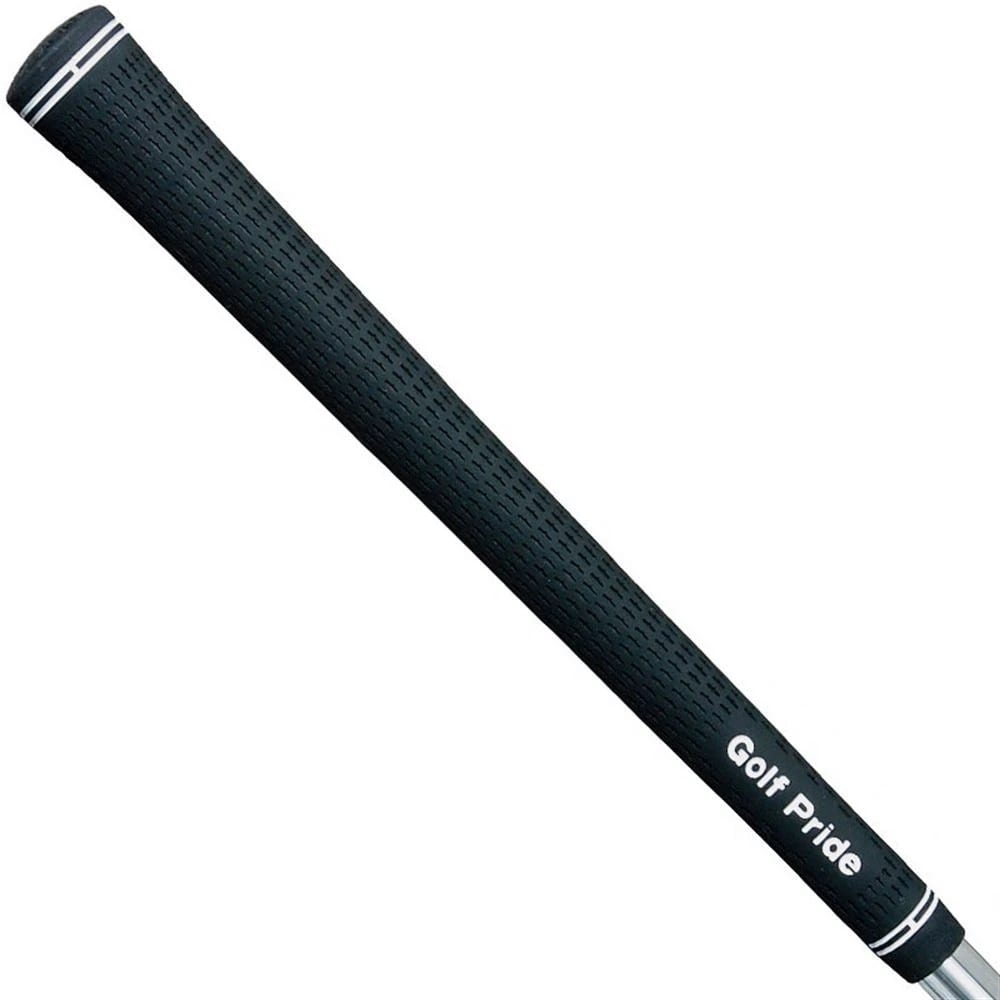
Photo: GolfWorks product listing for the Golf Pride Tour Velvet, retrieved 2026-09-18. This is the shape and texture most stock iron sets come with. I never recorded the brand of the old rubber grips on my 4, 5 and 6-irons, so read this as the category, not as my clubs.
Then there’s the grip on my irons, which shows how loose the label is. Elite’s own sheet for the Y360s lists the material as “NO.NKS10 special synthetic rubber material (silica blended)”, my translation. Elite’s shop files the same grip under “Material: elastomer”, also my translation (Elite Grips, Y series and Elite Grips store, both retrieved 2026-09-18). Same grip, two labels.
So I’d read “elastomer” on a tag as “the tackier family” and go by the two things every sheet prints: the feel words and the grams. “Standard” on a grip is a size, not a spec, the same way the 7 on an iron isn’t a loft.
| Rubber blend: Golf Pride Tour Velvet | Elastomer: Iomic Sticky 2.3 and Elite Y360s | |
|---|---|---|
| What the maker calls it | “rubber-blend compound” | Iomic: one IOMAX polymer, “elastomer-based (resin)”. Elite: NKS10 synthetic rubber with silica, sold under “elastomer” |
| Published weight, standard size | 49.5 g on a 60 core, 51.5 g on a 58 core | Iomic 50 g ±2. Elite 50.0 g ±1, or 51.0 g ±1 with a backline |
| Softness when new, one Japanese fitter’s general order | Softest of the three: rubber, then elastomer, then cord | Middle |
| Wear | Ages in the bag even unused, but scuffs less, so it holds up for people who practice a lot | Wears down faster; the durability claim is aimed at people who play few rounds |
| How often to replace | Golf Pride: at least once a year, any grip. Nakamura, in the e-Golf Japan interview: many golfers change at around 40 rounds, yearly if you play less, two years at the outside | Same advice, both materials |
| Price | The cheaper one | Costs more (Golf Digest Korea) |
| When wet | Sources disagree, next section | Sources disagree, next section |
Sources: weights from the Golf Pride grip specifications, IOMIC USA, Sticky 2.3 and Elite Grips, Y series; once a year from Golf Pride, Grip Wear; softness order from Golf Digest Online Japan, 2023-11-22; wear and replacement cadence from the Nakamura interview in e-Golf Japan, 2025-10-27; price from Golf Digest Korea, 2021-10-13. All retrieved 2026-09-18.
Three words from the table. Core is the grip’s inside diameter, written as 58 or 60, and it has to match the shaft it goes on. A backline is a ridge molded down the underside so your hands land in the same place each time. Cord is a rubber grip with thread molded into the surface.
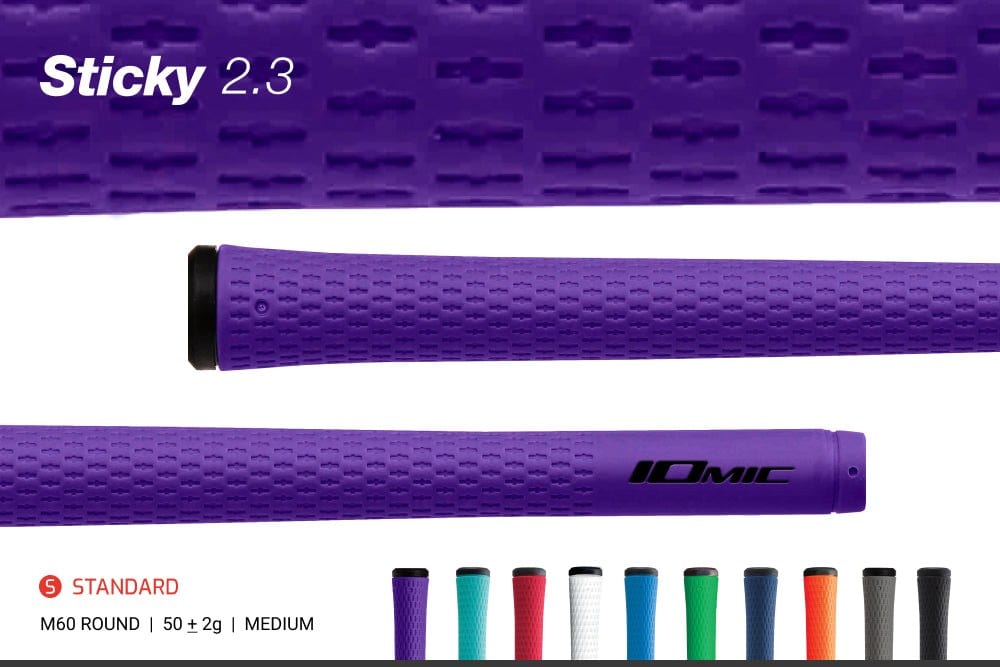
Photo: IOMIC USA product page, retrieved 2026-09-18. Spec strip on the image reads M60 round, 50 ±2 g, and “round” there means no backline. This is the grip on my utility, and that strip is where the weight in the table comes from.
My driver wears a CAVIAR, a Korean brand with no spec page I could find, so it stays out of the table. The second driver shaft carries an Elite.
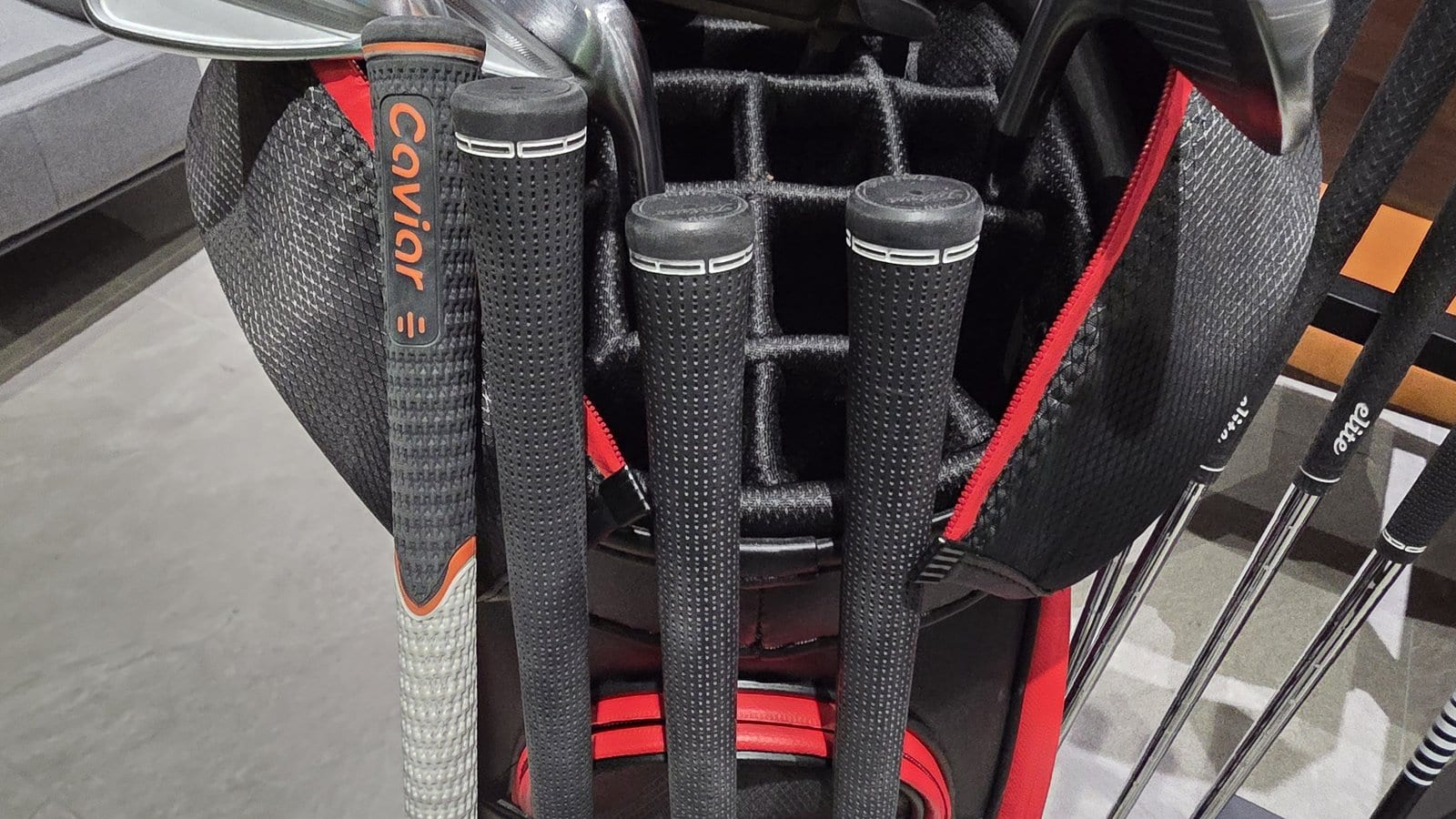
Photo: taken by the author, 2026-09-18. The leftmost grip, white with orange CAVIAR lettering, is the driver mentioned above. No spec page exists for it, so this photo is the only record of it in this article.
Why the Elite clubs need less squeeze, and what happens when they get wet
The difference I feel is in how hard I hold on. On the Elite 7-iron through wedges I can hold lightly and the club doesn’t feel like it wants to turn. On the rubber 4, 5 and 6, hit in the same session, I squeeze more, and they feel firmer and slicker by comparison.
Here’s the caveat, and it’s the reason I’m glad both are still in the bag. My rubber grips are the old ones. Golf Pride’s wear page says worn grips take on “a slick, glossy feel” and “feel firmer than they should be”.
Golf Pride’s page says lost tackiness “can lead to added tension in your swing” (Golf Pride, Grip Wear, retrieved 2026-09-18). So some of what I feel is age, not material, and I can’t tell you how much.
On new grips the softness order may even run the other way. A Golf Digest Online Japan fitter gives the general order, softest first, as rubber, then elastomer, then cord, my translation (Golf Digest Online Japan, 2023-11-22, retrieved 2026-09-18). What I’m feeling is grip pressure and wear. “Elastomer is softer” is not a line I’d repeat.
Squeeze matters because tight hands mean tight forearms, which is what Golf Pride’s “added tension” line is about. A grip can’t change how the shaft loads, though. If the club feels wrong through the swing rather than in your hands, the shaft flex guide is the check to run.
Wet hands and rain: the sources don’t agree
Three sources, two answers, and I’m not going to pick one for you.
- A grip maker says elastomer slips when wet. Nakamura (中村成守), the president of grip maker STM, told e-Golf Japan that elastomer has low affinity for water. It doesn’t soak in, so it sits on the surface and makes the grip slippery in rain. Rubber’s textured surface takes in some water and slips less. My translation (e-Golf Japan, 2025-10-27, retrieved 2026-09-18).
- A fitter says rubber slips most. The Golf Digest Online Japan fitter writes that when rain or sweat gets on the grip, the slip order flips completely to cord, elastomer, rubber (Golf Digest Online Japan, 2023-11-22, retrieved 2026-09-18).
- Elite tells you to wipe. Its Y360s sheet says the grip differs in how fast water wipes off. The footnote then tells you to wipe the moisture off the grip with a towel before every shot (Elite Grips, Y series, retrieved 2026-09-18).
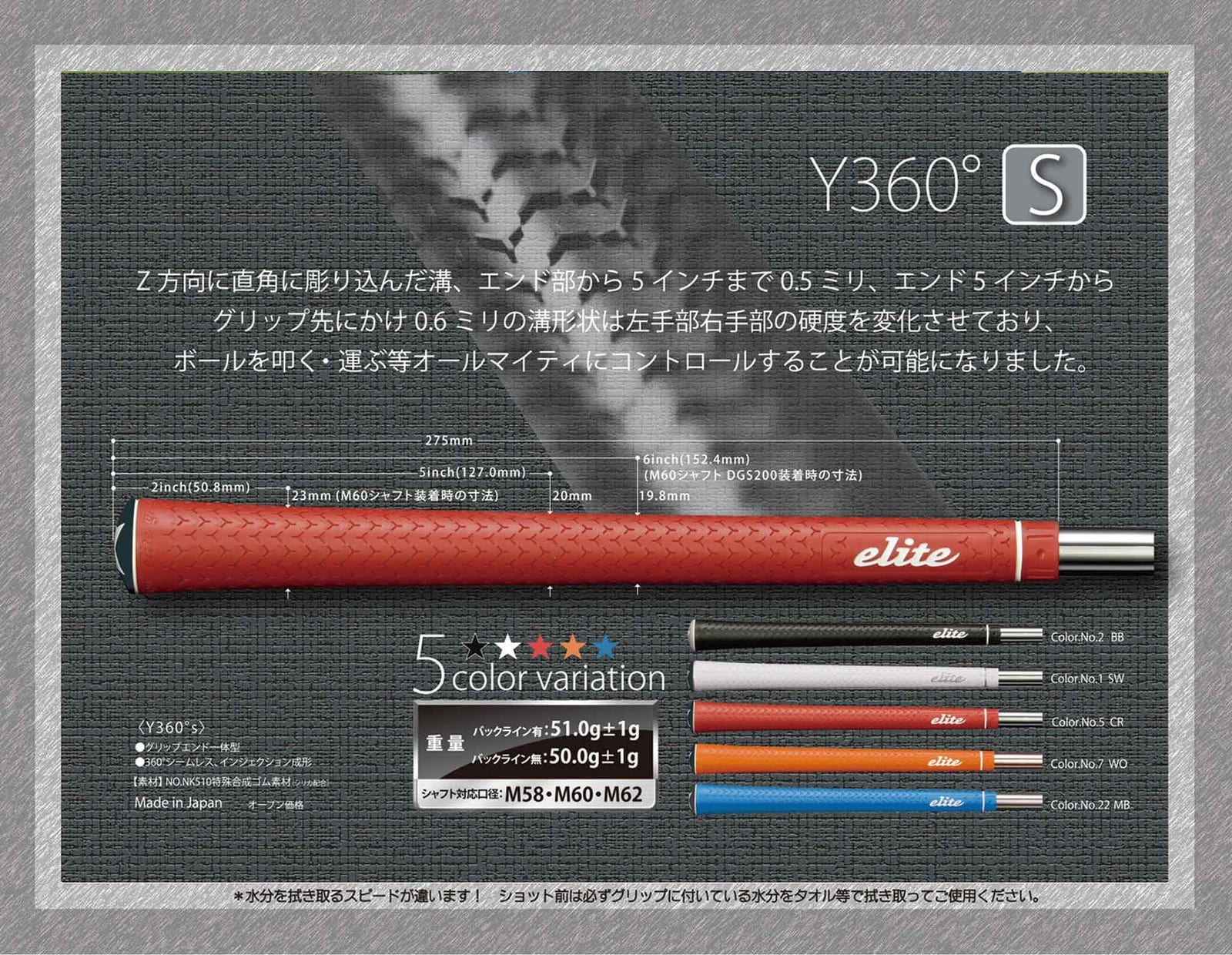
Photo: Elite Grips official product sheet, retrieved 2026-09-18. Weight printed as 51.0 g ±1 with backline, 50.0 g ±1 without; the footnote tells you to wipe water off before the shot.
I have not played mine in rain. What I can say is that the sticky feel comes back after a wipe, which is exactly what Elite tells you to do. If it were me choosing again, I wouldn’t buy either material on a wet-weather promise. I’d buy the feel and carry a towel, which is the one piece of wet-weather advice none of the three sources argues against.
The grip-weight trap: a lighter grip makes the head feel heavier
When you change the grams on the grip end, the balance of the club moves, and the direction is backwards from what you’d guess. Take weight off the grip and the head feels heavier. Add weight and it feels lighter.
Swingweight is the number for that: how heavy the head feels relative to the handle. It’s read on a balance as a letter and a number like D2. One step, D1 to D2, is a swingweight point.
Two clubmaking sources give the rate. Ralph Maltby’s site says “4 grams of weight change on the grip end = 1 swingweight point change” (Grip Weight and Swingweight, retrieved 2026-09-18). A second answer there works an example where 9 g moves the club 2.25 points (Grip Change Effect on Swing Weight, retrieved 2026-09-18). Kirkpatrick Golf, a clubfitter, puts it at five: “Increasing the weight of a grip by five grams will decrease the swing weight by one swing weight point. (i.e., D3 to D2)” (Kirkpatrick Golf, Changing Swing Weight, retrieved 2026-09-18).
They agree on the direction and round differently, so the table shows both. Every gram below is a Golf Pride published weight, so you can check each row.
| Grip change | Grams | At 4 g per point (Maltby) | At 5 g per point (Kirkpatrick) | What you’d feel |
|---|---|---|---|---|
| 51.5 g Tour Velvet, 58 core, to 43.0 g Tour Velvet 360 Lite | -8.5 g | +2.1 | +1.7 | Head feels heavier |
| 49.5 g Tour Velvet, 60 core, to 51.5 g Tour Velvet, 58 core | +2.0 g | -0.5 | -0.4 | You won’t notice |
| 49.5 g Tour Velvet Standard to 53.0 g Tour Velvet Midsize | +3.5 g | -0.9 | -0.7 | Head feels a little lighter |
| 53.0 g Tour Velvet Midsize to 59.0 g MCC Midsize, same size, Golf Pride’s cord-hybrid model instead | +6.0 g | -1.5 | -1.2 | Head feels lighter |
| 49.5 g Tour Velvet Standard to 61.0 g Tour Velvet Jumbo | +11.5 g | -2.9 | -2.3 | Head feels a lot lighter |
Source for the grams: Golf Pride grip specifications, retrieved 2026-09-18. Points are the grams divided by 4 or by 5, rounded to one decimal.
Now the part that’s easy to miss. Rubber and elastomer at the same size weigh almost the same. What moves the grams is the size.
Sources for the chart: Golf Pride grip specifications, IOMIC USA, Sticky 2.3, Elite Grips, Y series and Winn, Dri-Tac 2.0 Midsize, all retrieved 2026-09-18. Winn lists the Midsize at 54 g and the Oversize at 56 g.
That brings it back to the counter. Rubber to elastomer at the same size barely moves the grams. Going up a size does, and so does picking a lite model. If you change material and size in one visit, the size is what you’ll feel in the head, and the table above says how much.
That’s why the fitter’s scale mattered, and why I’d ask for it. I watched each grip go on the scale before it went on the shaft. I didn’t write the numbers down, so I don’t have grams or a swingweight reading for my own set.
What the scale bought me is that the six Elite clubs match each other. The 4, 5 and 6 didn’t move, because nobody touched them.
Which material fits how you play
Pick from the situation you’re in, not from the material names.
You catch yourself squeezing. White knuckles at address, tight forearms. Look at your current grips first. If they’ve gone glossy and firmer than they used to be, Golf Pride calls that wear.
A fresh grip of either material may give back most of what you’re missing. If they’re fresh and you still squeeze, my experience points to elastomer. Do one club first.
Your hands sweat, or you play in rain. The sources split, as above, and Golf Digest Korea’s advice is the one I’d take: choose with care. In practice that means trying one club with wet hands before regripping the set. Whichever you pick, Elite’s towel line applies.
You want them to last, or you’re counting the cost. Rubber, on both counts. Nakamura says elastomer scuffs faster.
Nakamura also says rubber ages in the bag but scuffs less, so people who play and practice a lot find it lasts longer (e-Golf Japan, 2025-10-27, retrieved 2026-09-18). Golf Digest Korea says elastomer costs more and wears faster. It also says synthetic rubber hardens as it ages, which shortens its life (Golf Digest Korea, 2021-10-13, retrieved 2026-09-18). Both agree that rubber ages with time.
Ask the counter for the price of each before you decide, since neither magazine prints a number you can hold them to. Golf Pride’s wear page recommends regripping at least once a year for any grip, so “lasts longer” has a ceiling either way.
You’re not the type to wipe anything. Elite’s own sheet assumes you wipe the grip before the shot. If that’s not you, I wouldn’t choose elastomer for its wet-weather behavior, whichever side of the disagreement turns out right for you.
You’re changing size at the same time. Then the weight section matters more than the material does. Ask the shop to weigh the old grip and the new one, or look up the maker’s grams. Up a size means the head feels lighter, by the table.
If I did it over: Elite on the short irons, and the scale on the counter both times. The 4, 5 and 6 get swapped when they wear, not before. A same-size swap is a feel decision.
The moment the size changes, it’s a weight decision too. It’s the same shape of choice as 2-piece vs 3-piece balls: neither is better. The one that suits you shows up after a round, not on the spec sheet.
Terms in this article
- Elastomer: a stretchy synthetic material. On a grip tag it covers the resin-type compounds that aren’t classic rubber. Each maker has its own name for its version.
- Rubber blend: Golf Pride’s phrase for the Tour Velvet compound. Elite’s sheet calls its grip a synthetic rubber while the shop files it under elastomer, so the two labels overlap.
- Tacky: the slightly sticky surface of a fresh grip. It’s the feel that goes first as a grip wears.
- Core (58, 60, M60): the grip’s inside diameter. It has to match the shaft the grip goes on.
- Backline: a ridge molded down the underside of the grip so your hands land in the same place. “Round” means no backline. Elite lists a different weight for each.
- Cord: a rubber grip with thread molded into the surface. Firmest in the Japanese fitter’s softness order.
- Swingweight: how heavy the head feels relative to the handle, read on a balance as a letter and a number like D2.
- Swingweight point: one step on that scale, D1 to D2. Two sources put it at 4 g or 5 g of grip weight.
- Fitter: the person at the shop who measures you and builds or adjusts the club. Mine weighed each grip before installing it.
- Standard, midsize, jumbo: grip diameter sizes. The sizing post covers which one fits your hand.