
Spikeless vs spiked golf shoes: where you swing decides it
No independent test compares modern spikeless and spiked golf shoes. If you mostly hit off mats, spikeless is a fine first pair. Spikes earn a look on wet grass.
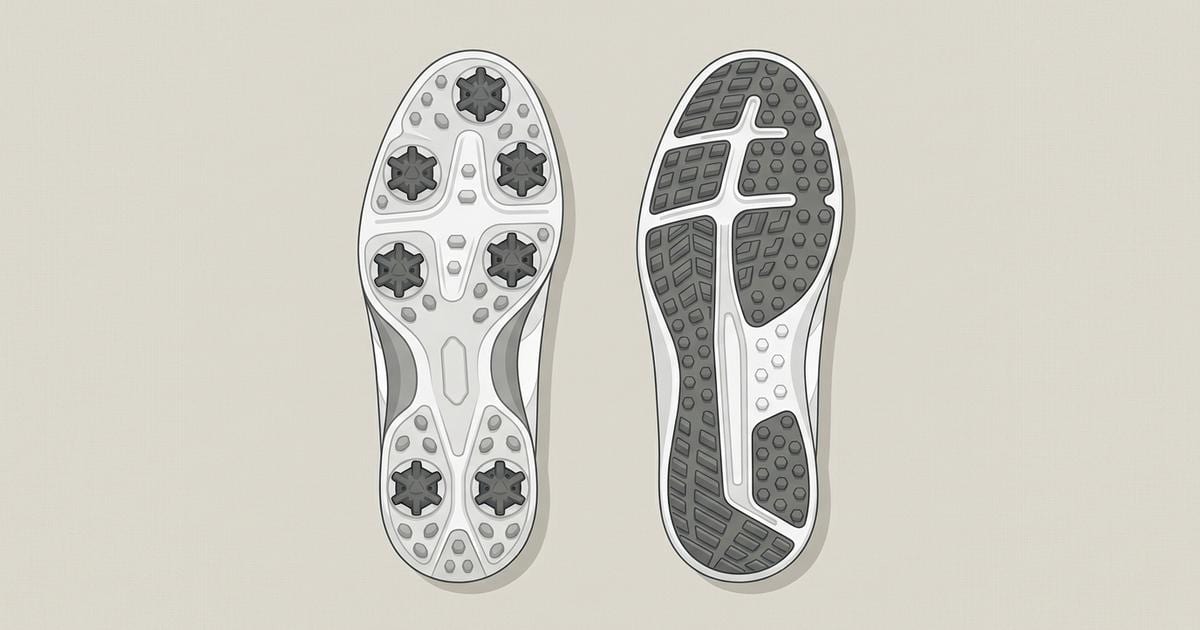
Your first golf shoe comes down to one choice on the sole. A spiked shoe has replaceable plastic cleats screwed into it. A spikeless shoe has small rubber bumps molded into the sole, like a sturdy sneaker.
Most answers to this question end on “it’s personal preference” or “own a pair of both”. Some add that fast swingers need spikes, without saying how fast is fast. None of the top pages I read mentions mats or simulators, which is where a lot of beginners do most of their swinging.
Here’s where I stand. I own one pair of golf shoes, a spikeless pair with a BOA dial. A BOA dial is a small knob on the shoe that you turn to tighten a thin cable, in place of tying laces.
I mostly go to screen golf and the practice range. Screen golf is a golf simulator room, common in Korea, where you hit a real ball off a mat into a screen. I wear the same shoes when I play a round on a course. I’ve never worn spiked golf shoes.
So I won’t tell you how the two feel on grass. For the grip question, this post leans on the few studies that exist and says plainly what they didn’t test.
The short answer
- Nobody independent has measured modern spiked shoes against modern spikeless shoes. The peer-reviewed studies used a plain flat sole, and the newer test was paid for by a cleat maker.
- “Spikes” today means plastic cleats, not metal. Metal bans come from course policy, not the Rules of Golf, which allow spikes (R&A Rules of Equipment, Part 6).
- The “fast swing needs spikes” advice gives no swing speed. The one test that measured driving distance by handicap found the bigger gain in the higher handicaps, not the better players.
- If you mostly swing on mats, in a simulator or at the range, you’ll be fine starting with spikeless.
- If you play regular rounds on real grass, especially dewy mornings or after rain, that’s when spikes are worth a look, usually as a second pair.
What “spiked” means now, and who bans metal
A spiked golf shoe today almost always means soft spikes. These are plastic cleats that twist into sockets on the sole and can be swapped out when they wear. Korean golfers often call them jing, a word for studs.
Softspikes, one of the big cleat makers, says it has made them “Since 1993” (Softspikes FAQ). It says the top shoe brands worldwide use its Fast Twist 3.0 system. That’s a cleat fitting, the socket shape the cleat screws into, and it’s why one cleat can fit shoes from the different brands that use it.
Metal spikes got pushed out by golf courses, not by the rules. A 1997 Purdue University release counted “1,600 courses nationwide” that had banned metal spikes. A turf researcher there said the greens stayed smooth without them (Purdue, 1997). Softspikes funded that research, so read it as history, not as a neutral count.
The Rules of Golf themselves don’t ban spikes. The R&A’s equipment rules say shoes “that assist the player in obtaining a firm stance may be worn”. They add that “features such as spikes on the sole are permitted” (R&A Rules of Equipment, Part 6, retrieved 2026-09-25). A tournament committee can add its own limits through a local rule (R&A Committee Procedures, Section 8). A local rule is an extra rule a course or tournament committee adds on top of the Rules of Golf.
For you, that means a “no metal spikes” sign is the course’s rule. You’re not breaking a Rule of Golf by wearing plastic cleats, and you’d rarely find metal ones on a new shoe anyway.
Spikeless vs spiked golf shoes: what the grip tests measured
This is the part I most wanted an answer to, and it’s thin. I couldn’t find an independent test of a modern spiked shoe against a modern spikeless shoe.
The university studies used a flat sole
A team led by Paul Worsfold ran the closest thing to it. In a 2008 study, 24 golfers swung on force plates covered in grass. They wore three shoes: a metal seven-spike shoe, a plastic seven-spike shoe and a flat-soled shoe (Worsfold et al., 2008, Journal of Sports Science and Medicine). A force plate is a platform that measures how hard, and in which direction, a person pushes against the ground.
The metal spike shoe let golfers produce “significantly more back foot torque” with a driver than the flat-soled shoe. Torque here means the twisting force your back foot pushes into the ground during the swing. The same paper found “no significant difference between the metal and alternative spike shoes”, meaning metal against plastic.
A 2009 follow-up with 18 golfers again found more back-foot torque in the metal spike shoe than in the flat-soled one (Worsfold et al., 2009).
Here’s the catch for you. The flat-soled shoe in these studies was a plain flat sole, not the rubber-nubbed spikeless shoe you’d buy now. So the studies tell you plastic cleats held about as well as metal. They don’t tell you how your spikeless shoe compares.
The Pinehurst test was paid for by a cleat maker
In late 2019, Pinehurst Resort ran a test with 28 golfers hitting drives in both shoe types on a launch monitor. A launch monitor is a device that measures each shot and reports numbers like how far the ball carried. PrideSports, the company that makes Champ and Softspikes cleats, commissioned it (Sports Illustrated, 2020-04-23).
The results were split by handicap. A handicap is a number that shows roughly how many strokes over par a golfer usually shoots, so lower means a better player. By SI’s account, both groups hit it farther in spikes, and the high handicappers gained more.
| Group | Driver in spikes | Driver in spikeless | Driver gap | Downhill 6-iron gap |
|---|---|---|---|---|
| Low handicappers | 262.7 yd | 260.1 yd | 2.6 yd | 2.8 yd |
| High handicappers | 198.3 yd | 192.2 yd | about 6 yd | 5.2 yd |
Source: Sports Illustrated, 2020-04-23, reporting the PrideSports-commissioned Pinehurst test. The downhill results are shown as gaps only.
SI doesn’t report whether those gaps were statistically significant. So you can’t tell from the coverage whether a gap that size is real or just the spread between swings. One of the researchers also said many players heard the results and still preferred spikeless for comfort.
The reports disagree on accuracy. Golf.com (2019-11-26) called driving accuracy “essentially the same across both designs”. Press-release coverage in Golf Business News (2019-12-17) said accuracy improved with cleats.
If it were me, I’d treat accuracy as unsettled and the distance gap as a small hint. It’s one test, paid for by the people who sell the cleats.
Wet grass, slopes and fast swings: how much backs each claim
Three reasons come up again and again for choosing spikes. The evidence behind each is thinner than the advice sounds.
Wet grass. This one rests on experience, not measurement. Puma’s Grant Knudson, one of the shoe-company people Golf.com asked, put it this way: “Some players prefer spiked shoes on difficult terrain or in wet conditions” (Golf.com, 2019-07-22). I found no test of either sole on wet turf. It’s the reason you’ll hear most, so I’d take it seriously as practice, not as proof.
Slopes. The only number is from the same Pinehurst test. On a downhill lie with a 6-iron, low handicappers gained 2.8 yards in spikes and high handicappers 5.2 yards (Sports Illustrated, 2020-04-23). So read those yards the same way as the driver numbers: a paid test, with no word on whether the gap is real.
Fast swings. Under Armour’s guide says “golfers who have high swing speeds” are probably better off in spiked shoes (Under Armour). It doesn’t say what counts as high, and I couldn’t find anyone who does. If you’d like a sense of what swing speeds look like in numbers, see the swing speed and distance post. It gives the average male amateur’s driver speed. It won’t tell you when to switch shoes, though.
The little data we have doesn’t point toward fast swingers either. In the Pinehurst table, the low handicappers drove it more than 60 yards farther than the high handicappers (262.7 vs 198.3 in spikes). SI doesn’t report swing speed, but a gap that size almost certainly means they swung faster. And they gained less from spikes: 2.6 yards against about 6.
You’ll also hear that tour players wear spikes, and that often gets tied to the “fast swing” advice. Joe Henderson, president of Softspikes, told Today’s Golfer that all 21 PGA Tour winners in 2026 up to that point wore Softspikes cleats (Today’s Golfer, updated 2026-06-05). That’s a cleat maker counting its own cleats. It also tells you what pros pick, not what a beginner needs.
Mats, simulators and the range: where spikeless fits
A lot of beginners hit most of their balls off artificial turf mats. That’s true in Korea, where screen golf is common.
A cleat is built to dig into turf, and a mat has no soft ground for it to dig into. Some venues also don’t want spikes at all.
- One indoor golf center lists “No spiked or high-heeled shoes in simulator” (Brookfields Indoor Golf).
- Another prefers “Athletic shoes or soft spike golf shoes” and bans metal spikes (U.P. Indoor Golf).
Policies differ by venue, so there’s no single rule. In Korea, I found no chain-wide spike ban. Golfzon’s etiquette page says golf shoes or sneakers are fine for screen golf (Golfzon). Wearing spikeless shoes there is common practice rather than a posted rule.
The more useful warning is about your cleats. Golf Digest Korea covers screen golf venues and ranges that use artificial turf mats. It notes that wearing spiked shoes there for long periods can damage the spikes themselves (Golf Digest Korea, 2022-10-25). The same article points beginners to spikeless, since they spend more time at the range and in simulators.
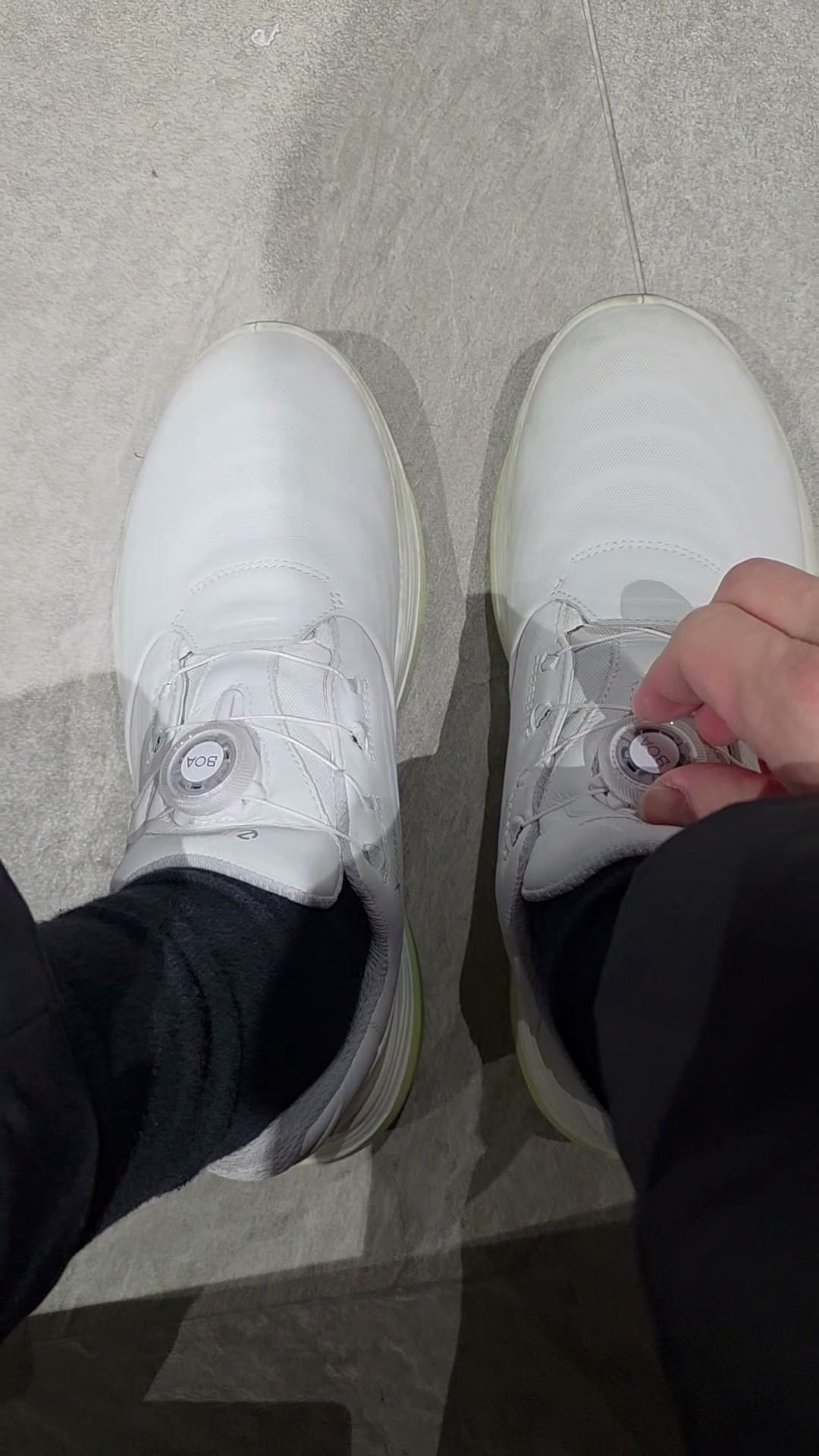
Photo: the author’s own spikeless shoes with a BOA dial. This is the one pair I wear for screen golf, the range and rounds on the course.
This is how I play too. Most of my swings happen on mats, and one pair of spikeless shoes covers it. It’s also the pair I take to the course for the rounds I do play. I haven’t worn spikes, so I can’t compare the two on grass.
Shoes are where I don’t split practice and rounds. With gloves I do: a synthetic one for practice and a cabretta one for rounds, as in cabretta vs synthetic golf gloves. If screen golf is where you’ll spend most of your time, the Golfzon NX Plus post covers what a round there is like.
So which one should you buy?
The better place to start is where you’ll mostly be standing, not the sole.
You mostly hit off mats, in a simulator or at the range. You’ll be fine starting with spikeless. Some venues don’t want spikes, long mat use can damage the cleats, and a mat has no turf for them to dig into anyway. A spikeless shoe also works for the rounds you do play.
You play regular rounds on real grass. This is when spikes are worth a look. The case is strongest on dewy mornings, after rain and on hilly courses. That rests on what golfers and shoe makers report more than on measurement, and the one slope number points the same way.
You’re not sure yet. I’d start with spikeless. If you later find yourself playing wet or hilly courses often, a spiked pair makes a sensible second shoe. You don’t need both on day one.
You swing fast and heard you need spikes. Nobody has put a number on “fast”. The one test that reported distance by handicap found the bigger gain in higher handicaps. Where you play is a better guide than swing speed.
You’re wondering about upkeep. Spikes are the shoe you maintain. Champ suggests checking cleats every 15-20 rounds, and says most avid golfers should change plastic cleats twice a season (Champ FAQ). Softspikes says every 15 rounds, or about twice a season (Softspikes). Both belong to PrideSports, so that’s one company’s guidance, not a measured wear life.
With spikeless, there’s nothing to swap.
You’re worried a course will turn you away. The bans you’ll see are aimed at metal spikes, and that’s course policy. The Rules of Golf allow spikes, and plastic cleats and spikeless soles aren’t what those signs target.
Laces vs BOA dials, width and sizing, waterproofing, and whether you need a separate indoor shoe each get their own post later.
Terms in this article
- BOA dial: a small knob on a shoe that you turn to tighten a thin cable, in place of tying laces.
- Spiked golf shoe: a golf shoe with replaceable cleats screwed into the sole. Today those cleats are almost always plastic.
- Spikeless golf shoe: a golf shoe with small rubber bumps molded into the sole instead of removable cleats.
- Soft spikes: plastic golf cleats that replaced metal spikes. Softspikes is also the name of one cleat brand.
- Jing: the Korean golfers’ word for the spikes on a golf shoe.
- Metal spikes: the older metal cleats many courses banned in the 1990s. The ban is course policy, not a Rule of Golf.
- Fast Twist 3.0: a cleat fitting system from Softspikes, used across many shoe brands so cleats can be swapped between makers.
- Torque: in the shoe studies, the twisting force a golfer’s foot pushes into the ground during the swing.
- Force plate: a platform that measures how hard, and in which direction, a person pushes against the ground.
- Launch monitor: a device that measures each shot and reports numbers like how far the ball carried.
- Handicap: a number that shows roughly how many strokes over par a golfer usually shoots. Lower means a better player.
- Local rule: an extra rule a course or tournament committee adds on top of the Rules of Golf.
- Screen golf: a golf simulator room, common in Korea, where you hit a real ball off a mat into a screen.
- Artificial turf mat: the synthetic grass mat you hit from at ranges and in simulators.