Balls & Gear
Voice Caddie T12 Pro Review: The Laser Became Optional
My Voice Caddie T12 Pro review after six rounds as a laser owner: green slope view, Auto Pin Location, battery, and when I still reach for the laser.
The short answer
After six rounds, the T12 Pro alone was enough for me and the laser became optional. I still reach for the laser on second shots when I can't tell exactly where the hole is cut.
- 6
- rounds on the T12 Pro behind this review Author's own rounds, Voice Caddie app
- more than 80%
- Korean golf courses quoted as APL partners Hankyung
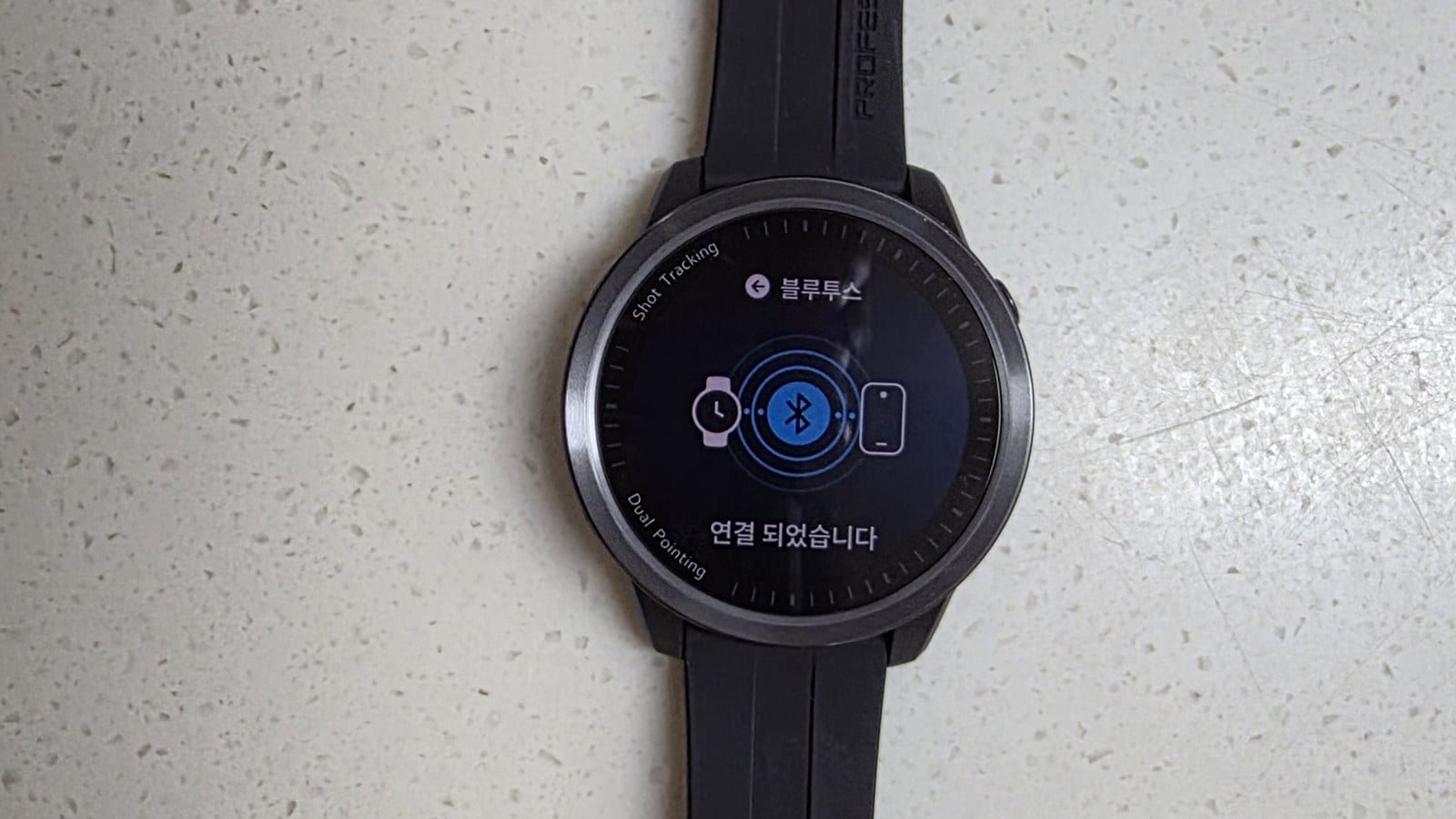
I owned a laser rangefinder before I owned a GPS watch. For my first rounds, the laser was the only distance tool I used. Then I bought a Voice Caddie T12 Pro, and after six rounds with it, the laser stopped being something I had to bring.
A laser rangefinder is a small handheld scope. You point it at a target, like the flagstick, and it reads the straight-line distance. A GPS watch reads your position by satellite and works out distances from a map of the course.
After six rounds
- The T12 Pro alone was enough for me. These days I sometimes carry both, and sometimes only the watch.
- I still take out the laser on second shots when I can’t tell exactly where the hole is cut.
- Its pin-finding feature worked at fewer courses than I expected. The feature I liked most was the green slope view.
- If you’re in the US, you can’t buy this model from Voice Caddie’s US store. It launched in Korea, and a Japanese retailer listed it from late 2025.
Why I bought a watch when I already had a laser
My first distance device was a Caddytalk Minimi, a Korean laser. I brought it to every round. It’s small and light enough to wear on my waist, and I honestly can’t name a downside. Caddytalk lists it at 135 g with the battery and 6x magnification (Caddytalk product page, in Korean).
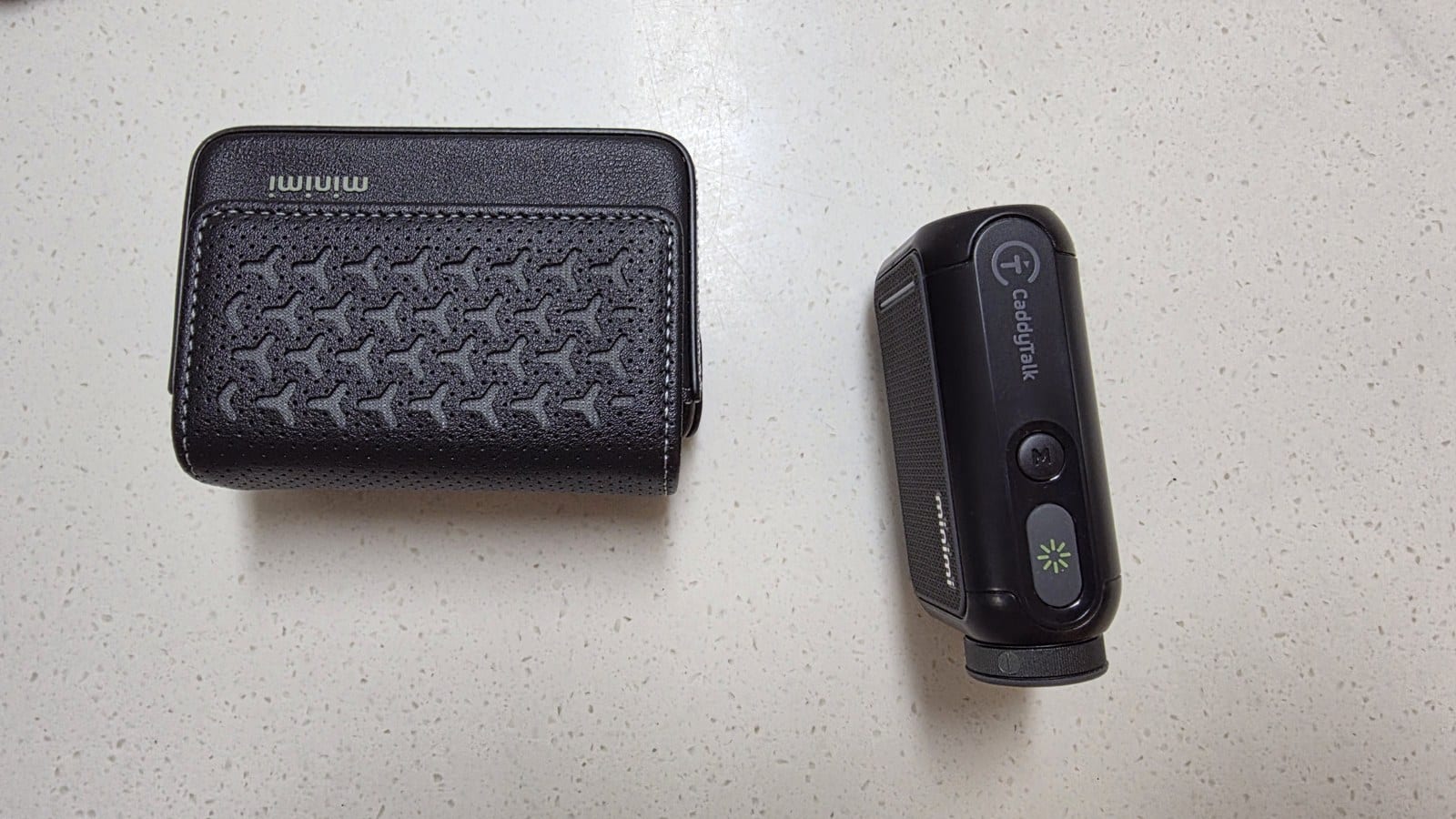 Photo: my Caddytalk Minimi and its pouch, 2026-10-15. This was my first distance device.
In September 2024, a friend lent me an older Voice Caddie watch for one round. I don’t know the model, only that it came before the T12. I liked it enough to want one of my own.
I bought the T12 Pro in 2025, around August, though I’m not sure of the month. I paid for it myself. Voice Caddie didn’t send it or ask for this review.
The Voice Caddie app shows seven rounds. The first one was on the borrowed watch, so everything in this review comes from six rounds on the T12 Pro.
What the Voice Caddie T12 Pro is
The T12 Pro is a GPS golf watch from Voice Caddie, a Korean brand. It went on sale in Korea on March 4, 2025 (Segye Biz, in Korean). Korean press described the Pro features as distance based on the real-time pin location, plus shot tracking. The same report put the course database at about 40,000 courses worldwide (Hankyung Money, in Korean).
Shot tracking means the watch records where each shot was hit, so the app can show distances afterward.
You won’t find the T12 Pro on Voice Caddie’s US store. When I checked on 2026-10-18, the watches listed there were the T11 Pro, T11 LT, T9, A3 and a refurbished T8.
In Japan, a retailer listing shows it on sale from late 2025 (Japanese retailer listing, in Japanese). I couldn’t find an official English page for it. Voice Caddie has also announced a 2026 model, the T13 Pro (twig24, in Korean). I haven’t used it, so I won’t compare the two.
Auto Pin Location, and how often it worked for me
The headline Pro feature is APL, short for Auto Pin Location. A device on the flagstick, which the company calls a Red Cube, collects the pin position and sends it out in real time (Startup Today, in Korean). The watch can then give you the distance to the actual hole, not just to the green.
Korean press quoted the feature as partnered with more than 80% of Korean golf courses (Hankyung, in Korean). In my six rounds, though, I found fewer courses where it worked than I expected.
I can’t tell you which side explains the gap. Six rounds is a small sample, and I don’t know how the partnership figure is counted. I also found no source saying whether APL works anywhere outside Korea. If you’d be buying the watch mainly for APL, that’s the part I’d treat as unproven.
What I actually used in six rounds
Three features earned their place on my wrist. A fourth annoyed me at first and then became routine.
The green slope view
This is the one I liked most. The watch draws the green with its slope, so you see which way it tilts before you get there. Korean press described the green view as showing the slope and the flow visually (Hankyung, in Korean).
Seeing it drawn first, then looking at the real green, made the slope easier for me to read. Some putts looked straight to me. Because of the picture, I aimed at the right edge of the cup instead, and it felt like that helped. That’s a feeling, not something I measured.
Reading the slope is only half of a putt. If your ball doesn’t start where you aim, why putts don’t start on line covers the other half.
I stopped needing to carry the laser
The watch already gives me distances on every shot, so the laser became optional. On some days I carry both. On others I bring only the watch.
Looking at the hole map while I wait on the tee
 Photo: near the tee at Golfzon County Anseong W, 2026-10-09.
When my group is waiting to tee off, I use that time to look at the hole map on the watch. By the time it’s my turn, I’ve already seen the shape of the hole.
The putt button I didn’t like at first
When you walk away from a green, the watch asks you to log how the hole ended. You pick whether you holed the putt or got an OK. An OK is a short putt your group lets you skip without hitting it, common in casual Korean rounds.
At first I didn’t pick anything and walked on to the next hole, which made it a hassle. After using it once or twice, I noticed the watch vibrates at that moment. Now I just make the choice when I feel it, and I use it without thinking about it.
Do you still need a rangefinder with a GPS watch?
For me, mostly no. The one time I still reach for the laser is a second shot when I can’t tell exactly where the hole is cut. That’s when I want the precise number.
When I’ve had both, the watch’s number and the laser’s number felt about the same to me. I haven’t done a side-by-side measurement, so take that as an impression. Both of my devices read in meters.
The difference comes from what each one measures. Garmin’s manual for one of its watches explains it simply. “Because pin locations change, the watch calculates the distance to the front, middle, and back of the green” (Garmin Forerunner 570 manual).
A laser measures to whatever you aim it at, including the pin. But it needs a clear line of sight. A blind shot is one where you can’t see the green or the target from where you’re standing. On a blind shot, GPS can still give you the center of the green when a laser can’t (GolfPass, 2015).
APL is Voice Caddie’s way of closing that gap, by telling the watch where the pin really is. Where it doesn’t work, you’re back to the map.
GPS accuracy may also depend on that map. Plugged In Golf tested the T11 Pro, the model before the T12 Pro. Its yardages “were always within two yards of markers on the ground or the cart’s GPS.”
At one course the gaps reached four yards, and that course “did not have their greens mapped” (Plugged In Golf, July 10, 2024). The reviewer suspected the missing green map was the reason, but didn’t claim it for certain. That’s a different model, so read it as a sense of scale.
A layup is a shot you deliberately play short, often to stay in front of a hazard like water. GPS can show layup distances along with distances to hazards (GolfPass, 2015).
| Your situation | Watch alone? | Why |
|---|---|---|
| You mostly want front, middle and back of the green | Yes | That’s what GPS is built to give, and it was enough for me most of the time |
| You want hazard and layup distances, or play blind shots | Yes, GPS helps here | A laser needs a line of sight. GPS works from the map |
| You want the exact distance to a pin tucked on one side | Keep the laser | That’s the one shot I still use mine for |
| Your courses aren’t APL partners, or you’re outside Korea | Keep the laser if pin distance matters to you | Without APL, the watch can’t know on its own where today’s pin is |
| You’re buying your first and only device | I’d lean watch | It covered almost every shot for me. The laser covered the few it didn’t |
What the rules allow
The Rules of Golf let you get distance and direction information from a device. Measuring elevation changes isn’t allowed (R&A Rule 4.3a).
A slope mode is a setting on some lasers that adjusts the distance for uphill or downhill, and that’s elevation. My Minimi has a slope on/off switch. I haven’t checked how the rules treat the watch’s green slope view.
A tournament committee can also ban distance devices entirely with a Local Rule. The model text for this is called Model Local Rule G-5. USGA open championships put it in effect, while its amateur championships allow devices for distance only (USGA). If you play in a competition, check that event’s terms before you bring either device.
Battery, the app, and how long I’ll keep it
The battery lasts a full round for me. After one round, I left the watch in the living room without charging it. A week later it was still running in watch mode. I didn’t check the percentage, so I can’t give you a figure.
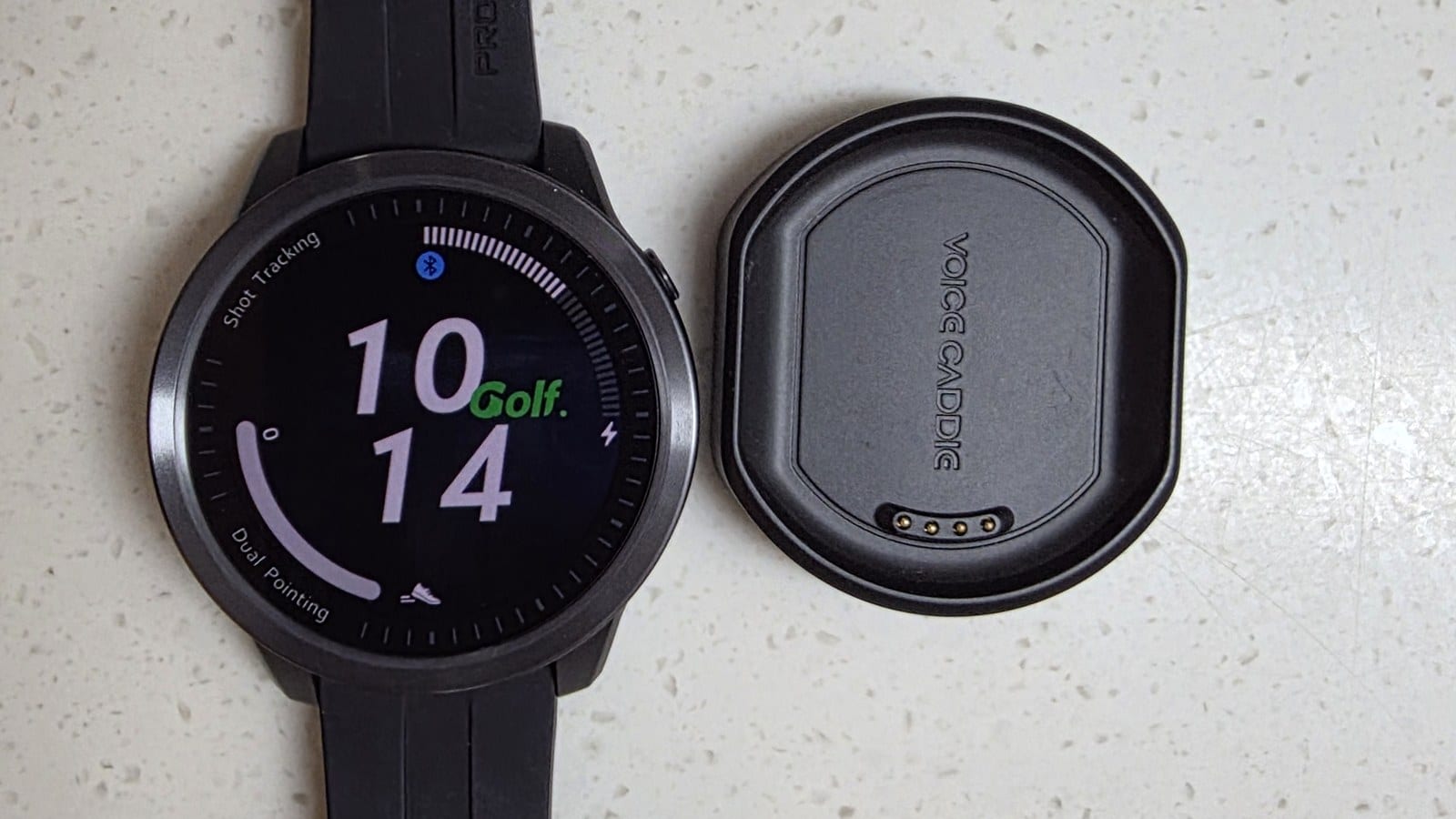 Photo: my T12 Pro beside its charging cradle, 2026-10-15.
The app keeps your score, putts, GIR and tee shot distance for every round. GIR, or green in regulation, means reaching the green with two strokes left for par. My app shows seven rounds from September 2024 to October 2026, with an average of 106 and a best of 96. The first of those was on the borrowed watch.
I’m sharing that so you know a high-handicap golfer wrote this review. If you want to know how scores like these turn into a handicap, how a golf handicap is calculated walks through it.
I’m not planning to replace the T12 Pro. It has plenty of features and it feels solid, so I expect to keep it for a few more years.
Terms in this article
- Laser rangefinder: a handheld scope you aim at a target to read the straight-line distance to it.
- GPS watch: a watch that finds your position by satellite and works out distances from a course map.
- APL (Auto Pin Location): Voice Caddie’s feature that uses a device on the flagstick to send the day’s pin position to the watch.
- Shot tracking: the watch recording where each shot was hit, so the app can show distances later.
- OK: a short putt your group lets you skip, common in casual Korean rounds.
- GIR (green in regulation): reaching the green with two strokes left for par.
- Blind shot: a shot where you can’t see the green or the target from where you’re standing.
- Layup: a shot you deliberately play short, often to stay in front of a hazard.
- Slope mode: a laser setting that adjusts the distance for uphill or downhill. Measuring elevation isn’t allowed under Rule 4.3a.