Drivers & Ball Flight
Ping G440 MAX vs K: Same Spec Sheet, but MAX Carried Farther
Ping G440 MAX vs K: PING's spec tables match line for line. In Golf Digest's robot test the MAX carried 4.4 yards farther; the K spread 2 yards narrower.
The short answer
Start with the MAX. PING's spec tables for the two heads are identical, and in Golf Digest's robot test the MAX carried farther in 8 of 9 face zones by my count of its grid. Try the K if your drives spread left and right more than they come up short.
- 4.4 yards
- longer average carry for the MAX, robot test at about 95 mph Golf Digest, 2026-05-14
- 29.4 vs 31.4 yards
- left-to-right width of 95% of shots, K vs MAX Golf Digest, 2026-05-14
- 29 g vs 32 g
- back weight, MAX vs K PING (MAX); Irish Golfer (K)
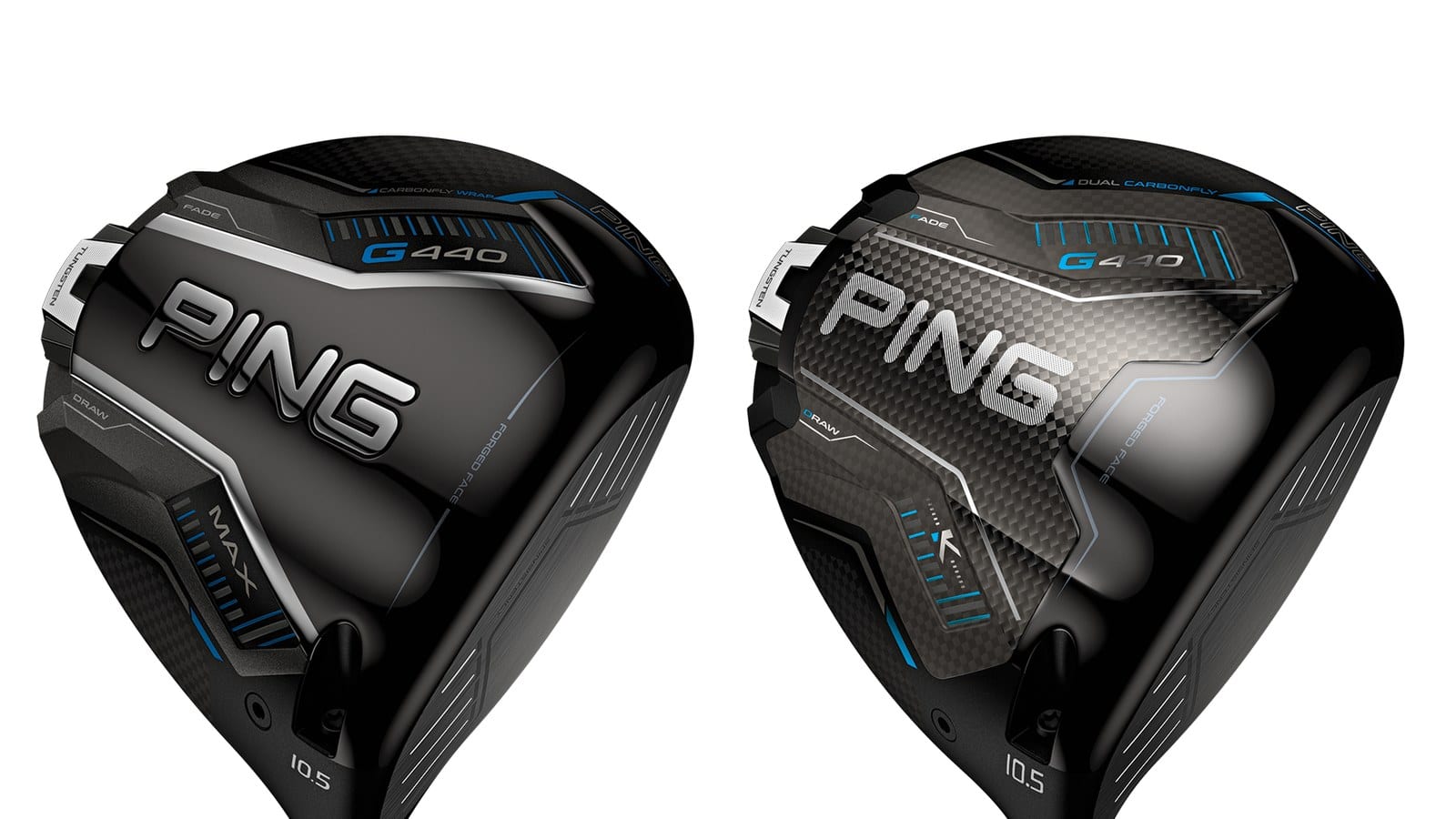
PING’s spec tables for the G440 MAX and the G440 K match cell for cell: 460cc, a 203.0-gram head, D3 swing weight, 46 inches, and lofts of 9, 10.5 and 12 degrees (PING G440 MAX, PING G440 K, retrieved 2026-11-07). The K arrived a year later, and PING calls it “our straightest and most forgiving model.” It’s easy to read that as the upgrade.
The one published robot test I found with both heads doesn’t read that way. Golf Digest’s robot hit 54 shots with each at about 95 mph, and the MAX carried 4.4 yards farther on average (Golf Digest, 2026-05-14). The K won one of the summary measures: its shots spread 2 yards less from left to right.
I haven’t hit either driver. Everything here comes from PING’s own pages, launch coverage, and that one test.
In one line: start with the MAX
If this is you Start with Why You want distance, or you don’t know your miss yet G440 MAX Longer average carry, and longer in 8 of 9 face zones Your misses are toward the heel G440 MAX Both heads were weakest low on the heel, and the K carried 12.9 yards less there (one test; K weight setting not stated) Your drives fan left and right more than they come up short G440 K Narrowest left-to-right spread in the test, 29.4 yards against 31.4 You picked the K because PING says “most forgiving” Either PING says “most forgiving” about both Robot numbers: Golf Digest, 2026-05-14. The zone count and the 12.9 are my own arithmetic from its heat map.
What’s the same on the G440 MAX and G440 K spec sheets
| G440 MAX | G440 K | |
|---|---|---|
| Lofts | 9°, 10.5°, 12° | 9°, 10.5°, 12° |
| Loft adjustment | ±1.5° | ±1.5° |
| Length | 46” | 46” |
| Average lie angle | 58.5° | 58.5° |
| Head weight | 203.0 g | 203.0 g |
| Head size | 460cc | 460cc |
| Swing weight | D3 | D3 |
| Stock shaft | ALTA CB Blue 50 | ALTA CB Blue 50 |
| Left-handed | Yes | Yes |
Source: the KEY SPECIFICATIONS tables on PING’s G440 MAX and G440 K pages, retrieved 2026-11-07.
Swing weight is how heavy the head end of the club feels when you swing it. It’s written as a letter and a number, and both heads are D3.
Lie angle is the angle between the shaft and the ground when the sole sits flat.
Even the stock shaft weights match. The ALTA CB Blue 50 is 49 grams in soft regular, 51 in regular and 55 in stiff on both pages. Both heads also use the same 8-position hosel. What those eight settings actually do is in the PING driver settings post.
So whatever separates these two, it isn’t in this table.
Where the K differs: back weight, carbon sole and MOI
| G440 MAX | G440 K | |
|---|---|---|
| Back weight | 29 g, three positions | 32 g tungsten, three positions |
| Carbon | Crown | Crown and sole (“Dual Carbonfly Wrap”) |
| Head shape | No length claim | PING’s “largest profile front to back” |
| MOI, as reported | 9,500, 9° head | Over 10,400 “in certain configurations” |
Sources: 29 g, carbon and head shape from PING’s MAX and K pages. 32 g and the K’s MOI from Irish Golfer, 2026-01-13. The MAX’s MOI from GOLF.com, 2025-01-14.
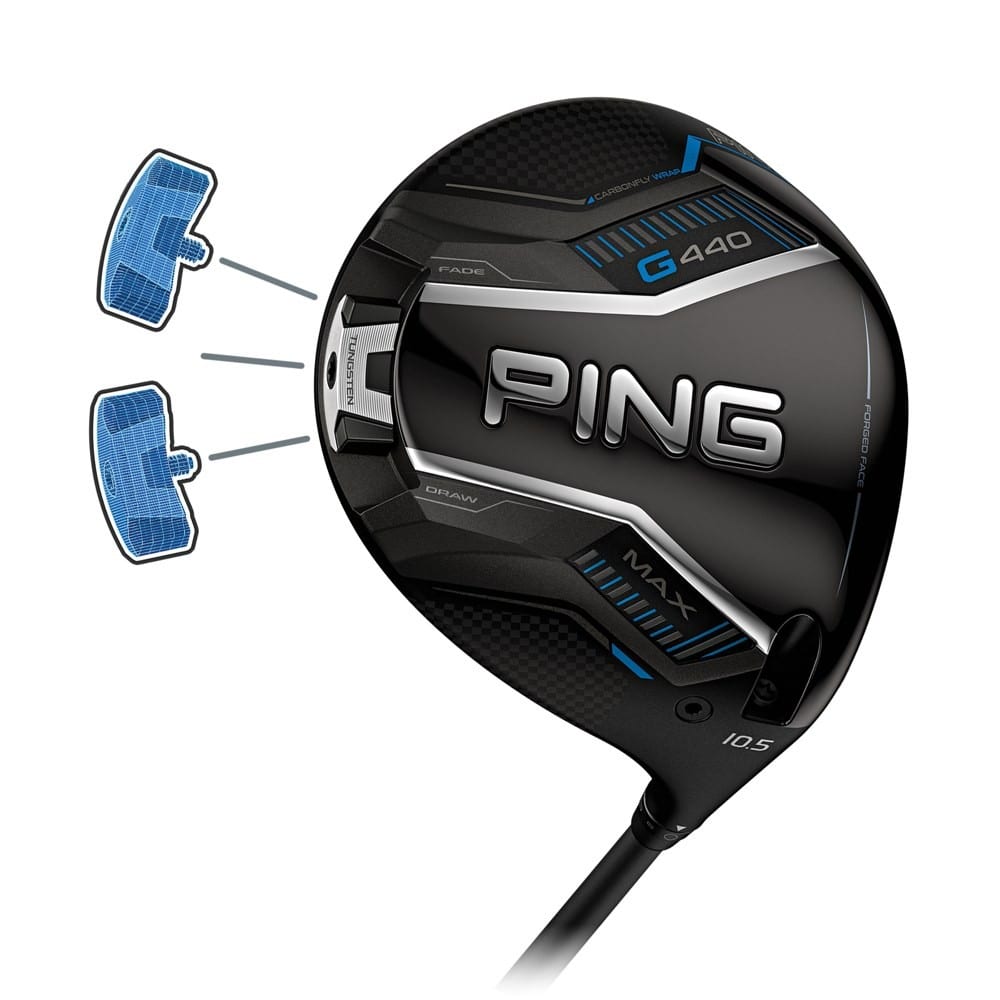
The back weight is the screw-in weight at the rear of the sole. Sliding it toward the heel or the toe shifts the CG, the head’s balance point, and that nudges the ball toward a draw or a fade.
PING’s K page calls its weight “heavier” but gives no grams. PING’s press release says it’s four grams heavier than the fixed weight in the G430 MAX 10K, PING’s previous highest-MOI driver (PING release, reprinted by PGA TOUR). The 32 grams is Irish Golfer’s figure.
MOI, or moment of inertia, is how hard the head resists twisting on a hit away from the center. It’s the number behind the word “forgiving.” GOLF.com’s figure is combined MOI, heel-to-toe plus top-to-bottom, and PING’s release describes the K’s record the same way.
Neither MOI number is on PING’s spec tables. The 9,500 is for the 9-degree MAX, from GOLF.com’s launch story, which gives no setting. The 10,400 is Irish Golfer’s, and it says the K hits that peak with the weight in the fade position. Different heads, different settings, so read the gap as a rough size rather than a measurement.
Then there’s PING’s own wording. The MAX page opens with “The most forgiving G440 model.” The K page’s first line calls it “our straightest and most forgiving model.” Both pages are live today.
The clearest split I found is in GOLF.com’s MAX launch story. Reporting what PING’s design engineering manager told it, GOLF.com wrote that PING wanted to separate its two forgiving drivers, “focusing more on speed with the G440 MAX and stability with the G430 MAX 10k” (GOLF.com). The K took over that 10K slot. So on paper: MAX for speed, K for stability.
G440 K vs MAX in Golf Digest’s robot test
Golf Digest’s lab robot hit 54 shots with each driver at roughly 95 mph of clubhead speed, six on each of nine spots on the face (Golf Digest, 2026-05-14; also reprinted by Australian Golf Digest). The story is mainly about the older G400, so the MAX and K numbers sit in its charts rather than its headline.
| Average of 54 shots | G440 MAX | G440 K |
|---|---|---|
| Ball speed | 136.7 mph | 136.5 mph |
| Carry | 221.4 yds | 217.0 yds |
| Total distance | 242.3 yds | 238.3 yds |
| Launch angle | 11.9° | 11.6° |
| Spin | 2,613 rpm | 2,574 rpm |
Ball speed is how fast the ball leaves the face. Carry is the distance in the air before the ball lands, and total adds the roll.
Ball speed came out almost identical. Carry didn’t. Golf Digest’s heat map shows where the 4.4 yards went.
Across the nine zones, the MAX carried farther in eight (my count from Golf Digest’s grid). The K’s one win was the middle of the toe, 228.3 yards to 225.9, the longest single reading in the whole test.
Three of those eight were close, 1.2 yards or less. The real gap was on the heel side, 7.7, 10.5 and 12.9 yards from top to bottom (my subtraction).
The heel is the end of the face nearest the shaft, and the toe is the far end. Both heads were weakest low on the heel: 212.1 yards for the MAX and 199.2 for the K. From a center hit to its worst zone, the MAX lost 15.8 yards and the K lost 27.5, by Golf Digest’s own figures.
Golf Digest wrote that “The K rewards golfers who tend to miss high and towards the toe.” On the K’s own grid that holds: its high-toe and mid-toe zones are among its longest. Against the MAX it’s narrower. Only the middle of the toe was a K win; on the high toe the MAX was still 1.1 yards longer, 224.7 to 223.6. (Golf Digest names the mid-toe and low-heel cells in its text; the other row labels are my reading of its grid.)
The width numbers go the other way. Dispersion is how widely shots scatter, and Golf Digest measured it two ways across all 54 shots.
| 95% of shots | G440 MAX | G440 K |
|---|---|---|
| Left-to-right width | 31.4 yds | 29.4 yds |
| Total area | 525.8 sq ft | 882.8 sq ft |
The K’s shots stayed in the narrowest strip of any driver in the test. But they covered a bigger patch overall, because they varied more in how far they went. In Golf Digest’s words, they “scatter narrower side-to-side but spread further downrange.”
Three limits before you lean on any of this:
- It’s one test. I didn’t find a second one that hit both heads.
- It’s one speed. About 95 mph. If you swing much faster or slower, the order could change.
- You can’t tell which K you’d be getting. The test doesn’t say where the K’s weight was, and its MOI peaks in fade, so the K you hit in a fitting bay may be more or less stable than the one tested. Loft and shaft aren’t stated either; in an earlier PING test Golf Digest said it runs 10.5-degree heads on the same shaft (Golf Digest, 2025-05-20), but this story doesn’t repeat that.
One more note for regular readers. My 2026 driver roundup lists the K for heel misses, going by a magazine’s description of who it suits. In this test the heel is exactly where the K lost the most. Because the weight position is missing, I’d call that unsettled rather than wrong.
Which one to try first
The spec sheet gives you nothing to choose with, so choose by your miss.
- The MAX if you want the longer average drive, if you don’t yet know your miss, or if your bad ones come off the heel (the one robot test favors the MAX there, with the K’s weight setting unknown). It led in 8 of 9 zones.
- The K if your problem is drives that finish on both sides of the fairway, and a few yards of carry matter less to you than staying in a narrower strip.
PING also sells two more G440 heads. The LST is a smaller 450cc head for faster swings that need less spin, and the SFT has a 23-gram weight set up for draw, built to correct a slice (GOLF.com). If you slice, PING’s own answer is the SFT rather than either of these. The PING driver settings post shows how far the SFT’s draw weight moves the ball. The G430 MAX 10K, the K’s predecessor, is set against TaylorMade’s 10K driver in this comparison.
If you get fit, hit the two at the same loft on the same shaft, and ask which position the K’s weight is in. Try the K in neutral and in fade.
If I were standing in the bay, I’d hit the MAX first and only switch to the K if the screen showed my drives fanning out sideways.
Terms in this article
- Swing weight: how heavy the head end of the club feels when you swing it, written as a letter and a number such as D3.
- Lie angle: the angle between the shaft and the ground when the sole sits flat.
- Back weight: the screw-in weight at the rear of the sole. Its position shifts the head’s balance point.
- CG (center of gravity): the balance point of the head. Moving it toward the heel favors a draw, toward the toe a fade.
- MOI (moment of inertia): how hard the head resists twisting on an off-center hit. Higher MOI is what “forgiving” usually means.
- Forgiveness: how much distance and direction a club keeps when you miss the center of the face.
- Draw / fade: a shot that curves gently left (draw) or gently right (fade) for a right-handed golfer.
- Slice: a shot that curves hard to the right for a right-handed golfer.
- Ball speed: how fast the ball leaves the face, in miles per hour.
- Carry: how far the ball flies in the air before it lands.
- Total distance: carry plus the roll after the ball lands.
- Launch angle: the angle the ball starts upward at.
- Spin: backspin on the ball, in revolutions per minute (rpm).
- Heel / toe: the end of the face nearest the shaft (heel) and the far end (toe).
- Dispersion: how widely your shots scatter around the target.