Drivers & Ball Flight
Ping G430 Max 10K vs TaylorMade Qi10 Max: one MOI, two faces
Both brands claim 10,000 MOI forgiveness, but the two heads are built very differently. A comparison of face, weighting and look from the published specs.
The short answer
Both drivers claim 10,000 g-cm² of combined MOI, so forgiveness won't separate them on paper. The face does: forged titanium on the Ping, carbon on the TaylorMade.
- 10,000 g-cm²
- combined MOI claimed for both heads PING specs, GolfTec listing
- 28g
- fixed tungsten backweight on the Ping PING press release
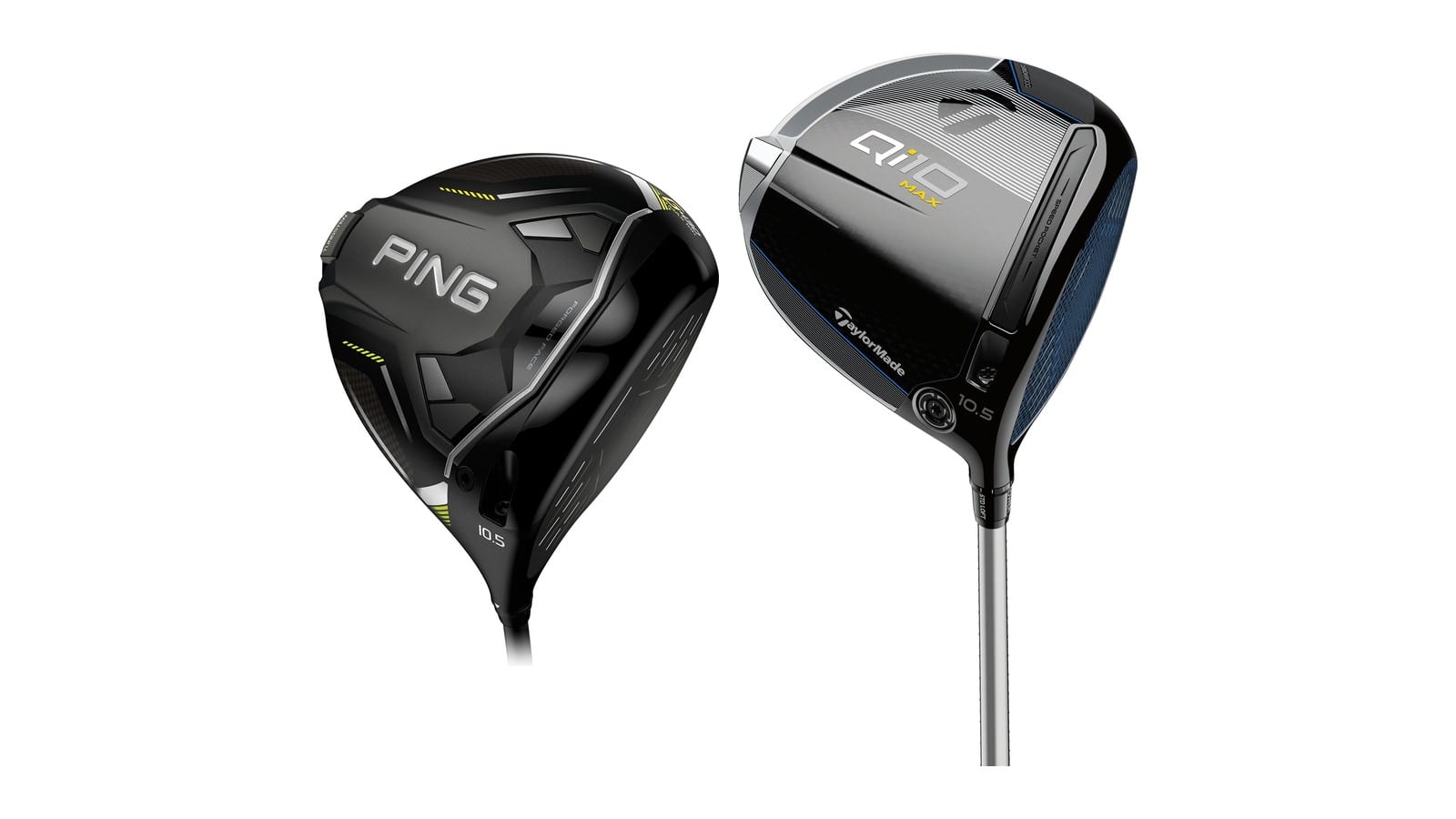
The Ping G430 Max 10K and the TaylorMade Qi10 Max both claim 10,000 g-cm² of combined moment of inertia. So forgiveness won’t separate them on paper. The face does: forged titanium on the Ping, carbon on the TaylorMade.
I haven’t hit either driver. This comparison is built from the published specs and the manufacturers’ own descriptions of how each head is made.
The Ping is a 2024 head. PING launched the 10K in January 2024 (PING press release, reprinted by PGA Tour), and its 2026 successor is the G440 K (2026 drivers compared).
Key Takeaways
- Both the 2024 Ping G430 Max 10K and the TaylorMade Qi10 Max claim 10,000 g-cm² of combined MOI (PING G430 MAX 10K specs; GolfTec Qi10 Max listing; both retrieved 2026-11-06). On the Ping, part of that comes from a fixed 28-gram tungsten backweight, a weight set into the rear of the head (PING press release, reprinted by PGA Tour).
- The face construction differs: Ping uses a forged T9S+ titanium face (PING press release, reprinted by PGA Tour), while TaylorMade uses what GolfTec lists as a 60X Carbon Twist Face.
- Address is the moment you set the club down behind the ball before you swing. The crown is the top of the head, the part you see when the club rests behind the ball. PING’s product images show a row of raised ridges on the crown just behind the face. TaylorMade’s product images show a glossy carbon crown with no ridges.
- High MOI cuts both ways: an extremely rear-weighted head resists twisting on off-center hits, but it can also make the face feel slower to close.
- Squaring the face means pointing it straight at the target at impact. The specs don’t tell you which of the two heads you will square more easily. That takes a launch monitor session with your own swing. A launch monitor is a device that tracks each shot and reports numbers like ball speed and spin.
In this article:
- What 10K MOI actually does (and what it doesn’t do)
- Forged titanium vs carbon face: sound and feel at impact
- Address profile: two crown designs
- Who should play the Ping, and who should play the Qi10
- Frequently Asked Questions
- Terms in this article
What 10K MOI actually does (and what it doesn’t do)
Moment of inertia (MOI) measures how much an object resists twisting around its axis. In driver design, higher MOI means that when you strike the ball on the toe or heel instead of dead center, the clubface twists less. Both brands quote a “combined” MOI figure without publishing the breakdown behind it.
Less twisting means two things on paper: higher ball speed retention on mishits, and tighter downrange shot dispersion. Dispersion is how widely your shots scatter left and right of the target.
| Specification | Ping G430 Max 10K | TaylorMade Qi10 Max |
|---|---|---|
| Stamped lofts | 9.0°, 10.5°, 12.0° | Not verified |
| Loft sleeve | ±1.5° | 4° adjustable loft sleeve |
| Head size | 460cc (PING’s illustration shows a long head) | Not verified |
| Crown material | Carbonfly Wrap composite | Carbon, covering 97% of the crown |
| Face material | T9S+ Forged Titanium | 60X Carbon Twist Face |
| Rear weight | 28g fixed tungsten | Not verified |
| Standard length | 45.75 inches (ALTA CB 55 Black stock shaft) | Not verified (retailer listings disagree) |
| Published MOI | 10,000+ g-cm² combined | 10,000 g-cm² combined |
Ping column: PING G430 MAX 10K specs, retrieved 2026-11-06. The 28g backweight and the T9S+ face material come from the PING press release, reprinted by PGA Tour (January 2024), which also lists 460cc. TaylorMade column: GolfTec’s Qi10 Max listing, a fitter’s product page rather than TaylorMade’s own, retrieved 2026-11-06. TaylorMade’s spec sheet couldn’t be read as text, so cells I couldn’t confirm say “Not verified”.
To reach that MOI figure, mass has to sit far back from the face. On the Ping, that is a fixed 28-gram tungsten weight; TaylorMade’s rear weight isn’t confirmed here.
What 10K MOI does not do is fix your swing. If your clubface arrives 6 degrees open, the ball still curves hard to the right. 10K simply means a toe strike loses less ball speed than it would on a lower-MOI head.
The 10K figure measures how much the head resists twisting around its center of gravity on off-center hits. Pushing weight that far back also moves the center of gravity away from the shaft, which can make the face feel slower to close.
Golfers who already struggle to close the face in time are the ones this matters to most. That includes players with a casting motion. Casting means releasing the wrist angle too early in the downswing. If a slice is your main miss, you’ll want to hit both on a launch monitor before you buy.
Forged titanium vs carbon face: sound and feel at impact
The biggest construction difference between these two drivers is the face.
Ping uses a forged T9S+ titanium face. PING’s launch release describes “thinning the forged T9S+ titanium face of the G430 MAX 10K” (PING press release, reprinted by PGA Tour).
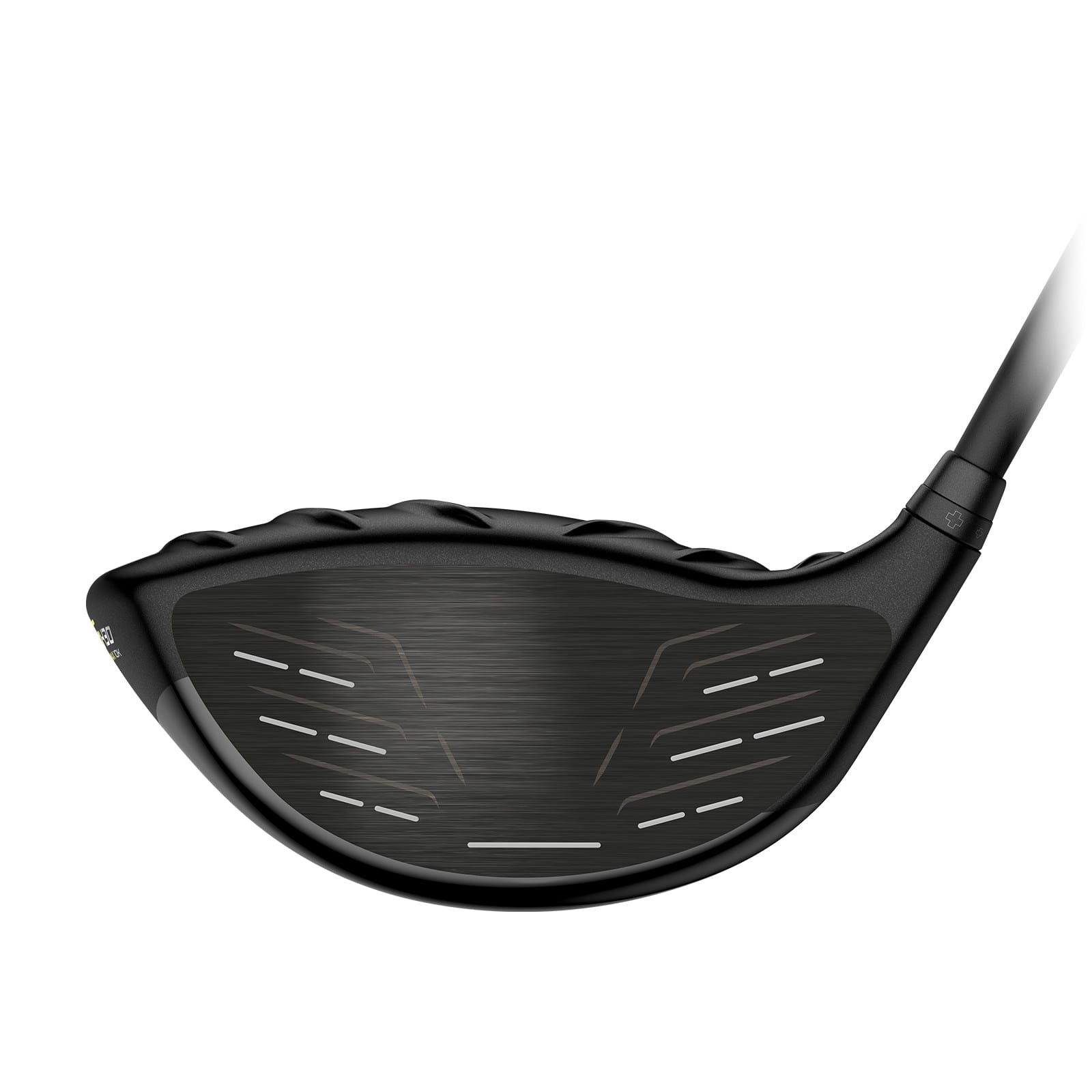
Image: PING, from the G430 MAX 10K product page.
TaylorMade uses a carbon face, listed by GolfTec as the 60X Carbon Twist Face. Carbon composite is far less dense than titanium, which is what lets a carbon face weigh less. TaylorMade doesn’t publish the face weight.
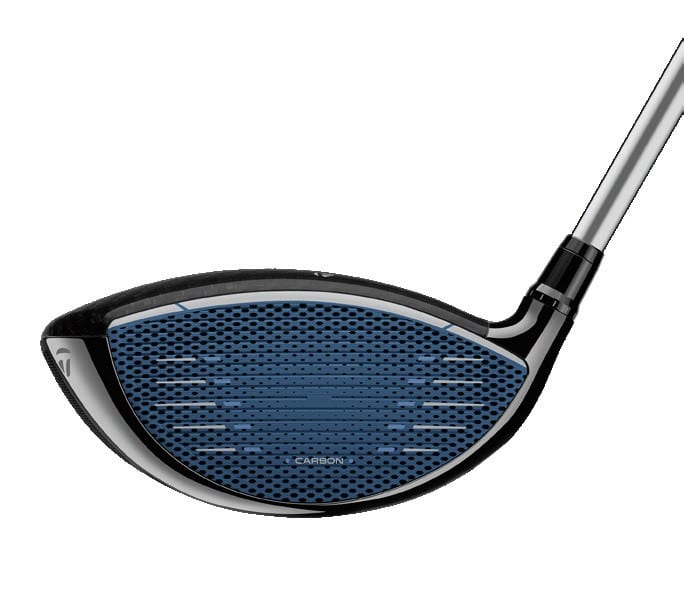
Image: TaylorMade Qi10 Max Driver Sell Sheet.
Since I haven’t hit either head, I can’t tell you how they sound or feel. Sound is a personal preference, and it’s the one item here worth judging by ear.
Address profile: two crown designs
How a driver looks behind the ball is the one thing you can judge in a shop without hitting it.
In PING’s product images, the G430 Max 10K’s black crown has a row of raised ridges just behind the face. The illustration below shows a head that runs long from the face to the back.
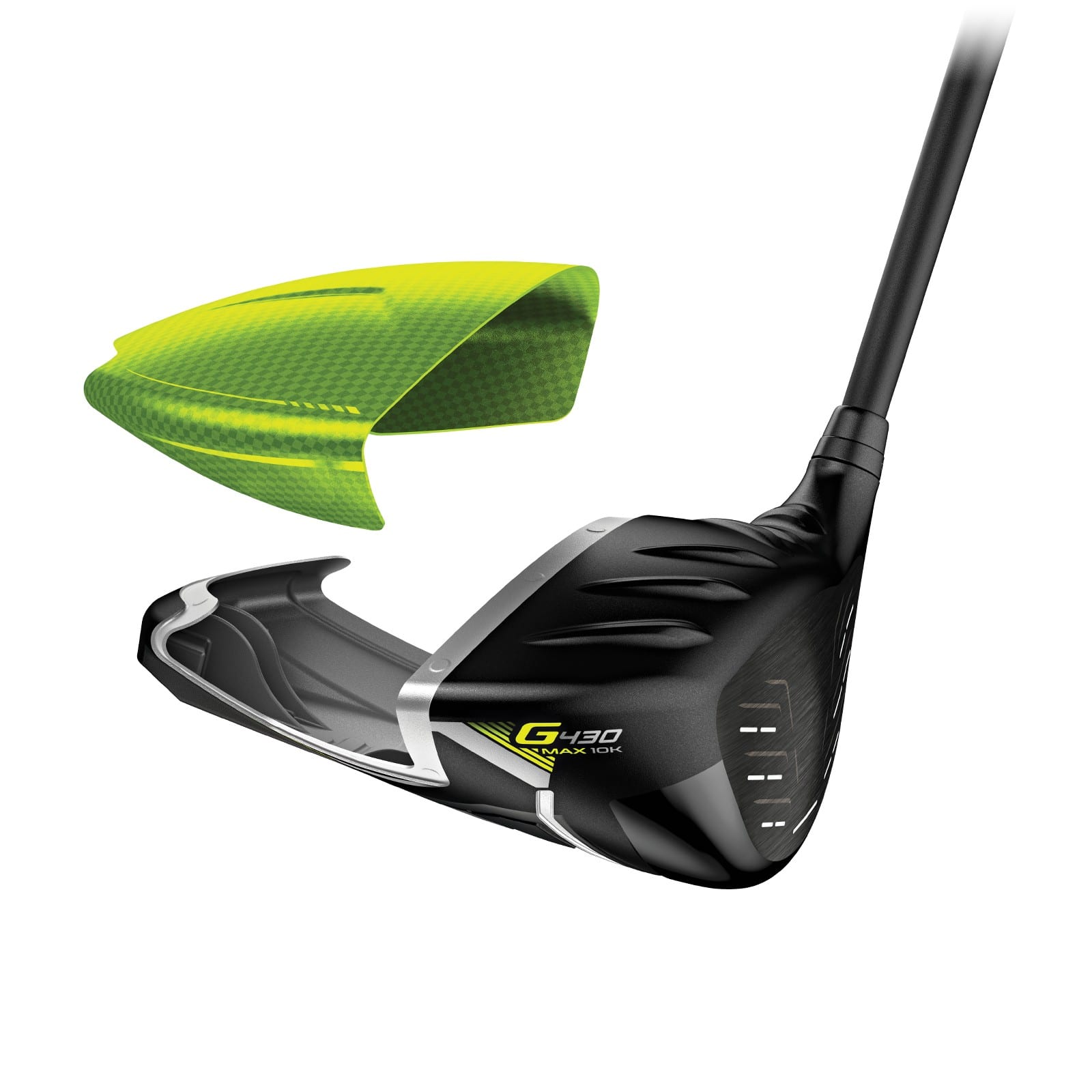
Illustration: PING, from the G430 MAX 10K product page. It shows the Carbonfly Wrap crown as a separate piece. The illustration colors that piece green; in PING’s product images the crown is black.
The TaylorMade Qi10 Max takes the clean route. GolfTec lists carbon covering 97% of the crown. In TaylorMade’s sell-sheet images, that carbon runs to the edge of the head in a glossy weave. A light line runs along the top of the face.
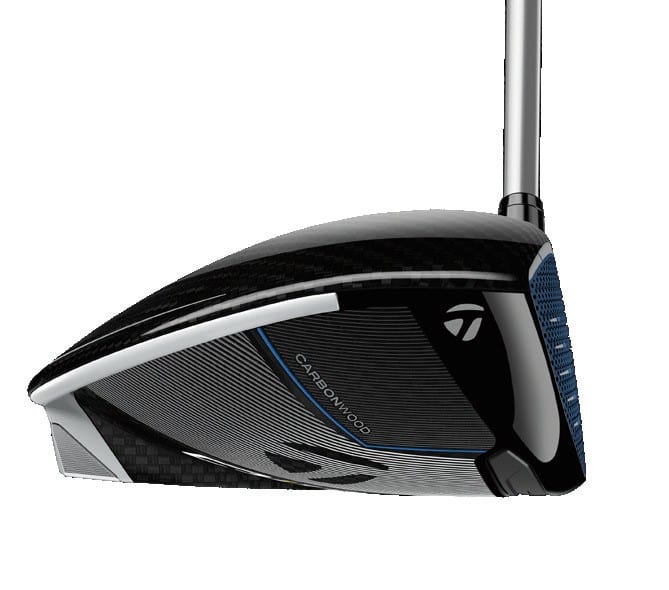
Image: TaylorMade Qi10 Max Driver Sell Sheet.
In the product photos, the Qi10 looks like a luxury sports car and the Ping like an armored truck.
Who should play the Ping, and who should play the Qi10
The two heads suit different situations.
Choose the Ping G430 Max 10K if:
- You’re replacing a titanium-faced driver and want more forgiveness without changing the face material. The 10K keeps a forged T9S+ titanium face.
- You want the factory weighting and have no plan to move weights: the 28g backweight is fixed. Shot shape is how the ball curves in the air, left or right. If you want weight you can move to change shot shape, the standard G430 Max has a movable 25g backweight instead (PING G430 MAX, retrieved 2026-11-06).
Choose the TaylorMade Qi10 Max if:
- You want to see a carbon face and crown behind the ball. GolfTec lists a 60X Carbon Twist Face and carbon covering 97% of the crown.
- You’re unsure of your loft and want room to change it after you buy. GolfTec lists a “4° adjustable loft sleeve” for the Qi10. PING lists ±1.5° (a 3° spread) on each 10K loft.
A loft sleeve is the adapter joining shaft and head that you turn with a wrench to change loft. The hosel is the neck of the head where the shaft goes in. Before you turn the wrench, you’ll want to read up on adjusting it on the Ping or the TaylorMade.
Let the things you can check without a fitting narrow it down: titanium or carbon face and the look at address. Then you’ll want to hit both on a launch monitor with your own swing before you buy. I haven’t, and the spec sheets alone won’t tell you which head you’ll square more easily.
If you haven’t settled on a loft yet, start with which loft to start at. And if neither head feels right, see this year’s drivers compared.
Frequently Asked Questions
Is the Ping G430 Max 10K different from the standard G430 Max? Yes. The standard G430 Max has a 25-gram movable backweight that positions the center of gravity to influence shot shape (PING G430 MAX, retrieved 2026-11-06). The G430 Max 10K replaces it with a fixed 28-gram tungsten backweight (PING press release, reprinted by PGA Tour). It also uses a Carbonfly Wrap crown, and PING’s illustration shows a head that runs long from the face to the back.
Will a 10K driver increase my driving distance? On center strikes, don’t count on it. Moving weight far back generally adds some backspin. That’s general club physics, not a published figure.
PING, by contrast, says the 10K’s Carbonfly Wrap crown helps it “launch the ball higher with less spin” (PING G430 MAX 10K). I’d trust a launch monitor reading of your own swing over either. Where a 10K head reliably helps is on mishits, because an off-center strike keeps more of its ball speed.
Terms in this article
- MOI (Moment of Inertia): A measure of a clubhead’s resistance to twisting on impact, expressed in gram-square centimeters (g-cm²). Higher numbers mean more stability on off-center hits.
- T9S+: The titanium alloy PING names for the G430 MAX 10K’s forged face (PING press release, reprinted by PGA Tour).
- Carbon Twist Face: TaylorMade’s name for its carbon driver face.
- Center of Gravity (CG): The balance point of the clubhead. Pushing CG deep and low raises launch and increases MOI.
- Dispersion: How widely your shots scatter left and right of the target. Tighter dispersion means more balls finish near your intended line.
- Casting: Releasing the wrist angle too early in the downswing, which can make it harder to square the face in time.
- Square the face: Point the clubface straight at the target at impact.
- Loft sleeve: The adapter joining shaft and head. Turning it with a wrench changes the loft.
- Hosel: The neck of the clubhead where the shaft goes in.
- Launch monitor: A device that tracks each shot and reports numbers like ball speed and spin.
- Crown: The top of the clubhead, the part you see when the club rests behind the ball.
- Address: The moment you set the club down behind the ball before you swing.
- Shot shape: How the ball curves in the air, left or right.
- Stock shaft: The shaft a driver comes with when you don’t order a custom one.